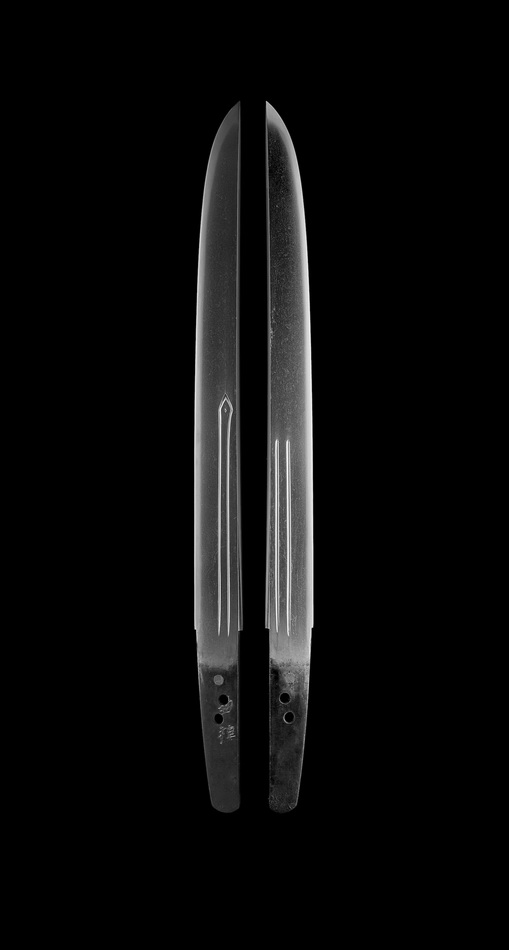
71. UDA KUNIFUSA(活跃于1530-1550年) 16世纪,蒙马奇时期,一个有山的蚀刻坦陀 高清作品[41%]

An Etchu tanto with mountsMuromachi period , 16th century

图片文件尺寸 : 5237 x 4800px

UDA KUNIFUSA (ACTIVE CIRCA 1530-1550):An Etchu tanto with mounts
Muromachi period (1333-1573), 16th century
Kanmuri-otoshi configuration forged in itame-hada along the shinogi and masame-hada along the cutting edge, with a narrow suguha tempered edge with nie and sunagashi and a suguha boshi, both sides carved with bohi, the ubu tang with four holes (two overlapping), katte sagari file marks and signed Uda Kunifusa, 10 3/4in (27.3cm) long, with a one-piece silvered copper habaki
The 19th-century koshira-e comprising a russet-lacquer saya decorated with a variety of insects in shell and bone inlays and fitted with a russet-iron kojiri and a kozuka handle, both carved with a dragonfly in relief highlighted in gilt, the dark wood tsuka decorated in inlays to match the saya and fitted with shinchu fuchi-gashira decorated with figures in a landscape in takabori, signed Nara Toshishige, the oval shinchu plate tsuba decorated with landscapes in takabori and gold takazogan
With Kanteisho certificate no. 11259 issued by the Nihon Token Hozonkai (Society for the Preservation of the Japanese Sword) (NPO), dated April 18, 2021
With Hozon Tosogu certificate no 4018203 issued by the Nihon Bijutsu Token Hozon Kyokai (Society for the Preservation of the Japanese Art Sword), dated January 15, 2021

UDA KUNIFUSA(活跃于1530-1550年) 16世纪,蒙马奇时期,一个有山的蚀刻坦陀

72. 托姆布雷 高清作品[39%]

DO-Cy Twombly  - 现代艺术 I
图片文件像素:5713 x 4685 px

托姆布雷-

Cy Twombly * - Zeitgenössische Kunst I-

(Lexington, Virginia 1928–2011 Rome)
Untitled, 1963/1964, signed Cy Twombly, colored pencil, wax crayon on paper, 86 x 67 cm, framed

Provenance:
Galleria La Tartaruga, Rome
Galerie Karsten Greve, Cologne
Private Collection, 德国y
Kunsthaus Lempertz, 3 December 2016, lot 450 - acquired there by the present owner

Literature:
Nicola Del Roscio, Cy Twombly, drawings, catalogue raisonné, Gagosian Gallery, New York (Ed.), Munich 2011, vol. 4, no. 20

Cy Twombly occupies a unique position among US artists. Twombly lived and worked in Italy, far from the 美国 art world, and felt free to experiment. In Rome, Twombly refined his distinctive artistic language. Twombly\'s visual language is informed by classical literature, ancient history, poetry and mythology, as well as his own life experience. Since the 1950s, Twombly\'s drawings have been dominated by rhythmically repeated line progressions, swirls, dense tangles and isolated numbers. Pencil, coloured pens and ballpoint pens enabled Twombly to make this \'scriptural\' drawing, which ultimately includes the signature of the artist himself. On the white of the paper, the pictorial elements provoke by appearing as scribbles, appearing as if randomly distributed on the surface.

The untitled work offered here is a vivid example of Twombly\'s unique pictorial language. The pictorial elements merge into an abstract composition that is both delicate and dynamic. The work was created in Italy between 1963-64. Twombly lived in a 17th-century palazzo on Via di Monserrato in Rome at the time the work was created. Untitled is emblematic of the groundbreaking work Twombly produced in the 1960s, widely regarded as a critical and highly fruitful period in his long and illustrious career.

“Paint is something that I use with my hands and do all those tactile things. I really don’t like oil because you can’t get back into it, or you make a mess. It’s not my favourite thing... pencil is more my medium than wet paint.”
Cy Twombly

73. 一件镶有努伊诺布胸甲的精美盔甲 江户时代,18世纪 高清作品[39%]

Edo period , 18th century

图片文件尺寸 : 4194 x 4067px

A FINE ARMOR WITH A NUINOBU CUIRASS:Edo period (1615-1868), 18th century
The matching components lacquered black and laced in blue with purple and white highlights, comprising a russet-iron 62-plate suji kabuto, finished with a four-stage gilt-metal tehen kanamono engraved with scrolling vines, the mabizashi with a gilt-copper fukurin and gilt kuwagata and maedate formed as a rhombus within a circle, the bowl fitted with a three-lame solid shikoro, the top edge of each lame scalloped, finishing in long fukigaeshi applied with printed leather and gilt-brass matsukawabishi crests; the menpo lacquered russet brown and fitted with a three-lame yodarekake; the nuinobe do laced in sugake style, applied with gilt-metal saihai no kan and tenugui no kan, the edges of the cuirass trimmed in gilt-metal fukurin, fitted with seven sections of five-lame kusazari with scalloped upper edges, and with solid-plate hinged wakibiki; sode with applied leather trim; tsutsu-gote; Etchu haidate; with two wood storage boxes; no armor stand

一件镶有努伊诺布胸甲的精美盔甲 江户时代,18世纪

74. 卡尼坦(约1467年活跃) 带山的米诺坦陀罗摩町时期,15世纪 高清作品[39%]

A Mino tanto with mountsMuromachi period , 15th century

图片文件尺寸 : 4213 x 6007px

KANETANE (ACTIVE CIRCA 1467):A Mino tanto with mounts
Muromachi period (1333-1573), 15th century
Hirazukuri, iorimune forged in itame-hada with visible ji-nie, the narrow suguha tempered edge ending in a short turnback and a very small boshi, the omote side carved with suken and the ura side with goma-bashi, the machi-okuri tang with three holes (one plugged), indistinct file marks and signed Kanetane, 11in (27.9cm) long, with a one-piece silver habaki
The koshira-e comprising a black-lacquer saya and tsuka wrapped with same stained dark, the en-suite silver fittings all carved with chrysanthemums with dew drops, the gilt-metal menuki formed as crabs
With Tokubetsu Hozon Token certificate no. 1013969 issued by the Nihon Bijutsu Token Hozon Kyokai (Society for the Preservation of the Japanese Art Sword), dated August 28, 2020

卡尼坦(约1467年活跃) 带山的米诺坦陀罗摩町时期,15世纪

75. 阿塔纳修斯·基尔彻。1602-1680. Romani Collegii Societatus Jesu Museum Celeberrrimum。阿姆斯特丹:Janssonius van Waesberge,1678年。 高清作品[38%]

Romani Collegii Societatus Jesu Musaeum Celeberrimum. Amsterdam: Janssonius van Waesberge, 1678.

图片文件尺寸 : 5163 x 5291px

KIRCHER, ATHANASIUS. 1602-1680. :Romani Collegii Societatus Jesu Musaeum Celeberrimum. Amsterdam: Janssonius van Waesberge, 1678.
Folio (375 x 260 mm). Engraved additional title, engraved portrait of Kircher, 17 engraved plates (9 folding), 4 engravings and numerous woodcuts to text, initials, tailpieces. Later half vellum and boards; few stray pen marks to rear cover, margins of text toned and spotted, final few leaves foxed.

FIRST EDITION of the first catalogue of the Museo Kircheriano at the Roman College, a detailed inventory of Kircher\'s cabinet of curiosities of Chinese and Egyptian antiquities, scientific instruments, optical devices and ancient musical instruments. Kircher \"was in an excellent situation, at the hub of the Jesuit order, to gather relics, specimens, manuscripts, and any other oddities or rarities his fellow Jesuits brought back to Rome from all parts of the world ... In 1678 , the Museo Kircheriano was at its peak, with a new exhibit hall and a printed catalogue\" (Merrill, p xxvii). A second catalogue was published in 1709 followed by a long period of decline in the maintenance of the collection. Much of Kircher\'s collection was eventually incorporated into the Museo Nazionale. Caillet 5784.

阿塔纳修斯·基尔彻。1602-1680. Romani Collegii Societatus Jesu Museum Celeberrrimum。阿姆斯特丹:Janssonius van Waesberge,1678年。

76. 肌球蛋白(活跃的18世纪) 18世纪,一个歌舞伎和门波江户时期 高清作品[37%]

A suji kabuto and menpoEdo period , 18th century

图片文件尺寸 : 4417 x 4336px

MYOCHIN IEHISA (ACTIVE 18th CENTURY):A suji kabuto and menpo
Edo period (1615-1868), 18th century
The russet-iron helmet constructed of 16 plates riveted together, the crown mounted with a three-stage gilt-copper and shakudo tehen kanamono, the front adorned with a lacquered-wood maedate formed as a long-eared demon, the helmet bowl fitted with a five-lave solid shikoro lacquered black and laced in green and orange sugake style, the fukigaeshi applied with pebbled leather highlighted with gold lacquer and applied with gilt-copper plum-floret family crests; the russet-iron menpo with a hinged nose plate and deep wrinkles on the cheeks, the interior lacquered red, fitted with a four-lame yodarekake laced to match the shikoro
9 7/8in (25.1cm) wide (across the helmet bowl)

肌球蛋白(活跃的18世纪) 18世纪,一个歌舞伎和门波江户时期

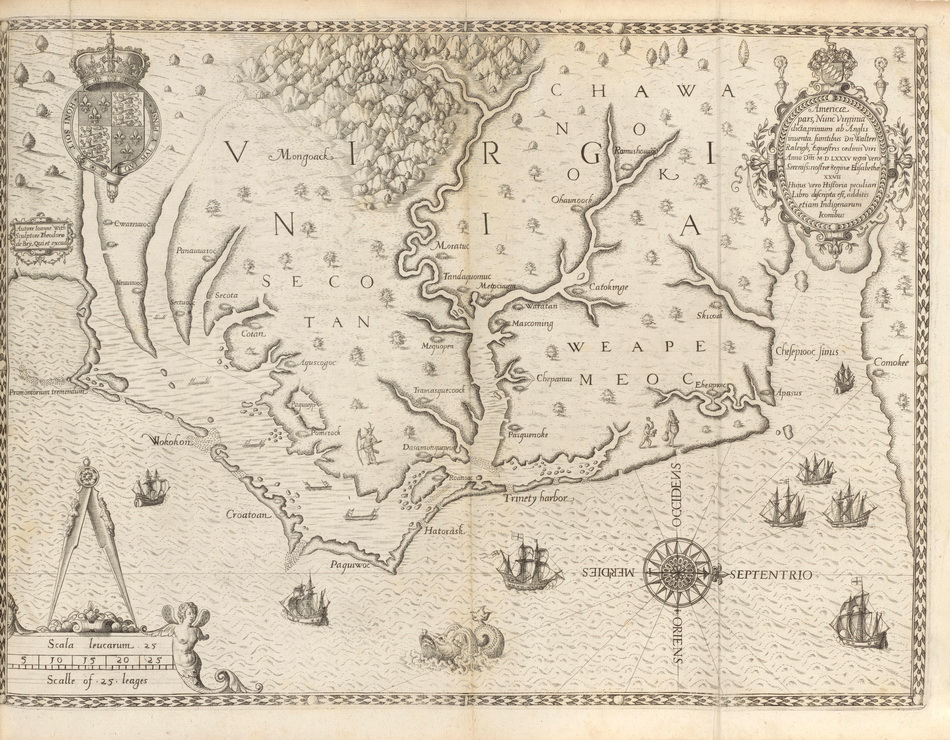
77. 布莱,西奥多·德。1528-1598年托马斯·哈里奥特。 弗吉尼亚州商业和国际贸易部。法兰克福:约翰·韦切尔,1590年。 高清作品[36%]

Admiranda Narratio Fida Tamen, de Commodis et Incolarum Ritibus Virginiae.  Frankfurt: Johann Wechel, 1590.

图片文件尺寸 : 4455 x 4726px

BRY, THEODOR DE. 1528-1598; AND THOMAS HARIOT.:Admiranda Narratio Fida Tamen, de Commodis et Incolarum Ritibus Virginiae. Frankfurt: Johann Wechel, 1590.
Folio (332 x 240 mm). Engraved title (first issue, see below), engraved arms on dedication leaf, double-page engraved map of Virginia in first state, engraved plate of Adam and Eve in first state with inscription \"Iodocus a winghe in Theodore de Bry fe.\" and 27 engraved plates after John White. Late 19th-century red morocco gilt by \"Bradstreet\'s for J. Comly MacCoy,\" gilt edges. Some light mostly marginal staining. Provenance: J.C. MacCoy (booklabel and binding).


FIRST EDITION, MOSTLY FIRST ISSUE (see below) OF THE FIRST VOLUME OF DE BRY\'S GREAT VOYAGES, BEING THOMAS HARIOT\'S DESCRIPTION OF VIRGINIA, and published during De Bry\'s lifetime. Thomas Hariot accompanied the 1585 expedition to Roanoke funded by Sir Walter Raleigh and acted as a translator. He had learned Carolina Algonquian from two Roanoke chiefs brought to England by Raleigh the year before. His account is a very encouraging one as the mysterious disappearance of Roanoke colony was not reported in Europe until John White, the expedition artist and mapmaker, returned in 1590.The 23 illustrations to the text, which are after John White\'s drawings, are by far the most important visual record of New World natives as first encountered by the English colonists. Also included is the highly important double-page map, the first map to identify Chesapeake Bay and \"the first printed map of this degree of detail and accuracy for any part of the present area of the United States\" (Cumming). It was dubbed by Burden \"one of the most significant cartographical milestones in colonial North American history ... the most accurate map drawn in the sixteenth century of any part of that continent. It became the prototype of the area until long after James Moxon\'s map in 1671... This is the first map to focus on Virginia (now largely North Carolina), and records the first English attempts at colonization in the New World. First issue engraved title as Church 140a, the plate not worn but without the printed \"cum gratia et privilege...\" at the bottom of the title panel. Map and most plates in first issue (plates 4, 7, 11, 12 second issue). D6 is a blank and genuine. Burden 76 (first state); Church 140; Cumming Southeast 12-13; European Americana 590/31; Sabin 8784.

布莱,西奥多·德。1528-1598年托马斯·哈里奥特。 弗吉尼亚州商业和国际贸易部。法兰克福:约翰·韦切尔,1590年。

78. 开普勒,约翰内斯。1571-1630. 鲁道夫的桌子被称为天文学,包括餐厅倒塌的时间。乌尔姆:乔纳斯·索,1627年。 高清作品[35%]

Tabulae Rudolphinae, quibus astronomicae scientiae, temporum longinquitate collapsae restauratio continentur.  Ulm: Jonas Saur, 1627.

图片文件尺寸 : 4192 x 4644px

KEPLER, JOHANNES. 1571-1630. :Tabulae Rudolphinae, quibus astronomicae scientiae, temporum longinquitate collapsae restauratio continentur. Ulm: Jonas Saur, 1627.
Folio (330 x 226 mm). Roman and italic types, double column, printed shoulder notes. Engraved allegorical frontispiece designed by Kepler, depicting Hipparchus, Ptolemy, Copernicus, Brahe, and Kepler gathered in the Temple of Urania, numerous woodcut diagrams in text, including a full-page of diagrams on k3v, woodcut initials, large woodcut device on part 2 section title. With the 4-leaves \"Sportula genethliacis missa\" (q4) printed in Sagan and dated 1629, inserted after the tabulae. Early 18th-century half-sheep and mottled boards, spine gilt in 7 compartments with red and green morocco lettering piece, red speckled edges, a few gatherings (including \"Sportula\", sig. q, issued in 1629) browned (as often). Provenance: Co. Riccati (Jacopo Francesco Riccati (1676-1754, Venetian mathematician; bookplate on title verso).

FIRST EDITION OF KEPLER\'S LAST LIFETIME PUBLICATION AND HIS CROWNING ACHIEVEMENT, THE \"FOUNDATION OF ALL PLANETARY CALCULATIONS FOR OVER A CENTURY\" (Sparrow). Third state, with second quire [):():(4] on different paper, albeit trimmed here to the same size as the adjacent leaves. \"The tables are extraordinarily important, for they document in a unique way Kepler\'s great contributions to astronomy\" (Gingerich). \"Besides the planetary, solar, and lunar tables and the associated tables of logarithms it includes Tycho Brahe\'s catalog of 1,000 fixed stars, a chronological synopsis, and a list of geographical positions ... Kepler was an astronomer\'s astronomer. It was the astronomers who recognized the immense superiority of the Tabulae Rudolphinae. For the professionals the improvement in planetary predictions was a forceful testimony to the efficacy of the Copernican system\" (Sparrow). Based on Tycho Brahe\'s observations, the tables were then supplemented by Kepler\'s own observations. The calculations were a major mathematical achievement, as of course, Brahe\'s data applied erroneously to \"perfect\" circular orbits. Kepler had discovered the true elliptical shape of the planetary orbits, and thus, had to recalculate everything according to his new laws. The printing history of the book, during the 30 years\' war, is quite complex. There were 1000 copies printed in Ulm in 1627, with three known states, affecting the title and the first two gatherings. Some copies are known with a posthumously published world map, and some have a posthumous appendix - neither is present in this copy. \"In excusing the long delay in publication... [Kepler] mentioned in the preface [p. 6] not only the difficulties of obtaining his salary and of the wartime conditions but also \'the novelty of my discoveries and the unexpected transfer of the whole of astronomy from fictitious circles to natural causes, which were most profound to investigate, difficult to explain, and difficult to calculate, since mine was the first attempt\'\" (DSB). Caspar 79; Gingerich Johannes Kepler and the Rudolphine tables; Houzeau and Lancaster 12754; Lalande p 190; Norman 1208; Sparrow 116.

开普勒,约翰内斯。1571-1630. 鲁道夫的桌子被称为天文学,包括餐厅倒塌的时间。乌尔姆:乔纳斯·索,1627年。

79. 行政卡有限。 奥地利大公查尔斯在西班牙王位继承战争中塑造了自己的西班牙查理三世, 高清作品[35%]

Rare patent of nobility issued by Archduke Charles of Austria , fashioning himself Charles III of Spain during the War of the Spanish Succession ,

图片文件尺寸 : 4726 x 4820px

ILLUMINATED CARTA EXECUTORIA.:Rare patent of nobility issued by Archduke Charles of Austria (later Charles VI, Holy Roman Emperor), fashioning himself Charles III of Spain during the War of the Spanish Succession (1701–1714), conveying the title of Marquess of Callus (in Catalonia) upon Don Jaime Vicente Alamany Descallar, manuscript on vellum, text in Latin, 1711, 290 x 200 mm, 8 leaves bound as a single quire of 4 bifolia.
Collation: i8, the first leaf treated as a blank flyleaf. 22-26 long lines written in brown ink in italic script with one-line roman capitals; headings in larger capitals on ff. 2r-2v; written area: 215 x 125 mm. All text pages decorated with full borders containing delicate brown ink drawings. F. 2r with a cartouche depicting the king on a rearing horse firing a pistol, surmounted by a crown, below him a globe held by two putti and inscribed \"America\", below that the words NOS CAROLUS in a cartouche, all flanked by personifications of the church and the state and other motifs. On f. 2v the continuation of the text continues under a round seal stamped in in black ink, containing a coat of arms, and inscribed: CAROLUS III DEI GRATIA HISPANIARUM ET INDIARUM REX. Borders of ff. 2v-6v filled with vedute, vignettes, putti, cartouches, and various flourishes similar to those found in engraved writing-master books of the period. F. 7r with the last lines of the text and several notarial attestations. F. 7v blank. F. 8r with a large colored coat of arms surrounded by colored arabesque flourishes. F. 8v blank. Binding of later red velvet over pasteboards (worn) with remains of two monkeys-fist closures of woven silk, red silk doublures and single red silk flyleaves front and back, remains of a braided silk cord intended to attach the seal and a circular depression inside the back cover intended to hold the seal (seal missing).

RARE PATENT OF NOBILITY OF \"CHARLES III\" DURING HIS EMBATTLED CLAIM TO THE SPANISH THRONE. On the death of his Hapsburg relative King Charles II of Spain (1661-1700) without a direct heir, Archduke Charles of Austria declared himself the King of Spain, thus occasioning the War of the Spanish Succession, which pitted him against a rival candidate, Philip, Duke of Anjou, grandson of Louis XIV, and a distant cousin of the Archduke. In 1711, when his brother, the Holy Roman Emperor Joseph I, died the Archduke returned to Vienna to assume the imperial crown, while Philip was eventually recognized as King Philip V of Spain. During his brief time as claimant to the Spanish throne, Charles never extended his sphere of influence beyond Catalonia and lived there only from 1705 to 1711.

行政卡有限。 奥地利大公查尔斯在西班牙王位继承战争中塑造了自己的西班牙查理三世,

80. 皮耶罗·多拉齐奥 高清作品[34%]

DO-Piero Dorazio  - 现代艺术 I
图片文件像素:5842 x 5474 px

皮耶罗·多拉齐奥-

Piero Dorazio * - Zeitgenössische Kunst I-

(Rome 1927–2005 Perugia)
Untitled [Contro il rassegnarsi], 1967, Signed, dated, dedicated and inscribed on the reverse, oil on canvas, 100 x 100, framed

This work is registered in the Archivio Piero Dorazio, Milan and is accompanied by a photo certificate of authenticity

Provenance:
V. Pirozzi Collection, Rome
Sale Farsetti, Prato, 27 May 2000, lot 303
Anfiteatro Arte, Milan
European Private Collection

Exhibited:
Milan, Galleria Anfiteatro Arte, 1999, exh. cat. p. 47 no. 15 with ill.
Genoa, Dorazio, Marco Canepa Arte Contemporanea, 2006, exh. cat. with ill.
Padua, Piero Dorazio, Anfiteatro Arte, 1 February – 18 March 2007, exh. cat. p. 74 and 75 with ill. (label on the reverse)


Literature:
M. Volpi Orandini, J. Lassaigne, G. Crisafi, Dorazio Catalogo ragionato delle opere, Alfieri Editore, 1977, no. 8 (in the addenda at the end of the catalogue)

The subject of the painting always drives from the previous painting, hence there is no reason for inspiration. One tries again, keeps on trying to do what he has already done…
Piero Dorazio

Of all the great first and second generation 美国 painters I have known since 1953 (the third generation is not yet discernable), Kenneth Noland is a truly singular case.

He is from North Carolina and Washington, i.e. the provinces, rather than the artistic milieu of New York.

[...]In the 1950s and 1960s I never understood whether some artistic circles in the Metropolis or certain isolated artists like Kenneth Noland and Morris Louis, Georgia O\'Keeffe in New Mexico or Andrew Wyeth in Pennsylvania were more provincial. Although isolated, Louis and Noland were already the most modern of modern 美国 painters in the early 1960s. They were a surprising revelation when discovered and presented by the critic Clement Greenberg at the 法国 and Co. Gallery in New York. Their exhibitions in that gallery between \'59 and \'60 remain by far the most exciting of the decade.

Kenneth Noland\'s painting has nothing to do, therefore, with all the clichés of 美国 painting disseminated here by European critics who have framed all expressions into schools or categories or groups (Action Painting, New Dada, Abstract expressionism, Pop Art, Minimal Art etc.) letting what were actually the most creative values and personalities slip through their fingers. [...]

Ken Noland established himself, from the late 1960s and 1970s, among those few artists defined as \'Colour field painters\' or \'Post Painterly Abstraction\' not as a group but rather as a trend: Helen Frankenhaler, Morris Louis, Jules Olitsky, Friedel Dzubas, Larry Poons. There was a convergence of interests among these painters for colour as an element that defines large spaces and long periods of time for the observer, who is induced to meditate because he is immersed in the rhythm of the lines and chromatic masses of a truly abstract painting, devoid of any allusion or reference to the real, the metaphysical or the subjective temperament. Painting that refers on the one hand to the decorative character of early Matisse, and on the other to the secular spirit of Constructivism. Among those painters, Noland was always the one who, with tenacity and clarity of purpose, was best able to sublimate \'pure visibility\' into a highly lyrical personal poetics. His nature as a colourist and his technique inspired his constant formal research into surface-colour and material-colour relationships. [...]

In these works chromatic fantasy and refined sensitivity, arranged in a precise structural order, bring the brushstrokes and pictorial matter to life in decisive and delicate spaces and lights and rhythms, expressing a constant reflection on the inevitable characteristics of reality. Constancy and appearance, the negative and the positive, fullness and emptiness; our gaze is entertained and delighted by this repertoire of perception, emotion and mind.

(Piero Dorazio, Il singolare caso di Kenenth Noland, in “Rigando dritto. Piero Dorazio Scritti 1945-2004, pp. 425-427)

ins long油画图片- 高清ins long绘画作品- 代表作全集 中艺名画下载


71. UDA KUNIFUSA(活跃于1530-1550年) 16世纪,蒙马奇时期,一个有山的蚀刻坦陀 高清作品[41%]

An Etchu tanto with mountsMuromachi period , 16th century

图片文件尺寸 : 5237 x 4800px

UDA KUNIFUSA (ACTIVE CIRCA 1530-1550):An Etchu tanto with mounts
Muromachi period (1333-1573), 16th century
Kanmuri-otoshi configuration forged in itame-hada along the shinogi and masame-hada along the cutting edge, with a narrow suguha tempered edge with nie and sunagashi and a suguha boshi, both sides carved with bohi, the ubu tang with four holes (two overlapping), katte sagari file marks and signed Uda Kunifusa, 10 3/4in (27.3cm) long, with a one-piece silvered copper habaki
The 19th-century koshira-e comprising a russet-lacquer saya decorated with a variety of insects in shell and bone inlays and fitted with a russet-iron kojiri and a kozuka handle, both carved with a dragonfly in relief highlighted in gilt, the dark wood tsuka decorated in inlays to match the saya and fitted with shinchu fuchi-gashira decorated with figures in a landscape in takabori, signed Nara Toshishige, the oval shinchu plate tsuba decorated with landscapes in takabori and gold takazogan
With Kanteisho certificate no. 11259 issued by the Nihon Token Hozonkai (Society for the Preservation of the Japanese Sword) (NPO), dated April 18, 2021
With Hozon Tosogu certificate no 4018203 issued by the Nihon Bijutsu Token Hozon Kyokai (Society for the Preservation of the Japanese Art Sword), dated January 15, 2021

UDA KUNIFUSA(活跃于1530-1550年) 16世纪,蒙马奇时期,一个有山的蚀刻坦陀

72. 托姆布雷 高清作品[39%]

DO-Cy Twombly  - 现代艺术 I
图片文件像素:5713 x 4685 px

托姆布雷-

Cy Twombly * - Zeitgenössische Kunst I-

(Lexington, Virginia 1928–2011 Rome)
Untitled, 1963/1964, signed Cy Twombly, colored pencil, wax crayon on paper, 86 x 67 cm, framed

Provenance:
Galleria La Tartaruga, Rome
Galerie Karsten Greve, Cologne
Private Collection, 德国y
Kunsthaus Lempertz, 3 December 2016, lot 450 - acquired there by the present owner

Literature:
Nicola Del Roscio, Cy Twombly, drawings, catalogue raisonné, Gagosian Gallery, New York (Ed.), Munich 2011, vol. 4, no. 20

Cy Twombly occupies a unique position among US artists. Twombly lived and worked in Italy, far from the 美国 art world, and felt free to experiment. In Rome, Twombly refined his distinctive artistic language. Twombly\'s visual language is informed by classical literature, ancient history, poetry and mythology, as well as his own life experience. Since the 1950s, Twombly\'s drawings have been dominated by rhythmically repeated line progressions, swirls, dense tangles and isolated numbers. Pencil, coloured pens and ballpoint pens enabled Twombly to make this \'scriptural\' drawing, which ultimately includes the signature of the artist himself. On the white of the paper, the pictorial elements provoke by appearing as scribbles, appearing as if randomly distributed on the surface.

The untitled work offered here is a vivid example of Twombly\'s unique pictorial language. The pictorial elements merge into an abstract composition that is both delicate and dynamic. The work was created in Italy between 1963-64. Twombly lived in a 17th-century palazzo on Via di Monserrato in Rome at the time the work was created. Untitled is emblematic of the groundbreaking work Twombly produced in the 1960s, widely regarded as a critical and highly fruitful period in his long and illustrious career.

“Paint is something that I use with my hands and do all those tactile things. I really don’t like oil because you can’t get back into it, or you make a mess. It’s not my favourite thing... pencil is more my medium than wet paint.”
Cy Twombly

73. 一件镶有努伊诺布胸甲的精美盔甲 江户时代,18世纪 高清作品[39%]

Edo period , 18th century

图片文件尺寸 : 4194 x 4067px

A FINE ARMOR WITH A NUINOBU CUIRASS:Edo period (1615-1868), 18th century
The matching components lacquered black and laced in blue with purple and white highlights, comprising a russet-iron 62-plate suji kabuto, finished with a four-stage gilt-metal tehen kanamono engraved with scrolling vines, the mabizashi with a gilt-copper fukurin and gilt kuwagata and maedate formed as a rhombus within a circle, the bowl fitted with a three-lame solid shikoro, the top edge of each lame scalloped, finishing in long fukigaeshi applied with printed leather and gilt-brass matsukawabishi crests; the menpo lacquered russet brown and fitted with a three-lame yodarekake; the nuinobe do laced in sugake style, applied with gilt-metal saihai no kan and tenugui no kan, the edges of the cuirass trimmed in gilt-metal fukurin, fitted with seven sections of five-lame kusazari with scalloped upper edges, and with solid-plate hinged wakibiki; sode with applied leather trim; tsutsu-gote; Etchu haidate; with two wood storage boxes; no armor stand

一件镶有努伊诺布胸甲的精美盔甲 江户时代,18世纪

74. 卡尼坦(约1467年活跃) 带山的米诺坦陀罗摩町时期,15世纪 高清作品[39%]

A Mino tanto with mountsMuromachi period , 15th century

图片文件尺寸 : 4213 x 6007px

KANETANE (ACTIVE CIRCA 1467):A Mino tanto with mounts
Muromachi period (1333-1573), 15th century
Hirazukuri, iorimune forged in itame-hada with visible ji-nie, the narrow suguha tempered edge ending in a short turnback and a very small boshi, the omote side carved with suken and the ura side with goma-bashi, the machi-okuri tang with three holes (one plugged), indistinct file marks and signed Kanetane, 11in (27.9cm) long, with a one-piece silver habaki
The koshira-e comprising a black-lacquer saya and tsuka wrapped with same stained dark, the en-suite silver fittings all carved with chrysanthemums with dew drops, the gilt-metal menuki formed as crabs
With Tokubetsu Hozon Token certificate no. 1013969 issued by the Nihon Bijutsu Token Hozon Kyokai (Society for the Preservation of the Japanese Art Sword), dated August 28, 2020

卡尼坦(约1467年活跃) 带山的米诺坦陀罗摩町时期,15世纪

75. 阿塔纳修斯·基尔彻。1602-1680. Romani Collegii Societatus Jesu Museum Celeberrrimum。阿姆斯特丹:Janssonius van Waesberge,1678年。 高清作品[38%]

Romani Collegii Societatus Jesu Musaeum Celeberrimum. Amsterdam: Janssonius van Waesberge, 1678.

图片文件尺寸 : 5163 x 5291px

KIRCHER, ATHANASIUS. 1602-1680. :Romani Collegii Societatus Jesu Musaeum Celeberrimum. Amsterdam: Janssonius van Waesberge, 1678.
Folio (375 x 260 mm). Engraved additional title, engraved portrait of Kircher, 17 engraved plates (9 folding), 4 engravings and numerous woodcuts to text, initials, tailpieces. Later half vellum and boards; few stray pen marks to rear cover, margins of text toned and spotted, final few leaves foxed.

FIRST EDITION of the first catalogue of the Museo Kircheriano at the Roman College, a detailed inventory of Kircher\'s cabinet of curiosities of Chinese and Egyptian antiquities, scientific instruments, optical devices and ancient musical instruments. Kircher \"was in an excellent situation, at the hub of the Jesuit order, to gather relics, specimens, manuscripts, and any other oddities or rarities his fellow Jesuits brought back to Rome from all parts of the world ... In 1678 , the Museo Kircheriano was at its peak, with a new exhibit hall and a printed catalogue\" (Merrill, p xxvii). A second catalogue was published in 1709 followed by a long period of decline in the maintenance of the collection. Much of Kircher\'s collection was eventually incorporated into the Museo Nazionale. Caillet 5784.

阿塔纳修斯·基尔彻。1602-1680. Romani Collegii Societatus Jesu Museum Celeberrrimum。阿姆斯特丹:Janssonius van Waesberge,1678年。

76. 肌球蛋白(活跃的18世纪) 18世纪,一个歌舞伎和门波江户时期 高清作品[37%]

A suji kabuto and menpoEdo period , 18th century

图片文件尺寸 : 4417 x 4336px

MYOCHIN IEHISA (ACTIVE 18th CENTURY):A suji kabuto and menpo
Edo period (1615-1868), 18th century
The russet-iron helmet constructed of 16 plates riveted together, the crown mounted with a three-stage gilt-copper and shakudo tehen kanamono, the front adorned with a lacquered-wood maedate formed as a long-eared demon, the helmet bowl fitted with a five-lave solid shikoro lacquered black and laced in green and orange sugake style, the fukigaeshi applied with pebbled leather highlighted with gold lacquer and applied with gilt-copper plum-floret family crests; the russet-iron menpo with a hinged nose plate and deep wrinkles on the cheeks, the interior lacquered red, fitted with a four-lame yodarekake laced to match the shikoro
9 7/8in (25.1cm) wide (across the helmet bowl)

肌球蛋白(活跃的18世纪) 18世纪,一个歌舞伎和门波江户时期

77. 布莱,西奥多·德。1528-1598年托马斯·哈里奥特。 弗吉尼亚州商业和国际贸易部。法兰克福:约翰·韦切尔,1590年。 高清作品[36%]

Admiranda Narratio Fida Tamen, de Commodis et Incolarum Ritibus Virginiae.  Frankfurt: Johann Wechel, 1590.

图片文件尺寸 : 4455 x 4726px

BRY, THEODOR DE. 1528-1598; AND THOMAS HARIOT.:Admiranda Narratio Fida Tamen, de Commodis et Incolarum Ritibus Virginiae. Frankfurt: Johann Wechel, 1590.
Folio (332 x 240 mm). Engraved title (first issue, see below), engraved arms on dedication leaf, double-page engraved map of Virginia in first state, engraved plate of Adam and Eve in first state with inscription \"Iodocus a winghe in Theodore de Bry fe.\" and 27 engraved plates after John White. Late 19th-century red morocco gilt by \"Bradstreet\'s for J. Comly MacCoy,\" gilt edges. Some light mostly marginal staining. Provenance: J.C. MacCoy (booklabel and binding).


FIRST EDITION, MOSTLY FIRST ISSUE (see below) OF THE FIRST VOLUME OF DE BRY\'S GREAT VOYAGES, BEING THOMAS HARIOT\'S DESCRIPTION OF VIRGINIA, and published during De Bry\'s lifetime. Thomas Hariot accompanied the 1585 expedition to Roanoke funded by Sir Walter Raleigh and acted as a translator. He had learned Carolina Algonquian from two Roanoke chiefs brought to England by Raleigh the year before. His account is a very encouraging one as the mysterious disappearance of Roanoke colony was not reported in Europe until John White, the expedition artist and mapmaker, returned in 1590.The 23 illustrations to the text, which are after John White\'s drawings, are by far the most important visual record of New World natives as first encountered by the English colonists. Also included is the highly important double-page map, the first map to identify Chesapeake Bay and \"the first printed map of this degree of detail and accuracy for any part of the present area of the United States\" (Cumming). It was dubbed by Burden \"one of the most significant cartographical milestones in colonial North American history ... the most accurate map drawn in the sixteenth century of any part of that continent. It became the prototype of the area until long after James Moxon\'s map in 1671... This is the first map to focus on Virginia (now largely North Carolina), and records the first English attempts at colonization in the New World. First issue engraved title as Church 140a, the plate not worn but without the printed \"cum gratia et privilege...\" at the bottom of the title panel. Map and most plates in first issue (plates 4, 7, 11, 12 second issue). D6 is a blank and genuine. Burden 76 (first state); Church 140; Cumming Southeast 12-13; European Americana 590/31; Sabin 8784.

布莱,西奥多·德。1528-1598年托马斯·哈里奥特。 弗吉尼亚州商业和国际贸易部。法兰克福:约翰·韦切尔,1590年。

78. 开普勒,约翰内斯。1571-1630. 鲁道夫的桌子被称为天文学,包括餐厅倒塌的时间。乌尔姆:乔纳斯·索,1627年。 高清作品[35%]

Tabulae Rudolphinae, quibus astronomicae scientiae, temporum longinquitate collapsae restauratio continentur.  Ulm: Jonas Saur, 1627.

图片文件尺寸 : 4192 x 4644px

KEPLER, JOHANNES. 1571-1630. :Tabulae Rudolphinae, quibus astronomicae scientiae, temporum longinquitate collapsae restauratio continentur. Ulm: Jonas Saur, 1627.
Folio (330 x 226 mm). Roman and italic types, double column, printed shoulder notes. Engraved allegorical frontispiece designed by Kepler, depicting Hipparchus, Ptolemy, Copernicus, Brahe, and Kepler gathered in the Temple of Urania, numerous woodcut diagrams in text, including a full-page of diagrams on k3v, woodcut initials, large woodcut device on part 2 section title. With the 4-leaves \"Sportula genethliacis missa\" (q4) printed in Sagan and dated 1629, inserted after the tabulae. Early 18th-century half-sheep and mottled boards, spine gilt in 7 compartments with red and green morocco lettering piece, red speckled edges, a few gatherings (including \"Sportula\", sig. q, issued in 1629) browned (as often). Provenance: Co. Riccati (Jacopo Francesco Riccati (1676-1754, Venetian mathematician; bookplate on title verso).

FIRST EDITION OF KEPLER\'S LAST LIFETIME PUBLICATION AND HIS CROWNING ACHIEVEMENT, THE \"FOUNDATION OF ALL PLANETARY CALCULATIONS FOR OVER A CENTURY\" (Sparrow). Third state, with second quire [):():(4] on different paper, albeit trimmed here to the same size as the adjacent leaves. \"The tables are extraordinarily important, for they document in a unique way Kepler\'s great contributions to astronomy\" (Gingerich). \"Besides the planetary, solar, and lunar tables and the associated tables of logarithms it includes Tycho Brahe\'s catalog of 1,000 fixed stars, a chronological synopsis, and a list of geographical positions ... Kepler was an astronomer\'s astronomer. It was the astronomers who recognized the immense superiority of the Tabulae Rudolphinae. For the professionals the improvement in planetary predictions was a forceful testimony to the efficacy of the Copernican system\" (Sparrow). Based on Tycho Brahe\'s observations, the tables were then supplemented by Kepler\'s own observations. The calculations were a major mathematical achievement, as of course, Brahe\'s data applied erroneously to \"perfect\" circular orbits. Kepler had discovered the true elliptical shape of the planetary orbits, and thus, had to recalculate everything according to his new laws. The printing history of the book, during the 30 years\' war, is quite complex. There were 1000 copies printed in Ulm in 1627, with three known states, affecting the title and the first two gatherings. Some copies are known with a posthumously published world map, and some have a posthumous appendix - neither is present in this copy. \"In excusing the long delay in publication... [Kepler] mentioned in the preface [p. 6] not only the difficulties of obtaining his salary and of the wartime conditions but also \'the novelty of my discoveries and the unexpected transfer of the whole of astronomy from fictitious circles to natural causes, which were most profound to investigate, difficult to explain, and difficult to calculate, since mine was the first attempt\'\" (DSB). Caspar 79; Gingerich Johannes Kepler and the Rudolphine tables; Houzeau and Lancaster 12754; Lalande p 190; Norman 1208; Sparrow 116.

开普勒,约翰内斯。1571-1630. 鲁道夫的桌子被称为天文学,包括餐厅倒塌的时间。乌尔姆:乔纳斯·索,1627年。

79. 行政卡有限。 奥地利大公查尔斯在西班牙王位继承战争中塑造了自己的西班牙查理三世, 高清作品[35%]

Rare patent of nobility issued by Archduke Charles of Austria , fashioning himself Charles III of Spain during the War of the Spanish Succession ,

图片文件尺寸 : 4726 x 4820px

ILLUMINATED CARTA EXECUTORIA.:Rare patent of nobility issued by Archduke Charles of Austria (later Charles VI, Holy Roman Emperor), fashioning himself Charles III of Spain during the War of the Spanish Succession (1701–1714), conveying the title of Marquess of Callus (in Catalonia) upon Don Jaime Vicente Alamany Descallar, manuscript on vellum, text in Latin, 1711, 290 x 200 mm, 8 leaves bound as a single quire of 4 bifolia.
Collation: i8, the first leaf treated as a blank flyleaf. 22-26 long lines written in brown ink in italic script with one-line roman capitals; headings in larger capitals on ff. 2r-2v; written area: 215 x 125 mm. All text pages decorated with full borders containing delicate brown ink drawings. F. 2r with a cartouche depicting the king on a rearing horse firing a pistol, surmounted by a crown, below him a globe held by two putti and inscribed \"America\", below that the words NOS CAROLUS in a cartouche, all flanked by personifications of the church and the state and other motifs. On f. 2v the continuation of the text continues under a round seal stamped in in black ink, containing a coat of arms, and inscribed: CAROLUS III DEI GRATIA HISPANIARUM ET INDIARUM REX. Borders of ff. 2v-6v filled with vedute, vignettes, putti, cartouches, and various flourishes similar to those found in engraved writing-master books of the period. F. 7r with the last lines of the text and several notarial attestations. F. 7v blank. F. 8r with a large colored coat of arms surrounded by colored arabesque flourishes. F. 8v blank. Binding of later red velvet over pasteboards (worn) with remains of two monkeys-fist closures of woven silk, red silk doublures and single red silk flyleaves front and back, remains of a braided silk cord intended to attach the seal and a circular depression inside the back cover intended to hold the seal (seal missing).

RARE PATENT OF NOBILITY OF \"CHARLES III\" DURING HIS EMBATTLED CLAIM TO THE SPANISH THRONE. On the death of his Hapsburg relative King Charles II of Spain (1661-1700) without a direct heir, Archduke Charles of Austria declared himself the King of Spain, thus occasioning the War of the Spanish Succession, which pitted him against a rival candidate, Philip, Duke of Anjou, grandson of Louis XIV, and a distant cousin of the Archduke. In 1711, when his brother, the Holy Roman Emperor Joseph I, died the Archduke returned to Vienna to assume the imperial crown, while Philip was eventually recognized as King Philip V of Spain. During his brief time as claimant to the Spanish throne, Charles never extended his sphere of influence beyond Catalonia and lived there only from 1705 to 1711.

行政卡有限。 奥地利大公查尔斯在西班牙王位继承战争中塑造了自己的西班牙查理三世,

80. 皮耶罗·多拉齐奥 高清作品[34%]

DO-Piero Dorazio  - 现代艺术 I
图片文件像素:5842 x 5474 px

皮耶罗·多拉齐奥-

Piero Dorazio * - Zeitgenössische Kunst I-

(Rome 1927–2005 Perugia)
Untitled [Contro il rassegnarsi], 1967, Signed, dated, dedicated and inscribed on the reverse, oil on canvas, 100 x 100, framed

This work is registered in the Archivio Piero Dorazio, Milan and is accompanied by a photo certificate of authenticity

Provenance:
V. Pirozzi Collection, Rome
Sale Farsetti, Prato, 27 May 2000, lot 303
Anfiteatro Arte, Milan
European Private Collection

Exhibited:
Milan, Galleria Anfiteatro Arte, 1999, exh. cat. p. 47 no. 15 with ill.
Genoa, Dorazio, Marco Canepa Arte Contemporanea, 2006, exh. cat. with ill.
Padua, Piero Dorazio, Anfiteatro Arte, 1 February – 18 March 2007, exh. cat. p. 74 and 75 with ill. (label on the reverse)


Literature:
M. Volpi Orandini, J. Lassaigne, G. Crisafi, Dorazio Catalogo ragionato delle opere, Alfieri Editore, 1977, no. 8 (in the addenda at the end of the catalogue)

The subject of the painting always drives from the previous painting, hence there is no reason for inspiration. One tries again, keeps on trying to do what he has already done…
Piero Dorazio

Of all the great first and second generation 美国 painters I have known since 1953 (the third generation is not yet discernable), Kenneth Noland is a truly singular case.

He is from North Carolina and Washington, i.e. the provinces, rather than the artistic milieu of New York.

[...]In the 1950s and 1960s I never understood whether some artistic circles in the Metropolis or certain isolated artists like Kenneth Noland and Morris Louis, Georgia O\'Keeffe in New Mexico or Andrew Wyeth in Pennsylvania were more provincial. Although isolated, Louis and Noland were already the most modern of modern 美国 painters in the early 1960s. They were a surprising revelation when discovered and presented by the critic Clement Greenberg at the 法国 and Co. Gallery in New York. Their exhibitions in that gallery between \'59 and \'60 remain by far the most exciting of the decade.

Kenneth Noland\'s painting has nothing to do, therefore, with all the clichés of 美国 painting disseminated here by European critics who have framed all expressions into schools or categories or groups (Action Painting, New Dada, Abstract expressionism, Pop Art, Minimal Art etc.) letting what were actually the most creative values and personalities slip through their fingers. [...]

Ken Noland established himself, from the late 1960s and 1970s, among those few artists defined as \'Colour field painters\' or \'Post Painterly Abstraction\' not as a group but rather as a trend: Helen Frankenhaler, Morris Louis, Jules Olitsky, Friedel Dzubas, Larry Poons. There was a convergence of interests among these painters for colour as an element that defines large spaces and long periods of time for the observer, who is induced to meditate because he is immersed in the rhythm of the lines and chromatic masses of a truly abstract painting, devoid of any allusion or reference to the real, the metaphysical or the subjective temperament. Painting that refers on the one hand to the decorative character of early Matisse, and on the other to the secular spirit of Constructivism. Among those painters, Noland was always the one who, with tenacity and clarity of purpose, was best able to sublimate \'pure visibility\' into a highly lyrical personal poetics. His nature as a colourist and his technique inspired his constant formal research into surface-colour and material-colour relationships. [...]

In these works chromatic fantasy and refined sensitivity, arranged in a precise structural order, bring the brushstrokes and pictorial matter to life in decisive and delicate spaces and lights and rhythms, expressing a constant reflection on the inevitable characteristics of reality. Constancy and appearance, the negative and the positive, fullness and emptiness; our gaze is entertained and delighted by this repertoire of perception, emotion and mind.

(Piero Dorazio, Il singolare caso di Kenenth Noland, in “Rigando dritto. Piero Dorazio Scritti 1945-2004, pp. 425-427)