41. 汤姆森,乔治。佛罗里达州17世纪。 Loimotomia[希腊语]:或,被解剖的害虫。伦敦:纳撒尼尔·克劳奇,1666年。 高清作品[33%]

Loimotomia [in Greek]: or, the Pest Anatomized.  London: Nathaniel Crouch, 1666.

图片文件尺寸 : 4197 x 4805px

THOMSON, GEORGE. Fl. 17th CENTURY.:Loimotomia [in Greek]: or, the Pest Anatomized. London: Nathaniel Crouch, 1666.
12mo (145 x 87 mm). Engraved frontispiece (small closed tear and shaved, with loss to imprint). Contemporary speckled sheep; rebacked, title finger soiled, some toning to text
Provenance: Library of the Medical Society of Abderdeen (donor\'s inscription on front paste-down, August 22, 1820, and ink stamp to recto of frontispiece and rear blank, ink shelf mark to frontispiece)

FIRST EDITION of the first account of an autopsy on a plague victim. The author remained in London during the plague of 1665, during which he treated several cases and contracted the illness himself. Wing T1027; Krivatsy 11830.

汤姆森,乔治。佛罗里达州17世纪。 Loimotomia[希腊语]:或,被解剖的害虫。伦敦:纳撒尼尔·克劳奇,1666年。

42. 佩特鲁斯,阿尔乔尼乌斯。C、 1487–1527年。 流亡的手段。威尼斯:阿尔迪,1522年。 高清作品[32%]

Medices legatus de exilio. Venice: Aldi, 1522.

图片文件尺寸 : 5426 x 6025px

ALCYONIUS, PETRUS (PIETRO ALCIONIO). C.1487-1527.:Medices legatus de exilio. Venice: Aldi, 1522.
4to (210 x 134 mm). Woodcut printer\'s device on title and colophon. 20th century red morocco, ruled in gilt, with gilt printer\'s devices reproduced on both covers, marbled endpapers. Some wear to joints, old ink notations, scattered browning and spotting.
Provenance: Giorgio di Veroli (1890-1952, bookplate).

Alcyonius, a Venetian classicist scholar under the patronage of Pope Clement VII, was appointed Professor of Classical Greek at the University of Florence in 1522. That same year, he published this work, written in the form of a dialogue whose thesis is that exile is not an evil. It was written in elegant Latin, reminiscent of Cicero, which lead to a personal enemy accusing him of secretly plagiarizing passages from Cicero\'s lost work De Gloria, and then destroying the only existing copy of the original to hide his plagiarism. Though the accusation was groundless, it did irreparable harm to his reputation. Adams A633; Brunet I, 153; Renouard 95/6.

佩特鲁斯,阿尔乔尼乌斯。C、 1487–1527年。 流亡的手段。威尼斯:阿尔迪,1522年。

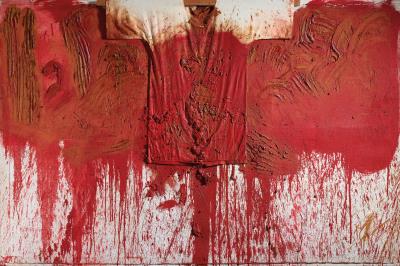
43. 赫尔曼·尼奇,当代艺术I 高清作品[31%]

DO-Hermann Nitsch  - 现代艺术 I
图片文件像素:6034 x 4375 px

赫尔曼·尼奇,当代艺术I-

Hermann Nitsch * - Zeitgenössische Kunst I-

(Vienna 1938–2022 Mistelbach, Lower Austria)
Splatter painting with chemise and impasto, signed, dated hermann nitsch 1995 on the reverse, oil on burlap, stretched over wooden frame along the right and left edge, fixed to wooden frame along the upper and lower front, 200 x 300 cm

Compare:
Hermann Nitsch. Das Gesamtkunstwerk des Orgien Mysterien Theaters, Verlag der Buchhandlung Walther König, 2015, pp. 606–607

Exhibited and illustrated in the catalogue:
Ekilibrio Foundation Collection, Galleria Sirio Arte, Padua, 10 October – 7 November 2020, pp. 168-169

Photo of this work signed hermann nitsch on the reverse available.

Provenance:
Aurelio Stefanini, Studio d’arte, Firenze (label on the reverse)
Private Collection, Italy

„… der in den exzess ekstatisch abgestiegene akteur befleckt und beschüttet… die bildfläche. oft noch spontaner, als es nur auf der bildfläche gelingt, trägt sich die intensität auf dem hemd zu. es wird automatisch befleckt, besudelt, beschmutzt, betappt, beschmiert, beschüttet, bespritzt… es ist, als ob der unsere abgründe eröffnende maler beim malvorgang in die nähe des blutschwitzens, des austrinkens des leidenskelches, der geisselung, der kreuzigung, der zerreissung des dionysos, der blendung des ödipus gerät. sein priesterkleid, sein opferhemd ist geprägt vom feuchten stempel der entäusserung… des hemd wird als höchster schmuck und trophäe auf ein bild gehängt, um dessen farbgefüge zu bereichern. es gibt bilder, die brauchen kein hemd, andere verlangen danach…“
Hermann Nitsch – aus der oben angeführten Literatur

“... the actor, ecstatically descended into the excess, stains and pours things onto … the surface of the image. often it’s even more spontaneous than just hitting the surface of the image, striking his shirt in its intensity, too. it’s automatically stained, sullied, dirtied, touched, smeared; it automatically has things poured onto it, sprayed onto it... it’s as if the painter, opening up our deepest depths, is almost sweating blood when he paints, almost drinking from the chalice of grief, flagellation, crucifixion, the dismemberment of dionysus, the blinding of oedipus. his priestly robes, his victim’s shirt is marked by the moistened stamp of renunciation. the shirt is hung on an image, enriching the texture of its colours, as if it were the most precious piece of jewellery, a trophy. there are some images that don’t need a shirt, but others demand it…”
Hermann Nitsch – from the literature cited above

44. HUGI,FRANZ JOSEPH。1791-1855. 自然历史阿尔卑斯之旅。Solothurn和莱比锡:J.Amiet Lutiger,1830年。 高清作品[31%]

Naturhistorische Alpenreise. Solothurn and Leipzig: J. Amiet-Lutiger, 1830.

图片文件尺寸 : 4025 x 5608px

HUGI, FRANZ JOSEPH. 1791-1855.:Naturhistorische Alpenreise. Solothurn and Leipzig: J. Amiet-Lutiger, 1830.
8vo (197 x 125 mm). Engraved frontispiece, additional engraved vignette title page, 9 folding tables, 16 lithographic plates (5 folding), 2 hand-colored folding engraved maps. Contemporary marbled boards, hand-inked paper lettering piece on spine. Spine ends bumped and chipped, a bit worn, scattered spotting, some curling and browning to edges of folding plates.

Swiss geologist and professor Hugi made the first scientific study of Alpine glaciers and was a member of the first party to attempt climbing the Finsteraarhorn in the Bernese Alps in 1829, although he did not reach the summit himself. The title page vignette depicts the construction of a hut on the Unteraar glacier in 1830, which is marked on one of the maps. This proved to have an unintended scientific benefit, as the movement of the hut down the glacier over the next several years would yield valuable information about glacial movement. Dreyer 364; Lonchamp 1561; Poggendorff I, 1155.

HUGI,FRANZ JOSEPH。1791-1855. 自然历史阿尔卑斯之旅。Solothurn和莱比锡:J.Amiet Lutiger,1830年。

45. 皮耶罗·多拉齐奥 高清作品[31%]

DO-Piero Dorazio  - 现代艺术 I
图片文件像素:5842 x 5474 px

皮耶罗·多拉齐奥-

Piero Dorazio * - Zeitgenössische Kunst I-

(Rome 1927–2005 Perugia)
Untitled [Contro il rassegnarsi], 1967, Signed, dated, dedicated and inscribed on the reverse, oil on canvas, 100 x 100, framed

This work is registered in the Archivio Piero Dorazio, Milan and is accompanied by a photo certificate of authenticity

Provenance:
V. Pirozzi Collection, Rome
Sale Farsetti, Prato, 27 May 2000, lot 303
Anfiteatro Arte, Milan
European Private Collection

Exhibited:
Milan, Galleria Anfiteatro Arte, 1999, exh. cat. p. 47 no. 15 with ill.
Genoa, Dorazio, Marco Canepa Arte Contemporanea, 2006, exh. cat. with ill.
Padua, Piero Dorazio, Anfiteatro Arte, 1 February – 18 March 2007, exh. cat. p. 74 and 75 with ill. (label on the reverse)


Literature:
M. Volpi Orandini, J. Lassaigne, G. Crisafi, Dorazio Catalogo ragionato delle opere, Alfieri Editore, 1977, no. 8 (in the addenda at the end of the catalogue)

The subject of the painting always drives from the previous painting, hence there is no reason for inspiration. One tries again, keeps on trying to do what he has already done…
Piero Dorazio

Of all the great first and second generation 美国 painters I have known since 1953 (the third generation is not yet discernable), Kenneth Noland is a truly singular case.

He is from North Carolina and Washington, i.e. the provinces, rather than the artistic milieu of New York.

[...]In the 1950s and 1960s I never understood whether some artistic circles in the Metropolis or certain isolated artists like Kenneth Noland and Morris Louis, Georgia O\'Keeffe in New Mexico or Andrew Wyeth in Pennsylvania were more provincial. Although isolated, Louis and Noland were already the most modern of modern 美国 painters in the early 1960s. They were a surprising revelation when discovered and presented by the critic Clement Greenberg at the 法国 and Co. Gallery in New York. Their exhibitions in that gallery between \'59 and \'60 remain by far the most exciting of the decade.

Kenneth Noland\'s painting has nothing to do, therefore, with all the clichés of 美国 painting disseminated here by European critics who have framed all expressions into schools or categories or groups (Action Painting, New Dada, Abstract expressionism, Pop Art, Minimal Art etc.) letting what were actually the most creative values and personalities slip through their fingers. [...]

Ken Noland established himself, from the late 1960s and 1970s, among those few artists defined as \'Colour field painters\' or \'Post Painterly Abstraction\' not as a group but rather as a trend: Helen Frankenhaler, Morris Louis, Jules Olitsky, Friedel Dzubas, Larry Poons. There was a convergence of interests among these painters for colour as an element that defines large spaces and long periods of time for the observer, who is induced to meditate because he is immersed in the rhythm of the lines and chromatic masses of a truly abstract painting, devoid of any allusion or reference to the real, the metaphysical or the subjective temperament. Painting that refers on the one hand to the decorative character of early Matisse, and on the other to the secular spirit of Constructivism. Among those painters, Noland was always the one who, with tenacity and clarity of purpose, was best able to sublimate \'pure visibility\' into a highly lyrical personal poetics. His nature as a colourist and his technique inspired his constant formal research into surface-colour and material-colour relationships. [...]

In these works chromatic fantasy and refined sensitivity, arranged in a precise structural order, bring the brushstrokes and pictorial matter to life in decisive and delicate spaces and lights and rhythms, expressing a constant reflection on the inevitable characteristics of reality. Constancy and appearance, the negative and the positive, fullness and emptiness; our gaze is entertained and delighted by this repertoire of perception, emotion and mind.

(Piero Dorazio, Il singolare caso di Kenenth Noland, in “Rigando dritto. Piero Dorazio Scritti 1945-2004, pp. 425-427)

46. 哈维,威廉。1578-1657. 解剖学练习,关于生物的产生。伦敦:詹姆斯·杨(James Young)为屋大维·普莱因(Octavian Pulleyn)创作,1653年。 高清作品[30%]

Anatomical Exercitations, concerning the Generation of Living Creatures. London: James Young for Octavian Pulleyn, 1653.

图片文件尺寸 : 4933 x 4582px

HARVEY, WILLIAM. 1578-1657.:Anatomical Exercitations, concerning the Generation of Living Creatures. London: James Young for Octavian Pulleyn, 1653.
8vo (165 x 110 mm). Engraved portrait frontispiece of Harvey by William Faithorne, errata leaf at end. Rebacked contemporary calf, titled in ink on fore-edge, modern cloth chemise and slipcase. Corners bumped, armorial bookplate to verso of title page (Clan Home), spotting throughout.

FIRST EDITION IN ENGLISH with the often lacking portrait of the author. \"Harvey considered this to be the culminating work of his life, and more significant than de Motu Cordis. ... Harvey was among the first to disbelieve the erroneous doctrine of the \'preformation\' of the foetus; he maintained that the organism derives from the ovum by the gradual building up and aggregation of its parts. The chapter on midwifery in this book is the first work on that subject to be written by an Englishman\" (Garrison-Morton-Norman 467, 1651 edition in Latin). Keynes 43; Russell 384; Wing H-1083.

哈维,威廉。1578-1657. 解剖学练习,关于生物的产生。伦敦:詹姆斯·杨(James Young)为屋大维·普莱因(Octavian Pulleyn)创作,1653年。

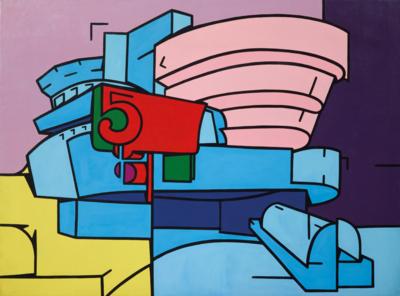
47. Valerio Adami,当代艺术I 高清作品[30%]

DO-Valerio Adami  - 现代艺术 I
图片文件像素:5850 x 5365 px

Valerio Adami,当代艺术I-

Valerio Adami * - Zeitgenössische Kunst I-

(born in Bologna in 1935)
The Guggenheim, 1968, dated, signed and titled on the reverse, oil on canvas, 97 x 130 cm, framed

This work is registered in the Archivio Valerio Adami

This work is accompanied by a certificate signed by the artist

Provenance:
Sale Farsetti, Prato, 26 November 1994
European Private Collection

As Valerio Adami wrote in 1968, “The hand is a kind of seismograph giving body to the traces left by the circuit of imagination”: the drawing hand is an instrument that records what the eye looks at and the mind sees. It is the starting point of the artist’s method: the hand-seismograph that in the “journey of drawing” goes through the kaleidoscope of his inspiration, and that in the essentiality of the line reworks, summarizes, juxtaposes, disassembles and reassembles it. […]

The lines of the drawing, eternally moving as the mind distilling them, - since for Adami “nulla dies sine linea” (no day without a line) – are the “off the beaten track” trails that the artist constantly crosses and connects. He does so by bringing distant worlds together, from the Ganges to the Matterhorn and from Paris to Finland by making the Greek mythological narrative coexist with New York street life, by recalling the light spells of Lake Maggiore or the clouds at sunrise.
(G. Ranzi, Valerio Adami and the lightly swaying desire, in “Valerio Adami. Immagine e pensiero”, Dep Art, Milan 2002)

48. 开普勒,约翰内斯。1571-1630. 沙漠和修女西德雷奥云从加利利送到死者那里。法兰克福:撒迦利亚斯·帕罗修斯,1611年。 高清作品[29%]

Dissertatio cum Nuncio Sidereo nuper ad mortales misso a Galilaeo Galilaeo. Frankfurt: Zacharias Palthenius, 1611.

图片文件尺寸 : 4271 x 4010px

KEPLER, JOHANNES. 1571-1630. :Dissertatio cum Nuncio Sidereo nuper ad mortales misso a Galilaeo Galilaeo. Frankfurt: Zacharias Palthenius, 1611.
8vo (162 x 90 mm). Woodcut device on title page. Modern blue morocco, ruled in gilt. Even toning, minor staining and some ink underlining.

Third, pirated edition of the Dissertatio cum Nuncio Sidereo, following the 1610 Prague and Florence editions. The work is an open letter to Galileo, responding enthusiastically to Galileo\'s telescopic observations published in Sidereus Nuncius in March of 1610. Galileo sent a copy to Kepler in April 1610, and Kepler felt it was necessary to publish a response in order to disseminate the knowledge of Galileo\'s discovery and its importance to the widest possible audience. He was also more than a little relieved that Galileo\'s conclusions did not undermine his own theories. The publisher of this edition, Zacharias Palthenius of Frankfurt, had also published a pirated edition of Galileo\'s Sidereus Nuncius in 1610. Caspar 34; Zinner 4277 (both for first edition).

开普勒,约翰内斯。1571-1630. 沙漠和修女西德雷奥云从加利利送到死者那里。法兰克福:撒迦利亚斯·帕罗修斯,1611年。

49. 多梅尼科·玛丽亚·弗雷塔` by Domenico Maria Fratta 高清作品[29%]

DO-Domenico Maria Fratta - Meisterzeichnungen und Druckgraphik bis 1900, Aquarelle, Miniaturen
图片文件像素:4600 x 3500 px

多梅尼科·玛丽亚·弗雷塔-

-

(Bologna 1696-1763) Das Urteil des Salomon (recto), Studie für den linken Teil derselben Komposition (verso), Feder in Braun, grau laviert, auf Bütten, 16,8 x 21,5 cm, Passep., ohne Rahmen, (Sch)

Die Zuschreibung an Domenico Fratta wurde von Dr. Marco Riccòmini anhand einer hochauflösenden digitalen Fotografie bestätigt.

Domenico Maria Fratta war einer der talentiertesten Schüler des bologneser Malers Donato Creti (1671-1749), dessen Zeichnungen lange seinem Meister zugeschrieben waren, bis man sie seinem individuellen Stil zuordnen konnte. Die Vorderseite der zeichnung ist vor allem in den Figuren der Krieger mit zwei Studien des Künstlers im Musée du Rouen vergleichbar (Inv. 1975.4.5301; Inv. 1975.4.5302), die in den Körperhaltungen und den antiken Rüstungen große Ähnlichkeiten mit dem vorliegenden Blatt aufweisen. Die Kombination der grauen Lavierung mit der braunen Feder findet sich auch in einer Zeichnung in der Glasgover Art Gallery (Inv. PR2000.4. t) Die Rückseite der Zeichnung zeigt die große Leichtigkeit des Künstlers im Umgang mit der Feder und die stilistische Nähe zu seinem Lehrer Creti. Vgl. M. Riccomini, "Guerriers en scene: Fratta et le Maitre de Philippe", in: Revue du Louvre, 2016, Nr. 5, S. 67-73;
V. Abbate / A. Mazza , Il Libro dei Panduri. Disegni di Domenico Maria Fratta nelle collezioni di Palazzo Abatellis, Ausst. Kat. Palermo, 10. November 1994 - 5. Februar 1995.

50. 克里斯多夫·谢纳。1573-1650. 来自Admirando FacularsMaculas Varius的Rosa Ursina Sive Sun。布拉恰诺:安德烈亚斯·菲乌斯(Andreas Phaeus)在公爵出版社,1626-1630年。 高清作品[29%]

Rosa Ursina Sive Sol ex Admirando Facularum  Macularum suarum Phoenomeno Varius.  Bracciano: Andreas Phaeus at the Ducal Press, 1626-1630.

图片文件尺寸 : 4065 x 5080px

SCHEINER, CHRISTOPH. 1573-1650. :Rosa Ursina Sive Sol ex Admirando Facularum Macularum suarum Phoenomeno Varius. Bracciano: Andreas Phaeus at the Ducal Press, 1626-1630.
Folio (375 x 260 mm). Engraved title vignette, engraved portrait of Paolo Giordano Orsini, Duke of Bracciano, additional engraved title, numerous engraved illustrations throughout (many full-page), woodcut head- and tailpieces and initials. [38], 784 (with numerous errors in pagination), [38] pp., with the blanks F4, R6 4I6. Full 18th-century (?) vellum, manuscript spine title, all edges gilt. Repairs to large portion of outer lower corner of first 5 leaves (letterpress half-title, title, portrait leaf, contents and engraved title) with loss to text and images, occasional heavy browning and waterstaining, especially to prefatory and end matter, sporadic foxing, loss to top blank corner of 4G6.

FIRST EDITION of Scheiner\'s major work on sunspots. Scheiner first observed sunspots in 1611, publishing his finding pseudonymously the following year in Tres Epistolae de Maculis Solaribus. The tract initiated a dispute with Galileo over the nature of sunspots. The present work, Scheiner\'s magnum opus and the standard work on sunspots for over well over a century, opens with an extended attack on Galileo, although Scheiner had by this point accepted Galileo\'s theory that sunspots exist on the surface of the sun and are not, as he had previously argued, caused by shadows cast by satellites of the sun. The many fine engravings depict Scheiner\'s observations, a map of the moon, and the helioscope and other instruments. \"For his masterpiece, Scheiner produced the first monograph on a heavenly body, the Sun. Even today it is still an impressive volume, with scores of engravings of sunspots and the various instruments needed for solar observations\" (Jesuit Science in the Age of Galileo). Cinti 79; Honeyman 2781.

克里斯多夫·谢纳。1573-1650. 来自Admirando FacularsMaculas Varius的Rosa Ursina Sive Sun。布拉恰诺:安德烈亚斯·菲乌斯(Andreas Phaeus)在公爵出版社,1626-1630年。

an he油画图片- 高清an he绘画作品- 代表作全集 中艺名画下载


41. 汤姆森,乔治。佛罗里达州17世纪。 Loimotomia[希腊语]:或,被解剖的害虫。伦敦:纳撒尼尔·克劳奇,1666年。 高清作品[33%]

Loimotomia [in Greek]: or, the Pest Anatomized.  London: Nathaniel Crouch, 1666.

图片文件尺寸 : 4197 x 4805px

THOMSON, GEORGE. Fl. 17th CENTURY.:Loimotomia [in Greek]: or, the Pest Anatomized. London: Nathaniel Crouch, 1666.
12mo (145 x 87 mm). Engraved frontispiece (small closed tear and shaved, with loss to imprint). Contemporary speckled sheep; rebacked, title finger soiled, some toning to text
Provenance: Library of the Medical Society of Abderdeen (donor\'s inscription on front paste-down, August 22, 1820, and ink stamp to recto of frontispiece and rear blank, ink shelf mark to frontispiece)

FIRST EDITION of the first account of an autopsy on a plague victim. The author remained in London during the plague of 1665, during which he treated several cases and contracted the illness himself. Wing T1027; Krivatsy 11830.

汤姆森,乔治。佛罗里达州17世纪。 Loimotomia[希腊语]:或,被解剖的害虫。伦敦:纳撒尼尔·克劳奇,1666年。
42. 佩特鲁斯,阿尔乔尼乌斯。C、 1487–1527年。 流亡的手段。威尼斯:阿尔迪,1522年。 高清作品[32%]

Medices legatus de exilio. Venice: Aldi, 1522.

图片文件尺寸 : 5426 x 6025px

ALCYONIUS, PETRUS (PIETRO ALCIONIO). C.1487-1527.:Medices legatus de exilio. Venice: Aldi, 1522.
4to (210 x 134 mm). Woodcut printer\'s device on title and colophon. 20th century red morocco, ruled in gilt, with gilt printer\'s devices reproduced on both covers, marbled endpapers. Some wear to joints, old ink notations, scattered browning and spotting.
Provenance: Giorgio di Veroli (1890-1952, bookplate).

Alcyonius, a Venetian classicist scholar under the patronage of Pope Clement VII, was appointed Professor of Classical Greek at the University of Florence in 1522. That same year, he published this work, written in the form of a dialogue whose thesis is that exile is not an evil. It was written in elegant Latin, reminiscent of Cicero, which lead to a personal enemy accusing him of secretly plagiarizing passages from Cicero\'s lost work De Gloria, and then destroying the only existing copy of the original to hide his plagiarism. Though the accusation was groundless, it did irreparable harm to his reputation. Adams A633; Brunet I, 153; Renouard 95/6.

佩特鲁斯,阿尔乔尼乌斯。C、 1487–1527年。 流亡的手段。威尼斯:阿尔迪,1522年。

43. 赫尔曼·尼奇,当代艺术I 高清作品[31%]

DO-Hermann Nitsch  - 现代艺术 I
图片文件像素:6034 x 4375 px

赫尔曼·尼奇,当代艺术I-

Hermann Nitsch * - Zeitgenössische Kunst I-

(Vienna 1938–2022 Mistelbach, Lower Austria)
Splatter painting with chemise and impasto, signed, dated hermann nitsch 1995 on the reverse, oil on burlap, stretched over wooden frame along the right and left edge, fixed to wooden frame along the upper and lower front, 200 x 300 cm

Compare:
Hermann Nitsch. Das Gesamtkunstwerk des Orgien Mysterien Theaters, Verlag der Buchhandlung Walther König, 2015, pp. 606–607

Exhibited and illustrated in the catalogue:
Ekilibrio Foundation Collection, Galleria Sirio Arte, Padua, 10 October – 7 November 2020, pp. 168-169

Photo of this work signed hermann nitsch on the reverse available.

Provenance:
Aurelio Stefanini, Studio d’arte, Firenze (label on the reverse)
Private Collection, Italy

„… der in den exzess ekstatisch abgestiegene akteur befleckt und beschüttet… die bildfläche. oft noch spontaner, als es nur auf der bildfläche gelingt, trägt sich die intensität auf dem hemd zu. es wird automatisch befleckt, besudelt, beschmutzt, betappt, beschmiert, beschüttet, bespritzt… es ist, als ob der unsere abgründe eröffnende maler beim malvorgang in die nähe des blutschwitzens, des austrinkens des leidenskelches, der geisselung, der kreuzigung, der zerreissung des dionysos, der blendung des ödipus gerät. sein priesterkleid, sein opferhemd ist geprägt vom feuchten stempel der entäusserung… des hemd wird als höchster schmuck und trophäe auf ein bild gehängt, um dessen farbgefüge zu bereichern. es gibt bilder, die brauchen kein hemd, andere verlangen danach…“
Hermann Nitsch – aus der oben angeführten Literatur

“... the actor, ecstatically descended into the excess, stains and pours things onto … the surface of the image. often it’s even more spontaneous than just hitting the surface of the image, striking his shirt in its intensity, too. it’s automatically stained, sullied, dirtied, touched, smeared; it automatically has things poured onto it, sprayed onto it... it’s as if the painter, opening up our deepest depths, is almost sweating blood when he paints, almost drinking from the chalice of grief, flagellation, crucifixion, the dismemberment of dionysus, the blinding of oedipus. his priestly robes, his victim’s shirt is marked by the moistened stamp of renunciation. the shirt is hung on an image, enriching the texture of its colours, as if it were the most precious piece of jewellery, a trophy. there are some images that don’t need a shirt, but others demand it…”
Hermann Nitsch – from the literature cited above

44. HUGI,FRANZ JOSEPH。1791-1855. 自然历史阿尔卑斯之旅。Solothurn和莱比锡:J.Amiet Lutiger,1830年。 高清作品[31%]

Naturhistorische Alpenreise. Solothurn and Leipzig: J. Amiet-Lutiger, 1830.

图片文件尺寸 : 4025 x 5608px

HUGI, FRANZ JOSEPH. 1791-1855.:Naturhistorische Alpenreise. Solothurn and Leipzig: J. Amiet-Lutiger, 1830.
8vo (197 x 125 mm). Engraved frontispiece, additional engraved vignette title page, 9 folding tables, 16 lithographic plates (5 folding), 2 hand-colored folding engraved maps. Contemporary marbled boards, hand-inked paper lettering piece on spine. Spine ends bumped and chipped, a bit worn, scattered spotting, some curling and browning to edges of folding plates.

Swiss geologist and professor Hugi made the first scientific study of Alpine glaciers and was a member of the first party to attempt climbing the Finsteraarhorn in the Bernese Alps in 1829, although he did not reach the summit himself. The title page vignette depicts the construction of a hut on the Unteraar glacier in 1830, which is marked on one of the maps. This proved to have an unintended scientific benefit, as the movement of the hut down the glacier over the next several years would yield valuable information about glacial movement. Dreyer 364; Lonchamp 1561; Poggendorff I, 1155.

HUGI,FRANZ JOSEPH。1791-1855. 自然历史阿尔卑斯之旅。Solothurn和莱比锡:J.Amiet Lutiger,1830年。

45. 皮耶罗·多拉齐奥 高清作品[31%]

DO-Piero Dorazio  - 现代艺术 I
图片文件像素:5842 x 5474 px

皮耶罗·多拉齐奥-

Piero Dorazio * - Zeitgenössische Kunst I-

(Rome 1927–2005 Perugia)
Untitled [Contro il rassegnarsi], 1967, Signed, dated, dedicated and inscribed on the reverse, oil on canvas, 100 x 100, framed

This work is registered in the Archivio Piero Dorazio, Milan and is accompanied by a photo certificate of authenticity

Provenance:
V. Pirozzi Collection, Rome
Sale Farsetti, Prato, 27 May 2000, lot 303
Anfiteatro Arte, Milan
European Private Collection

Exhibited:
Milan, Galleria Anfiteatro Arte, 1999, exh. cat. p. 47 no. 15 with ill.
Genoa, Dorazio, Marco Canepa Arte Contemporanea, 2006, exh. cat. with ill.
Padua, Piero Dorazio, Anfiteatro Arte, 1 February – 18 March 2007, exh. cat. p. 74 and 75 with ill. (label on the reverse)


Literature:
M. Volpi Orandini, J. Lassaigne, G. Crisafi, Dorazio Catalogo ragionato delle opere, Alfieri Editore, 1977, no. 8 (in the addenda at the end of the catalogue)

The subject of the painting always drives from the previous painting, hence there is no reason for inspiration. One tries again, keeps on trying to do what he has already done…
Piero Dorazio

Of all the great first and second generation 美国 painters I have known since 1953 (the third generation is not yet discernable), Kenneth Noland is a truly singular case.

He is from North Carolina and Washington, i.e. the provinces, rather than the artistic milieu of New York.

[...]In the 1950s and 1960s I never understood whether some artistic circles in the Metropolis or certain isolated artists like Kenneth Noland and Morris Louis, Georgia O\'Keeffe in New Mexico or Andrew Wyeth in Pennsylvania were more provincial. Although isolated, Louis and Noland were already the most modern of modern 美国 painters in the early 1960s. They were a surprising revelation when discovered and presented by the critic Clement Greenberg at the 法国 and Co. Gallery in New York. Their exhibitions in that gallery between \'59 and \'60 remain by far the most exciting of the decade.

Kenneth Noland\'s painting has nothing to do, therefore, with all the clichés of 美国 painting disseminated here by European critics who have framed all expressions into schools or categories or groups (Action Painting, New Dada, Abstract expressionism, Pop Art, Minimal Art etc.) letting what were actually the most creative values and personalities slip through their fingers. [...]

Ken Noland established himself, from the late 1960s and 1970s, among those few artists defined as \'Colour field painters\' or \'Post Painterly Abstraction\' not as a group but rather as a trend: Helen Frankenhaler, Morris Louis, Jules Olitsky, Friedel Dzubas, Larry Poons. There was a convergence of interests among these painters for colour as an element that defines large spaces and long periods of time for the observer, who is induced to meditate because he is immersed in the rhythm of the lines and chromatic masses of a truly abstract painting, devoid of any allusion or reference to the real, the metaphysical or the subjective temperament. Painting that refers on the one hand to the decorative character of early Matisse, and on the other to the secular spirit of Constructivism. Among those painters, Noland was always the one who, with tenacity and clarity of purpose, was best able to sublimate \'pure visibility\' into a highly lyrical personal poetics. His nature as a colourist and his technique inspired his constant formal research into surface-colour and material-colour relationships. [...]

In these works chromatic fantasy and refined sensitivity, arranged in a precise structural order, bring the brushstrokes and pictorial matter to life in decisive and delicate spaces and lights and rhythms, expressing a constant reflection on the inevitable characteristics of reality. Constancy and appearance, the negative and the positive, fullness and emptiness; our gaze is entertained and delighted by this repertoire of perception, emotion and mind.

(Piero Dorazio, Il singolare caso di Kenenth Noland, in “Rigando dritto. Piero Dorazio Scritti 1945-2004, pp. 425-427)

46. 哈维,威廉。1578-1657. 解剖学练习,关于生物的产生。伦敦:詹姆斯·杨(James Young)为屋大维·普莱因(Octavian Pulleyn)创作,1653年。 高清作品[30%]

Anatomical Exercitations, concerning the Generation of Living Creatures. London: James Young for Octavian Pulleyn, 1653.

图片文件尺寸 : 4933 x 4582px

HARVEY, WILLIAM. 1578-1657.:Anatomical Exercitations, concerning the Generation of Living Creatures. London: James Young for Octavian Pulleyn, 1653.
8vo (165 x 110 mm). Engraved portrait frontispiece of Harvey by William Faithorne, errata leaf at end. Rebacked contemporary calf, titled in ink on fore-edge, modern cloth chemise and slipcase. Corners bumped, armorial bookplate to verso of title page (Clan Home), spotting throughout.

FIRST EDITION IN ENGLISH with the often lacking portrait of the author. \"Harvey considered this to be the culminating work of his life, and more significant than de Motu Cordis. ... Harvey was among the first to disbelieve the erroneous doctrine of the \'preformation\' of the foetus; he maintained that the organism derives from the ovum by the gradual building up and aggregation of its parts. The chapter on midwifery in this book is the first work on that subject to be written by an Englishman\" (Garrison-Morton-Norman 467, 1651 edition in Latin). Keynes 43; Russell 384; Wing H-1083.

哈维,威廉。1578-1657. 解剖学练习,关于生物的产生。伦敦:詹姆斯·杨(James Young)为屋大维·普莱因(Octavian Pulleyn)创作,1653年。

47. Valerio Adami,当代艺术I 高清作品[30%]

DO-Valerio Adami  - 现代艺术 I
图片文件像素:5850 x 5365 px

Valerio Adami,当代艺术I-

Valerio Adami * - Zeitgenössische Kunst I-

(born in Bologna in 1935)
The Guggenheim, 1968, dated, signed and titled on the reverse, oil on canvas, 97 x 130 cm, framed

This work is registered in the Archivio Valerio Adami

This work is accompanied by a certificate signed by the artist

Provenance:
Sale Farsetti, Prato, 26 November 1994
European Private Collection

As Valerio Adami wrote in 1968, “The hand is a kind of seismograph giving body to the traces left by the circuit of imagination”: the drawing hand is an instrument that records what the eye looks at and the mind sees. It is the starting point of the artist’s method: the hand-seismograph that in the “journey of drawing” goes through the kaleidoscope of his inspiration, and that in the essentiality of the line reworks, summarizes, juxtaposes, disassembles and reassembles it. […]

The lines of the drawing, eternally moving as the mind distilling them, - since for Adami “nulla dies sine linea” (no day without a line) – are the “off the beaten track” trails that the artist constantly crosses and connects. He does so by bringing distant worlds together, from the Ganges to the Matterhorn and from Paris to Finland by making the Greek mythological narrative coexist with New York street life, by recalling the light spells of Lake Maggiore or the clouds at sunrise.
(G. Ranzi, Valerio Adami and the lightly swaying desire, in “Valerio Adami. Immagine e pensiero”, Dep Art, Milan 2002)

48. 开普勒,约翰内斯。1571-1630. 沙漠和修女西德雷奥云从加利利送到死者那里。法兰克福:撒迦利亚斯·帕罗修斯,1611年。 高清作品[29%]

Dissertatio cum Nuncio Sidereo nuper ad mortales misso a Galilaeo Galilaeo. Frankfurt: Zacharias Palthenius, 1611.

图片文件尺寸 : 4271 x 4010px

KEPLER, JOHANNES. 1571-1630. :Dissertatio cum Nuncio Sidereo nuper ad mortales misso a Galilaeo Galilaeo. Frankfurt: Zacharias Palthenius, 1611.
8vo (162 x 90 mm). Woodcut device on title page. Modern blue morocco, ruled in gilt. Even toning, minor staining and some ink underlining.

Third, pirated edition of the Dissertatio cum Nuncio Sidereo, following the 1610 Prague and Florence editions. The work is an open letter to Galileo, responding enthusiastically to Galileo\'s telescopic observations published in Sidereus Nuncius in March of 1610. Galileo sent a copy to Kepler in April 1610, and Kepler felt it was necessary to publish a response in order to disseminate the knowledge of Galileo\'s discovery and its importance to the widest possible audience. He was also more than a little relieved that Galileo\'s conclusions did not undermine his own theories. The publisher of this edition, Zacharias Palthenius of Frankfurt, had also published a pirated edition of Galileo\'s Sidereus Nuncius in 1610. Caspar 34; Zinner 4277 (both for first edition).

开普勒,约翰内斯。1571-1630. 沙漠和修女西德雷奥云从加利利送到死者那里。法兰克福:撒迦利亚斯·帕罗修斯,1611年。

49. 多梅尼科·玛丽亚·弗雷塔` by Domenico Maria Fratta 高清作品[29%]

DO-Domenico Maria Fratta - Meisterzeichnungen und Druckgraphik bis 1900, Aquarelle, Miniaturen
图片文件像素:4600 x 3500 px

多梅尼科·玛丽亚·弗雷塔-

-

(Bologna 1696-1763) Das Urteil des Salomon (recto), Studie für den linken Teil derselben Komposition (verso), Feder in Braun, grau laviert, auf Bütten, 16,8 x 21,5 cm, Passep., ohne Rahmen, (Sch)

Die Zuschreibung an Domenico Fratta wurde von Dr. Marco Riccòmini anhand einer hochauflösenden digitalen Fotografie bestätigt.

Domenico Maria Fratta war einer der talentiertesten Schüler des bologneser Malers Donato Creti (1671-1749), dessen Zeichnungen lange seinem Meister zugeschrieben waren, bis man sie seinem individuellen Stil zuordnen konnte. Die Vorderseite der zeichnung ist vor allem in den Figuren der Krieger mit zwei Studien des Künstlers im Musée du Rouen vergleichbar (Inv. 1975.4.5301; Inv. 1975.4.5302), die in den Körperhaltungen und den antiken Rüstungen große Ähnlichkeiten mit dem vorliegenden Blatt aufweisen. Die Kombination der grauen Lavierung mit der braunen Feder findet sich auch in einer Zeichnung in der Glasgover Art Gallery (Inv. PR2000.4. t) Die Rückseite der Zeichnung zeigt die große Leichtigkeit des Künstlers im Umgang mit der Feder und die stilistische Nähe zu seinem Lehrer Creti. Vgl. M. Riccomini, "Guerriers en scene: Fratta et le Maitre de Philippe", in: Revue du Louvre, 2016, Nr. 5, S. 67-73;
V. Abbate / A. Mazza , Il Libro dei Panduri. Disegni di Domenico Maria Fratta nelle collezioni di Palazzo Abatellis, Ausst. Kat. Palermo, 10. November 1994 - 5. Februar 1995.

50. 克里斯多夫·谢纳。1573-1650. 来自Admirando FacularsMaculas Varius的Rosa Ursina Sive Sun。布拉恰诺:安德烈亚斯·菲乌斯(Andreas Phaeus)在公爵出版社,1626-1630年。 高清作品[29%]

Rosa Ursina Sive Sol ex Admirando Facularum  Macularum suarum Phoenomeno Varius.  Bracciano: Andreas Phaeus at the Ducal Press, 1626-1630.

图片文件尺寸 : 4065 x 5080px

SCHEINER, CHRISTOPH. 1573-1650. :Rosa Ursina Sive Sol ex Admirando Facularum Macularum suarum Phoenomeno Varius. Bracciano: Andreas Phaeus at the Ducal Press, 1626-1630.
Folio (375 x 260 mm). Engraved title vignette, engraved portrait of Paolo Giordano Orsini, Duke of Bracciano, additional engraved title, numerous engraved illustrations throughout (many full-page), woodcut head- and tailpieces and initials. [38], 784 (with numerous errors in pagination), [38] pp., with the blanks F4, R6 4I6. Full 18th-century (?) vellum, manuscript spine title, all edges gilt. Repairs to large portion of outer lower corner of first 5 leaves (letterpress half-title, title, portrait leaf, contents and engraved title) with loss to text and images, occasional heavy browning and waterstaining, especially to prefatory and end matter, sporadic foxing, loss to top blank corner of 4G6.

FIRST EDITION of Scheiner\'s major work on sunspots. Scheiner first observed sunspots in 1611, publishing his finding pseudonymously the following year in Tres Epistolae de Maculis Solaribus. The tract initiated a dispute with Galileo over the nature of sunspots. The present work, Scheiner\'s magnum opus and the standard work on sunspots for over well over a century, opens with an extended attack on Galileo, although Scheiner had by this point accepted Galileo\'s theory that sunspots exist on the surface of the sun and are not, as he had previously argued, caused by shadows cast by satellites of the sun. The many fine engravings depict Scheiner\'s observations, a map of the moon, and the helioscope and other instruments. \"For his masterpiece, Scheiner produced the first monograph on a heavenly body, the Sun. Even today it is still an impressive volume, with scores of engravings of sunspots and the various instruments needed for solar observations\" (Jesuit Science in the Age of Galileo). Cinti 79; Honeyman 2781.

克里斯多夫·谢纳。1573-1650. 来自Admirando FacularsMaculas Varius的Rosa Ursina Sive Sun。布拉恰诺:安德烈亚斯·菲乌斯(Andreas Phaeus)在公爵出版社,1626-1630年。