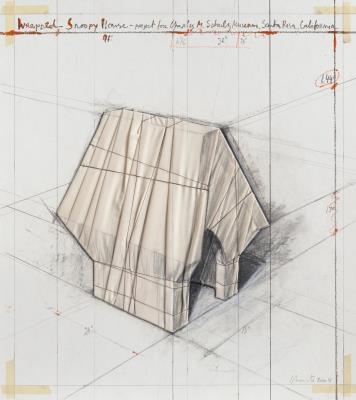
441. 克里斯托(Javacheff Christo,当代艺术I 高清作品[20%]

DO-Christo  (Javacheff Christo) - 现代艺术 I
图片文件像素:6353 x 5789 px

克里斯托(Javacheff Christo,当代艺术I-

Christo * (Javacheff Christo) - Zeitgenössische Kunst I-

(Gabrovo, Bulgaria 1935–2020 New York)
Wrapped Snoopy House (Collage), 2004, signed, dated Christo 2004, cloth, threads, charcoal, pencil, color crayon, paint and adhesive tape on cardboard, 61.2 x 55 cm,
framed under plexiglass

The wrapped Snoopy House is registered in the Christo and Jeanne-Claude Archives, New York.

We are grateful to Jonathan Henery, Christo and Jeanne-Claude Archives, New York, for his scientific support in cataloguing the work.

Provenance:
Studio of the artist
Collection of the printer and fabricator Jack Lemon, Chicago
Private collection, 德国y

Literature:
This work is the prototype for the multiple, published by Schulz Museum, Santa Rosa, California see: Matthias Koddenberg, Jörg Schellmann: Christo and Jeanne-Claude: Prints and Objects. Catalogue Raisonné, p. 213, no 188

Charles M. Schulz (1922-2000) was the cartoonist of the globally successful comic series \"Peanuts\". The 美国 author and illustrator portrayed 美国 suburban life from the perspective of a group of children in the daily comic strips, which ran for decades. Peanuts was special in that it combined pointed wit with philosophical reflection.

Most of the comic strips focus on the main characters Charlie Brown and his dog Snoopy. Snoopy, the white dog with the black floppy ears, is now considered an integral part of our popular culture.
Snoopy lives in a kennel in Charlie Brown\'s garden. There, the beagle spends most of his time lying lazily on the roof of his hut, the so-called Snoopy Dog House, pondering his philosophical thoughts while waiting for his next meal.

In 1975, Charles M. Schulz met the packaging artists Jeanne-Claude and Christo at a discussion group in Colorado. The cartoonist then paid tribute to the artist couple by creating a Peanuts comic strip in 1978 in which Christo wraps Snoopy‘s House in fabric. In the comic strip, Snoopy wonders what Christo will cover next and finds his house wrapped at the end of the sequence. Christo returned the cartoonist\'s compliment by turning the comic image into reality decades later, designing a life-size, three-dimensional doghouse for the Charles M. Schulz Museum and wrapping it in tarpaulin, polyethylene and rope.
The work offered here is an original collage with real fabric wrapping, created by Christo in 1994 as a prototype for the later multiple. The multiple is number 188 in the catalogue raisonné.
This original work came from the estate of printer Jack Lemon, who founded his life\'s work, the Landfall Press, in Chicago in 1970. Lemon and his team printed lithographs by Christo, Philip Pearlstein and Sol LeWitt, among others.

442. 蒙迪尼斯(DI LUZZI,MONDINO)。1275–1326. 阿纳托米娅·蒙迪尼由梅勒斯塔特医生修正。[莱比锡:马丁·兰茨贝格,1493年。] 高清作品[20%]

Anathomia Mundini emendata per doctorem melerstat. [Leipzig: Martin Landsberg, 1493.]

图片文件尺寸 : 5043 x 4532px

MUNDINUS (DI LUZZI, MONDINO). 1275–1326.:MELLERSTADT, MARTINUS, editor. c.1455-1513. Anathomia Mundini emendata per doctorem melerstat. [Leipzig: Martin Landsberg, 1493.]
4to (200 x 140 mm). 40 leaves, 34 lines, title with full-page woodcut of an anatomical scene. Modern calf antique. Inner margin of title neatly reinforced, tiny repair to blank outer margin of last leaf, illegible old library stamp to lower margin of title page, scattered light browning, mostly marginal.

FIRST ILLUSTRATED EDITION OF THE FIRST DEDICATED ANATOMY BOOK. \"The first modern book devoted solely to anatomy ... Mundinus re-introduced human dissection, which had been neglected for 1500 years before him; he was the most noted dissector of his period, and he set forth the medieval anatomical vocabulary, deriving it mainly from Arabic\" (Garrison). Mondino de\' Luzzi, professor at Bologna, is considered to be the founder of anatomy in the Middle Ages. His treatise remained popular until the beginning of the 16th-century and appeared in multiple editions.

\"The subject of anatomy was not taught either by lectures or by dissection in the universities at the middle of the fifteenth century. An occasional \'anatomy\' was held, but the neglect of the subject is well illustrated by the absence of anatomical books. There is only one in the list, that of Mundinus . . . Mundinus was a professor at Bologna from 1306 to 1326, and was the first to teach anatomy from the subject, usually the corpse of a condemned criminal; but there is the record of a procedure in 1319 against four medical students for body-snatching. His Anatomia, written in 1316, was for two hundred years the popular text book\" (Osler).

In the introduction of the book, Mundinus says, \"proposui meis scholaribus in medicina quoddam opus componere, \'I have proposed to compose a work in medicine for my scholars.\" The work \"met a need universally felt just at that time and commended itself for its brevity, conciseness, and completeness, as well as for the fact that it taught for each separate organ the necessary anatomic technique, as. for example, in the first chapter: \'Situato itaque corpore vel homine mortuo per decollationem vel suspensionem supino\', etc., \'accordingly, laying out the body of a man dead by decapitation or hanging, etc....\" (Choulant). VERY RARE: According to American Book Prices Current no copy sold in the past 42 years. Choulant-Frank History and Bibliography of Anatomic Illustration (Chicago 1920, pp 88-93); Garrison-Morton-Norman 361 (for the 1478 edition); Goff M-874; GW M-25671 (recording only 2 copies/fragments); Hain 11633; see Osler Incunabula Medica 156; Wellcome I, 4484.

蒙迪尼斯(DI LUZZI,MONDINO)。1275–1326. 阿纳托米娅·蒙迪尼由梅勒斯塔特医生修正。[莱比锡:马丁·兰茨贝格,1493年。]

443. 行政卡有限。 奥地利大公查尔斯在西班牙王位继承战争中塑造了自己的西班牙查理三世, 高清作品[19%]

Rare patent of nobility issued by Archduke Charles of Austria , fashioning himself Charles III of Spain during the War of the Spanish Succession ,

图片文件尺寸 : 4726 x 4820px

ILLUMINATED CARTA EXECUTORIA.:Rare patent of nobility issued by Archduke Charles of Austria (later Charles VI, Holy Roman Emperor), fashioning himself Charles III of Spain during the War of the Spanish Succession (1701–1714), conveying the title of Marquess of Callus (in Catalonia) upon Don Jaime Vicente Alamany Descallar, manuscript on vellum, text in Latin, 1711, 290 x 200 mm, 8 leaves bound as a single quire of 4 bifolia.
Collation: i8, the first leaf treated as a blank flyleaf. 22-26 long lines written in brown ink in italic script with one-line roman capitals; headings in larger capitals on ff. 2r-2v; written area: 215 x 125 mm. All text pages decorated with full borders containing delicate brown ink drawings. F. 2r with a cartouche depicting the king on a rearing horse firing a pistol, surmounted by a crown, below him a globe held by two putti and inscribed \"America\", below that the words NOS CAROLUS in a cartouche, all flanked by personifications of the church and the state and other motifs. On f. 2v the continuation of the text continues under a round seal stamped in in black ink, containing a coat of arms, and inscribed: CAROLUS III DEI GRATIA HISPANIARUM ET INDIARUM REX. Borders of ff. 2v-6v filled with vedute, vignettes, putti, cartouches, and various flourishes similar to those found in engraved writing-master books of the period. F. 7r with the last lines of the text and several notarial attestations. F. 7v blank. F. 8r with a large colored coat of arms surrounded by colored arabesque flourishes. F. 8v blank. Binding of later red velvet over pasteboards (worn) with remains of two monkeys-fist closures of woven silk, red silk doublures and single red silk flyleaves front and back, remains of a braided silk cord intended to attach the seal and a circular depression inside the back cover intended to hold the seal (seal missing).

RARE PATENT OF NOBILITY OF \"CHARLES III\" DURING HIS EMBATTLED CLAIM TO THE SPANISH THRONE. On the death of his Hapsburg relative King Charles II of Spain (1661-1700) without a direct heir, Archduke Charles of Austria declared himself the King of Spain, thus occasioning the War of the Spanish Succession, which pitted him against a rival candidate, Philip, Duke of Anjou, grandson of Louis XIV, and a distant cousin of the Archduke. In 1711, when his brother, the Holy Roman Emperor Joseph I, died the Archduke returned to Vienna to assume the imperial crown, while Philip was eventually recognized as King Philip V of Spain. During his brief time as claimant to the Spanish throne, Charles never extended his sphere of influence beyond Catalonia and lived there only from 1705 to 1711.

行政卡有限。 奥地利大公查尔斯在西班牙王位继承战争中塑造了自己的西班牙查理三世,

444. 纽伦堡编年史。 Liber chronicarum[德语:《克洛诺斯和故事书》]。纽伦堡:Anton Koberger代表Sebald Schreyer和Sebastian Kammermeister,1493年12月23日。 高清作品[18%]

Liber chronicarum  [in German: Das Buch der Croniken und Geschichten]. Nuremberg: Anton Koberger for Sebald Schreyer and Sebastian Kammermeister, 23 December 1493.

图片文件尺寸 : 4242 x 3809px

NUREMBERG CHRONICLE.:SCHEDEL, HARTMANN. 1440-1514. Liber chronicarum [in German: Das Buch der Croniken und Geschichten]. Nuremberg: Anton Koberger for Sebald Schreyer and Sebastian Kammermeister, 23 December 1493.
Imperial folio (472 x 325 mm). 297 leaves (of 298, without final blank). 59-64 lines and headline, table and parts of the text in two columns. Types: 24:111G (text), 9:165G (headlines), c. 1809 woodcut illustrations printed from 645 blocks by Michael Wolgemut, Wilhelm Pleydenwurff and their workshop, including Albrecht Dürer, comprising 29 double-page town views, 8 full-page woodcuts and double-page maps of the World [Shirley 19] and of Europe by Hieronymus Münzer after Nicolas Khrypffs. Contemporary Nuremberg pigskin over wooden boards, stained pink, ruled and stamped in blind, upper cover lettered in German: \"Cronica von anfang der welt\" [\"Chronical of the beginning of the world\"] brass clasps and catch-plates. Some minor marginal tears and occasional light staining, a few leaves (138-150) with repair to inner margins slightly affecting woodcuts or text, leaf 281 loose, spine ends neatly repaired.
Provenance: Georg Frauenlob Landt, gift inscription to Wolfgang Häberl, dated 18 August 1599 (first numbered leaf verso); Häberl, Wolfgang (*1553) from Berchtesgaden, Pastor of the parish church of St. Martin in Thalgau, and motto dated 1595 (inscription \"Sum ex libris Wolfgangi Häberl Berchtersgadiam / Ecclesiae parochialis S. Martini in Talgeio Pastoris. / Honesti cultor uirtute content. 1599\" on title page).

FIRST EDITION IN GERMAN of the Nuremberg Chronicle, printed in the same year as the Latin edition. The German and Latin editions were planned simultaneously, with the German edition of Georg Alt\'s translation appearing five months after the Latin edition. A TALL COPY of the most extensively illustrated book of the 15th century. The 29 large double-page city views, many illustrated for the first time, are accurate in depicting distinguished features of each city. In addition, it includes many details of 15th-century daily life: carpenters with their tools, astronomers and their instruments, a chess player, archers, bridges, derricks, dishes, furniture, windmills, ships, beds, houses, fortifications, weapons, tents, wharves, ferries, books, drawing materials, dogs, horses, and other animals, as well as costumes. Hartmann Schedel\'s Nuremberg Chronicle epitomizes \"the commercial sophistication, economic power and technical virtuosity that brought the art of print to this extraordinary climax\" (Pettegree). Reference: BMC II 437; BSB-Ink. S-197; Bod-Inc. S-110; Goff S-309; GW M40796; HC *14510; Pettegree, The Book in the Renaissance, New Haven, 2011 p. 42; Reske, The Production of Schedel\'s Nuremberg Chronicle Wiesbaden, 2000; Ellen Shaffer The Nuremberg Chronicle, Los Angeles, 1950; Wilson, The Making of the Nuremberg Chronicle Amsterdam, 1976.

纽伦堡编年史。 Liber chronicarum[德语:《克洛诺斯和故事书》]。纽伦堡:Anton Koberger代表Sebald Schreyer和Sebastian Kammermeister,1493年12月23日。

445. 西格马尔·波尔克,当代艺术I 高清作品[18%]

DO-Sigmar Polke  - 现代艺术 I
图片文件像素:4483 x 5098 px

西格马尔·波尔克,当代艺术I-

Sigmar Polke * - Zeitgenössische Kunst I-

(Oels/Niederschlesien 1942-2010 Cologne)
Untitled, 1994, on the reverse signed, dated twice S. Polke 94, natural resin and pigments (malachite, lapis lazuli and realgar) on canvas, 95 x 75 cm, framed

We are grateful to Michael Trier, Cologne, for his scientific advice in cataloguing this work.

Provenance:
Private Collection, North Rhine-Westphalia - directly from the artist
Van Ham Kunstauktionen, Cologne, 01 December 2021, lot 301 - acquired there by the present owner

Sigmar Polke has left us an extensive oeuvre, centred first and foremost on his irrepressible interest in colour. The production of colours was of great importance to the artist, who was often described as an alchemist, and he wanted to explore it from the bottom up. With the aid of the most modern techniques and motifs he was constantly searching for the origin of painting, sometimes also with a great deal of irony. Art ought to be an experiment with an open outcome, and he, the artist, ought to elicit the hidden beauty from the material world with his works.

Polke worked with the so-called \"Schüttbilder\" from the early 1970s on, colour samples and \"Probierbilder\", in which calculated chaos is elevated to a creative principle. Ten years later, Polke\'s painting showed a change \"that was much discussed in connection with the works for the exhibition Zeitgeist in 1982, for Documenta 7 in the same year and reached a climax in his contribution to the 德国 pavilion at the 42nd Venice Biennale (1986). Figuration recedes in favour of the more gestural and process-like use of colour, its lush or veil-like overlays and fusions.\"
(Katharina Schmidt, quoted from: Sigmar Polke – Zeichnungen, Aquarelle, Skizzenbücher 1962 – 1988, exh. cat., Kunstmuseum Bonn 1988, p. 194).

The 1994 work offered here is in the tradition of the colour samples of the 1970s and refers pictorially to the colour plates from 1992, which are in the Stedelijk Museum in Amsterdam. Its presentation is very painterly and overall reminiscent of the wall painting at the Venice Biennale (1986), for which Sigmar Polke was awarded the Golden Lion.

In the present work, the artist mixed a total of three dyes with natural resin and applied them to the canvas. In the lower area, the ultramarine blue of the dark blue semi-precious stone lapis lazuli dominates. Lapis lazuli is one of the oldest pigment stones of all and was already used as pigment in prehistoric Europe. For the upper part of the picture, Polke used the powdered pigment of the semi-precious stone malachite. The coarser the grain, the more intense the shade of colour. Malachite pigment was prized in antiquity as a cold green for wall paintings. It was used in panel paintings in the Renaissance. Next to green earths, malachite was the most important green pigment until the 18th century. On the left-hand side in the central area of the canvas, Polke painted an oval with the chemical pigment realgar. Realgar, also called ruby sulphur or ruby of arsenic, has a changing hue, which depends on the grind of the pigment. The darker shades are an orange-red, the lighter ones a yellow-orange, as seen in this painting. Although there are modern alternatives, Polke seems to have found processing the colours and pigments of the old masters with an awareness of modern times highly interesting.

446. 皮耶罗·多拉齐奥 高清作品[16%]

DO-Piero Dorazio  - 现代艺术 I
图片文件像素:5842 x 5474 px

皮耶罗·多拉齐奥-

Piero Dorazio * - Zeitgenössische Kunst I-

(Rome 1927–2005 Perugia)
Untitled [Contro il rassegnarsi], 1967, Signed, dated, dedicated and inscribed on the reverse, oil on canvas, 100 x 100, framed

This work is registered in the Archivio Piero Dorazio, Milan and is accompanied by a photo certificate of authenticity

Provenance:
V. Pirozzi Collection, Rome
Sale Farsetti, Prato, 27 May 2000, lot 303
Anfiteatro Arte, Milan
European Private Collection

Exhibited:
Milan, Galleria Anfiteatro Arte, 1999, exh. cat. p. 47 no. 15 with ill.
Genoa, Dorazio, Marco Canepa Arte Contemporanea, 2006, exh. cat. with ill.
Padua, Piero Dorazio, Anfiteatro Arte, 1 February – 18 March 2007, exh. cat. p. 74 and 75 with ill. (label on the reverse)


Literature:
M. Volpi Orandini, J. Lassaigne, G. Crisafi, Dorazio Catalogo ragionato delle opere, Alfieri Editore, 1977, no. 8 (in the addenda at the end of the catalogue)

The subject of the painting always drives from the previous painting, hence there is no reason for inspiration. One tries again, keeps on trying to do what he has already done…
Piero Dorazio

Of all the great first and second generation 美国 painters I have known since 1953 (the third generation is not yet discernable), Kenneth Noland is a truly singular case.

He is from North Carolina and Washington, i.e. the provinces, rather than the artistic milieu of New York.

[...]In the 1950s and 1960s I never understood whether some artistic circles in the Metropolis or certain isolated artists like Kenneth Noland and Morris Louis, Georgia O\'Keeffe in New Mexico or Andrew Wyeth in Pennsylvania were more provincial. Although isolated, Louis and Noland were already the most modern of modern 美国 painters in the early 1960s. They were a surprising revelation when discovered and presented by the critic Clement Greenberg at the 法国 and Co. Gallery in New York. Their exhibitions in that gallery between \'59 and \'60 remain by far the most exciting of the decade.

Kenneth Noland\'s painting has nothing to do, therefore, with all the clichés of 美国 painting disseminated here by European critics who have framed all expressions into schools or categories or groups (Action Painting, New Dada, Abstract expressionism, Pop Art, Minimal Art etc.) letting what were actually the most creative values and personalities slip through their fingers. [...]

Ken Noland established himself, from the late 1960s and 1970s, among those few artists defined as \'Colour field painters\' or \'Post Painterly Abstraction\' not as a group but rather as a trend: Helen Frankenhaler, Morris Louis, Jules Olitsky, Friedel Dzubas, Larry Poons. There was a convergence of interests among these painters for colour as an element that defines large spaces and long periods of time for the observer, who is induced to meditate because he is immersed in the rhythm of the lines and chromatic masses of a truly abstract painting, devoid of any allusion or reference to the real, the metaphysical or the subjective temperament. Painting that refers on the one hand to the decorative character of early Matisse, and on the other to the secular spirit of Constructivism. Among those painters, Noland was always the one who, with tenacity and clarity of purpose, was best able to sublimate \'pure visibility\' into a highly lyrical personal poetics. His nature as a colourist and his technique inspired his constant formal research into surface-colour and material-colour relationships. [...]

In these works chromatic fantasy and refined sensitivity, arranged in a precise structural order, bring the brushstrokes and pictorial matter to life in decisive and delicate spaces and lights and rhythms, expressing a constant reflection on the inevitable characteristics of reality. Constancy and appearance, the negative and the positive, fullness and emptiness; our gaze is entertained and delighted by this repertoire of perception, emotion and mind.

(Piero Dorazio, Il singolare caso di Kenenth Noland, in “Rigando dritto. Piero Dorazio Scritti 1945-2004, pp. 425-427)

447. 哈莱姆文艺复兴艺术家大全 – 哈莱姆文艺复兴都有哪些画家? 高清作品[12%]

 
20 年代初至 1930 年代
哈莱姆文艺复兴是非裔美国人社会思想的繁荣,它通过视觉艺术、音乐(路易斯·阿姆斯特朗、尤比·布莱克、法茨·沃勒和比莉·哈乐黛)、文学(兰斯顿·休斯、佐拉·尼尔·赫斯顿和 WEB)表现出来DuBois)、戏剧 (Paul Robeson) 和舞蹈 (Josephine Baker)。以纽约市哈莱姆区为中心的新黑人运动(当时的称呼)在美国乃至全世界产生了深远的影响。 那个时代的知识和社会自由吸引了许多美国黑人,从南方的农村来到北方的工业中心——尤其是纽约市。 哈莱姆文艺复兴运动的核心艺术家包括William H. JohnsonLois Mailou Jones和雕塑家兼版画家Sargent Claude Johnson。与哈莱姆文艺复兴有关的其他著名艺术家包括雅各布·劳伦斯阿奇博尔德·莫特利罗马尔·比尔登。 后来受该运动影响的艺术家包括Charles SebreeHale WoodruffBeauford DelaneyJohn BiggersErnie Barnes(Barnes 的Sugar Shack是电视节目Good Times片尾的著名画作)。 下面列出了与哈莱姆文艺复兴密切相关的艺术家。或者单击此处查看我们数据库中所有非裔美国艺术家的列表
哈莱姆文艺复兴时期艺术家的时间列表
使用ctrl-F (PC) 或command-F (Mac) 搜索姓名

梅塔·沃里克·富勒 1877-1968 非裔美国雕塑家
詹姆斯范德泽 1886-1983 非裔美国摄影师
中士克劳德约翰逊 1887-1967 非裔美国雕塑家
帕默·海登 1890-1973 非裔美国画家
阿奇博尔德·莫特利 1891-1981 非裔美国画家
奥古斯塔萨维奇 1892-1962 非裔美国雕塑家
Dox 痛击 1893-1965 非裔美国版画家
亚伦·道格拉斯 1899-1979 非裔美国画家
里士满巴特 1901-1989 非裔美国雕塑家
威廉·约翰逊 1901-1970 非裔美国画家
路易斯·梅卢·琼斯 1905-1998 非裔美国画家
查尔斯·阿尔斯通 1907-1977 非裔美国画家/雕塑家
艾伦·罗汉·克里特 1910-2007 非裔美国画家
罗曼比尔登 1911-1988 非裔美国画家
雅各布·劳伦斯 1917-2000 非裔美国画家
Martin Luther King Jr. - Mountain Top
 

448. 多斯托耶夫斯基的名片上写着亚历山大·赫尔岑。 照片署名并题写(俄语)给亚历山大·赫尔岑, 高清作品[11%]

Photograph signed and inscribed [in Russian] to Alexander Herzen,

图片文件尺寸 : 3981 x 5780px

DOSTOEVSKY CARTE-DE-VISITE INSCRIBED TO ALEXANDER HERZEN.:DOSTOEVSKY, FYODOR. 1821-1881. Photograph signed and inscribed [in Russian] to Alexander Herzen, albumen print carte-de-visite full length portrait by M.B. Tulinov, Petersburg, 1861, 105 x 65 mm, inscribed by Dostoevsky in Russian to the verso, \"Alexander Ivanovich Herzen in memory of our meeting in London. Fyodor Dostoyevsky 8 July/20 July 1862,\" minor stain to verso.
Provenance: Alexander Ivanovich Herzen; to daughter Olga Aleksandrovna [Herzen] Monod; by descent.
Publication: For a discussion of the photograph, see Volgin, Igor. \"Introduction\" to The Dostoevsky Archive (1997), p 21.

Pull quote: \"Herzen awaits his readers in the future. Far above the heads of the present crowd, he transmits his thoughts to those who will be able to comprehend them.\" – Leo Tolstoy, 1905.

VERY RARE CARTE DE VISITE PHOTOGRAPH OF FYODOR DOSTOEVSKY PRESENTED TO ALEXANDER HERZEN IN REMEMBRANCE OF THEIR 1862 MEETING IN LONDON: A TREMENDOUSLY IMPORTANT ASSOCIATION BETWEEN TWO OF THE LEADING INTELLECTUALS OF THE 19TH-CENTURY.

Alexander Herzen was one of the most important and influential Russian writers and thinkers of the 19th-century. called the \"father of Russian socialism,\" he had a profound influence on late-19th century Russian writers, including Fyodor Dostoevsky. Born illegitimately to a wealthy Russian landowner, Herzen became a dissident and critic of the Russian feudal system. Of Herzen, Tolstoy said he had never met a man \"with so rare a combination of scintillating brilliance and depth.\" His writings, including From the Other Shore (1848) and those appearing in his influential publications of the 1850s-60s The Bell and the Polestar, would help mold a generation of Russian writing and thought.

Herzen and Dostoevsky met for the first time in Russia in 1846, following Dostoevsky\'s comment in a letter to his brother that Herzen and Goncharov stand as \"the most remarkable\" of his rivals; Herzen\'s recollection of the meeting was less than effusive, however: \"I can\'t say he made a particularly present impression.\" Their second meeting occurred when Dostoevsky visited Herzen in London in July of 1862, of which this photograph is a memento. During the 1850s and early 1860s, visits to the emigree Herzen by Russian writers and intellectuals were something of a right of passage, and Dostoevsky\'s visit followed right on the heels of Turgenev. This series of meetings profoundly affected Dostoevsky and his work, and is clearly acknowledged in his Winter Notes which he wrote later that year, exhibiting a clear debt to Herzen\'s own writings. Dostoevsky, along with Solzhenitsyn, acknowledged the formative influence of Herzen on his work, and Herzen would also appear in composite in a number of Dostoevsky\'s characters throughout his career. Herzen, however, noted, rather condescendingly, \"Dostoevsky was here yesterday—he is a naïve, not entirely lucid, but a very dear person. He believes enthusiastically in the Russian people.\"

The two towering figures would meet again on a steamship from Naples to Livorno the following year, where Dostoevsky was travelling with his mistress Polina Suslova. According to Suslova\'s diaries (as published in The Dostoevsky Archives), Dostoevsky took pains to hide their relationship from Herzen, introducing her vaguely as a family member, and even encouraged her to arrange a visit with Herzen\'s son in Paris that Winter. After they parted, Dostoevsky became angry with her over a photograph of her he had seen at Herzen\'s, which she had given at an earlier date. In 1865, Dostoevsky wrote to Herzen imploring him for a loan, and became peevish when Herzen did not immediately respond. By the late 1860s Dostoevsky would disparage Herzen, somewhat unfairly, as a \"Westernizer,\" leading to his more severe criticism of Herzen in his Writer\'s Diary.

Herzen was one of the most complex and brilliant figures of the 19th-century, and was largely responsible for assimilating western ideas into Russian thought, while still maintaining his advocacy for the freedom of the Russian serf.

In reality, the two writers/thinkers shared a great deal in their outlook: both asserted the importance of the individual, and the folly of the search for a unified teleological system, cutting against the grain of their mid-19th century contemporaries. While Herzen was embraced by Lenin, identified as the \"father of Russian socialism,\" Herzen\'s socialism was a different breed, \"Centralization may do a great deal for order and for various public undertakings, but it is incompatible with freedom. It easily brings a nation to the position of a well-tended flock or a pack of hounds cleverly kept in order by a huntsman.\" Lenin regarded Herzen\'s focus on freedom as a shortcoming of his bourgeois roots. During the 20th-century Russian-British philosopher Isaiah Berlin came across Herzen\'s writings and recognized the prescience of Herzen\'s thought. It was Berlin, who reestablished Herzen\'s influence, agreeing with and amplifying his idea that the pursuit of \"a perfect society\" invariably leads to blood.

The present photograph was taken by Mikhail Borisovich Tulinov (1823–1889) in Petersburg in 1861. Any period photograph of Dostoevsky is rare, and moreso inscribed. We trace two inscribed photographs at auction in the last 40 years. However, we find no record of an inscribed photograph of similar substance and importance in the historical record. An incredible, and incredibly rare, Dostoevsky item tying together two of the greatest thinkers and writers of the 19th-century.

REFERENCES:
Kelly, Aileen. The Discovery of Chance: The Life and Thought of Alexander Herzen. 2016.
Kelly, Aileen. \"Irony and Utopia in Herzen and Dostoevsky: From the Other Shore and Diary of a Writer.\" The Russian Review, 50:4 (1991), pp 397-416.
Lantz, Kenneth. The Dostoevsky Encycolpedia. 2004.
Serakin, Peter. The Dostoevsky Archive: Firsthand Accounts of the Novelist from Contemporaries\' Memoirs and Rare Periodicals. 1997.


\"If only people wanted to save themselves instead of saving the world, how much they would do for the salvation of the world and the liberation of humanity!\" – Alexander Herzen, From the Other Shore, 1848.

多斯托耶夫斯基的名片上写着亚历山大·赫尔岑。 照片署名并题写(俄语)给亚历山大·赫尔岑,

time油画图片- 高清time绘画作品- 代表作全集 中艺名画下载


441. 克里斯托(Javacheff Christo,当代艺术I 高清作品[20%]

DO-Christo  (Javacheff Christo) - 现代艺术 I
图片文件像素:6353 x 5789 px

克里斯托(Javacheff Christo,当代艺术I-

Christo * (Javacheff Christo) - Zeitgenössische Kunst I-

(Gabrovo, Bulgaria 1935–2020 New York)
Wrapped Snoopy House (Collage), 2004, signed, dated Christo 2004, cloth, threads, charcoal, pencil, color crayon, paint and adhesive tape on cardboard, 61.2 x 55 cm,
framed under plexiglass

The wrapped Snoopy House is registered in the Christo and Jeanne-Claude Archives, New York.

We are grateful to Jonathan Henery, Christo and Jeanne-Claude Archives, New York, for his scientific support in cataloguing the work.

Provenance:
Studio of the artist
Collection of the printer and fabricator Jack Lemon, Chicago
Private collection, 德国y

Literature:
This work is the prototype for the multiple, published by Schulz Museum, Santa Rosa, California see: Matthias Koddenberg, Jörg Schellmann: Christo and Jeanne-Claude: Prints and Objects. Catalogue Raisonné, p. 213, no 188

Charles M. Schulz (1922-2000) was the cartoonist of the globally successful comic series \"Peanuts\". The 美国 author and illustrator portrayed 美国 suburban life from the perspective of a group of children in the daily comic strips, which ran for decades. Peanuts was special in that it combined pointed wit with philosophical reflection.

Most of the comic strips focus on the main characters Charlie Brown and his dog Snoopy. Snoopy, the white dog with the black floppy ears, is now considered an integral part of our popular culture.
Snoopy lives in a kennel in Charlie Brown\'s garden. There, the beagle spends most of his time lying lazily on the roof of his hut, the so-called Snoopy Dog House, pondering his philosophical thoughts while waiting for his next meal.

In 1975, Charles M. Schulz met the packaging artists Jeanne-Claude and Christo at a discussion group in Colorado. The cartoonist then paid tribute to the artist couple by creating a Peanuts comic strip in 1978 in which Christo wraps Snoopy‘s House in fabric. In the comic strip, Snoopy wonders what Christo will cover next and finds his house wrapped at the end of the sequence. Christo returned the cartoonist\'s compliment by turning the comic image into reality decades later, designing a life-size, three-dimensional doghouse for the Charles M. Schulz Museum and wrapping it in tarpaulin, polyethylene and rope.
The work offered here is an original collage with real fabric wrapping, created by Christo in 1994 as a prototype for the later multiple. The multiple is number 188 in the catalogue raisonné.
This original work came from the estate of printer Jack Lemon, who founded his life\'s work, the Landfall Press, in Chicago in 1970. Lemon and his team printed lithographs by Christo, Philip Pearlstein and Sol LeWitt, among others.

442. 蒙迪尼斯(DI LUZZI,MONDINO)。1275–1326. 阿纳托米娅·蒙迪尼由梅勒斯塔特医生修正。[莱比锡:马丁·兰茨贝格,1493年。] 高清作品[20%]

Anathomia Mundini emendata per doctorem melerstat. [Leipzig: Martin Landsberg, 1493.]

图片文件尺寸 : 5043 x 4532px

MUNDINUS (DI LUZZI, MONDINO). 1275–1326.:MELLERSTADT, MARTINUS, editor. c.1455-1513. Anathomia Mundini emendata per doctorem melerstat. [Leipzig: Martin Landsberg, 1493.]
4to (200 x 140 mm). 40 leaves, 34 lines, title with full-page woodcut of an anatomical scene. Modern calf antique. Inner margin of title neatly reinforced, tiny repair to blank outer margin of last leaf, illegible old library stamp to lower margin of title page, scattered light browning, mostly marginal.

FIRST ILLUSTRATED EDITION OF THE FIRST DEDICATED ANATOMY BOOK. \"The first modern book devoted solely to anatomy ... Mundinus re-introduced human dissection, which had been neglected for 1500 years before him; he was the most noted dissector of his period, and he set forth the medieval anatomical vocabulary, deriving it mainly from Arabic\" (Garrison). Mondino de\' Luzzi, professor at Bologna, is considered to be the founder of anatomy in the Middle Ages. His treatise remained popular until the beginning of the 16th-century and appeared in multiple editions.

\"The subject of anatomy was not taught either by lectures or by dissection in the universities at the middle of the fifteenth century. An occasional \'anatomy\' was held, but the neglect of the subject is well illustrated by the absence of anatomical books. There is only one in the list, that of Mundinus . . . Mundinus was a professor at Bologna from 1306 to 1326, and was the first to teach anatomy from the subject, usually the corpse of a condemned criminal; but there is the record of a procedure in 1319 against four medical students for body-snatching. His Anatomia, written in 1316, was for two hundred years the popular text book\" (Osler).

In the introduction of the book, Mundinus says, \"proposui meis scholaribus in medicina quoddam opus componere, \'I have proposed to compose a work in medicine for my scholars.\" The work \"met a need universally felt just at that time and commended itself for its brevity, conciseness, and completeness, as well as for the fact that it taught for each separate organ the necessary anatomic technique, as. for example, in the first chapter: \'Situato itaque corpore vel homine mortuo per decollationem vel suspensionem supino\', etc., \'accordingly, laying out the body of a man dead by decapitation or hanging, etc....\" (Choulant). VERY RARE: According to American Book Prices Current no copy sold in the past 42 years. Choulant-Frank History and Bibliography of Anatomic Illustration (Chicago 1920, pp 88-93); Garrison-Morton-Norman 361 (for the 1478 edition); Goff M-874; GW M-25671 (recording only 2 copies/fragments); Hain 11633; see Osler Incunabula Medica 156; Wellcome I, 4484.

蒙迪尼斯(DI LUZZI,MONDINO)。1275–1326. 阿纳托米娅·蒙迪尼由梅勒斯塔特医生修正。[莱比锡:马丁·兰茨贝格,1493年。]

443. 行政卡有限。 奥地利大公查尔斯在西班牙王位继承战争中塑造了自己的西班牙查理三世, 高清作品[19%]

Rare patent of nobility issued by Archduke Charles of Austria , fashioning himself Charles III of Spain during the War of the Spanish Succession ,

图片文件尺寸 : 4726 x 4820px

ILLUMINATED CARTA EXECUTORIA.:Rare patent of nobility issued by Archduke Charles of Austria (later Charles VI, Holy Roman Emperor), fashioning himself Charles III of Spain during the War of the Spanish Succession (1701–1714), conveying the title of Marquess of Callus (in Catalonia) upon Don Jaime Vicente Alamany Descallar, manuscript on vellum, text in Latin, 1711, 290 x 200 mm, 8 leaves bound as a single quire of 4 bifolia.
Collation: i8, the first leaf treated as a blank flyleaf. 22-26 long lines written in brown ink in italic script with one-line roman capitals; headings in larger capitals on ff. 2r-2v; written area: 215 x 125 mm. All text pages decorated with full borders containing delicate brown ink drawings. F. 2r with a cartouche depicting the king on a rearing horse firing a pistol, surmounted by a crown, below him a globe held by two putti and inscribed \"America\", below that the words NOS CAROLUS in a cartouche, all flanked by personifications of the church and the state and other motifs. On f. 2v the continuation of the text continues under a round seal stamped in in black ink, containing a coat of arms, and inscribed: CAROLUS III DEI GRATIA HISPANIARUM ET INDIARUM REX. Borders of ff. 2v-6v filled with vedute, vignettes, putti, cartouches, and various flourishes similar to those found in engraved writing-master books of the period. F. 7r with the last lines of the text and several notarial attestations. F. 7v blank. F. 8r with a large colored coat of arms surrounded by colored arabesque flourishes. F. 8v blank. Binding of later red velvet over pasteboards (worn) with remains of two monkeys-fist closures of woven silk, red silk doublures and single red silk flyleaves front and back, remains of a braided silk cord intended to attach the seal and a circular depression inside the back cover intended to hold the seal (seal missing).

RARE PATENT OF NOBILITY OF \"CHARLES III\" DURING HIS EMBATTLED CLAIM TO THE SPANISH THRONE. On the death of his Hapsburg relative King Charles II of Spain (1661-1700) without a direct heir, Archduke Charles of Austria declared himself the King of Spain, thus occasioning the War of the Spanish Succession, which pitted him against a rival candidate, Philip, Duke of Anjou, grandson of Louis XIV, and a distant cousin of the Archduke. In 1711, when his brother, the Holy Roman Emperor Joseph I, died the Archduke returned to Vienna to assume the imperial crown, while Philip was eventually recognized as King Philip V of Spain. During his brief time as claimant to the Spanish throne, Charles never extended his sphere of influence beyond Catalonia and lived there only from 1705 to 1711.

行政卡有限。 奥地利大公查尔斯在西班牙王位继承战争中塑造了自己的西班牙查理三世,

444. 纽伦堡编年史。 Liber chronicarum[德语:《克洛诺斯和故事书》]。纽伦堡:Anton Koberger代表Sebald Schreyer和Sebastian Kammermeister,1493年12月23日。 高清作品[18%]

Liber chronicarum  [in German: Das Buch der Croniken und Geschichten]. Nuremberg: Anton Koberger for Sebald Schreyer and Sebastian Kammermeister, 23 December 1493.

图片文件尺寸 : 4242 x 3809px

NUREMBERG CHRONICLE.:SCHEDEL, HARTMANN. 1440-1514. Liber chronicarum [in German: Das Buch der Croniken und Geschichten]. Nuremberg: Anton Koberger for Sebald Schreyer and Sebastian Kammermeister, 23 December 1493.
Imperial folio (472 x 325 mm). 297 leaves (of 298, without final blank). 59-64 lines and headline, table and parts of the text in two columns. Types: 24:111G (text), 9:165G (headlines), c. 1809 woodcut illustrations printed from 645 blocks by Michael Wolgemut, Wilhelm Pleydenwurff and their workshop, including Albrecht Dürer, comprising 29 double-page town views, 8 full-page woodcuts and double-page maps of the World [Shirley 19] and of Europe by Hieronymus Münzer after Nicolas Khrypffs. Contemporary Nuremberg pigskin over wooden boards, stained pink, ruled and stamped in blind, upper cover lettered in German: \"Cronica von anfang der welt\" [\"Chronical of the beginning of the world\"] brass clasps and catch-plates. Some minor marginal tears and occasional light staining, a few leaves (138-150) with repair to inner margins slightly affecting woodcuts or text, leaf 281 loose, spine ends neatly repaired.
Provenance: Georg Frauenlob Landt, gift inscription to Wolfgang Häberl, dated 18 August 1599 (first numbered leaf verso); Häberl, Wolfgang (*1553) from Berchtesgaden, Pastor of the parish church of St. Martin in Thalgau, and motto dated 1595 (inscription \"Sum ex libris Wolfgangi Häberl Berchtersgadiam / Ecclesiae parochialis S. Martini in Talgeio Pastoris. / Honesti cultor uirtute content. 1599\" on title page).

FIRST EDITION IN GERMAN of the Nuremberg Chronicle, printed in the same year as the Latin edition. The German and Latin editions were planned simultaneously, with the German edition of Georg Alt\'s translation appearing five months after the Latin edition. A TALL COPY of the most extensively illustrated book of the 15th century. The 29 large double-page city views, many illustrated for the first time, are accurate in depicting distinguished features of each city. In addition, it includes many details of 15th-century daily life: carpenters with their tools, astronomers and their instruments, a chess player, archers, bridges, derricks, dishes, furniture, windmills, ships, beds, houses, fortifications, weapons, tents, wharves, ferries, books, drawing materials, dogs, horses, and other animals, as well as costumes. Hartmann Schedel\'s Nuremberg Chronicle epitomizes \"the commercial sophistication, economic power and technical virtuosity that brought the art of print to this extraordinary climax\" (Pettegree). Reference: BMC II 437; BSB-Ink. S-197; Bod-Inc. S-110; Goff S-309; GW M40796; HC *14510; Pettegree, The Book in the Renaissance, New Haven, 2011 p. 42; Reske, The Production of Schedel\'s Nuremberg Chronicle Wiesbaden, 2000; Ellen Shaffer The Nuremberg Chronicle, Los Angeles, 1950; Wilson, The Making of the Nuremberg Chronicle Amsterdam, 1976.

纽伦堡编年史。 Liber chronicarum[德语:《克洛诺斯和故事书》]。纽伦堡:Anton Koberger代表Sebald Schreyer和Sebastian Kammermeister,1493年12月23日。

445. 西格马尔·波尔克,当代艺术I 高清作品[18%]

DO-Sigmar Polke  - 现代艺术 I
图片文件像素:4483 x 5098 px

西格马尔·波尔克,当代艺术I-

Sigmar Polke * - Zeitgenössische Kunst I-

(Oels/Niederschlesien 1942-2010 Cologne)
Untitled, 1994, on the reverse signed, dated twice S. Polke 94, natural resin and pigments (malachite, lapis lazuli and realgar) on canvas, 95 x 75 cm, framed

We are grateful to Michael Trier, Cologne, for his scientific advice in cataloguing this work.

Provenance:
Private Collection, North Rhine-Westphalia - directly from the artist
Van Ham Kunstauktionen, Cologne, 01 December 2021, lot 301 - acquired there by the present owner

Sigmar Polke has left us an extensive oeuvre, centred first and foremost on his irrepressible interest in colour. The production of colours was of great importance to the artist, who was often described as an alchemist, and he wanted to explore it from the bottom up. With the aid of the most modern techniques and motifs he was constantly searching for the origin of painting, sometimes also with a great deal of irony. Art ought to be an experiment with an open outcome, and he, the artist, ought to elicit the hidden beauty from the material world with his works.

Polke worked with the so-called \"Schüttbilder\" from the early 1970s on, colour samples and \"Probierbilder\", in which calculated chaos is elevated to a creative principle. Ten years later, Polke\'s painting showed a change \"that was much discussed in connection with the works for the exhibition Zeitgeist in 1982, for Documenta 7 in the same year and reached a climax in his contribution to the 德国 pavilion at the 42nd Venice Biennale (1986). Figuration recedes in favour of the more gestural and process-like use of colour, its lush or veil-like overlays and fusions.\"
(Katharina Schmidt, quoted from: Sigmar Polke – Zeichnungen, Aquarelle, Skizzenbücher 1962 – 1988, exh. cat., Kunstmuseum Bonn 1988, p. 194).

The 1994 work offered here is in the tradition of the colour samples of the 1970s and refers pictorially to the colour plates from 1992, which are in the Stedelijk Museum in Amsterdam. Its presentation is very painterly and overall reminiscent of the wall painting at the Venice Biennale (1986), for which Sigmar Polke was awarded the Golden Lion.

In the present work, the artist mixed a total of three dyes with natural resin and applied them to the canvas. In the lower area, the ultramarine blue of the dark blue semi-precious stone lapis lazuli dominates. Lapis lazuli is one of the oldest pigment stones of all and was already used as pigment in prehistoric Europe. For the upper part of the picture, Polke used the powdered pigment of the semi-precious stone malachite. The coarser the grain, the more intense the shade of colour. Malachite pigment was prized in antiquity as a cold green for wall paintings. It was used in panel paintings in the Renaissance. Next to green earths, malachite was the most important green pigment until the 18th century. On the left-hand side in the central area of the canvas, Polke painted an oval with the chemical pigment realgar. Realgar, also called ruby sulphur or ruby of arsenic, has a changing hue, which depends on the grind of the pigment. The darker shades are an orange-red, the lighter ones a yellow-orange, as seen in this painting. Although there are modern alternatives, Polke seems to have found processing the colours and pigments of the old masters with an awareness of modern times highly interesting.

446. 皮耶罗·多拉齐奥 高清作品[16%]

DO-Piero Dorazio  - 现代艺术 I
图片文件像素:5842 x 5474 px

皮耶罗·多拉齐奥-

Piero Dorazio * - Zeitgenössische Kunst I-

(Rome 1927–2005 Perugia)
Untitled [Contro il rassegnarsi], 1967, Signed, dated, dedicated and inscribed on the reverse, oil on canvas, 100 x 100, framed

This work is registered in the Archivio Piero Dorazio, Milan and is accompanied by a photo certificate of authenticity

Provenance:
V. Pirozzi Collection, Rome
Sale Farsetti, Prato, 27 May 2000, lot 303
Anfiteatro Arte, Milan
European Private Collection

Exhibited:
Milan, Galleria Anfiteatro Arte, 1999, exh. cat. p. 47 no. 15 with ill.
Genoa, Dorazio, Marco Canepa Arte Contemporanea, 2006, exh. cat. with ill.
Padua, Piero Dorazio, Anfiteatro Arte, 1 February – 18 March 2007, exh. cat. p. 74 and 75 with ill. (label on the reverse)


Literature:
M. Volpi Orandini, J. Lassaigne, G. Crisafi, Dorazio Catalogo ragionato delle opere, Alfieri Editore, 1977, no. 8 (in the addenda at the end of the catalogue)

The subject of the painting always drives from the previous painting, hence there is no reason for inspiration. One tries again, keeps on trying to do what he has already done…
Piero Dorazio

Of all the great first and second generation 美国 painters I have known since 1953 (the third generation is not yet discernable), Kenneth Noland is a truly singular case.

He is from North Carolina and Washington, i.e. the provinces, rather than the artistic milieu of New York.

[...]In the 1950s and 1960s I never understood whether some artistic circles in the Metropolis or certain isolated artists like Kenneth Noland and Morris Louis, Georgia O\'Keeffe in New Mexico or Andrew Wyeth in Pennsylvania were more provincial. Although isolated, Louis and Noland were already the most modern of modern 美国 painters in the early 1960s. They were a surprising revelation when discovered and presented by the critic Clement Greenberg at the 法国 and Co. Gallery in New York. Their exhibitions in that gallery between \'59 and \'60 remain by far the most exciting of the decade.

Kenneth Noland\'s painting has nothing to do, therefore, with all the clichés of 美国 painting disseminated here by European critics who have framed all expressions into schools or categories or groups (Action Painting, New Dada, Abstract expressionism, Pop Art, Minimal Art etc.) letting what were actually the most creative values and personalities slip through their fingers. [...]

Ken Noland established himself, from the late 1960s and 1970s, among those few artists defined as \'Colour field painters\' or \'Post Painterly Abstraction\' not as a group but rather as a trend: Helen Frankenhaler, Morris Louis, Jules Olitsky, Friedel Dzubas, Larry Poons. There was a convergence of interests among these painters for colour as an element that defines large spaces and long periods of time for the observer, who is induced to meditate because he is immersed in the rhythm of the lines and chromatic masses of a truly abstract painting, devoid of any allusion or reference to the real, the metaphysical or the subjective temperament. Painting that refers on the one hand to the decorative character of early Matisse, and on the other to the secular spirit of Constructivism. Among those painters, Noland was always the one who, with tenacity and clarity of purpose, was best able to sublimate \'pure visibility\' into a highly lyrical personal poetics. His nature as a colourist and his technique inspired his constant formal research into surface-colour and material-colour relationships. [...]

In these works chromatic fantasy and refined sensitivity, arranged in a precise structural order, bring the brushstrokes and pictorial matter to life in decisive and delicate spaces and lights and rhythms, expressing a constant reflection on the inevitable characteristics of reality. Constancy and appearance, the negative and the positive, fullness and emptiness; our gaze is entertained and delighted by this repertoire of perception, emotion and mind.

(Piero Dorazio, Il singolare caso di Kenenth Noland, in “Rigando dritto. Piero Dorazio Scritti 1945-2004, pp. 425-427)

447. 哈莱姆文艺复兴艺术家大全 – 哈莱姆文艺复兴都有哪些画家? 高清作品[12%]

 
20 年代初至 1930 年代
哈莱姆文艺复兴是非裔美国人社会思想的繁荣,它通过视觉艺术、音乐(路易斯·阿姆斯特朗、尤比·布莱克、法茨·沃勒和比莉·哈乐黛)、文学(兰斯顿·休斯、佐拉·尼尔·赫斯顿和 WEB)表现出来DuBois)、戏剧 (Paul Robeson) 和舞蹈 (Josephine Baker)。以纽约市哈莱姆区为中心的新黑人运动(当时的称呼)在美国乃至全世界产生了深远的影响。 那个时代的知识和社会自由吸引了许多美国黑人,从南方的农村来到北方的工业中心——尤其是纽约市。 哈莱姆文艺复兴运动的核心艺术家包括William H. JohnsonLois Mailou Jones和雕塑家兼版画家Sargent Claude Johnson。与哈莱姆文艺复兴有关的其他著名艺术家包括雅各布·劳伦斯阿奇博尔德·莫特利罗马尔·比尔登。 后来受该运动影响的艺术家包括Charles SebreeHale WoodruffBeauford DelaneyJohn BiggersErnie Barnes(Barnes 的Sugar Shack是电视节目Good Times片尾的著名画作)。 下面列出了与哈莱姆文艺复兴密切相关的艺术家。或者单击此处查看我们数据库中所有非裔美国艺术家的列表
哈莱姆文艺复兴时期艺术家的时间列表
使用ctrl-F (PC) 或command-F (Mac) 搜索姓名

梅塔·沃里克·富勒 1877-1968 非裔美国雕塑家
詹姆斯范德泽 1886-1983 非裔美国摄影师
中士克劳德约翰逊 1887-1967 非裔美国雕塑家
帕默·海登 1890-1973 非裔美国画家
阿奇博尔德·莫特利 1891-1981 非裔美国画家
奥古斯塔萨维奇 1892-1962 非裔美国雕塑家
Dox 痛击 1893-1965 非裔美国版画家
亚伦·道格拉斯 1899-1979 非裔美国画家
里士满巴特 1901-1989 非裔美国雕塑家
威廉·约翰逊 1901-1970 非裔美国画家
路易斯·梅卢·琼斯 1905-1998 非裔美国画家
查尔斯·阿尔斯通 1907-1977 非裔美国画家/雕塑家
艾伦·罗汉·克里特 1910-2007 非裔美国画家
罗曼比尔登 1911-1988 非裔美国画家
雅各布·劳伦斯 1917-2000 非裔美国画家
Martin Luther King Jr. - Mountain Top
 

448. 多斯托耶夫斯基的名片上写着亚历山大·赫尔岑。 照片署名并题写(俄语)给亚历山大·赫尔岑, 高清作品[11%]

Photograph signed and inscribed [in Russian] to Alexander Herzen,

图片文件尺寸 : 3981 x 5780px

DOSTOEVSKY CARTE-DE-VISITE INSCRIBED TO ALEXANDER HERZEN.:DOSTOEVSKY, FYODOR. 1821-1881. Photograph signed and inscribed [in Russian] to Alexander Herzen, albumen print carte-de-visite full length portrait by M.B. Tulinov, Petersburg, 1861, 105 x 65 mm, inscribed by Dostoevsky in Russian to the verso, \"Alexander Ivanovich Herzen in memory of our meeting in London. Fyodor Dostoyevsky 8 July/20 July 1862,\" minor stain to verso.
Provenance: Alexander Ivanovich Herzen; to daughter Olga Aleksandrovna [Herzen] Monod; by descent.
Publication: For a discussion of the photograph, see Volgin, Igor. \"Introduction\" to The Dostoevsky Archive (1997), p 21.

Pull quote: \"Herzen awaits his readers in the future. Far above the heads of the present crowd, he transmits his thoughts to those who will be able to comprehend them.\" – Leo Tolstoy, 1905.

VERY RARE CARTE DE VISITE PHOTOGRAPH OF FYODOR DOSTOEVSKY PRESENTED TO ALEXANDER HERZEN IN REMEMBRANCE OF THEIR 1862 MEETING IN LONDON: A TREMENDOUSLY IMPORTANT ASSOCIATION BETWEEN TWO OF THE LEADING INTELLECTUALS OF THE 19TH-CENTURY.

Alexander Herzen was one of the most important and influential Russian writers and thinkers of the 19th-century. called the \"father of Russian socialism,\" he had a profound influence on late-19th century Russian writers, including Fyodor Dostoevsky. Born illegitimately to a wealthy Russian landowner, Herzen became a dissident and critic of the Russian feudal system. Of Herzen, Tolstoy said he had never met a man \"with so rare a combination of scintillating brilliance and depth.\" His writings, including From the Other Shore (1848) and those appearing in his influential publications of the 1850s-60s The Bell and the Polestar, would help mold a generation of Russian writing and thought.

Herzen and Dostoevsky met for the first time in Russia in 1846, following Dostoevsky\'s comment in a letter to his brother that Herzen and Goncharov stand as \"the most remarkable\" of his rivals; Herzen\'s recollection of the meeting was less than effusive, however: \"I can\'t say he made a particularly present impression.\" Their second meeting occurred when Dostoevsky visited Herzen in London in July of 1862, of which this photograph is a memento. During the 1850s and early 1860s, visits to the emigree Herzen by Russian writers and intellectuals were something of a right of passage, and Dostoevsky\'s visit followed right on the heels of Turgenev. This series of meetings profoundly affected Dostoevsky and his work, and is clearly acknowledged in his Winter Notes which he wrote later that year, exhibiting a clear debt to Herzen\'s own writings. Dostoevsky, along with Solzhenitsyn, acknowledged the formative influence of Herzen on his work, and Herzen would also appear in composite in a number of Dostoevsky\'s characters throughout his career. Herzen, however, noted, rather condescendingly, \"Dostoevsky was here yesterday—he is a naïve, not entirely lucid, but a very dear person. He believes enthusiastically in the Russian people.\"

The two towering figures would meet again on a steamship from Naples to Livorno the following year, where Dostoevsky was travelling with his mistress Polina Suslova. According to Suslova\'s diaries (as published in The Dostoevsky Archives), Dostoevsky took pains to hide their relationship from Herzen, introducing her vaguely as a family member, and even encouraged her to arrange a visit with Herzen\'s son in Paris that Winter. After they parted, Dostoevsky became angry with her over a photograph of her he had seen at Herzen\'s, which she had given at an earlier date. In 1865, Dostoevsky wrote to Herzen imploring him for a loan, and became peevish when Herzen did not immediately respond. By the late 1860s Dostoevsky would disparage Herzen, somewhat unfairly, as a \"Westernizer,\" leading to his more severe criticism of Herzen in his Writer\'s Diary.

Herzen was one of the most complex and brilliant figures of the 19th-century, and was largely responsible for assimilating western ideas into Russian thought, while still maintaining his advocacy for the freedom of the Russian serf.

In reality, the two writers/thinkers shared a great deal in their outlook: both asserted the importance of the individual, and the folly of the search for a unified teleological system, cutting against the grain of their mid-19th century contemporaries. While Herzen was embraced by Lenin, identified as the \"father of Russian socialism,\" Herzen\'s socialism was a different breed, \"Centralization may do a great deal for order and for various public undertakings, but it is incompatible with freedom. It easily brings a nation to the position of a well-tended flock or a pack of hounds cleverly kept in order by a huntsman.\" Lenin regarded Herzen\'s focus on freedom as a shortcoming of his bourgeois roots. During the 20th-century Russian-British philosopher Isaiah Berlin came across Herzen\'s writings and recognized the prescience of Herzen\'s thought. It was Berlin, who reestablished Herzen\'s influence, agreeing with and amplifying his idea that the pursuit of \"a perfect society\" invariably leads to blood.

The present photograph was taken by Mikhail Borisovich Tulinov (1823–1889) in Petersburg in 1861. Any period photograph of Dostoevsky is rare, and moreso inscribed. We trace two inscribed photographs at auction in the last 40 years. However, we find no record of an inscribed photograph of similar substance and importance in the historical record. An incredible, and incredibly rare, Dostoevsky item tying together two of the greatest thinkers and writers of the 19th-century.

REFERENCES:
Kelly, Aileen. The Discovery of Chance: The Life and Thought of Alexander Herzen. 2016.
Kelly, Aileen. \"Irony and Utopia in Herzen and Dostoevsky: From the Other Shore and Diary of a Writer.\" The Russian Review, 50:4 (1991), pp 397-416.
Lantz, Kenneth. The Dostoevsky Encycolpedia. 2004.
Serakin, Peter. The Dostoevsky Archive: Firsthand Accounts of the Novelist from Contemporaries\' Memoirs and Rare Periodicals. 1997.


\"If only people wanted to save themselves instead of saving the world, how much they would do for the salvation of the world and the liberation of humanity!\" – Alexander Herzen, From the Other Shore, 1848.

多斯托耶夫斯基的名片上写着亚历山大·赫尔岑。 照片署名并题写(俄语)给亚历山大·赫尔岑,