401. 索尔·莱维特 板1,从颜色上的彩色线条从角边和中心到网格上的特定点 高清作品[38%]

Plate 1, from Lines In Color on Color From Corners Sides and Centers to Specific Points on a Grid

图片文件尺寸 : 4656 x 5760px

Sol LeWitt: Plate 1, from Lines In Color on Color From Corners Sides and Centers to Specific Points on a Grid, 1978
Screenprint in colors on Arches 88 paper, signed in pencil and numbered 5/25 (there were also 15 artist\'s proofs), published/printed by Multiples Inc./Jo Watanabe, New York, the full sheet.
sheet 30 x 30in (76.2 x 76.2cm)

索尔·莱维特 板1,从颜色上的彩色线条从角边和中心到网格上的特定点

402. 罗伊·利希滕斯坦 来自1#162的喷雾罐生活横幅多人日历中的手枪 高清作品[37%]

Spray Can from 1¢ Life; Pistol from Banner Multiples Calendar

图片文件尺寸 : 4700 x 4811px

Roy Lichtenstein: Spray Can from 1¢ Life; Pistol from Banner Multiples Calendar (2 works) (Corlett 34), 1963-64; 1968
Spray Can Lithograph in colors on wove paper, from the edition of 2000, published by E.W. Kornfeld, Bern, Switzerland, printed by Maurice Beaudet, Paris, the full sheet.
WITH
Pistol, (not in Corlett), Screenprint in colors on wove paper, from an edition of unknown size, with the inkstamp on verso of the publisher, Multiples, Inc., New York, the full sheet. (2 works)
sheets 16 1/8 x 11 1/2in (40.9 x 29.2cm); 15 3/4 x 15in (40 x 38.1cm)

罗伊·利希滕斯坦 来自1#162的喷雾罐生活横幅多人日历中的手枪

403. 索尔·莱维特 一个板,从颜色上的颜色线从角边和中心到网格上的特定点 高清作品[37%]

One plate, from Lines In Color on Color From Corners Sides and Centers to Specific Points on a Grid

图片文件尺寸 : 4742 x 6030px

Sol LeWitt:One plate, from Lines In Color on Color From Corners Sides and Centers to Specific Points on a Grid (Krakow Witkin 1978.2.05), 1978
Screenprint in colors on Arches 88 paper, signed in pencil and numbered 11/15 AP (an artist\'s proof aside from the edition of 25), published by Multiples Inc., New York, printed by Jo Watanabe, New York, the full sheet.
sheet 30 x 30in (76.2 x 76.2cm)

索尔·莱维特 一个板,从颜色上的颜色线从角边和中心到网格上的特定点

404. 索尔·莱维特 一个板,从颜色上的颜色线从角边和中心到网格上的特定点 高清作品[37%]

One plate, from Lines In Color on Color From Corners Sides and Centers to Specific Points on a Grid

图片文件尺寸 : 5346 x 5224px

Sol LeWitt:One plate, from Lines In Color on Color From Corners Sides and Centers to Specific Points on a Grid (Krakow Witkin 1978.2.08), 1978
Screenprint in colors on Arches 88 paper, signed in pencil and numbered 11/15 AP (an artist\'s proof aside from the edition of 25), published by Multiples Inc., New York, printed by Jo Watanabe, New York, the full sheet.
sheet 30 x 30in (76.2 x 76.2cm)

索尔·莱维特 一个板,从颜色上的颜色线从角边和中心到网格上的特定点

405. 路易丝·豪兰·金·考克斯 粉色女孩坐在长椅上42 x 34英寸。框架46 1/2 x 38 1/2 x 1 3/4英寸。 高清作品[36%]

Girl in Pink Seated on a Bench 42 x 34 in.  framed 46 1/2 x 38 1/2 x 1 3/4 in.

图片文件尺寸 : 4613 x 4137px

Louise Howland King Cox:Girl in Pink Seated on a Bench
signed and dated \'LOUISE COX 1919\' (lower right), identified on a label from Berry-Hill Galleries, Inc., New York (affixed to the stretcher)
oil on canvas
42 x 34 in. (107.0 x 86.5 cm)
framed 46 1/2 x 38 1/2 x 1 3/4 in.

路易丝·豪兰·金·考克斯 粉色女孩坐在长椅上42 x 34英寸。框架46 1/2 x 38 1/2 x 1 3/4英寸。

406. 安迪·沃霍尔 格特鲁德·斯坦因(Gertrude Stein),《二十世纪犹太人十幅肖像》 高清作品[36%]

Gertrude Stein, from Ten Portraits of Jews of the Twentieth Century

图片文件尺寸 : 4281 x 5797px

Andy Warhol:Gertrude Stein, from Ten Portraits of Jews of the Twentieth Century (Feldman Schellmann II.227), 1980
Screenprint in colors on Lenox Museum Board, signed in pencil and numbered PP 4/5 (a printer\'s proof, aside from the edition of 200), with the inkstamp on the reverse of the co-publishers Ronald Feldman Fine Arts, Inc., New York, and Jonathan A. Editions, Tel Aviv, with the blindstamp of the printer, Rupert Jasen Smith, New York, the full sheet.
sheet 40 x 32in (101.6 x 81.3cm)

安迪·沃霍尔 格特鲁德·斯坦因(Gertrude Stein),《二十世纪犹太人十幅肖像》

407. 洛杉矶的布鲁斯和其他人 布鲁斯·贝拉斯、米洛和其他人的照片档案,包括: 高清作品[32%]

An archive of photographs from Bruce Bellas , Milo, and others, including:

图片文件尺寸 : 5132 x 5047px

Bruce of Los Angeles, and others:An archive of photographs from Bruce Bellas (\"Bruce of Los Angeles\"), Milo, and others, including:
1. 78 negatives (39 double film strips) of bodybuilders, each negative 2 ¼ x 2 ¼ in., strip together 4 ½ x 2 ¼ inc., in sleeves with contact proofs, numbered on sleeve 62-1025-1058 (some duplication of numbers on sleeves, but not images), one sleeve noted in ink \"Mr Gulf Coast 1962\"
2. 17 4 x 5 in. photographs, 7 nudes (2 stamped \"Bruce\"), and 10 bodybuilders, pencil notations to the versos of many
3. 6 5 x 7 in. photographs of nudes, 4 with photographer\'s stamp \"Bruce\" to the verso, one notated in pencil \"Rusty Steele/ Saxon/ 1965\"
4. 17 8 x 10 in. photographs of nudes, 2 with photographer\'s stamp to verso (\"Bruce\" and \"Bruce of Los Angeles\"), and 5 with photographer\'s stamp (\"Milo of Los Angeles\")

洛杉矶的布鲁斯和其他人 布鲁斯·贝拉斯、米洛和其他人的照片档案,包括:

408. 安迪·沃霍尔,当代艺术I 高清作品[20%]

DO-Andy Warhol - 现代艺术 I
图片文件像素:5347 x 5320 px

安迪·沃霍尔,当代艺术I-

Andy Warhol - Zeitgenössische Kunst I-

(Pittsburgh 1928-1987 New York)
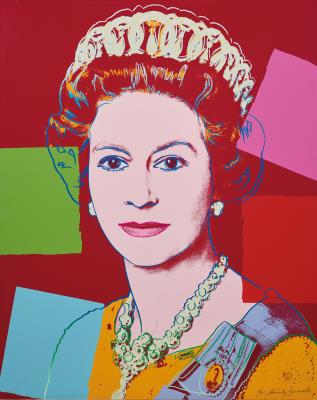
Queen Elizabeth II of the United Kingdom, from Reigning Queens, 1985, signed in pencil and numbered 9/40, screenprint in colours on Lenox Museum Board with the blindstamp of the printer Rupert Jasen Smith, New York, published by George C.P. Mulder, Amsterdam, 100 x 80 cm, In plexiglass case

This is no. 9 from an edition of 40 + 10 artist’s proofs

Provenance:
Martin Lawrence Limited Editions, Inc., New York (label on the reverse)
European private collection

Literature:
F. Feldman J. Schellmann, Andy Warhol Prints, A Catalogue Raisonné 1962-1987, II. 334-349, p. 138 with ill.

For the realisation of Queen Elizabeth II of the United Kingdom, a photograph taken on the occasion of the Silver Jubilee, the 25th anniversary of her reign, was used as a reference. The sitter\'s pose remains unaltered, retaining the structure and grandeur that are typical of classical portraiture. Warhol adds the commercial medium, emphasising it. His are classical depictions that praise the importance and solemnity of the subject depicted.

The same image of the queen appears in each of her four prints but they vary in colour. This one in particular has a primarily red background, and features graphic shapes printed from separate screens. Warhol began working in this style in the mid-1970s, fragmenting the image with various overlayed shapes and patches of colour.

The association of commercial medium and traditional portraiture is key, allowing Warhol to create a product that would subsequently be hailed as a work of art. Seriality, consumerism, the concept of fame and social hierarchy emanate from the superimposition of colour fields that enhance the subject\'s femininity. The pronounced make-up and bright colours denote the Pop character of mass culture, emphasising appearance and conveying a certain frivolity - unlike traditional portraits, where character and gravitas prevailed over aesthetics. Despite beginning with an impersonal approach and a mechanical reproduction of the subject, these interventions in the image gave the work a deliberately ‘artistic’ look. In many of his female portraits, such as here, the multicoloured surfaces and suggestion of make-up enhance the glamour and femininity of the subjects. With characteristic ambivalence, Warhol explained his additions to these later prints as immaterial:

‘I really would still rather do just a silkscreen of the face without all the rest, but people expect just a little bit more. That’s why I put in all the drawing.’ (Barry Blinderman, ‘Modern Myths: An Interview with Andy Warhol’, Arts, October 1981, p.145.)

This work is published in an edition of forty with ten artist’s proofs, five printer’s proofs and three hors commerce. The work is also published as a Royal Edition with diamond dust on the drawing lines, published in an edition of thirty with five artist’s proofs, two printer’s proofs and two hors commerce.

409. 纽伦堡编年史。 Liber chronicarum[德语:《克洛诺斯和故事书》]。纽伦堡:Anton Koberger代表Sebald Schreyer和Sebastian Kammermeister,1493年12月23日。 高清作品[19%]

Liber chronicarum  [in German: Das Buch der Croniken und Geschichten]. Nuremberg: Anton Koberger for Sebald Schreyer and Sebastian Kammermeister, 23 December 1493.

图片文件尺寸 : 4242 x 3809px

NUREMBERG CHRONICLE.:SCHEDEL, HARTMANN. 1440-1514. Liber chronicarum [in German: Das Buch der Croniken und Geschichten]. Nuremberg: Anton Koberger for Sebald Schreyer and Sebastian Kammermeister, 23 December 1493.
Imperial folio (472 x 325 mm). 297 leaves (of 298, without final blank). 59-64 lines and headline, table and parts of the text in two columns. Types: 24:111G (text), 9:165G (headlines), c. 1809 woodcut illustrations printed from 645 blocks by Michael Wolgemut, Wilhelm Pleydenwurff and their workshop, including Albrecht Dürer, comprising 29 double-page town views, 8 full-page woodcuts and double-page maps of the World [Shirley 19] and of Europe by Hieronymus Münzer after Nicolas Khrypffs. Contemporary Nuremberg pigskin over wooden boards, stained pink, ruled and stamped in blind, upper cover lettered in German: \"Cronica von anfang der welt\" [\"Chronical of the beginning of the world\"] brass clasps and catch-plates. Some minor marginal tears and occasional light staining, a few leaves (138-150) with repair to inner margins slightly affecting woodcuts or text, leaf 281 loose, spine ends neatly repaired.
Provenance: Georg Frauenlob Landt, gift inscription to Wolfgang Häberl, dated 18 August 1599 (first numbered leaf verso); Häberl, Wolfgang (*1553) from Berchtesgaden, Pastor of the parish church of St. Martin in Thalgau, and motto dated 1595 (inscription \"Sum ex libris Wolfgangi Häberl Berchtersgadiam / Ecclesiae parochialis S. Martini in Talgeio Pastoris. / Honesti cultor uirtute content. 1599\" on title page).

FIRST EDITION IN GERMAN of the Nuremberg Chronicle, printed in the same year as the Latin edition. The German and Latin editions were planned simultaneously, with the German edition of Georg Alt\'s translation appearing five months after the Latin edition. A TALL COPY of the most extensively illustrated book of the 15th century. The 29 large double-page city views, many illustrated for the first time, are accurate in depicting distinguished features of each city. In addition, it includes many details of 15th-century daily life: carpenters with their tools, astronomers and their instruments, a chess player, archers, bridges, derricks, dishes, furniture, windmills, ships, beds, houses, fortifications, weapons, tents, wharves, ferries, books, drawing materials, dogs, horses, and other animals, as well as costumes. Hartmann Schedel\'s Nuremberg Chronicle epitomizes \"the commercial sophistication, economic power and technical virtuosity that brought the art of print to this extraordinary climax\" (Pettegree). Reference: BMC II 437; BSB-Ink. S-197; Bod-Inc. S-110; Goff S-309; GW M40796; HC *14510; Pettegree, The Book in the Renaissance, New Haven, 2011 p. 42; Reske, The Production of Schedel\'s Nuremberg Chronicle Wiesbaden, 2000; Ellen Shaffer The Nuremberg Chronicle, Los Angeles, 1950; Wilson, The Making of the Nuremberg Chronicle Amsterdam, 1976.

纽伦堡编年史。 Liber chronicarum[德语:《克洛诺斯和故事书》]。纽伦堡:Anton Koberger代表Sebald Schreyer和Sebastian Kammermeister,1493年12月23日。

410. 草间弥生,当代艺术I 高清作品[18%]

DO-Yayoi Kusama - 现代艺术 I
图片文件像素:5457 x 4998 px

草间弥生,当代艺术I-

Yayoi Kusama - Zeitgenössische Kunst I-

(born in Matsumoto, Japan 1929)
Pumpkin KKK, 2002, signed, dated and titled on the reverse, acrylic on canvas, 22.7 x 15.8 cm, in plexiglass box

This work is accompanied by a registration card issued by Yayoi Kusama Studio

We are grateful to Yayoi Kusama Inc. for confirming the registration of the work in its database

Provenance:
European Private Collection

Iconic Pumpkin

Yayoi Kusama is possibly the best known Japanese artist in the world. Her famous polka dots have become her trademark and Kusama\'s stylized pumpkins are among the most iconic masterpieces of contemporary art.

Born in the late 1920s, Yayoi Kusama grew up in the conservative confines of the small town of Matsumoto in Nagano Prefecture in Japan. She attended the Kyoto School of Arts and Crafts, and after staging her first exhibitions, through which she was ‘discovered’ by the international art world, Kusama was able to emigrate to America, where she lived and worked, primarily in New York, from 1957 to 1973. Kusama celebrated her first major success in New York in 1959 with a solo exhibition at the Brata Gallery, entitled Obsessional Monochrome. The Infinity Net Paintings exhibited there were compositions of dense networks executed with white brushstrokes on a black ground and characterised by the theme of repetition.

Grids, flashes of light and, above all, dots that repeat endlessly are the most striking characteristic of Kusama\'s works and established her fame as the ‘Polka Dot Princess’. For the artist, the dots that overgrow everything are not merely a harmless pattern. They have their origins in the hallucinations and panic attacks she has experienced since her youth, which determined her perception of the world. Growing up, she saw dot and net patterns and feared she would dissolve into them. The polka dots and their constant repetition now became an expression of the search for infinity and the desire for self-dissolution. The dots erase the image into which the artist channels her fears. With her polka dots, Kusama covers not only canvases, but also everyday objects such as tea kettles or bookshelves, clothes, giant tentacles, oversized flowers, entire rooms or herself. And pumpkins as well.

\"Pumpkin KKK\" (2002) represents another important theme in Yayoi Kusama\'s work. For Kusama, the pumpkin is associated with memories of childhood and has been a favourite motif with almost mythical status since the 1970s-1980s. The artist first saw pumpkins during walks with her grandfather, and they had a calming effect on the hallucination-stricken artist. \"I love pumpkins for their humorous shape, their warmth and their human quality,\" Kusama says. She devoted herself to pumpkins in paintings and sculptures and incorporated them into her Infinity Rooms. Bold colours characterise the pumpkins, as do the precisely placed polka dots. The colour scheme follows an inner symbolism, according to which the artist categorises unprocessed experiences. The pumpkins stand for triumph over inner struggles, their endless repetition allows the artist to find her mental balance.

Since her return to Japan, Kusama, who has never made a secret of her illness, has voluntarily lived in a psychiatric institution. In 2017, a museum dedicated solely to her opened in Tokyo and numerous international exhibitions testify to considerable on-going interest in her work. With her unconventional works, her extraordinary performances, self-dramatisations and happenings, Kusama has anticipated many trends in contemporary art.

inc油画图片- 高清inc绘画作品- 代表作全集 中艺名画下载


401. 索尔·莱维特 板1,从颜色上的彩色线条从角边和中心到网格上的特定点 高清作品[38%]

Plate 1, from Lines In Color on Color From Corners Sides and Centers to Specific Points on a Grid

图片文件尺寸 : 4656 x 5760px

Sol LeWitt: Plate 1, from Lines In Color on Color From Corners Sides and Centers to Specific Points on a Grid, 1978
Screenprint in colors on Arches 88 paper, signed in pencil and numbered 5/25 (there were also 15 artist\'s proofs), published/printed by Multiples Inc./Jo Watanabe, New York, the full sheet.
sheet 30 x 30in (76.2 x 76.2cm)

索尔·莱维特 板1,从颜色上的彩色线条从角边和中心到网格上的特定点

402. 罗伊·利希滕斯坦 来自1#162的喷雾罐生活横幅多人日历中的手枪 高清作品[37%]

Spray Can from 1¢ Life; Pistol from Banner Multiples Calendar

图片文件尺寸 : 4700 x 4811px

Roy Lichtenstein: Spray Can from 1¢ Life; Pistol from Banner Multiples Calendar (2 works) (Corlett 34), 1963-64; 1968
Spray Can Lithograph in colors on wove paper, from the edition of 2000, published by E.W. Kornfeld, Bern, Switzerland, printed by Maurice Beaudet, Paris, the full sheet.
WITH
Pistol, (not in Corlett), Screenprint in colors on wove paper, from an edition of unknown size, with the inkstamp on verso of the publisher, Multiples, Inc., New York, the full sheet. (2 works)
sheets 16 1/8 x 11 1/2in (40.9 x 29.2cm); 15 3/4 x 15in (40 x 38.1cm)

罗伊·利希滕斯坦 来自1#162的喷雾罐生活横幅多人日历中的手枪

403. 索尔·莱维特 一个板,从颜色上的颜色线从角边和中心到网格上的特定点 高清作品[37%]

One plate, from Lines In Color on Color From Corners Sides and Centers to Specific Points on a Grid

图片文件尺寸 : 4742 x 6030px

Sol LeWitt:One plate, from Lines In Color on Color From Corners Sides and Centers to Specific Points on a Grid (Krakow Witkin 1978.2.05), 1978
Screenprint in colors on Arches 88 paper, signed in pencil and numbered 11/15 AP (an artist\'s proof aside from the edition of 25), published by Multiples Inc., New York, printed by Jo Watanabe, New York, the full sheet.
sheet 30 x 30in (76.2 x 76.2cm)

索尔·莱维特 一个板,从颜色上的颜色线从角边和中心到网格上的特定点

404. 索尔·莱维特 一个板,从颜色上的颜色线从角边和中心到网格上的特定点 高清作品[37%]

One plate, from Lines In Color on Color From Corners Sides and Centers to Specific Points on a Grid

图片文件尺寸 : 5346 x 5224px

Sol LeWitt:One plate, from Lines In Color on Color From Corners Sides and Centers to Specific Points on a Grid (Krakow Witkin 1978.2.08), 1978
Screenprint in colors on Arches 88 paper, signed in pencil and numbered 11/15 AP (an artist\'s proof aside from the edition of 25), published by Multiples Inc., New York, printed by Jo Watanabe, New York, the full sheet.
sheet 30 x 30in (76.2 x 76.2cm)

索尔·莱维特 一个板,从颜色上的颜色线从角边和中心到网格上的特定点

405. 路易丝·豪兰·金·考克斯 粉色女孩坐在长椅上42 x 34英寸。框架46 1/2 x 38 1/2 x 1 3/4英寸。 高清作品[36%]

Girl in Pink Seated on a Bench 42 x 34 in.  framed 46 1/2 x 38 1/2 x 1 3/4 in.

图片文件尺寸 : 4613 x 4137px

Louise Howland King Cox:Girl in Pink Seated on a Bench
signed and dated \'LOUISE COX 1919\' (lower right), identified on a label from Berry-Hill Galleries, Inc., New York (affixed to the stretcher)
oil on canvas
42 x 34 in. (107.0 x 86.5 cm)
framed 46 1/2 x 38 1/2 x 1 3/4 in.

路易丝·豪兰·金·考克斯 粉色女孩坐在长椅上42 x 34英寸。框架46 1/2 x 38 1/2 x 1 3/4英寸。

406. 安迪·沃霍尔 格特鲁德·斯坦因(Gertrude Stein),《二十世纪犹太人十幅肖像》 高清作品[36%]

Gertrude Stein, from Ten Portraits of Jews of the Twentieth Century

图片文件尺寸 : 4281 x 5797px

Andy Warhol:Gertrude Stein, from Ten Portraits of Jews of the Twentieth Century (Feldman Schellmann II.227), 1980
Screenprint in colors on Lenox Museum Board, signed in pencil and numbered PP 4/5 (a printer\'s proof, aside from the edition of 200), with the inkstamp on the reverse of the co-publishers Ronald Feldman Fine Arts, Inc., New York, and Jonathan A. Editions, Tel Aviv, with the blindstamp of the printer, Rupert Jasen Smith, New York, the full sheet.
sheet 40 x 32in (101.6 x 81.3cm)

安迪·沃霍尔 格特鲁德·斯坦因(Gertrude Stein),《二十世纪犹太人十幅肖像》

407. 洛杉矶的布鲁斯和其他人 布鲁斯·贝拉斯、米洛和其他人的照片档案,包括: 高清作品[32%]

An archive of photographs from Bruce Bellas , Milo, and others, including:

图片文件尺寸 : 5132 x 5047px

Bruce of Los Angeles, and others:An archive of photographs from Bruce Bellas (\"Bruce of Los Angeles\"), Milo, and others, including:
1. 78 negatives (39 double film strips) of bodybuilders, each negative 2 ¼ x 2 ¼ in., strip together 4 ½ x 2 ¼ inc., in sleeves with contact proofs, numbered on sleeve 62-1025-1058 (some duplication of numbers on sleeves, but not images), one sleeve noted in ink \"Mr Gulf Coast 1962\"
2. 17 4 x 5 in. photographs, 7 nudes (2 stamped \"Bruce\"), and 10 bodybuilders, pencil notations to the versos of many
3. 6 5 x 7 in. photographs of nudes, 4 with photographer\'s stamp \"Bruce\" to the verso, one notated in pencil \"Rusty Steele/ Saxon/ 1965\"
4. 17 8 x 10 in. photographs of nudes, 2 with photographer\'s stamp to verso (\"Bruce\" and \"Bruce of Los Angeles\"), and 5 with photographer\'s stamp (\"Milo of Los Angeles\")

洛杉矶的布鲁斯和其他人 布鲁斯·贝拉斯、米洛和其他人的照片档案,包括:

408. 安迪·沃霍尔,当代艺术I 高清作品[20%]

DO-Andy Warhol - 现代艺术 I
图片文件像素:5347 x 5320 px

安迪·沃霍尔,当代艺术I-

Andy Warhol - Zeitgenössische Kunst I-

(Pittsburgh 1928-1987 New York)
Queen Elizabeth II of the United Kingdom, from Reigning Queens, 1985, signed in pencil and numbered 9/40, screenprint in colours on Lenox Museum Board with the blindstamp of the printer Rupert Jasen Smith, New York, published by George C.P. Mulder, Amsterdam, 100 x 80 cm, In plexiglass case

This is no. 9 from an edition of 40 + 10 artist’s proofs

Provenance:
Martin Lawrence Limited Editions, Inc., New York (label on the reverse)
European private collection

Literature:
F. Feldman J. Schellmann, Andy Warhol Prints, A Catalogue Raisonné 1962-1987, II. 334-349, p. 138 with ill.

For the realisation of Queen Elizabeth II of the United Kingdom, a photograph taken on the occasion of the Silver Jubilee, the 25th anniversary of her reign, was used as a reference. The sitter\'s pose remains unaltered, retaining the structure and grandeur that are typical of classical portraiture. Warhol adds the commercial medium, emphasising it. His are classical depictions that praise the importance and solemnity of the subject depicted.

The same image of the queen appears in each of her four prints but they vary in colour. This one in particular has a primarily red background, and features graphic shapes printed from separate screens. Warhol began working in this style in the mid-1970s, fragmenting the image with various overlayed shapes and patches of colour.

The association of commercial medium and traditional portraiture is key, allowing Warhol to create a product that would subsequently be hailed as a work of art. Seriality, consumerism, the concept of fame and social hierarchy emanate from the superimposition of colour fields that enhance the subject\'s femininity. The pronounced make-up and bright colours denote the Pop character of mass culture, emphasising appearance and conveying a certain frivolity - unlike traditional portraits, where character and gravitas prevailed over aesthetics. Despite beginning with an impersonal approach and a mechanical reproduction of the subject, these interventions in the image gave the work a deliberately ‘artistic’ look. In many of his female portraits, such as here, the multicoloured surfaces and suggestion of make-up enhance the glamour and femininity of the subjects. With characteristic ambivalence, Warhol explained his additions to these later prints as immaterial:

‘I really would still rather do just a silkscreen of the face without all the rest, but people expect just a little bit more. That’s why I put in all the drawing.’ (Barry Blinderman, ‘Modern Myths: An Interview with Andy Warhol’, Arts, October 1981, p.145.)

This work is published in an edition of forty with ten artist’s proofs, five printer’s proofs and three hors commerce. The work is also published as a Royal Edition with diamond dust on the drawing lines, published in an edition of thirty with five artist’s proofs, two printer’s proofs and two hors commerce.

409. 纽伦堡编年史。 Liber chronicarum[德语:《克洛诺斯和故事书》]。纽伦堡:Anton Koberger代表Sebald Schreyer和Sebastian Kammermeister,1493年12月23日。 高清作品[19%]

Liber chronicarum  [in German: Das Buch der Croniken und Geschichten]. Nuremberg: Anton Koberger for Sebald Schreyer and Sebastian Kammermeister, 23 December 1493.

图片文件尺寸 : 4242 x 3809px

NUREMBERG CHRONICLE.:SCHEDEL, HARTMANN. 1440-1514. Liber chronicarum [in German: Das Buch der Croniken und Geschichten]. Nuremberg: Anton Koberger for Sebald Schreyer and Sebastian Kammermeister, 23 December 1493.
Imperial folio (472 x 325 mm). 297 leaves (of 298, without final blank). 59-64 lines and headline, table and parts of the text in two columns. Types: 24:111G (text), 9:165G (headlines), c. 1809 woodcut illustrations printed from 645 blocks by Michael Wolgemut, Wilhelm Pleydenwurff and their workshop, including Albrecht Dürer, comprising 29 double-page town views, 8 full-page woodcuts and double-page maps of the World [Shirley 19] and of Europe by Hieronymus Münzer after Nicolas Khrypffs. Contemporary Nuremberg pigskin over wooden boards, stained pink, ruled and stamped in blind, upper cover lettered in German: \"Cronica von anfang der welt\" [\"Chronical of the beginning of the world\"] brass clasps and catch-plates. Some minor marginal tears and occasional light staining, a few leaves (138-150) with repair to inner margins slightly affecting woodcuts or text, leaf 281 loose, spine ends neatly repaired.
Provenance: Georg Frauenlob Landt, gift inscription to Wolfgang Häberl, dated 18 August 1599 (first numbered leaf verso); Häberl, Wolfgang (*1553) from Berchtesgaden, Pastor of the parish church of St. Martin in Thalgau, and motto dated 1595 (inscription \"Sum ex libris Wolfgangi Häberl Berchtersgadiam / Ecclesiae parochialis S. Martini in Talgeio Pastoris. / Honesti cultor uirtute content. 1599\" on title page).

FIRST EDITION IN GERMAN of the Nuremberg Chronicle, printed in the same year as the Latin edition. The German and Latin editions were planned simultaneously, with the German edition of Georg Alt\'s translation appearing five months after the Latin edition. A TALL COPY of the most extensively illustrated book of the 15th century. The 29 large double-page city views, many illustrated for the first time, are accurate in depicting distinguished features of each city. In addition, it includes many details of 15th-century daily life: carpenters with their tools, astronomers and their instruments, a chess player, archers, bridges, derricks, dishes, furniture, windmills, ships, beds, houses, fortifications, weapons, tents, wharves, ferries, books, drawing materials, dogs, horses, and other animals, as well as costumes. Hartmann Schedel\'s Nuremberg Chronicle epitomizes \"the commercial sophistication, economic power and technical virtuosity that brought the art of print to this extraordinary climax\" (Pettegree). Reference: BMC II 437; BSB-Ink. S-197; Bod-Inc. S-110; Goff S-309; GW M40796; HC *14510; Pettegree, The Book in the Renaissance, New Haven, 2011 p. 42; Reske, The Production of Schedel\'s Nuremberg Chronicle Wiesbaden, 2000; Ellen Shaffer The Nuremberg Chronicle, Los Angeles, 1950; Wilson, The Making of the Nuremberg Chronicle Amsterdam, 1976.

纽伦堡编年史。 Liber chronicarum[德语:《克洛诺斯和故事书》]。纽伦堡:Anton Koberger代表Sebald Schreyer和Sebastian Kammermeister,1493年12月23日。

410. 草间弥生,当代艺术I 高清作品[18%]

DO-Yayoi Kusama - 现代艺术 I
图片文件像素:5457 x 4998 px

草间弥生,当代艺术I-

Yayoi Kusama - Zeitgenössische Kunst I-

(born in Matsumoto, Japan 1929)
Pumpkin KKK, 2002, signed, dated and titled on the reverse, acrylic on canvas, 22.7 x 15.8 cm, in plexiglass box

This work is accompanied by a registration card issued by Yayoi Kusama Studio

We are grateful to Yayoi Kusama Inc. for confirming the registration of the work in its database

Provenance:
European Private Collection

Iconic Pumpkin

Yayoi Kusama is possibly the best known Japanese artist in the world. Her famous polka dots have become her trademark and Kusama\'s stylized pumpkins are among the most iconic masterpieces of contemporary art.

Born in the late 1920s, Yayoi Kusama grew up in the conservative confines of the small town of Matsumoto in Nagano Prefecture in Japan. She attended the Kyoto School of Arts and Crafts, and after staging her first exhibitions, through which she was ‘discovered’ by the international art world, Kusama was able to emigrate to America, where she lived and worked, primarily in New York, from 1957 to 1973. Kusama celebrated her first major success in New York in 1959 with a solo exhibition at the Brata Gallery, entitled Obsessional Monochrome. The Infinity Net Paintings exhibited there were compositions of dense networks executed with white brushstrokes on a black ground and characterised by the theme of repetition.

Grids, flashes of light and, above all, dots that repeat endlessly are the most striking characteristic of Kusama\'s works and established her fame as the ‘Polka Dot Princess’. For the artist, the dots that overgrow everything are not merely a harmless pattern. They have their origins in the hallucinations and panic attacks she has experienced since her youth, which determined her perception of the world. Growing up, she saw dot and net patterns and feared she would dissolve into them. The polka dots and their constant repetition now became an expression of the search for infinity and the desire for self-dissolution. The dots erase the image into which the artist channels her fears. With her polka dots, Kusama covers not only canvases, but also everyday objects such as tea kettles or bookshelves, clothes, giant tentacles, oversized flowers, entire rooms or herself. And pumpkins as well.

\"Pumpkin KKK\" (2002) represents another important theme in Yayoi Kusama\'s work. For Kusama, the pumpkin is associated with memories of childhood and has been a favourite motif with almost mythical status since the 1970s-1980s. The artist first saw pumpkins during walks with her grandfather, and they had a calming effect on the hallucination-stricken artist. \"I love pumpkins for their humorous shape, their warmth and their human quality,\" Kusama says. She devoted herself to pumpkins in paintings and sculptures and incorporated them into her Infinity Rooms. Bold colours characterise the pumpkins, as do the precisely placed polka dots. The colour scheme follows an inner symbolism, according to which the artist categorises unprocessed experiences. The pumpkins stand for triumph over inner struggles, their endless repetition allows the artist to find her mental balance.

Since her return to Japan, Kusama, who has never made a secret of her illness, has voluntarily lived in a psychiatric institution. In 2017, a museum dedicated solely to her opened in Tokyo and numerous international exhibitions testify to considerable on-going interest in her work. With her unconventional works, her extraordinary performances, self-dramatisations and happenings, Kusama has anticipated many trends in contemporary art.