291. 托姆布雷 高清作品[26%]

DO-Cy Twombly  - 现代艺术 I
图片文件像素:5713 x 4685 px

托姆布雷-

Cy Twombly * - Zeitgenössische Kunst I-

(Lexington, Virginia 1928–2011 Rome)
Untitled, 1963/1964, signed Cy Twombly, colored pencil, wax crayon on paper, 86 x 67 cm, framed

Provenance:
Galleria La Tartaruga, Rome
Galerie Karsten Greve, Cologne
Private Collection, 德国y
Kunsthaus Lempertz, 3 December 2016, lot 450 - acquired there by the present owner

Literature:
Nicola Del Roscio, Cy Twombly, drawings, catalogue raisonné, Gagosian Gallery, New York (Ed.), Munich 2011, vol. 4, no. 20

Cy Twombly occupies a unique position among US artists. Twombly lived and worked in Italy, far from the 美国 art world, and felt free to experiment. In Rome, Twombly refined his distinctive artistic language. Twombly\'s visual language is informed by classical literature, ancient history, poetry and mythology, as well as his own life experience. Since the 1950s, Twombly\'s drawings have been dominated by rhythmically repeated line progressions, swirls, dense tangles and isolated numbers. Pencil, coloured pens and ballpoint pens enabled Twombly to make this \'scriptural\' drawing, which ultimately includes the signature of the artist himself. On the white of the paper, the pictorial elements provoke by appearing as scribbles, appearing as if randomly distributed on the surface.

The untitled work offered here is a vivid example of Twombly\'s unique pictorial language. The pictorial elements merge into an abstract composition that is both delicate and dynamic. The work was created in Italy between 1963-64. Twombly lived in a 17th-century palazzo on Via di Monserrato in Rome at the time the work was created. Untitled is emblematic of the groundbreaking work Twombly produced in the 1960s, widely regarded as a critical and highly fruitful period in his long and illustrious career.

“Paint is something that I use with my hands and do all those tactile things. I really don’t like oil because you can’t get back into it, or you make a mess. It’s not my favourite thing... pencil is more my medium than wet paint.”
Cy Twombly

292. Hans Hartung,当代艺术I 高清作品[26%]

DO-Hans Hartung  - 现代艺术 I
图片文件像素:5822 x 4298 px

Hans Hartung,当代艺术I-

Hans Hartung * - Zeitgenössische Kunst I-

(Leipzig 1904–1989 Antibes)
T 1964 - E 40, 1964, signed, dated Hartung 64, titled and inscribed and with directional arrow on the stretcher, acrylic on canvas, 81 x 130 cm, framed

This work is registered at the Foundation Hans Hartung and Anna-Eva Bergman, Antibes, and will be included in the forthcoming Catalogue Raisonné being prepared by the Foundation Hartung Bergman, Antibes (confirmation via email 3. October 2022).

Provenance:
Galerie Kallenbach, Munich
Private collection, North Rhine-Westphalia
Ketterer Kunst, Munich, 18 June 2021, lot 302 - acquired there by the present owner

Hans Hartung\'s entire oeuvre is characterised by abstract, non-objective painting. This interplay of light and shadow, structure, texture and airiness would become the formative elements of his later works. The non-figurative painting T 1964 - E 40 offered here also belongs to his catalogue of work. The canvas is primed in yellow, the upper part of the painting is dipped in a rich black. Above this is a layer of dark blue paint splashes with white accents, which the artist has worked on with a steel brush and scraper. A particular focus of the work is the complementary contrast of blue and yellow as well as the contrast between surface and stroke. The pictorial space is composed of light, shadow and their contrast.

The multitude of brushstrokes and scratches, the result of the painter\'s activity on the canvas, represent Hartung\'s style of the 1960s. The compositional scheme of the work offered here is reminiscent of the depiction of fireworks. The rockets explode in the night sky and colour it a sulphurous yellow.

“The first and most important thing is to remain free, free in each line you undertake, in your ideas and in your political action, in your moral conduct. The artist especially must remain free from all outer restraints.”
Hans Hartung

293. 杰森·马丁,当代艺术I 高清作品[26%]

DO-Jason Martin  - 现代艺术 I
图片文件像素:6259 x 4573 px

杰森·马丁,当代艺术I-

Jason Martin * - Zeitgenössische Kunst I-

(born in London in 1970)
Untitled, 2008, oil on steel, 236 x 354 x 11 cm

Provenance:
Private collection Thomas Olbricht, Essen
Van Ham, Cologne, 26 September 2020, lot 333 - acquired there by the present owner

Exhibited:
Hamburg, Deichtorhallen, Zwei Sammler: Thomas Olbricht und Harald Falckenberg, 24 June – 21 August 2011

Literature:
Luckow, Dirk: Zwei Sammler - Thomas Olbricht und Harald Falckenberg, Cologne 2011, p. 52 (without ill.)

The British artist Jason Martin expands the possibilities of painting with his innovative approach in using unusual materials which serve as paint. He attracted international attention with his large, brushed oil paintings, executed in thin layers of paint with self-made comb-like tools – such as the one being auctioned off. Because of the light bouncing off the shiny surface, experiencing the work in person is like walking towards a sculpture rather than a painting.

“There’s never really any single point to review the work or to experience the work, it’s about moving around. But there is a stillness as well, in that the organisation of the marks all collide into a central or suggested central point. […] When you encounter a work of mine, there is an academic approach to the performative act, the gestural act. I have a series of reduced movements that then compile in a composition. And you also look through it, because there is this implied sense of looking through, this illusion. […] I would suggest that my paintings are a hybrid between that naturalism, that looking through, that perspectival space, that implied pictorial depth and the didactic, academic concerns of abstraction, which are for me physical and arm-led, or I immerse my body into the whole making of the work. And they sit very much in between these two places, these two worlds. [...]”
Jason Martin on the exhibition: Convergence. Thaddaeus Ropac, Seoul Fort Hill, 24.2.-16.4.22

294. 约翰·威尔金斯。1614-1672. 一个新世界的发现,或者一个倾向于证明的话语,月球上可能有另一个可居住的世界。伦敦:约翰·诺顿,约翰·梅纳德,1640年。 高清作品[25%]

The Discovery of a New World or, a Discourse Tending to Prove, That tis Probable There May Be Another Habitable World in the Moone. London: John Norton, for John Maynard, 1640.

图片文件尺寸 : 4967 x 4295px

WILKINS, JOHN. 1614-1672.:The Discovery of a New World or, a Discourse Tending to Prove, That tis Probable There May Be Another Habitable World in the Moone. London: John Norton, for John Maynard, 1640.
2 parts in 1 volume. 8vo. (160 x 102 mm). Additional engraved title by W. Marshall, engraved illustration on p 222 of part 2, numerous woodcut diagrams in text. 18th century calf, spine with 4 raised bands and morocco gilt lettering piece, marbled endpapers. Covers detached, front endpapers and first leaf (additional engraved title) separated from text block, top margins somewhat tightly trimmed, scattered browning and spotting.
Provenance: Boies Penrose II (American travel writer and historian, 1902-1976, 2 bookplates).

Third edition. Wilkins\' bold assertions in his various editions of this book include the possibility that the moon might be inhabited, that humans might be able to find a way to travel there, and that the Earth might indeed be a planet. An Anglican clergyman and Bishop of Chester, Wilkins was a visionary polymath who remained well-respected in science and the clergy, despite his sometimes controversial writings. In addition to writing on mathematics, religious philosophy, and astronomy, he proposed a universal language, and a universal system of measurement that predated the metric system. ESTC S119973; Macclesfield 2125; Nicholson 93.

约翰·威尔金斯。1614-1672. 一个新世界的发现,或者一个倾向于证明的话语,月球上可能有另一个可居住的世界。伦敦:约翰·诺顿,约翰·梅纳德,1640年。

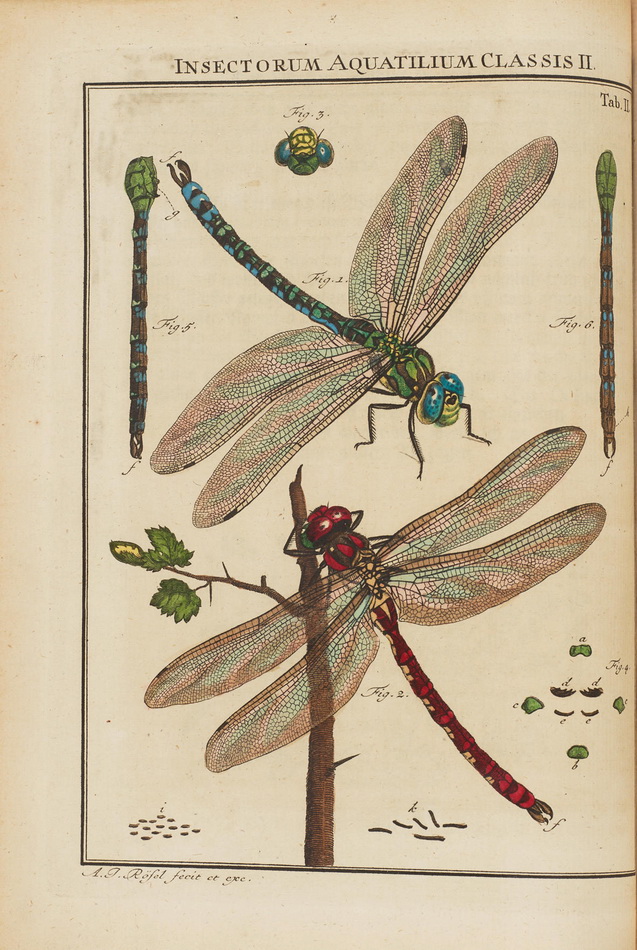
295. 奥塞尔·冯·罗森霍夫(RÖSEL von ROSENHOF),8月JOHANN。1705-1759. 每月的昆虫娱乐。纽伦堡:约翰·约瑟夫·弗莱斯曼,1746-1761年。 高清作品[25%]

Der monatlich-herausgegebenen Insecten-Belustigung. Nuremburg: Johann Joseph Fleischman, 1746-1761.

图片文件尺寸 : 4018 x 4668px

RÖSEL VON ROSENHOF, AUGUST JOHANN. 1705-1759.:Der monatlich-herausgegebenen Insecten-Belustigung. Nuremburg: Johann Joseph Fleischman, 1746-1761.
WITH: RÖSEL VON ROSENHOF, AUGUST JOHANN; KATHARINA BARABARA RÖSEL VON ROSENHOF; and CHRISTIAN FRIEDRICH CARL KLEEMANN. Der beyträge zur Natur-oder Insecten-Geschichte erster Theil. [Nuremburg: 1776].
Together, 5 volumes. 4to (209 x 174 mm). Hand-colored engraved frontispiece in volume I, hand-colored engraved half-titles in volumes II and III (with additional engraved section half-title after p 432 in volume III), engraved portrait in volume IV; 247 hand-colored engraved plates in volumes I-IV, some with two illustrations per plate, and 44 additional plates in the second work (volume V). Modern quarter tan morocco and marbled boards, tissue guards. Browning, foxing, and minor offsetting throughout; marginal dampstaining to volume V.

RÖSEL VON ROSENHOF\'S COMPLETE WORKS ON INSECTS, including the much rarer posthumous work, completed by his daughter Katharina and her husband, artist and astronomer Christian Friedrich Carl Kleemann. Born to an aristocratic family in Austria, August Johann Rösel was raised by his uncle, noted animal painter Wilhelm Rösel von Rosenhof, from whom he inherited the \"von Rosenhof\" title. His observations in this work cover marine invertebrates as well as insects, and his detailed classifications made him a pioneer among European entomologists, influencing Carl Linnaeus, among others. Nissen ZBI 3466 and 2201.

奥塞尔·冯·罗森霍夫(RÖSEL von ROSENHOF),8月JOHANN。1705-1759. 每月的昆虫娱乐。纽伦堡:约翰·约瑟夫·弗莱斯曼,1746-1761年。

296. Maria Lassnig,当代艺术I 高清作品[25%]

DO-Maria Lassnig  - 现代艺术 I
图片文件像素:5485 x 5808 px

Maria Lassnig,当代艺术I-

Maria Lassnig * - Zeitgenössische Kunst I-

(Kappel, Carinthia, 1919–2014 Vienna)
“Untitled”, 1980, gouache, colour instruction for the print version of the painting “Die Last des Fleisches”, 1973, of the catalogue “Austria. Biennale di Venezia 1980. Maria Lassnig”, on paper (envelope from the gallery Peithner-Lichtenfels - addressed to Maria Lassnig), to the upper edge in the artist’s handwriting “Text ausbessern”, image size 17 x 21.5 cm, envelope 20.5 x 21.5 cm, framed

Provenance:
excerpt from an email from 20 May 2022

Registered:
Maria Lassnig Stiftung (14.10.2022)

This work is included in the Maria Lassnig catalogue raisonné (certificate available).

Auszug aus einem E-Mail, 20. Mai 2022:
“Mein Vater ... bekam die kleinformatige Arbeit von Maria Lassnig während der Herstellung des Kataloges “Austria. Biennale di Venezia 1980. Maria Lassnig” ... in der Druckerei Brüder Rosenbaum 1980 geschenkt.
Leider befand Maria Lassnig das Ektachrom ... ihres Gemäldes “Die Last des Fleisches” ... in der Farbwiedergabe nicht zufriedenstellend.
... mein Vater bat sie entsprechend um eine Orientierungshilfe ...
Maria Lassnig fertigte zuhause die vorliegende Gouache ... an.
Nach dem zweiten Probedruck und diversen Farbkorrekturen bekam mein Vater ... die Zustimmung Maria Lassnigs für den Druck sowie die Gouache von “Die Last des Fleisches” als Dankeschön zum Geschenk.
Die Arbeit blieb seither in Familienbesitz.”

Excerpt from an email from 20 May 2022:
“My father [...] received the small-format work by Maria Lassnig during the production of the catalogue Austria. Biennale di Venezia 1980.
Maria Lassnig [...] in the Rosenbaum Brothers printing house in 1980.

Unfortunately, Maria Lassnig found the ectachrome [...] of her painting „Die Last des Fleisches“ [...] was not satisfactory in its colour reproduction [...]. Accordingly, my father asked her for a guide [...] Maria Lassnig made the present gouache at home [...]. After the second test print and various colour corrections, my father [...] received Maria Lassnig’s approval for the print as well as the gouache of„Die Last des Fleisches“ as a thank-you gift. The work has remained in the family ever since.”

297. 阿里吉耶罗·波提 高清作品[23%]

DO-Alighiero Boetti  - 现代艺术 I
图片文件像素:5357 x 5537 px

阿里吉耶罗·波提-

Alighiero Boetti * - Zeitgenössische Kunst I-

(Turin 1940–1994 Rome)
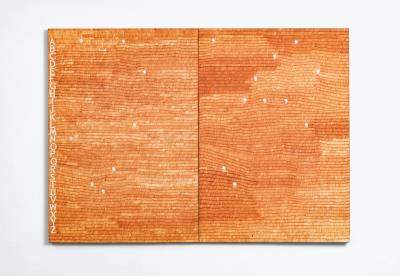
Naturale Artificiale, 1982, 2 parts, ballpen on paper laid on canvas / biro su carta intelata, each 100 x 70 cm, on stretcher (2)

The work is registered in the Archivio Alighiero Boetti and is accompanied by a photo certificate of authenticity, Rome, 30 May 2007

Photo-certificate, issued by La Bertesca/c.o. Masnata, Genoa, signed by the artist, Rome, October 1983

Provenance:
The artist Francesco Masnata, Genoa (formerly Galleria La Bertesca)
Private Collection, Southem 德国y – acquired directly from the above in the late 1990s

Literature:
Jean-Christophe Ammann, Alighiero Boetti, Catalogo generale, Vol 3, Milan 2015, Vol. 3, no. 1391 (with color illustration)

The work NATURALE ARTIFICIALE comes from Alighiero Boetti\'s biro drawings series. The artist created unique artistic narratives through play, poetry, measure, numbers, order and disorder, which he combined with material diversity, conceptual complexity, and extraordinary visual beauty. Boetti began his biro series in the 1970s, when he created entire sheets collaboratively using different coloured biro ink. Each work in the series contains panels of images created by different students, similar to Boetti\'s well-known tapestries. With a consistently playful approach to \"simple\" ideas, Boetti posed fundamental questions about contemporary art production. The liminal space between artist and author is a major concern in Boetti\'s catalogue of works.

The biro work offered here is a diptych of two sheets hand-coloured with red biros. Looking at the diptych as a whole, the irregular structure, gradations and patterns become apparent. Latin letters are arranged in alphabetical order on the left edge of the picture. Distributed over the two halves of the picture are small white commas in a seemingly arbitrary arrangement. A closer look at the signs reveals that they each correspond to one of the letters of the alphabet. When read in sequence from left to right, they themselves spell out the work’s title NATURALE ARTIFICIALE. Boetti\'s biro works are generally abstract images that name themselves.

\"My works arise from changing forms of collaboration. I am interested in primary things like the alphabet, maps, newspapers - not least because of the sudden surge of order and disorder. Everything has its own precise order, even if that order is realised in a disorderly way.\"
Alighiero Boetti

298. 克里斯多夫·谢纳。1573-1650. 来自Admirando FacularsMaculas Varius的Rosa Ursina Sive Sun。布拉恰诺:安德烈亚斯·菲乌斯(Andreas Phaeus)在公爵出版社,1626-1630年。 高清作品[22%]

Rosa Ursina Sive Sol ex Admirando Facularum  Macularum suarum Phoenomeno Varius.  Bracciano: Andreas Phaeus at the Ducal Press, 1626-1630.

图片文件尺寸 : 4065 x 5080px

SCHEINER, CHRISTOPH. 1573-1650. :Rosa Ursina Sive Sol ex Admirando Facularum Macularum suarum Phoenomeno Varius. Bracciano: Andreas Phaeus at the Ducal Press, 1626-1630.
Folio (375 x 260 mm). Engraved title vignette, engraved portrait of Paolo Giordano Orsini, Duke of Bracciano, additional engraved title, numerous engraved illustrations throughout (many full-page), woodcut head- and tailpieces and initials. [38], 784 (with numerous errors in pagination), [38] pp., with the blanks F4, R6 4I6. Full 18th-century (?) vellum, manuscript spine title, all edges gilt. Repairs to large portion of outer lower corner of first 5 leaves (letterpress half-title, title, portrait leaf, contents and engraved title) with loss to text and images, occasional heavy browning and waterstaining, especially to prefatory and end matter, sporadic foxing, loss to top blank corner of 4G6.

FIRST EDITION of Scheiner\'s major work on sunspots. Scheiner first observed sunspots in 1611, publishing his finding pseudonymously the following year in Tres Epistolae de Maculis Solaribus. The tract initiated a dispute with Galileo over the nature of sunspots. The present work, Scheiner\'s magnum opus and the standard work on sunspots for over well over a century, opens with an extended attack on Galileo, although Scheiner had by this point accepted Galileo\'s theory that sunspots exist on the surface of the sun and are not, as he had previously argued, caused by shadows cast by satellites of the sun. The many fine engravings depict Scheiner\'s observations, a map of the moon, and the helioscope and other instruments. \"For his masterpiece, Scheiner produced the first monograph on a heavenly body, the Sun. Even today it is still an impressive volume, with scores of engravings of sunspots and the various instruments needed for solar observations\" (Jesuit Science in the Age of Galileo). Cinti 79; Honeyman 2781.

克里斯多夫·谢纳。1573-1650. 来自Admirando FacularsMaculas Varius的Rosa Ursina Sive Sun。布拉恰诺:安德烈亚斯·菲乌斯(Andreas Phaeus)在公爵出版社,1626-1630年。

299. 纽伦堡编年史。 Liber chronicarum[德语:《克洛诺斯和故事书》]。纽伦堡:Anton Koberger代表Sebald Schreyer和Sebastian Kammermeister,1493年12月23日。 高清作品[19%]

Liber chronicarum  [in German: Das Buch der Croniken und Geschichten]. Nuremberg: Anton Koberger for Sebald Schreyer and Sebastian Kammermeister, 23 December 1493.

图片文件尺寸 : 4242 x 3809px

NUREMBERG CHRONICLE.:SCHEDEL, HARTMANN. 1440-1514. Liber chronicarum [in German: Das Buch der Croniken und Geschichten]. Nuremberg: Anton Koberger for Sebald Schreyer and Sebastian Kammermeister, 23 December 1493.
Imperial folio (472 x 325 mm). 297 leaves (of 298, without final blank). 59-64 lines and headline, table and parts of the text in two columns. Types: 24:111G (text), 9:165G (headlines), c. 1809 woodcut illustrations printed from 645 blocks by Michael Wolgemut, Wilhelm Pleydenwurff and their workshop, including Albrecht Dürer, comprising 29 double-page town views, 8 full-page woodcuts and double-page maps of the World [Shirley 19] and of Europe by Hieronymus Münzer after Nicolas Khrypffs. Contemporary Nuremberg pigskin over wooden boards, stained pink, ruled and stamped in blind, upper cover lettered in German: \"Cronica von anfang der welt\" [\"Chronical of the beginning of the world\"] brass clasps and catch-plates. Some minor marginal tears and occasional light staining, a few leaves (138-150) with repair to inner margins slightly affecting woodcuts or text, leaf 281 loose, spine ends neatly repaired.
Provenance: Georg Frauenlob Landt, gift inscription to Wolfgang Häberl, dated 18 August 1599 (first numbered leaf verso); Häberl, Wolfgang (*1553) from Berchtesgaden, Pastor of the parish church of St. Martin in Thalgau, and motto dated 1595 (inscription \"Sum ex libris Wolfgangi Häberl Berchtersgadiam / Ecclesiae parochialis S. Martini in Talgeio Pastoris. / Honesti cultor uirtute content. 1599\" on title page).

FIRST EDITION IN GERMAN of the Nuremberg Chronicle, printed in the same year as the Latin edition. The German and Latin editions were planned simultaneously, with the German edition of Georg Alt\'s translation appearing five months after the Latin edition. A TALL COPY of the most extensively illustrated book of the 15th century. The 29 large double-page city views, many illustrated for the first time, are accurate in depicting distinguished features of each city. In addition, it includes many details of 15th-century daily life: carpenters with their tools, astronomers and their instruments, a chess player, archers, bridges, derricks, dishes, furniture, windmills, ships, beds, houses, fortifications, weapons, tents, wharves, ferries, books, drawing materials, dogs, horses, and other animals, as well as costumes. Hartmann Schedel\'s Nuremberg Chronicle epitomizes \"the commercial sophistication, economic power and technical virtuosity that brought the art of print to this extraordinary climax\" (Pettegree). Reference: BMC II 437; BSB-Ink. S-197; Bod-Inc. S-110; Goff S-309; GW M40796; HC *14510; Pettegree, The Book in the Renaissance, New Haven, 2011 p. 42; Reske, The Production of Schedel\'s Nuremberg Chronicle Wiesbaden, 2000; Ellen Shaffer The Nuremberg Chronicle, Los Angeles, 1950; Wilson, The Making of the Nuremberg Chronicle Amsterdam, 1976.

纽伦堡编年史。 Liber chronicarum[德语:《克洛诺斯和故事书》]。纽伦堡:Anton Koberger代表Sebald Schreyer和Sebastian Kammermeister,1493年12月23日。

300. 草间弥生,当代艺术I 高清作品[18%]

DO-Yayoi Kusama - 现代艺术 I
图片文件像素:5457 x 4998 px

草间弥生,当代艺术I-

Yayoi Kusama - Zeitgenössische Kunst I-

(born in Matsumoto, Japan 1929)
Pumpkin KKK, 2002, signed, dated and titled on the reverse, acrylic on canvas, 22.7 x 15.8 cm, in plexiglass box

This work is accompanied by a registration card issued by Yayoi Kusama Studio

We are grateful to Yayoi Kusama Inc. for confirming the registration of the work in its database

Provenance:
European Private Collection

Iconic Pumpkin

Yayoi Kusama is possibly the best known Japanese artist in the world. Her famous polka dots have become her trademark and Kusama\'s stylized pumpkins are among the most iconic masterpieces of contemporary art.

Born in the late 1920s, Yayoi Kusama grew up in the conservative confines of the small town of Matsumoto in Nagano Prefecture in Japan. She attended the Kyoto School of Arts and Crafts, and after staging her first exhibitions, through which she was ‘discovered’ by the international art world, Kusama was able to emigrate to America, where she lived and worked, primarily in New York, from 1957 to 1973. Kusama celebrated her first major success in New York in 1959 with a solo exhibition at the Brata Gallery, entitled Obsessional Monochrome. The Infinity Net Paintings exhibited there were compositions of dense networks executed with white brushstrokes on a black ground and characterised by the theme of repetition.

Grids, flashes of light and, above all, dots that repeat endlessly are the most striking characteristic of Kusama\'s works and established her fame as the ‘Polka Dot Princess’. For the artist, the dots that overgrow everything are not merely a harmless pattern. They have their origins in the hallucinations and panic attacks she has experienced since her youth, which determined her perception of the world. Growing up, she saw dot and net patterns and feared she would dissolve into them. The polka dots and their constant repetition now became an expression of the search for infinity and the desire for self-dissolution. The dots erase the image into which the artist channels her fears. With her polka dots, Kusama covers not only canvases, but also everyday objects such as tea kettles or bookshelves, clothes, giant tentacles, oversized flowers, entire rooms or herself. And pumpkins as well.

\"Pumpkin KKK\" (2002) represents another important theme in Yayoi Kusama\'s work. For Kusama, the pumpkin is associated with memories of childhood and has been a favourite motif with almost mythical status since the 1970s-1980s. The artist first saw pumpkins during walks with her grandfather, and they had a calming effect on the hallucination-stricken artist. \"I love pumpkins for their humorous shape, their warmth and their human quality,\" Kusama says. She devoted herself to pumpkins in paintings and sculptures and incorporated them into her Infinity Rooms. Bold colours characterise the pumpkins, as do the precisely placed polka dots. The colour scheme follows an inner symbolism, according to which the artist categorises unprocessed experiences. The pumpkins stand for triumph over inner struggles, their endless repetition allows the artist to find her mental balance.

Since her return to Japan, Kusama, who has never made a secret of her illness, has voluntarily lived in a psychiatric institution. In 2017, a museum dedicated solely to her opened in Tokyo and numerous international exhibitions testify to considerable on-going interest in her work. With her unconventional works, her extraordinary performances, self-dramatisations and happenings, Kusama has anticipated many trends in contemporary art.

wells油画图片- 高清wells绘画作品- 代表作全集 中艺名画下载


291. 托姆布雷 高清作品[26%]

DO-Cy Twombly  - 现代艺术 I
图片文件像素:5713 x 4685 px

托姆布雷-

Cy Twombly * - Zeitgenössische Kunst I-

(Lexington, Virginia 1928–2011 Rome)
Untitled, 1963/1964, signed Cy Twombly, colored pencil, wax crayon on paper, 86 x 67 cm, framed

Provenance:
Galleria La Tartaruga, Rome
Galerie Karsten Greve, Cologne
Private Collection, 德国y
Kunsthaus Lempertz, 3 December 2016, lot 450 - acquired there by the present owner

Literature:
Nicola Del Roscio, Cy Twombly, drawings, catalogue raisonné, Gagosian Gallery, New York (Ed.), Munich 2011, vol. 4, no. 20

Cy Twombly occupies a unique position among US artists. Twombly lived and worked in Italy, far from the 美国 art world, and felt free to experiment. In Rome, Twombly refined his distinctive artistic language. Twombly\'s visual language is informed by classical literature, ancient history, poetry and mythology, as well as his own life experience. Since the 1950s, Twombly\'s drawings have been dominated by rhythmically repeated line progressions, swirls, dense tangles and isolated numbers. Pencil, coloured pens and ballpoint pens enabled Twombly to make this \'scriptural\' drawing, which ultimately includes the signature of the artist himself. On the white of the paper, the pictorial elements provoke by appearing as scribbles, appearing as if randomly distributed on the surface.

The untitled work offered here is a vivid example of Twombly\'s unique pictorial language. The pictorial elements merge into an abstract composition that is both delicate and dynamic. The work was created in Italy between 1963-64. Twombly lived in a 17th-century palazzo on Via di Monserrato in Rome at the time the work was created. Untitled is emblematic of the groundbreaking work Twombly produced in the 1960s, widely regarded as a critical and highly fruitful period in his long and illustrious career.

“Paint is something that I use with my hands and do all those tactile things. I really don’t like oil because you can’t get back into it, or you make a mess. It’s not my favourite thing... pencil is more my medium than wet paint.”
Cy Twombly

292. Hans Hartung,当代艺术I 高清作品[26%]

DO-Hans Hartung  - 现代艺术 I
图片文件像素:5822 x 4298 px

Hans Hartung,当代艺术I-

Hans Hartung * - Zeitgenössische Kunst I-

(Leipzig 1904–1989 Antibes)
T 1964 - E 40, 1964, signed, dated Hartung 64, titled and inscribed and with directional arrow on the stretcher, acrylic on canvas, 81 x 130 cm, framed

This work is registered at the Foundation Hans Hartung and Anna-Eva Bergman, Antibes, and will be included in the forthcoming Catalogue Raisonné being prepared by the Foundation Hartung Bergman, Antibes (confirmation via email 3. October 2022).

Provenance:
Galerie Kallenbach, Munich
Private collection, North Rhine-Westphalia
Ketterer Kunst, Munich, 18 June 2021, lot 302 - acquired there by the present owner

Hans Hartung\'s entire oeuvre is characterised by abstract, non-objective painting. This interplay of light and shadow, structure, texture and airiness would become the formative elements of his later works. The non-figurative painting T 1964 - E 40 offered here also belongs to his catalogue of work. The canvas is primed in yellow, the upper part of the painting is dipped in a rich black. Above this is a layer of dark blue paint splashes with white accents, which the artist has worked on with a steel brush and scraper. A particular focus of the work is the complementary contrast of blue and yellow as well as the contrast between surface and stroke. The pictorial space is composed of light, shadow and their contrast.

The multitude of brushstrokes and scratches, the result of the painter\'s activity on the canvas, represent Hartung\'s style of the 1960s. The compositional scheme of the work offered here is reminiscent of the depiction of fireworks. The rockets explode in the night sky and colour it a sulphurous yellow.

“The first and most important thing is to remain free, free in each line you undertake, in your ideas and in your political action, in your moral conduct. The artist especially must remain free from all outer restraints.”
Hans Hartung

293. 杰森·马丁,当代艺术I 高清作品[26%]

DO-Jason Martin  - 现代艺术 I
图片文件像素:6259 x 4573 px

杰森·马丁,当代艺术I-

Jason Martin * - Zeitgenössische Kunst I-

(born in London in 1970)
Untitled, 2008, oil on steel, 236 x 354 x 11 cm

Provenance:
Private collection Thomas Olbricht, Essen
Van Ham, Cologne, 26 September 2020, lot 333 - acquired there by the present owner

Exhibited:
Hamburg, Deichtorhallen, Zwei Sammler: Thomas Olbricht und Harald Falckenberg, 24 June – 21 August 2011

Literature:
Luckow, Dirk: Zwei Sammler - Thomas Olbricht und Harald Falckenberg, Cologne 2011, p. 52 (without ill.)

The British artist Jason Martin expands the possibilities of painting with his innovative approach in using unusual materials which serve as paint. He attracted international attention with his large, brushed oil paintings, executed in thin layers of paint with self-made comb-like tools – such as the one being auctioned off. Because of the light bouncing off the shiny surface, experiencing the work in person is like walking towards a sculpture rather than a painting.

“There’s never really any single point to review the work or to experience the work, it’s about moving around. But there is a stillness as well, in that the organisation of the marks all collide into a central or suggested central point. […] When you encounter a work of mine, there is an academic approach to the performative act, the gestural act. I have a series of reduced movements that then compile in a composition. And you also look through it, because there is this implied sense of looking through, this illusion. […] I would suggest that my paintings are a hybrid between that naturalism, that looking through, that perspectival space, that implied pictorial depth and the didactic, academic concerns of abstraction, which are for me physical and arm-led, or I immerse my body into the whole making of the work. And they sit very much in between these two places, these two worlds. [...]”
Jason Martin on the exhibition: Convergence. Thaddaeus Ropac, Seoul Fort Hill, 24.2.-16.4.22

294. 约翰·威尔金斯。1614-1672. 一个新世界的发现,或者一个倾向于证明的话语,月球上可能有另一个可居住的世界。伦敦:约翰·诺顿,约翰·梅纳德,1640年。 高清作品[25%]

The Discovery of a New World or, a Discourse Tending to Prove, That tis Probable There May Be Another Habitable World in the Moone. London: John Norton, for John Maynard, 1640.

图片文件尺寸 : 4967 x 4295px

WILKINS, JOHN. 1614-1672.:The Discovery of a New World or, a Discourse Tending to Prove, That tis Probable There May Be Another Habitable World in the Moone. London: John Norton, for John Maynard, 1640.
2 parts in 1 volume. 8vo. (160 x 102 mm). Additional engraved title by W. Marshall, engraved illustration on p 222 of part 2, numerous woodcut diagrams in text. 18th century calf, spine with 4 raised bands and morocco gilt lettering piece, marbled endpapers. Covers detached, front endpapers and first leaf (additional engraved title) separated from text block, top margins somewhat tightly trimmed, scattered browning and spotting.
Provenance: Boies Penrose II (American travel writer and historian, 1902-1976, 2 bookplates).

Third edition. Wilkins\' bold assertions in his various editions of this book include the possibility that the moon might be inhabited, that humans might be able to find a way to travel there, and that the Earth might indeed be a planet. An Anglican clergyman and Bishop of Chester, Wilkins was a visionary polymath who remained well-respected in science and the clergy, despite his sometimes controversial writings. In addition to writing on mathematics, religious philosophy, and astronomy, he proposed a universal language, and a universal system of measurement that predated the metric system. ESTC S119973; Macclesfield 2125; Nicholson 93.

约翰·威尔金斯。1614-1672. 一个新世界的发现,或者一个倾向于证明的话语,月球上可能有另一个可居住的世界。伦敦:约翰·诺顿,约翰·梅纳德,1640年。

295. 奥塞尔·冯·罗森霍夫(RÖSEL von ROSENHOF),8月JOHANN。1705-1759. 每月的昆虫娱乐。纽伦堡:约翰·约瑟夫·弗莱斯曼,1746-1761年。 高清作品[25%]

Der monatlich-herausgegebenen Insecten-Belustigung. Nuremburg: Johann Joseph Fleischman, 1746-1761.

图片文件尺寸 : 4018 x 4668px

RÖSEL VON ROSENHOF, AUGUST JOHANN. 1705-1759.:Der monatlich-herausgegebenen Insecten-Belustigung. Nuremburg: Johann Joseph Fleischman, 1746-1761.
WITH: RÖSEL VON ROSENHOF, AUGUST JOHANN; KATHARINA BARABARA RÖSEL VON ROSENHOF; and CHRISTIAN FRIEDRICH CARL KLEEMANN. Der beyträge zur Natur-oder Insecten-Geschichte erster Theil. [Nuremburg: 1776].
Together, 5 volumes. 4to (209 x 174 mm). Hand-colored engraved frontispiece in volume I, hand-colored engraved half-titles in volumes II and III (with additional engraved section half-title after p 432 in volume III), engraved portrait in volume IV; 247 hand-colored engraved plates in volumes I-IV, some with two illustrations per plate, and 44 additional plates in the second work (volume V). Modern quarter tan morocco and marbled boards, tissue guards. Browning, foxing, and minor offsetting throughout; marginal dampstaining to volume V.

RÖSEL VON ROSENHOF\'S COMPLETE WORKS ON INSECTS, including the much rarer posthumous work, completed by his daughter Katharina and her husband, artist and astronomer Christian Friedrich Carl Kleemann. Born to an aristocratic family in Austria, August Johann Rösel was raised by his uncle, noted animal painter Wilhelm Rösel von Rosenhof, from whom he inherited the \"von Rosenhof\" title. His observations in this work cover marine invertebrates as well as insects, and his detailed classifications made him a pioneer among European entomologists, influencing Carl Linnaeus, among others. Nissen ZBI 3466 and 2201.

奥塞尔·冯·罗森霍夫(RÖSEL von ROSENHOF),8月JOHANN。1705-1759. 每月的昆虫娱乐。纽伦堡:约翰·约瑟夫·弗莱斯曼,1746-1761年。

296. Maria Lassnig,当代艺术I 高清作品[25%]

DO-Maria Lassnig  - 现代艺术 I
图片文件像素:5485 x 5808 px

Maria Lassnig,当代艺术I-

Maria Lassnig * - Zeitgenössische Kunst I-

(Kappel, Carinthia, 1919–2014 Vienna)
“Untitled”, 1980, gouache, colour instruction for the print version of the painting “Die Last des Fleisches”, 1973, of the catalogue “Austria. Biennale di Venezia 1980. Maria Lassnig”, on paper (envelope from the gallery Peithner-Lichtenfels - addressed to Maria Lassnig), to the upper edge in the artist’s handwriting “Text ausbessern”, image size 17 x 21.5 cm, envelope 20.5 x 21.5 cm, framed

Provenance:
excerpt from an email from 20 May 2022

Registered:
Maria Lassnig Stiftung (14.10.2022)

This work is included in the Maria Lassnig catalogue raisonné (certificate available).

Auszug aus einem E-Mail, 20. Mai 2022:
“Mein Vater ... bekam die kleinformatige Arbeit von Maria Lassnig während der Herstellung des Kataloges “Austria. Biennale di Venezia 1980. Maria Lassnig” ... in der Druckerei Brüder Rosenbaum 1980 geschenkt.
Leider befand Maria Lassnig das Ektachrom ... ihres Gemäldes “Die Last des Fleisches” ... in der Farbwiedergabe nicht zufriedenstellend.
... mein Vater bat sie entsprechend um eine Orientierungshilfe ...
Maria Lassnig fertigte zuhause die vorliegende Gouache ... an.
Nach dem zweiten Probedruck und diversen Farbkorrekturen bekam mein Vater ... die Zustimmung Maria Lassnigs für den Druck sowie die Gouache von “Die Last des Fleisches” als Dankeschön zum Geschenk.
Die Arbeit blieb seither in Familienbesitz.”

Excerpt from an email from 20 May 2022:
“My father [...] received the small-format work by Maria Lassnig during the production of the catalogue Austria. Biennale di Venezia 1980.
Maria Lassnig [...] in the Rosenbaum Brothers printing house in 1980.

Unfortunately, Maria Lassnig found the ectachrome [...] of her painting „Die Last des Fleisches“ [...] was not satisfactory in its colour reproduction [...]. Accordingly, my father asked her for a guide [...] Maria Lassnig made the present gouache at home [...]. After the second test print and various colour corrections, my father [...] received Maria Lassnig’s approval for the print as well as the gouache of„Die Last des Fleisches“ as a thank-you gift. The work has remained in the family ever since.”

297. 阿里吉耶罗·波提 高清作品[23%]

DO-Alighiero Boetti  - 现代艺术 I
图片文件像素:5357 x 5537 px

阿里吉耶罗·波提-

Alighiero Boetti * - Zeitgenössische Kunst I-

(Turin 1940–1994 Rome)
Naturale Artificiale, 1982, 2 parts, ballpen on paper laid on canvas / biro su carta intelata, each 100 x 70 cm, on stretcher (2)

The work is registered in the Archivio Alighiero Boetti and is accompanied by a photo certificate of authenticity, Rome, 30 May 2007

Photo-certificate, issued by La Bertesca/c.o. Masnata, Genoa, signed by the artist, Rome, October 1983

Provenance:
The artist Francesco Masnata, Genoa (formerly Galleria La Bertesca)
Private Collection, Southem 德国y – acquired directly from the above in the late 1990s

Literature:
Jean-Christophe Ammann, Alighiero Boetti, Catalogo generale, Vol 3, Milan 2015, Vol. 3, no. 1391 (with color illustration)

The work NATURALE ARTIFICIALE comes from Alighiero Boetti\'s biro drawings series. The artist created unique artistic narratives through play, poetry, measure, numbers, order and disorder, which he combined with material diversity, conceptual complexity, and extraordinary visual beauty. Boetti began his biro series in the 1970s, when he created entire sheets collaboratively using different coloured biro ink. Each work in the series contains panels of images created by different students, similar to Boetti\'s well-known tapestries. With a consistently playful approach to \"simple\" ideas, Boetti posed fundamental questions about contemporary art production. The liminal space between artist and author is a major concern in Boetti\'s catalogue of works.

The biro work offered here is a diptych of two sheets hand-coloured with red biros. Looking at the diptych as a whole, the irregular structure, gradations and patterns become apparent. Latin letters are arranged in alphabetical order on the left edge of the picture. Distributed over the two halves of the picture are small white commas in a seemingly arbitrary arrangement. A closer look at the signs reveals that they each correspond to one of the letters of the alphabet. When read in sequence from left to right, they themselves spell out the work’s title NATURALE ARTIFICIALE. Boetti\'s biro works are generally abstract images that name themselves.

\"My works arise from changing forms of collaboration. I am interested in primary things like the alphabet, maps, newspapers - not least because of the sudden surge of order and disorder. Everything has its own precise order, even if that order is realised in a disorderly way.\"
Alighiero Boetti

298. 克里斯多夫·谢纳。1573-1650. 来自Admirando FacularsMaculas Varius的Rosa Ursina Sive Sun。布拉恰诺:安德烈亚斯·菲乌斯(Andreas Phaeus)在公爵出版社,1626-1630年。 高清作品[22%]

Rosa Ursina Sive Sol ex Admirando Facularum  Macularum suarum Phoenomeno Varius.  Bracciano: Andreas Phaeus at the Ducal Press, 1626-1630.

图片文件尺寸 : 4065 x 5080px

SCHEINER, CHRISTOPH. 1573-1650. :Rosa Ursina Sive Sol ex Admirando Facularum Macularum suarum Phoenomeno Varius. Bracciano: Andreas Phaeus at the Ducal Press, 1626-1630.
Folio (375 x 260 mm). Engraved title vignette, engraved portrait of Paolo Giordano Orsini, Duke of Bracciano, additional engraved title, numerous engraved illustrations throughout (many full-page), woodcut head- and tailpieces and initials. [38], 784 (with numerous errors in pagination), [38] pp., with the blanks F4, R6 4I6. Full 18th-century (?) vellum, manuscript spine title, all edges gilt. Repairs to large portion of outer lower corner of first 5 leaves (letterpress half-title, title, portrait leaf, contents and engraved title) with loss to text and images, occasional heavy browning and waterstaining, especially to prefatory and end matter, sporadic foxing, loss to top blank corner of 4G6.

FIRST EDITION of Scheiner\'s major work on sunspots. Scheiner first observed sunspots in 1611, publishing his finding pseudonymously the following year in Tres Epistolae de Maculis Solaribus. The tract initiated a dispute with Galileo over the nature of sunspots. The present work, Scheiner\'s magnum opus and the standard work on sunspots for over well over a century, opens with an extended attack on Galileo, although Scheiner had by this point accepted Galileo\'s theory that sunspots exist on the surface of the sun and are not, as he had previously argued, caused by shadows cast by satellites of the sun. The many fine engravings depict Scheiner\'s observations, a map of the moon, and the helioscope and other instruments. \"For his masterpiece, Scheiner produced the first monograph on a heavenly body, the Sun. Even today it is still an impressive volume, with scores of engravings of sunspots and the various instruments needed for solar observations\" (Jesuit Science in the Age of Galileo). Cinti 79; Honeyman 2781.

克里斯多夫·谢纳。1573-1650. 来自Admirando FacularsMaculas Varius的Rosa Ursina Sive Sun。布拉恰诺:安德烈亚斯·菲乌斯(Andreas Phaeus)在公爵出版社,1626-1630年。

299. 纽伦堡编年史。 Liber chronicarum[德语:《克洛诺斯和故事书》]。纽伦堡:Anton Koberger代表Sebald Schreyer和Sebastian Kammermeister,1493年12月23日。 高清作品[19%]

Liber chronicarum  [in German: Das Buch der Croniken und Geschichten]. Nuremberg: Anton Koberger for Sebald Schreyer and Sebastian Kammermeister, 23 December 1493.

图片文件尺寸 : 4242 x 3809px

NUREMBERG CHRONICLE.:SCHEDEL, HARTMANN. 1440-1514. Liber chronicarum [in German: Das Buch der Croniken und Geschichten]. Nuremberg: Anton Koberger for Sebald Schreyer and Sebastian Kammermeister, 23 December 1493.
Imperial folio (472 x 325 mm). 297 leaves (of 298, without final blank). 59-64 lines and headline, table and parts of the text in two columns. Types: 24:111G (text), 9:165G (headlines), c. 1809 woodcut illustrations printed from 645 blocks by Michael Wolgemut, Wilhelm Pleydenwurff and their workshop, including Albrecht Dürer, comprising 29 double-page town views, 8 full-page woodcuts and double-page maps of the World [Shirley 19] and of Europe by Hieronymus Münzer after Nicolas Khrypffs. Contemporary Nuremberg pigskin over wooden boards, stained pink, ruled and stamped in blind, upper cover lettered in German: \"Cronica von anfang der welt\" [\"Chronical of the beginning of the world\"] brass clasps and catch-plates. Some minor marginal tears and occasional light staining, a few leaves (138-150) with repair to inner margins slightly affecting woodcuts or text, leaf 281 loose, spine ends neatly repaired.
Provenance: Georg Frauenlob Landt, gift inscription to Wolfgang Häberl, dated 18 August 1599 (first numbered leaf verso); Häberl, Wolfgang (*1553) from Berchtesgaden, Pastor of the parish church of St. Martin in Thalgau, and motto dated 1595 (inscription \"Sum ex libris Wolfgangi Häberl Berchtersgadiam / Ecclesiae parochialis S. Martini in Talgeio Pastoris. / Honesti cultor uirtute content. 1599\" on title page).

FIRST EDITION IN GERMAN of the Nuremberg Chronicle, printed in the same year as the Latin edition. The German and Latin editions were planned simultaneously, with the German edition of Georg Alt\'s translation appearing five months after the Latin edition. A TALL COPY of the most extensively illustrated book of the 15th century. The 29 large double-page city views, many illustrated for the first time, are accurate in depicting distinguished features of each city. In addition, it includes many details of 15th-century daily life: carpenters with their tools, astronomers and their instruments, a chess player, archers, bridges, derricks, dishes, furniture, windmills, ships, beds, houses, fortifications, weapons, tents, wharves, ferries, books, drawing materials, dogs, horses, and other animals, as well as costumes. Hartmann Schedel\'s Nuremberg Chronicle epitomizes \"the commercial sophistication, economic power and technical virtuosity that brought the art of print to this extraordinary climax\" (Pettegree). Reference: BMC II 437; BSB-Ink. S-197; Bod-Inc. S-110; Goff S-309; GW M40796; HC *14510; Pettegree, The Book in the Renaissance, New Haven, 2011 p. 42; Reske, The Production of Schedel\'s Nuremberg Chronicle Wiesbaden, 2000; Ellen Shaffer The Nuremberg Chronicle, Los Angeles, 1950; Wilson, The Making of the Nuremberg Chronicle Amsterdam, 1976.

纽伦堡编年史。 Liber chronicarum[德语:《克洛诺斯和故事书》]。纽伦堡:Anton Koberger代表Sebald Schreyer和Sebastian Kammermeister,1493年12月23日。

300. 草间弥生,当代艺术I 高清作品[18%]

DO-Yayoi Kusama - 现代艺术 I
图片文件像素:5457 x 4998 px

草间弥生,当代艺术I-

Yayoi Kusama - Zeitgenössische Kunst I-

(born in Matsumoto, Japan 1929)
Pumpkin KKK, 2002, signed, dated and titled on the reverse, acrylic on canvas, 22.7 x 15.8 cm, in plexiglass box

This work is accompanied by a registration card issued by Yayoi Kusama Studio

We are grateful to Yayoi Kusama Inc. for confirming the registration of the work in its database

Provenance:
European Private Collection

Iconic Pumpkin

Yayoi Kusama is possibly the best known Japanese artist in the world. Her famous polka dots have become her trademark and Kusama\'s stylized pumpkins are among the most iconic masterpieces of contemporary art.

Born in the late 1920s, Yayoi Kusama grew up in the conservative confines of the small town of Matsumoto in Nagano Prefecture in Japan. She attended the Kyoto School of Arts and Crafts, and after staging her first exhibitions, through which she was ‘discovered’ by the international art world, Kusama was able to emigrate to America, where she lived and worked, primarily in New York, from 1957 to 1973. Kusama celebrated her first major success in New York in 1959 with a solo exhibition at the Brata Gallery, entitled Obsessional Monochrome. The Infinity Net Paintings exhibited there were compositions of dense networks executed with white brushstrokes on a black ground and characterised by the theme of repetition.

Grids, flashes of light and, above all, dots that repeat endlessly are the most striking characteristic of Kusama\'s works and established her fame as the ‘Polka Dot Princess’. For the artist, the dots that overgrow everything are not merely a harmless pattern. They have their origins in the hallucinations and panic attacks she has experienced since her youth, which determined her perception of the world. Growing up, she saw dot and net patterns and feared she would dissolve into them. The polka dots and their constant repetition now became an expression of the search for infinity and the desire for self-dissolution. The dots erase the image into which the artist channels her fears. With her polka dots, Kusama covers not only canvases, but also everyday objects such as tea kettles or bookshelves, clothes, giant tentacles, oversized flowers, entire rooms or herself. And pumpkins as well.

\"Pumpkin KKK\" (2002) represents another important theme in Yayoi Kusama\'s work. For Kusama, the pumpkin is associated with memories of childhood and has been a favourite motif with almost mythical status since the 1970s-1980s. The artist first saw pumpkins during walks with her grandfather, and they had a calming effect on the hallucination-stricken artist. \"I love pumpkins for their humorous shape, their warmth and their human quality,\" Kusama says. She devoted herself to pumpkins in paintings and sculptures and incorporated them into her Infinity Rooms. Bold colours characterise the pumpkins, as do the precisely placed polka dots. The colour scheme follows an inner symbolism, according to which the artist categorises unprocessed experiences. The pumpkins stand for triumph over inner struggles, their endless repetition allows the artist to find her mental balance.

Since her return to Japan, Kusama, who has never made a secret of her illness, has voluntarily lived in a psychiatric institution. In 2017, a museum dedicated solely to her opened in Tokyo and numerous international exhibitions testify to considerable on-going interest in her work. With her unconventional works, her extraordinary performances, self-dramatisations and happenings, Kusama has anticipated many trends in contemporary art.