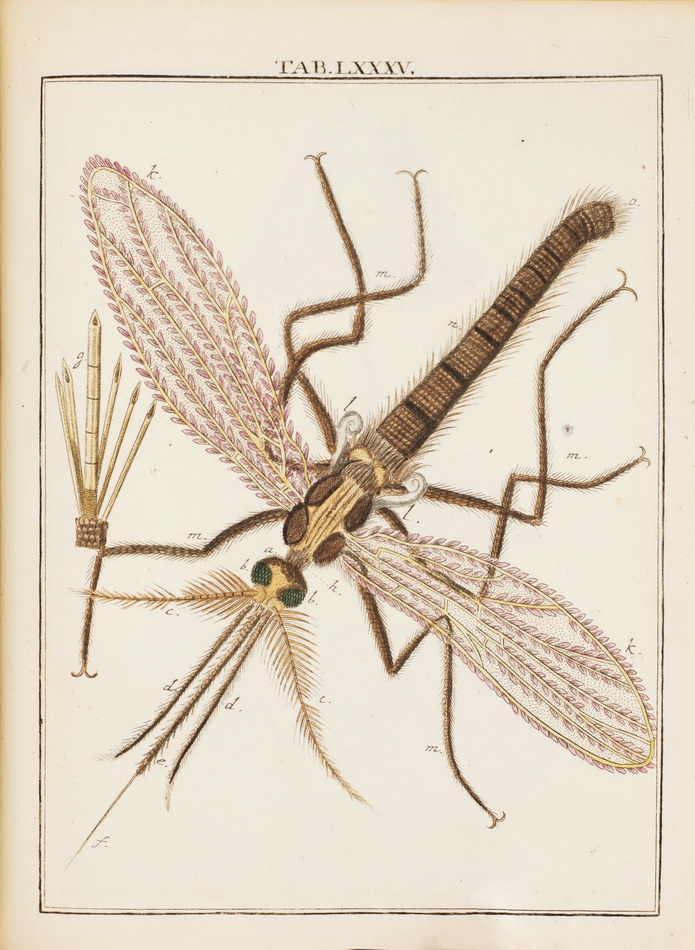
281. 显微镜检查。 7个标题: 高清作品[25%]

7 titles:

图片文件尺寸 : 5267 x 4043px

MICROSCOPY.:7 titles:
1. HOOKE, ROBERT. 1635-1702. The Posthumous Works of Robert Hooke. London: Samuel Smith and Benjamin Walford, 1705. Folio (320 x 202 mm). Half-title, title page in red and black, 15 engraved plates. Modern quarter vellum and marbled boards, morocco lettering piece on spine. Half-title laid down, title page tipped to stub, worming with some loss of text in front matter, dampstaining and browning throughout, ink ownership inscription on title page.
2. NEEDHAM, M. Nouvelles observations microscopiques. Paris: Louis-Etienne Ganeau, 1750. 16mo (168 x 96 mm). 8 folding engraved plates. Recased in contemporary mottled calf, 5 raised bands on spine, red morocco lettering pieces. Repairs to spine ends, dampstaining.
3. BAKER, HENRY. 1698-1774. Het Microscoop gemakkelyk gemaakt. Amsterdam: Isaak Tirion, 1744. Title page in red and black type, 14 engraved plates, folding table. 19th century half red morocco and marbled boards. Joints tender, rubbed, scattered spotting.
4. ---. Employment for the Microscope, in Two Parts. London: R. Dodsley, 1753. 8vo (195 x 120 mm). 17 engraved plates. Rebacked contemporary calf. Worming to lower margins, tear to outside margin of last plate with loss to corner, bookplate on front paste-down, browning and spotting.
5. ---. The Microscope Made Easy. London: J. Dodsley, 1769. 8vo. (210 x 128 mm). 15 engraved plates, some folding, folding table. 19th century calf, 5 raised bands on spine, red morocco gilt lettering piece. Joints tender, some ink marginalia, scattered spotting. Provenance: William Brodie of Brodie (bookplate).
6. LEDERMÜLLER, MARTIN FROBENIUS. Mikroskopische Gemüths- und Augen-Ergötzung. Nuremburg: Adam Wolffgang Winterschmidt, 1763. 4to (240 x 193 mm). Engraved allegorical frontispiece, engraved dedication portrait of Frederick of Brandenburg, 100 engraved plates, most tinted or hand-colored. Contemporary calf, rebacked. Frontispiece supplied from another copy, with top and margins trimmed, light dampstaining along top edge, browning and spotting.
7. GORING, C.R. 1792-1840, and ANDREW PRITCHARD. 1804-1882. Micrographia. London: Whittaker Co., 1837. 8vo (222 x 135 mm). Folding engraved frontispiece, 2 engraved full-page plates, 6 pp printer\'s ads at back. Contemporary tan buckram over plain boards. Covers soiled, corners bumped, shelfwear, library tape labels on spine, hinges cracked, a little loose, browning and spotting.

显微镜检查。 7个标题:

282. 米谢·弗龙 高清作品[24%]

DO-Jean-Michel Folon  - 现代艺术 I
图片文件像素:5663 x 4147 px

米谢·弗龙-

Jean-Michel Folon * - Zeitgenössische Kunst I-

(Brussels 1934–2005 Monaco)
La pêche miraculeuse (Buste aux poissons) / The Miraculous Catch (Bust with Fish), 2005, bronze, signed and numbered HC 2/2 (from an edition of 2 + 2 EA + 2 HC) with the foundry mark: Romain Fils, h 81 cm w 43 cm.

This work will be included in the artist’s forthcoming catalogue raisonné currently being prepared by the Fondation Folon.

This work is registered at the Fondation Folon with the number F400 and is accompanied by a certificate of authenticity.

Provenance:
European Private Collection

The 比利时 artist Jean-Michel Folon (1934-2005) has left a universal mark on the collective imagination of the last third of the 20th century through his posters, illustrations, television animations, and his numerous exhibitions. A humanist, he left behind a figurative and poetic body of work rooted in traditional techniques, which was atypical for an environment dominated by conceptual art. Folon turned to sculpture in the early 1990s, having initially focused on paper-based techniques (inks, silk-screen printing, watercolour), thus providing him with a new challenge.
His sculptures are inspired by ethnographic art and characterised by their frontality and corporality, from the Cyclades to the Etruscans, from African masks to Amerindian totems. They are largely centred on the human being and embody themes that were once treated graphically and thus project the artist\'s universe into atypical and natural environments: landscapes, gardens, parks, interiors.

La pêche miraculeuse (Buste aux poissons) [The Miraculous Catch (Bust with Fish)] from 2005 presents the artist’s favoured Everyman, the character with the hat, onto whom everyone can project themselves. He is holding an armful of fish. This bust sculpture is a variation on a theme that Folon had explored with a few years earlier in his Fontaine aux poissons [Fountain with Fish], which has been shown to the public on numerous occasions at major exhibitions, notably in Florence in 2005. The quality of the patina of this remarkable Catch is typical of Folon\'s quasi-pictorial quest for sculpture. It drew this comment from the sculptor.

“You make impressionist sculptures, these are the patinas of a painter and each of your sculptures will be unique because you will never be able to do the same thing twice.”
César

283. 蒙迪尼斯(DI LUZZI,MONDINO)。1275–1326. 阿纳托米娅·蒙迪尼由梅勒斯塔特医生修正。[莱比锡:马丁·兰茨贝格,1493年。] 高清作品[21%]

Anathomia Mundini emendata per doctorem melerstat. [Leipzig: Martin Landsberg, 1493.]

图片文件尺寸 : 5043 x 4532px

MUNDINUS (DI LUZZI, MONDINO). 1275–1326.:MELLERSTADT, MARTINUS, editor. c.1455-1513. Anathomia Mundini emendata per doctorem melerstat. [Leipzig: Martin Landsberg, 1493.]
4to (200 x 140 mm). 40 leaves, 34 lines, title with full-page woodcut of an anatomical scene. Modern calf antique. Inner margin of title neatly reinforced, tiny repair to blank outer margin of last leaf, illegible old library stamp to lower margin of title page, scattered light browning, mostly marginal.

FIRST ILLUSTRATED EDITION OF THE FIRST DEDICATED ANATOMY BOOK. \"The first modern book devoted solely to anatomy ... Mundinus re-introduced human dissection, which had been neglected for 1500 years before him; he was the most noted dissector of his period, and he set forth the medieval anatomical vocabulary, deriving it mainly from Arabic\" (Garrison). Mondino de\' Luzzi, professor at Bologna, is considered to be the founder of anatomy in the Middle Ages. His treatise remained popular until the beginning of the 16th-century and appeared in multiple editions.

\"The subject of anatomy was not taught either by lectures or by dissection in the universities at the middle of the fifteenth century. An occasional \'anatomy\' was held, but the neglect of the subject is well illustrated by the absence of anatomical books. There is only one in the list, that of Mundinus . . . Mundinus was a professor at Bologna from 1306 to 1326, and was the first to teach anatomy from the subject, usually the corpse of a condemned criminal; but there is the record of a procedure in 1319 against four medical students for body-snatching. His Anatomia, written in 1316, was for two hundred years the popular text book\" (Osler).

In the introduction of the book, Mundinus says, \"proposui meis scholaribus in medicina quoddam opus componere, \'I have proposed to compose a work in medicine for my scholars.\" The work \"met a need universally felt just at that time and commended itself for its brevity, conciseness, and completeness, as well as for the fact that it taught for each separate organ the necessary anatomic technique, as. for example, in the first chapter: \'Situato itaque corpore vel homine mortuo per decollationem vel suspensionem supino\', etc., \'accordingly, laying out the body of a man dead by decapitation or hanging, etc....\" (Choulant). VERY RARE: According to American Book Prices Current no copy sold in the past 42 years. Choulant-Frank History and Bibliography of Anatomic Illustration (Chicago 1920, pp 88-93); Garrison-Morton-Norman 361 (for the 1478 edition); Goff M-874; GW M-25671 (recording only 2 copies/fragments); Hain 11633; see Osler Incunabula Medica 156; Wellcome I, 4484.

蒙迪尼斯(DI LUZZI,MONDINO)。1275–1326. 阿纳托米娅·蒙迪尼由梅勒斯塔特医生修正。[莱比锡:马丁·兰茨贝格,1493年。]

284. 行政卡有限。 奥地利大公查尔斯在西班牙王位继承战争中塑造了自己的西班牙查理三世, 高清作品[20%]

Rare patent of nobility issued by Archduke Charles of Austria , fashioning himself Charles III of Spain during the War of the Spanish Succession ,

图片文件尺寸 : 4726 x 4820px

ILLUMINATED CARTA EXECUTORIA.:Rare patent of nobility issued by Archduke Charles of Austria (later Charles VI, Holy Roman Emperor), fashioning himself Charles III of Spain during the War of the Spanish Succession (1701–1714), conveying the title of Marquess of Callus (in Catalonia) upon Don Jaime Vicente Alamany Descallar, manuscript on vellum, text in Latin, 1711, 290 x 200 mm, 8 leaves bound as a single quire of 4 bifolia.
Collation: i8, the first leaf treated as a blank flyleaf. 22-26 long lines written in brown ink in italic script with one-line roman capitals; headings in larger capitals on ff. 2r-2v; written area: 215 x 125 mm. All text pages decorated with full borders containing delicate brown ink drawings. F. 2r with a cartouche depicting the king on a rearing horse firing a pistol, surmounted by a crown, below him a globe held by two putti and inscribed \"America\", below that the words NOS CAROLUS in a cartouche, all flanked by personifications of the church and the state and other motifs. On f. 2v the continuation of the text continues under a round seal stamped in in black ink, containing a coat of arms, and inscribed: CAROLUS III DEI GRATIA HISPANIARUM ET INDIARUM REX. Borders of ff. 2v-6v filled with vedute, vignettes, putti, cartouches, and various flourishes similar to those found in engraved writing-master books of the period. F. 7r with the last lines of the text and several notarial attestations. F. 7v blank. F. 8r with a large colored coat of arms surrounded by colored arabesque flourishes. F. 8v blank. Binding of later red velvet over pasteboards (worn) with remains of two monkeys-fist closures of woven silk, red silk doublures and single red silk flyleaves front and back, remains of a braided silk cord intended to attach the seal and a circular depression inside the back cover intended to hold the seal (seal missing).

RARE PATENT OF NOBILITY OF \"CHARLES III\" DURING HIS EMBATTLED CLAIM TO THE SPANISH THRONE. On the death of his Hapsburg relative King Charles II of Spain (1661-1700) without a direct heir, Archduke Charles of Austria declared himself the King of Spain, thus occasioning the War of the Spanish Succession, which pitted him against a rival candidate, Philip, Duke of Anjou, grandson of Louis XIV, and a distant cousin of the Archduke. In 1711, when his brother, the Holy Roman Emperor Joseph I, died the Archduke returned to Vienna to assume the imperial crown, while Philip was eventually recognized as King Philip V of Spain. During his brief time as claimant to the Spanish throne, Charles never extended his sphere of influence beyond Catalonia and lived there only from 1705 to 1711.

行政卡有限。 奥地利大公查尔斯在西班牙王位继承战争中塑造了自己的西班牙查理三世,

285. 英语圣经:伟大的“她”圣经。 《圣经》、《旧约》和《新约》。伦敦:罗伯特·巴克,[1613]-1611。 高清作品[20%]

The Holy Bible, Conteyning the Old Testament, and the New. London: Robert Barker, [1613] - 1611.

图片文件尺寸 : 5080 x 4062px

BIBLE IN ENGLISH: THE GREAT \"SHE\" BIBLE.:The Holy Bible, Conteyning the Old Testament, and the New. London: Robert Barker, [1613] - 1611. Folio (390 x 257 mm). title and final leaf supplied in facsimile, lacking 2 quires A and F, and with 19 leaves supplied from a later edition, engraved map of Canaan by John Speed, loosely inserted, and with its margins restored with some loss. Title to New Testament title dated 1611, set within wide woodcut pictorial borders, wood-cut head and tail pieces, calendar and almanack printed in red and black, occasional light toning, a few upper margins cut slightly close to border line. Paneled calf, antique, red speckled edges.
Collation: A1 (General Title, a facsimile of the He Bible and dated 1611), A2-4 (a2 margin slightly restored, a few restored holes affecting letters), B1-4, C1-6, D1-4: Quire A1-6 lacking (Title to genealogies and first 11 pages), B-E6, (Lacking quire F1-6), G-Z6, Aa-Zz6, Aaa-Zzz6 (rrr1 outer and lower margins torn with loss), Aaaa-Zzzz6, Aaaaa-Ccccc6;
New Testament: A-Z6 (with 15 leaves P1-6, S3-4, V5, X2-6 and Z3 all silked and damaged, and supplied from a shorter later edition, possibly the 1617 folio edition), 6A 1-5 supplied from another folio edition, 6A6 a facsimile leaf.
Provenance: Exhibited by Mr. Young (of Leicester, UK) in the early 20th Century, with a printed and manuscript exhibition label, containing manuscript notes on the typographical errors in the \"SHE\" Bible, the label loosely inserted at the front.

THE KING JAMES\' GREAT \"SHE\' BIBLE, THE SECOND FOLIO EDITION, with the reading in Ruth 3:15 corrected to \"She went into the citie,\" and with other errors including Matthew 26:36 where Judas appears for Jesus, but in this copy that error has been a corrected in an 18th century manuscript hand.

The King James Great Bible is considered to be the most important English Bible to have been printed. The biblical scholar Francis Fry described the \"SHE\" Bible as the first edition second issue without reprints, printed within two years of the first issue to correct typographical errors that were found in the text. The King James Bible was drawn up to reconcile the versions of the bible used by the Clergy, on the one hand, and the laity on the other. The translators, who numbered around 50, were divided into committees based in Oxford. Cambridge and London, and they were instructed to take the Bishops Bible as their basis and then consult with Tyndale\'s, Coverdale\'s, Matthew\'s, Whitchurch\'s and the Geneva versions to come up with an authorized text. This copy, although with facsimile first and last leaves, and two quires lacking, is substantially complete. \"From about the middle of the seventeenth century until the appearance of the Revised Bible of 1881-5, the King James\' version reigned without rival\"(Herbert 319). cf. PMM 114; STC 2224.

英语圣经:伟大的“她”圣经。 《圣经》、《旧约》和《新约》。伦敦:罗伯特·巴克,[1613]-1611。

286. 开普勒,约翰内斯。1571-1630. 鲁道夫的桌子被称为天文学,包括餐厅倒塌的时间。乌尔姆:乔纳斯·索,1627年。 高清作品[19%]

Tabulae Rudolphinae, quibus astronomicae scientiae, temporum longinquitate collapsae restauratio continentur.  Ulm: Jonas Saur, 1627.

图片文件尺寸 : 4192 x 4644px

KEPLER, JOHANNES. 1571-1630. :Tabulae Rudolphinae, quibus astronomicae scientiae, temporum longinquitate collapsae restauratio continentur. Ulm: Jonas Saur, 1627.
Folio (330 x 226 mm). Roman and italic types, double column, printed shoulder notes. Engraved allegorical frontispiece designed by Kepler, depicting Hipparchus, Ptolemy, Copernicus, Brahe, and Kepler gathered in the Temple of Urania, numerous woodcut diagrams in text, including a full-page of diagrams on k3v, woodcut initials, large woodcut device on part 2 section title. With the 4-leaves \"Sportula genethliacis missa\" (q4) printed in Sagan and dated 1629, inserted after the tabulae. Early 18th-century half-sheep and mottled boards, spine gilt in 7 compartments with red and green morocco lettering piece, red speckled edges, a few gatherings (including \"Sportula\", sig. q, issued in 1629) browned (as often). Provenance: Co. Riccati (Jacopo Francesco Riccati (1676-1754, Venetian mathematician; bookplate on title verso).

FIRST EDITION OF KEPLER\'S LAST LIFETIME PUBLICATION AND HIS CROWNING ACHIEVEMENT, THE \"FOUNDATION OF ALL PLANETARY CALCULATIONS FOR OVER A CENTURY\" (Sparrow). Third state, with second quire [):():(4] on different paper, albeit trimmed here to the same size as the adjacent leaves. \"The tables are extraordinarily important, for they document in a unique way Kepler\'s great contributions to astronomy\" (Gingerich). \"Besides the planetary, solar, and lunar tables and the associated tables of logarithms it includes Tycho Brahe\'s catalog of 1,000 fixed stars, a chronological synopsis, and a list of geographical positions ... Kepler was an astronomer\'s astronomer. It was the astronomers who recognized the immense superiority of the Tabulae Rudolphinae. For the professionals the improvement in planetary predictions was a forceful testimony to the efficacy of the Copernican system\" (Sparrow). Based on Tycho Brahe\'s observations, the tables were then supplemented by Kepler\'s own observations. The calculations were a major mathematical achievement, as of course, Brahe\'s data applied erroneously to \"perfect\" circular orbits. Kepler had discovered the true elliptical shape of the planetary orbits, and thus, had to recalculate everything according to his new laws. The printing history of the book, during the 30 years\' war, is quite complex. There were 1000 copies printed in Ulm in 1627, with three known states, affecting the title and the first two gatherings. Some copies are known with a posthumously published world map, and some have a posthumous appendix - neither is present in this copy. \"In excusing the long delay in publication... [Kepler] mentioned in the preface [p. 6] not only the difficulties of obtaining his salary and of the wartime conditions but also \'the novelty of my discoveries and the unexpected transfer of the whole of astronomy from fictitious circles to natural causes, which were most profound to investigate, difficult to explain, and difficult to calculate, since mine was the first attempt\'\" (DSB). Caspar 79; Gingerich Johannes Kepler and the Rudolphine tables; Houzeau and Lancaster 12754; Lalande p 190; Norman 1208; Sparrow 116.

开普勒,约翰内斯。1571-1630. 鲁道夫的桌子被称为天文学,包括餐厅倒塌的时间。乌尔姆:乔纳斯·索,1627年。

287. 多斯托耶夫斯基的名片上写着亚历山大·赫尔岑。 照片署名并题写(俄语)给亚历山大·赫尔岑, 高清作品[12%]

Photograph signed and inscribed [in Russian] to Alexander Herzen,

图片文件尺寸 : 3981 x 5780px

DOSTOEVSKY CARTE-DE-VISITE INSCRIBED TO ALEXANDER HERZEN.:DOSTOEVSKY, FYODOR. 1821-1881. Photograph signed and inscribed [in Russian] to Alexander Herzen, albumen print carte-de-visite full length portrait by M.B. Tulinov, Petersburg, 1861, 105 x 65 mm, inscribed by Dostoevsky in Russian to the verso, \"Alexander Ivanovich Herzen in memory of our meeting in London. Fyodor Dostoyevsky 8 July/20 July 1862,\" minor stain to verso.
Provenance: Alexander Ivanovich Herzen; to daughter Olga Aleksandrovna [Herzen] Monod; by descent.
Publication: For a discussion of the photograph, see Volgin, Igor. \"Introduction\" to The Dostoevsky Archive (1997), p 21.

Pull quote: \"Herzen awaits his readers in the future. Far above the heads of the present crowd, he transmits his thoughts to those who will be able to comprehend them.\" – Leo Tolstoy, 1905.

VERY RARE CARTE DE VISITE PHOTOGRAPH OF FYODOR DOSTOEVSKY PRESENTED TO ALEXANDER HERZEN IN REMEMBRANCE OF THEIR 1862 MEETING IN LONDON: A TREMENDOUSLY IMPORTANT ASSOCIATION BETWEEN TWO OF THE LEADING INTELLECTUALS OF THE 19TH-CENTURY.

Alexander Herzen was one of the most important and influential Russian writers and thinkers of the 19th-century. called the \"father of Russian socialism,\" he had a profound influence on late-19th century Russian writers, including Fyodor Dostoevsky. Born illegitimately to a wealthy Russian landowner, Herzen became a dissident and critic of the Russian feudal system. Of Herzen, Tolstoy said he had never met a man \"with so rare a combination of scintillating brilliance and depth.\" His writings, including From the Other Shore (1848) and those appearing in his influential publications of the 1850s-60s The Bell and the Polestar, would help mold a generation of Russian writing and thought.

Herzen and Dostoevsky met for the first time in Russia in 1846, following Dostoevsky\'s comment in a letter to his brother that Herzen and Goncharov stand as \"the most remarkable\" of his rivals; Herzen\'s recollection of the meeting was less than effusive, however: \"I can\'t say he made a particularly present impression.\" Their second meeting occurred when Dostoevsky visited Herzen in London in July of 1862, of which this photograph is a memento. During the 1850s and early 1860s, visits to the emigree Herzen by Russian writers and intellectuals were something of a right of passage, and Dostoevsky\'s visit followed right on the heels of Turgenev. This series of meetings profoundly affected Dostoevsky and his work, and is clearly acknowledged in his Winter Notes which he wrote later that year, exhibiting a clear debt to Herzen\'s own writings. Dostoevsky, along with Solzhenitsyn, acknowledged the formative influence of Herzen on his work, and Herzen would also appear in composite in a number of Dostoevsky\'s characters throughout his career. Herzen, however, noted, rather condescendingly, \"Dostoevsky was here yesterday—he is a naïve, not entirely lucid, but a very dear person. He believes enthusiastically in the Russian people.\"

The two towering figures would meet again on a steamship from Naples to Livorno the following year, where Dostoevsky was travelling with his mistress Polina Suslova. According to Suslova\'s diaries (as published in The Dostoevsky Archives), Dostoevsky took pains to hide their relationship from Herzen, introducing her vaguely as a family member, and even encouraged her to arrange a visit with Herzen\'s son in Paris that Winter. After they parted, Dostoevsky became angry with her over a photograph of her he had seen at Herzen\'s, which she had given at an earlier date. In 1865, Dostoevsky wrote to Herzen imploring him for a loan, and became peevish when Herzen did not immediately respond. By the late 1860s Dostoevsky would disparage Herzen, somewhat unfairly, as a \"Westernizer,\" leading to his more severe criticism of Herzen in his Writer\'s Diary.

Herzen was one of the most complex and brilliant figures of the 19th-century, and was largely responsible for assimilating western ideas into Russian thought, while still maintaining his advocacy for the freedom of the Russian serf.

In reality, the two writers/thinkers shared a great deal in their outlook: both asserted the importance of the individual, and the folly of the search for a unified teleological system, cutting against the grain of their mid-19th century contemporaries. While Herzen was embraced by Lenin, identified as the \"father of Russian socialism,\" Herzen\'s socialism was a different breed, \"Centralization may do a great deal for order and for various public undertakings, but it is incompatible with freedom. It easily brings a nation to the position of a well-tended flock or a pack of hounds cleverly kept in order by a huntsman.\" Lenin regarded Herzen\'s focus on freedom as a shortcoming of his bourgeois roots. During the 20th-century Russian-British philosopher Isaiah Berlin came across Herzen\'s writings and recognized the prescience of Herzen\'s thought. It was Berlin, who reestablished Herzen\'s influence, agreeing with and amplifying his idea that the pursuit of \"a perfect society\" invariably leads to blood.

The present photograph was taken by Mikhail Borisovich Tulinov (1823–1889) in Petersburg in 1861. Any period photograph of Dostoevsky is rare, and moreso inscribed. We trace two inscribed photographs at auction in the last 40 years. However, we find no record of an inscribed photograph of similar substance and importance in the historical record. An incredible, and incredibly rare, Dostoevsky item tying together two of the greatest thinkers and writers of the 19th-century.

REFERENCES:
Kelly, Aileen. The Discovery of Chance: The Life and Thought of Alexander Herzen. 2016.
Kelly, Aileen. \"Irony and Utopia in Herzen and Dostoevsky: From the Other Shore and Diary of a Writer.\" The Russian Review, 50:4 (1991), pp 397-416.
Lantz, Kenneth. The Dostoevsky Encycolpedia. 2004.
Serakin, Peter. The Dostoevsky Archive: Firsthand Accounts of the Novelist from Contemporaries\' Memoirs and Rare Periodicals. 1997.


\"If only people wanted to save themselves instead of saving the world, how much they would do for the salvation of the world and the liberation of humanity!\" – Alexander Herzen, From the Other Shore, 1848.

多斯托耶夫斯基的名片上写着亚历山大·赫尔岑。 照片署名并题写(俄语)给亚历山大·赫尔岑,

last油画图片- 高清last绘画作品- 代表作全集 中艺名画下载


281. 显微镜检查。 7个标题: 高清作品[25%]

7 titles:

图片文件尺寸 : 5267 x 4043px

MICROSCOPY.:7 titles:
1. HOOKE, ROBERT. 1635-1702. The Posthumous Works of Robert Hooke. London: Samuel Smith and Benjamin Walford, 1705. Folio (320 x 202 mm). Half-title, title page in red and black, 15 engraved plates. Modern quarter vellum and marbled boards, morocco lettering piece on spine. Half-title laid down, title page tipped to stub, worming with some loss of text in front matter, dampstaining and browning throughout, ink ownership inscription on title page.
2. NEEDHAM, M. Nouvelles observations microscopiques. Paris: Louis-Etienne Ganeau, 1750. 16mo (168 x 96 mm). 8 folding engraved plates. Recased in contemporary mottled calf, 5 raised bands on spine, red morocco lettering pieces. Repairs to spine ends, dampstaining.
3. BAKER, HENRY. 1698-1774. Het Microscoop gemakkelyk gemaakt. Amsterdam: Isaak Tirion, 1744. Title page in red and black type, 14 engraved plates, folding table. 19th century half red morocco and marbled boards. Joints tender, rubbed, scattered spotting.
4. ---. Employment for the Microscope, in Two Parts. London: R. Dodsley, 1753. 8vo (195 x 120 mm). 17 engraved plates. Rebacked contemporary calf. Worming to lower margins, tear to outside margin of last plate with loss to corner, bookplate on front paste-down, browning and spotting.
5. ---. The Microscope Made Easy. London: J. Dodsley, 1769. 8vo. (210 x 128 mm). 15 engraved plates, some folding, folding table. 19th century calf, 5 raised bands on spine, red morocco gilt lettering piece. Joints tender, some ink marginalia, scattered spotting. Provenance: William Brodie of Brodie (bookplate).
6. LEDERMÜLLER, MARTIN FROBENIUS. Mikroskopische Gemüths- und Augen-Ergötzung. Nuremburg: Adam Wolffgang Winterschmidt, 1763. 4to (240 x 193 mm). Engraved allegorical frontispiece, engraved dedication portrait of Frederick of Brandenburg, 100 engraved plates, most tinted or hand-colored. Contemporary calf, rebacked. Frontispiece supplied from another copy, with top and margins trimmed, light dampstaining along top edge, browning and spotting.
7. GORING, C.R. 1792-1840, and ANDREW PRITCHARD. 1804-1882. Micrographia. London: Whittaker Co., 1837. 8vo (222 x 135 mm). Folding engraved frontispiece, 2 engraved full-page plates, 6 pp printer\'s ads at back. Contemporary tan buckram over plain boards. Covers soiled, corners bumped, shelfwear, library tape labels on spine, hinges cracked, a little loose, browning and spotting.

显微镜检查。 7个标题:

282. 米谢·弗龙 高清作品[24%]

DO-Jean-Michel Folon  - 现代艺术 I
图片文件像素:5663 x 4147 px

米谢·弗龙-

Jean-Michel Folon * - Zeitgenössische Kunst I-

(Brussels 1934–2005 Monaco)
La pêche miraculeuse (Buste aux poissons) / The Miraculous Catch (Bust with Fish), 2005, bronze, signed and numbered HC 2/2 (from an edition of 2 + 2 EA + 2 HC) with the foundry mark: Romain Fils, h 81 cm w 43 cm.

This work will be included in the artist’s forthcoming catalogue raisonné currently being prepared by the Fondation Folon.

This work is registered at the Fondation Folon with the number F400 and is accompanied by a certificate of authenticity.

Provenance:
European Private Collection

The 比利时 artist Jean-Michel Folon (1934-2005) has left a universal mark on the collective imagination of the last third of the 20th century through his posters, illustrations, television animations, and his numerous exhibitions. A humanist, he left behind a figurative and poetic body of work rooted in traditional techniques, which was atypical for an environment dominated by conceptual art. Folon turned to sculpture in the early 1990s, having initially focused on paper-based techniques (inks, silk-screen printing, watercolour), thus providing him with a new challenge.
His sculptures are inspired by ethnographic art and characterised by their frontality and corporality, from the Cyclades to the Etruscans, from African masks to Amerindian totems. They are largely centred on the human being and embody themes that were once treated graphically and thus project the artist\'s universe into atypical and natural environments: landscapes, gardens, parks, interiors.

La pêche miraculeuse (Buste aux poissons) [The Miraculous Catch (Bust with Fish)] from 2005 presents the artist’s favoured Everyman, the character with the hat, onto whom everyone can project themselves. He is holding an armful of fish. This bust sculpture is a variation on a theme that Folon had explored with a few years earlier in his Fontaine aux poissons [Fountain with Fish], which has been shown to the public on numerous occasions at major exhibitions, notably in Florence in 2005. The quality of the patina of this remarkable Catch is typical of Folon\'s quasi-pictorial quest for sculpture. It drew this comment from the sculptor.

“You make impressionist sculptures, these are the patinas of a painter and each of your sculptures will be unique because you will never be able to do the same thing twice.”
César

283. 蒙迪尼斯(DI LUZZI,MONDINO)。1275–1326. 阿纳托米娅·蒙迪尼由梅勒斯塔特医生修正。[莱比锡:马丁·兰茨贝格,1493年。] 高清作品[21%]

Anathomia Mundini emendata per doctorem melerstat. [Leipzig: Martin Landsberg, 1493.]

图片文件尺寸 : 5043 x 4532px

MUNDINUS (DI LUZZI, MONDINO). 1275–1326.:MELLERSTADT, MARTINUS, editor. c.1455-1513. Anathomia Mundini emendata per doctorem melerstat. [Leipzig: Martin Landsberg, 1493.]
4to (200 x 140 mm). 40 leaves, 34 lines, title with full-page woodcut of an anatomical scene. Modern calf antique. Inner margin of title neatly reinforced, tiny repair to blank outer margin of last leaf, illegible old library stamp to lower margin of title page, scattered light browning, mostly marginal.

FIRST ILLUSTRATED EDITION OF THE FIRST DEDICATED ANATOMY BOOK. \"The first modern book devoted solely to anatomy ... Mundinus re-introduced human dissection, which had been neglected for 1500 years before him; he was the most noted dissector of his period, and he set forth the medieval anatomical vocabulary, deriving it mainly from Arabic\" (Garrison). Mondino de\' Luzzi, professor at Bologna, is considered to be the founder of anatomy in the Middle Ages. His treatise remained popular until the beginning of the 16th-century and appeared in multiple editions.

\"The subject of anatomy was not taught either by lectures or by dissection in the universities at the middle of the fifteenth century. An occasional \'anatomy\' was held, but the neglect of the subject is well illustrated by the absence of anatomical books. There is only one in the list, that of Mundinus . . . Mundinus was a professor at Bologna from 1306 to 1326, and was the first to teach anatomy from the subject, usually the corpse of a condemned criminal; but there is the record of a procedure in 1319 against four medical students for body-snatching. His Anatomia, written in 1316, was for two hundred years the popular text book\" (Osler).

In the introduction of the book, Mundinus says, \"proposui meis scholaribus in medicina quoddam opus componere, \'I have proposed to compose a work in medicine for my scholars.\" The work \"met a need universally felt just at that time and commended itself for its brevity, conciseness, and completeness, as well as for the fact that it taught for each separate organ the necessary anatomic technique, as. for example, in the first chapter: \'Situato itaque corpore vel homine mortuo per decollationem vel suspensionem supino\', etc., \'accordingly, laying out the body of a man dead by decapitation or hanging, etc....\" (Choulant). VERY RARE: According to American Book Prices Current no copy sold in the past 42 years. Choulant-Frank History and Bibliography of Anatomic Illustration (Chicago 1920, pp 88-93); Garrison-Morton-Norman 361 (for the 1478 edition); Goff M-874; GW M-25671 (recording only 2 copies/fragments); Hain 11633; see Osler Incunabula Medica 156; Wellcome I, 4484.

蒙迪尼斯(DI LUZZI,MONDINO)。1275–1326. 阿纳托米娅·蒙迪尼由梅勒斯塔特医生修正。[莱比锡:马丁·兰茨贝格,1493年。]

284. 行政卡有限。 奥地利大公查尔斯在西班牙王位继承战争中塑造了自己的西班牙查理三世, 高清作品[20%]

Rare patent of nobility issued by Archduke Charles of Austria , fashioning himself Charles III of Spain during the War of the Spanish Succession ,

图片文件尺寸 : 4726 x 4820px

ILLUMINATED CARTA EXECUTORIA.:Rare patent of nobility issued by Archduke Charles of Austria (later Charles VI, Holy Roman Emperor), fashioning himself Charles III of Spain during the War of the Spanish Succession (1701–1714), conveying the title of Marquess of Callus (in Catalonia) upon Don Jaime Vicente Alamany Descallar, manuscript on vellum, text in Latin, 1711, 290 x 200 mm, 8 leaves bound as a single quire of 4 bifolia.
Collation: i8, the first leaf treated as a blank flyleaf. 22-26 long lines written in brown ink in italic script with one-line roman capitals; headings in larger capitals on ff. 2r-2v; written area: 215 x 125 mm. All text pages decorated with full borders containing delicate brown ink drawings. F. 2r with a cartouche depicting the king on a rearing horse firing a pistol, surmounted by a crown, below him a globe held by two putti and inscribed \"America\", below that the words NOS CAROLUS in a cartouche, all flanked by personifications of the church and the state and other motifs. On f. 2v the continuation of the text continues under a round seal stamped in in black ink, containing a coat of arms, and inscribed: CAROLUS III DEI GRATIA HISPANIARUM ET INDIARUM REX. Borders of ff. 2v-6v filled with vedute, vignettes, putti, cartouches, and various flourishes similar to those found in engraved writing-master books of the period. F. 7r with the last lines of the text and several notarial attestations. F. 7v blank. F. 8r with a large colored coat of arms surrounded by colored arabesque flourishes. F. 8v blank. Binding of later red velvet over pasteboards (worn) with remains of two monkeys-fist closures of woven silk, red silk doublures and single red silk flyleaves front and back, remains of a braided silk cord intended to attach the seal and a circular depression inside the back cover intended to hold the seal (seal missing).

RARE PATENT OF NOBILITY OF \"CHARLES III\" DURING HIS EMBATTLED CLAIM TO THE SPANISH THRONE. On the death of his Hapsburg relative King Charles II of Spain (1661-1700) without a direct heir, Archduke Charles of Austria declared himself the King of Spain, thus occasioning the War of the Spanish Succession, which pitted him against a rival candidate, Philip, Duke of Anjou, grandson of Louis XIV, and a distant cousin of the Archduke. In 1711, when his brother, the Holy Roman Emperor Joseph I, died the Archduke returned to Vienna to assume the imperial crown, while Philip was eventually recognized as King Philip V of Spain. During his brief time as claimant to the Spanish throne, Charles never extended his sphere of influence beyond Catalonia and lived there only from 1705 to 1711.

行政卡有限。 奥地利大公查尔斯在西班牙王位继承战争中塑造了自己的西班牙查理三世,

285. 英语圣经:伟大的“她”圣经。 《圣经》、《旧约》和《新约》。伦敦:罗伯特·巴克,[1613]-1611。 高清作品[20%]

The Holy Bible, Conteyning the Old Testament, and the New. London: Robert Barker, [1613] - 1611.

图片文件尺寸 : 5080 x 4062px

BIBLE IN ENGLISH: THE GREAT \"SHE\" BIBLE.:The Holy Bible, Conteyning the Old Testament, and the New. London: Robert Barker, [1613] - 1611. Folio (390 x 257 mm). title and final leaf supplied in facsimile, lacking 2 quires A and F, and with 19 leaves supplied from a later edition, engraved map of Canaan by John Speed, loosely inserted, and with its margins restored with some loss. Title to New Testament title dated 1611, set within wide woodcut pictorial borders, wood-cut head and tail pieces, calendar and almanack printed in red and black, occasional light toning, a few upper margins cut slightly close to border line. Paneled calf, antique, red speckled edges.
Collation: A1 (General Title, a facsimile of the He Bible and dated 1611), A2-4 (a2 margin slightly restored, a few restored holes affecting letters), B1-4, C1-6, D1-4: Quire A1-6 lacking (Title to genealogies and first 11 pages), B-E6, (Lacking quire F1-6), G-Z6, Aa-Zz6, Aaa-Zzz6 (rrr1 outer and lower margins torn with loss), Aaaa-Zzzz6, Aaaaa-Ccccc6;
New Testament: A-Z6 (with 15 leaves P1-6, S3-4, V5, X2-6 and Z3 all silked and damaged, and supplied from a shorter later edition, possibly the 1617 folio edition), 6A 1-5 supplied from another folio edition, 6A6 a facsimile leaf.
Provenance: Exhibited by Mr. Young (of Leicester, UK) in the early 20th Century, with a printed and manuscript exhibition label, containing manuscript notes on the typographical errors in the \"SHE\" Bible, the label loosely inserted at the front.

THE KING JAMES\' GREAT \"SHE\' BIBLE, THE SECOND FOLIO EDITION, with the reading in Ruth 3:15 corrected to \"She went into the citie,\" and with other errors including Matthew 26:36 where Judas appears for Jesus, but in this copy that error has been a corrected in an 18th century manuscript hand.

The King James Great Bible is considered to be the most important English Bible to have been printed. The biblical scholar Francis Fry described the \"SHE\" Bible as the first edition second issue without reprints, printed within two years of the first issue to correct typographical errors that were found in the text. The King James Bible was drawn up to reconcile the versions of the bible used by the Clergy, on the one hand, and the laity on the other. The translators, who numbered around 50, were divided into committees based in Oxford. Cambridge and London, and they were instructed to take the Bishops Bible as their basis and then consult with Tyndale\'s, Coverdale\'s, Matthew\'s, Whitchurch\'s and the Geneva versions to come up with an authorized text. This copy, although with facsimile first and last leaves, and two quires lacking, is substantially complete. \"From about the middle of the seventeenth century until the appearance of the Revised Bible of 1881-5, the King James\' version reigned without rival\"(Herbert 319). cf. PMM 114; STC 2224.

英语圣经:伟大的“她”圣经。 《圣经》、《旧约》和《新约》。伦敦:罗伯特·巴克,[1613]-1611。

286. 开普勒,约翰内斯。1571-1630. 鲁道夫的桌子被称为天文学,包括餐厅倒塌的时间。乌尔姆:乔纳斯·索,1627年。 高清作品[19%]

Tabulae Rudolphinae, quibus astronomicae scientiae, temporum longinquitate collapsae restauratio continentur.  Ulm: Jonas Saur, 1627.

图片文件尺寸 : 4192 x 4644px

KEPLER, JOHANNES. 1571-1630. :Tabulae Rudolphinae, quibus astronomicae scientiae, temporum longinquitate collapsae restauratio continentur. Ulm: Jonas Saur, 1627.
Folio (330 x 226 mm). Roman and italic types, double column, printed shoulder notes. Engraved allegorical frontispiece designed by Kepler, depicting Hipparchus, Ptolemy, Copernicus, Brahe, and Kepler gathered in the Temple of Urania, numerous woodcut diagrams in text, including a full-page of diagrams on k3v, woodcut initials, large woodcut device on part 2 section title. With the 4-leaves \"Sportula genethliacis missa\" (q4) printed in Sagan and dated 1629, inserted after the tabulae. Early 18th-century half-sheep and mottled boards, spine gilt in 7 compartments with red and green morocco lettering piece, red speckled edges, a few gatherings (including \"Sportula\", sig. q, issued in 1629) browned (as often). Provenance: Co. Riccati (Jacopo Francesco Riccati (1676-1754, Venetian mathematician; bookplate on title verso).

FIRST EDITION OF KEPLER\'S LAST LIFETIME PUBLICATION AND HIS CROWNING ACHIEVEMENT, THE \"FOUNDATION OF ALL PLANETARY CALCULATIONS FOR OVER A CENTURY\" (Sparrow). Third state, with second quire [):():(4] on different paper, albeit trimmed here to the same size as the adjacent leaves. \"The tables are extraordinarily important, for they document in a unique way Kepler\'s great contributions to astronomy\" (Gingerich). \"Besides the planetary, solar, and lunar tables and the associated tables of logarithms it includes Tycho Brahe\'s catalog of 1,000 fixed stars, a chronological synopsis, and a list of geographical positions ... Kepler was an astronomer\'s astronomer. It was the astronomers who recognized the immense superiority of the Tabulae Rudolphinae. For the professionals the improvement in planetary predictions was a forceful testimony to the efficacy of the Copernican system\" (Sparrow). Based on Tycho Brahe\'s observations, the tables were then supplemented by Kepler\'s own observations. The calculations were a major mathematical achievement, as of course, Brahe\'s data applied erroneously to \"perfect\" circular orbits. Kepler had discovered the true elliptical shape of the planetary orbits, and thus, had to recalculate everything according to his new laws. The printing history of the book, during the 30 years\' war, is quite complex. There were 1000 copies printed in Ulm in 1627, with three known states, affecting the title and the first two gatherings. Some copies are known with a posthumously published world map, and some have a posthumous appendix - neither is present in this copy. \"In excusing the long delay in publication... [Kepler] mentioned in the preface [p. 6] not only the difficulties of obtaining his salary and of the wartime conditions but also \'the novelty of my discoveries and the unexpected transfer of the whole of astronomy from fictitious circles to natural causes, which were most profound to investigate, difficult to explain, and difficult to calculate, since mine was the first attempt\'\" (DSB). Caspar 79; Gingerich Johannes Kepler and the Rudolphine tables; Houzeau and Lancaster 12754; Lalande p 190; Norman 1208; Sparrow 116.

开普勒,约翰内斯。1571-1630. 鲁道夫的桌子被称为天文学,包括餐厅倒塌的时间。乌尔姆:乔纳斯·索,1627年。

287. 多斯托耶夫斯基的名片上写着亚历山大·赫尔岑。 照片署名并题写(俄语)给亚历山大·赫尔岑, 高清作品[12%]

Photograph signed and inscribed [in Russian] to Alexander Herzen,

图片文件尺寸 : 3981 x 5780px

DOSTOEVSKY CARTE-DE-VISITE INSCRIBED TO ALEXANDER HERZEN.:DOSTOEVSKY, FYODOR. 1821-1881. Photograph signed and inscribed [in Russian] to Alexander Herzen, albumen print carte-de-visite full length portrait by M.B. Tulinov, Petersburg, 1861, 105 x 65 mm, inscribed by Dostoevsky in Russian to the verso, \"Alexander Ivanovich Herzen in memory of our meeting in London. Fyodor Dostoyevsky 8 July/20 July 1862,\" minor stain to verso.
Provenance: Alexander Ivanovich Herzen; to daughter Olga Aleksandrovna [Herzen] Monod; by descent.
Publication: For a discussion of the photograph, see Volgin, Igor. \"Introduction\" to The Dostoevsky Archive (1997), p 21.

Pull quote: \"Herzen awaits his readers in the future. Far above the heads of the present crowd, he transmits his thoughts to those who will be able to comprehend them.\" – Leo Tolstoy, 1905.

VERY RARE CARTE DE VISITE PHOTOGRAPH OF FYODOR DOSTOEVSKY PRESENTED TO ALEXANDER HERZEN IN REMEMBRANCE OF THEIR 1862 MEETING IN LONDON: A TREMENDOUSLY IMPORTANT ASSOCIATION BETWEEN TWO OF THE LEADING INTELLECTUALS OF THE 19TH-CENTURY.

Alexander Herzen was one of the most important and influential Russian writers and thinkers of the 19th-century. called the \"father of Russian socialism,\" he had a profound influence on late-19th century Russian writers, including Fyodor Dostoevsky. Born illegitimately to a wealthy Russian landowner, Herzen became a dissident and critic of the Russian feudal system. Of Herzen, Tolstoy said he had never met a man \"with so rare a combination of scintillating brilliance and depth.\" His writings, including From the Other Shore (1848) and those appearing in his influential publications of the 1850s-60s The Bell and the Polestar, would help mold a generation of Russian writing and thought.

Herzen and Dostoevsky met for the first time in Russia in 1846, following Dostoevsky\'s comment in a letter to his brother that Herzen and Goncharov stand as \"the most remarkable\" of his rivals; Herzen\'s recollection of the meeting was less than effusive, however: \"I can\'t say he made a particularly present impression.\" Their second meeting occurred when Dostoevsky visited Herzen in London in July of 1862, of which this photograph is a memento. During the 1850s and early 1860s, visits to the emigree Herzen by Russian writers and intellectuals were something of a right of passage, and Dostoevsky\'s visit followed right on the heels of Turgenev. This series of meetings profoundly affected Dostoevsky and his work, and is clearly acknowledged in his Winter Notes which he wrote later that year, exhibiting a clear debt to Herzen\'s own writings. Dostoevsky, along with Solzhenitsyn, acknowledged the formative influence of Herzen on his work, and Herzen would also appear in composite in a number of Dostoevsky\'s characters throughout his career. Herzen, however, noted, rather condescendingly, \"Dostoevsky was here yesterday—he is a naïve, not entirely lucid, but a very dear person. He believes enthusiastically in the Russian people.\"

The two towering figures would meet again on a steamship from Naples to Livorno the following year, where Dostoevsky was travelling with his mistress Polina Suslova. According to Suslova\'s diaries (as published in The Dostoevsky Archives), Dostoevsky took pains to hide their relationship from Herzen, introducing her vaguely as a family member, and even encouraged her to arrange a visit with Herzen\'s son in Paris that Winter. After they parted, Dostoevsky became angry with her over a photograph of her he had seen at Herzen\'s, which she had given at an earlier date. In 1865, Dostoevsky wrote to Herzen imploring him for a loan, and became peevish when Herzen did not immediately respond. By the late 1860s Dostoevsky would disparage Herzen, somewhat unfairly, as a \"Westernizer,\" leading to his more severe criticism of Herzen in his Writer\'s Diary.

Herzen was one of the most complex and brilliant figures of the 19th-century, and was largely responsible for assimilating western ideas into Russian thought, while still maintaining his advocacy for the freedom of the Russian serf.

In reality, the two writers/thinkers shared a great deal in their outlook: both asserted the importance of the individual, and the folly of the search for a unified teleological system, cutting against the grain of their mid-19th century contemporaries. While Herzen was embraced by Lenin, identified as the \"father of Russian socialism,\" Herzen\'s socialism was a different breed, \"Centralization may do a great deal for order and for various public undertakings, but it is incompatible with freedom. It easily brings a nation to the position of a well-tended flock or a pack of hounds cleverly kept in order by a huntsman.\" Lenin regarded Herzen\'s focus on freedom as a shortcoming of his bourgeois roots. During the 20th-century Russian-British philosopher Isaiah Berlin came across Herzen\'s writings and recognized the prescience of Herzen\'s thought. It was Berlin, who reestablished Herzen\'s influence, agreeing with and amplifying his idea that the pursuit of \"a perfect society\" invariably leads to blood.

The present photograph was taken by Mikhail Borisovich Tulinov (1823–1889) in Petersburg in 1861. Any period photograph of Dostoevsky is rare, and moreso inscribed. We trace two inscribed photographs at auction in the last 40 years. However, we find no record of an inscribed photograph of similar substance and importance in the historical record. An incredible, and incredibly rare, Dostoevsky item tying together two of the greatest thinkers and writers of the 19th-century.

REFERENCES:
Kelly, Aileen. The Discovery of Chance: The Life and Thought of Alexander Herzen. 2016.
Kelly, Aileen. \"Irony and Utopia in Herzen and Dostoevsky: From the Other Shore and Diary of a Writer.\" The Russian Review, 50:4 (1991), pp 397-416.
Lantz, Kenneth. The Dostoevsky Encycolpedia. 2004.
Serakin, Peter. The Dostoevsky Archive: Firsthand Accounts of the Novelist from Contemporaries\' Memoirs and Rare Periodicals. 1997.


\"If only people wanted to save themselves instead of saving the world, how much they would do for the salvation of the world and the liberation of humanity!\" – Alexander Herzen, From the Other Shore, 1848.

多斯托耶夫斯基的名片上写着亚历山大·赫尔岑。 照片署名并题写(俄语)给亚历山大·赫尔岑,