11. 犹大。 犹太人和基督徒在共同和对话中留下的痕迹。[巴塞尔:马丁·弗莱奇,1474年之后才开始。] 高清作品[47%]

Tractatus de Judaeorum et Christianorum communione et conversatione.  [Basel: Martin Flach, not after 1474.]

图片文件尺寸 : 4576 x 5013px

JUDAICA.:Tractatus de Judaeorum et Christianorum communione et conversatione. [Basel: Martin Flach, not after 1474.]
Folio (282 x 210 mm). 16 leaves. 34 lines. Flach\'s type 1:117G. Initials in blue and red. Modern mottled calf. Some minor staining.

FIRST EDITION of the 1447 edict commanding that Jews convert to Christianity. Martin Flach began his career as a journeyman in Strassburg in 1472 before printing in his own name from 1487. RARE: according to American Book Prices Current only one other copy sold at auction in the past 45 years. BMC III,740; BSB-Ink T-411; Goff J-493; GW 7258; HC 9464.

犹大。 犹太人和基督徒在共同和对话中留下的痕迹。[巴塞尔:马丁·弗莱奇,1474年之后才开始。]

12. 英语圣经:伟大的“她”圣经。 《圣经》、《旧约》和《新约》。伦敦:罗伯特·巴克,[1613]-1611。 高清作品[35%]

The Holy Bible, Conteyning the Old Testament, and the New. London: Robert Barker, [1613] - 1611.

图片文件尺寸 : 5080 x 4062px

BIBLE IN ENGLISH: THE GREAT \"SHE\" BIBLE.:The Holy Bible, Conteyning the Old Testament, and the New. London: Robert Barker, [1613] - 1611. Folio (390 x 257 mm). title and final leaf supplied in facsimile, lacking 2 quires A and F, and with 19 leaves supplied from a later edition, engraved map of Canaan by John Speed, loosely inserted, and with its margins restored with some loss. Title to New Testament title dated 1611, set within wide woodcut pictorial borders, wood-cut head and tail pieces, calendar and almanack printed in red and black, occasional light toning, a few upper margins cut slightly close to border line. Paneled calf, antique, red speckled edges.
Collation: A1 (General Title, a facsimile of the He Bible and dated 1611), A2-4 (a2 margin slightly restored, a few restored holes affecting letters), B1-4, C1-6, D1-4: Quire A1-6 lacking (Title to genealogies and first 11 pages), B-E6, (Lacking quire F1-6), G-Z6, Aa-Zz6, Aaa-Zzz6 (rrr1 outer and lower margins torn with loss), Aaaa-Zzzz6, Aaaaa-Ccccc6;
New Testament: A-Z6 (with 15 leaves P1-6, S3-4, V5, X2-6 and Z3 all silked and damaged, and supplied from a shorter later edition, possibly the 1617 folio edition), 6A 1-5 supplied from another folio edition, 6A6 a facsimile leaf.
Provenance: Exhibited by Mr. Young (of Leicester, UK) in the early 20th Century, with a printed and manuscript exhibition label, containing manuscript notes on the typographical errors in the \"SHE\" Bible, the label loosely inserted at the front.

THE KING JAMES\' GREAT \"SHE\' BIBLE, THE SECOND FOLIO EDITION, with the reading in Ruth 3:15 corrected to \"She went into the citie,\" and with other errors including Matthew 26:36 where Judas appears for Jesus, but in this copy that error has been a corrected in an 18th century manuscript hand.

The King James Great Bible is considered to be the most important English Bible to have been printed. The biblical scholar Francis Fry described the \"SHE\" Bible as the first edition second issue without reprints, printed within two years of the first issue to correct typographical errors that were found in the text. The King James Bible was drawn up to reconcile the versions of the bible used by the Clergy, on the one hand, and the laity on the other. The translators, who numbered around 50, were divided into committees based in Oxford. Cambridge and London, and they were instructed to take the Bishops Bible as their basis and then consult with Tyndale\'s, Coverdale\'s, Matthew\'s, Whitchurch\'s and the Geneva versions to come up with an authorized text. This copy, although with facsimile first and last leaves, and two quires lacking, is substantially complete. \"From about the middle of the seventeenth century until the appearance of the Revised Bible of 1881-5, the King James\' version reigned without rival\"(Herbert 319). cf. PMM 114; STC 2224.

英语圣经:伟大的“她”圣经。 《圣经》、《旧约》和《新约》。伦敦:罗伯特·巴克,[1613]-1611。

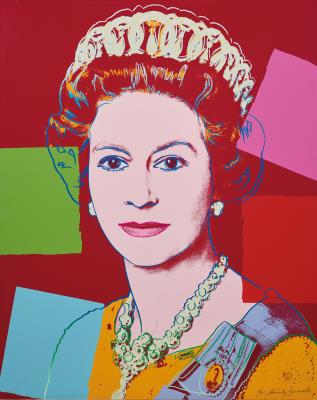
13. 安迪·沃霍尔,当代艺术I 高清作品[28%]

DO-Andy Warhol - 现代艺术 I
图片文件像素:5347 x 5320 px

安迪·沃霍尔,当代艺术I-

Andy Warhol - Zeitgenössische Kunst I-

(Pittsburgh 1928-1987 New York)
Queen Elizabeth II of the United Kingdom, from Reigning Queens, 1985, signed in pencil and numbered 9/40, screenprint in colours on Lenox Museum Board with the blindstamp of the printer Rupert Jasen Smith, New York, published by George C.P. Mulder, Amsterdam, 100 x 80 cm, In plexiglass case

This is no. 9 from an edition of 40 + 10 artist’s proofs

Provenance:
Martin Lawrence Limited Editions, Inc., New York (label on the reverse)
European private collection

Literature:
F. Feldman J. Schellmann, Andy Warhol Prints, A Catalogue Raisonné 1962-1987, II. 334-349, p. 138 with ill.

For the realisation of Queen Elizabeth II of the United Kingdom, a photograph taken on the occasion of the Silver Jubilee, the 25th anniversary of her reign, was used as a reference. The sitter\'s pose remains unaltered, retaining the structure and grandeur that are typical of classical portraiture. Warhol adds the commercial medium, emphasising it. His are classical depictions that praise the importance and solemnity of the subject depicted.

The same image of the queen appears in each of her four prints but they vary in colour. This one in particular has a primarily red background, and features graphic shapes printed from separate screens. Warhol began working in this style in the mid-1970s, fragmenting the image with various overlayed shapes and patches of colour.

The association of commercial medium and traditional portraiture is key, allowing Warhol to create a product that would subsequently be hailed as a work of art. Seriality, consumerism, the concept of fame and social hierarchy emanate from the superimposition of colour fields that enhance the subject\'s femininity. The pronounced make-up and bright colours denote the Pop character of mass culture, emphasising appearance and conveying a certain frivolity - unlike traditional portraits, where character and gravitas prevailed over aesthetics. Despite beginning with an impersonal approach and a mechanical reproduction of the subject, these interventions in the image gave the work a deliberately ‘artistic’ look. In many of his female portraits, such as here, the multicoloured surfaces and suggestion of make-up enhance the glamour and femininity of the subjects. With characteristic ambivalence, Warhol explained his additions to these later prints as immaterial:

‘I really would still rather do just a silkscreen of the face without all the rest, but people expect just a little bit more. That’s why I put in all the drawing.’ (Barry Blinderman, ‘Modern Myths: An Interview with Andy Warhol’, Arts, October 1981, p.145.)

This work is published in an edition of forty with ten artist’s proofs, five printer’s proofs and three hors commerce. The work is also published as a Royal Edition with diamond dust on the drawing lines, published in an edition of thirty with five artist’s proofs, two printer’s proofs and two hors commerce.

red line油画图片- 高清red line绘画作品- 代表作全集 中艺名画下载


11. 犹大。 犹太人和基督徒在共同和对话中留下的痕迹。[巴塞尔:马丁·弗莱奇,1474年之后才开始。] 高清作品[47%]

Tractatus de Judaeorum et Christianorum communione et conversatione.  [Basel: Martin Flach, not after 1474.]

图片文件尺寸 : 4576 x 5013px

JUDAICA.:Tractatus de Judaeorum et Christianorum communione et conversatione. [Basel: Martin Flach, not after 1474.]
Folio (282 x 210 mm). 16 leaves. 34 lines. Flach\'s type 1:117G. Initials in blue and red. Modern mottled calf. Some minor staining.

FIRST EDITION of the 1447 edict commanding that Jews convert to Christianity. Martin Flach began his career as a journeyman in Strassburg in 1472 before printing in his own name from 1487. RARE: according to American Book Prices Current only one other copy sold at auction in the past 45 years. BMC III,740; BSB-Ink T-411; Goff J-493; GW 7258; HC 9464.

犹大。 犹太人和基督徒在共同和对话中留下的痕迹。[巴塞尔:马丁·弗莱奇,1474年之后才开始。]

12. 英语圣经:伟大的“她”圣经。 《圣经》、《旧约》和《新约》。伦敦:罗伯特·巴克,[1613]-1611。 高清作品[35%]

The Holy Bible, Conteyning the Old Testament, and the New. London: Robert Barker, [1613] - 1611.

图片文件尺寸 : 5080 x 4062px

BIBLE IN ENGLISH: THE GREAT \"SHE\" BIBLE.:The Holy Bible, Conteyning the Old Testament, and the New. London: Robert Barker, [1613] - 1611. Folio (390 x 257 mm). title and final leaf supplied in facsimile, lacking 2 quires A and F, and with 19 leaves supplied from a later edition, engraved map of Canaan by John Speed, loosely inserted, and with its margins restored with some loss. Title to New Testament title dated 1611, set within wide woodcut pictorial borders, wood-cut head and tail pieces, calendar and almanack printed in red and black, occasional light toning, a few upper margins cut slightly close to border line. Paneled calf, antique, red speckled edges.
Collation: A1 (General Title, a facsimile of the He Bible and dated 1611), A2-4 (a2 margin slightly restored, a few restored holes affecting letters), B1-4, C1-6, D1-4: Quire A1-6 lacking (Title to genealogies and first 11 pages), B-E6, (Lacking quire F1-6), G-Z6, Aa-Zz6, Aaa-Zzz6 (rrr1 outer and lower margins torn with loss), Aaaa-Zzzz6, Aaaaa-Ccccc6;
New Testament: A-Z6 (with 15 leaves P1-6, S3-4, V5, X2-6 and Z3 all silked and damaged, and supplied from a shorter later edition, possibly the 1617 folio edition), 6A 1-5 supplied from another folio edition, 6A6 a facsimile leaf.
Provenance: Exhibited by Mr. Young (of Leicester, UK) in the early 20th Century, with a printed and manuscript exhibition label, containing manuscript notes on the typographical errors in the \"SHE\" Bible, the label loosely inserted at the front.

THE KING JAMES\' GREAT \"SHE\' BIBLE, THE SECOND FOLIO EDITION, with the reading in Ruth 3:15 corrected to \"She went into the citie,\" and with other errors including Matthew 26:36 where Judas appears for Jesus, but in this copy that error has been a corrected in an 18th century manuscript hand.

The King James Great Bible is considered to be the most important English Bible to have been printed. The biblical scholar Francis Fry described the \"SHE\" Bible as the first edition second issue without reprints, printed within two years of the first issue to correct typographical errors that were found in the text. The King James Bible was drawn up to reconcile the versions of the bible used by the Clergy, on the one hand, and the laity on the other. The translators, who numbered around 50, were divided into committees based in Oxford. Cambridge and London, and they were instructed to take the Bishops Bible as their basis and then consult with Tyndale\'s, Coverdale\'s, Matthew\'s, Whitchurch\'s and the Geneva versions to come up with an authorized text. This copy, although with facsimile first and last leaves, and two quires lacking, is substantially complete. \"From about the middle of the seventeenth century until the appearance of the Revised Bible of 1881-5, the King James\' version reigned without rival\"(Herbert 319). cf. PMM 114; STC 2224.

英语圣经:伟大的“她”圣经。 《圣经》、《旧约》和《新约》。伦敦:罗伯特·巴克,[1613]-1611。

13. 安迪·沃霍尔,当代艺术I 高清作品[28%]

DO-Andy Warhol - 现代艺术 I
图片文件像素:5347 x 5320 px

安迪·沃霍尔,当代艺术I-

Andy Warhol - Zeitgenössische Kunst I-

(Pittsburgh 1928-1987 New York)
Queen Elizabeth II of the United Kingdom, from Reigning Queens, 1985, signed in pencil and numbered 9/40, screenprint in colours on Lenox Museum Board with the blindstamp of the printer Rupert Jasen Smith, New York, published by George C.P. Mulder, Amsterdam, 100 x 80 cm, In plexiglass case

This is no. 9 from an edition of 40 + 10 artist’s proofs

Provenance:
Martin Lawrence Limited Editions, Inc., New York (label on the reverse)
European private collection

Literature:
F. Feldman J. Schellmann, Andy Warhol Prints, A Catalogue Raisonné 1962-1987, II. 334-349, p. 138 with ill.

For the realisation of Queen Elizabeth II of the United Kingdom, a photograph taken on the occasion of the Silver Jubilee, the 25th anniversary of her reign, was used as a reference. The sitter\'s pose remains unaltered, retaining the structure and grandeur that are typical of classical portraiture. Warhol adds the commercial medium, emphasising it. His are classical depictions that praise the importance and solemnity of the subject depicted.

The same image of the queen appears in each of her four prints but they vary in colour. This one in particular has a primarily red background, and features graphic shapes printed from separate screens. Warhol began working in this style in the mid-1970s, fragmenting the image with various overlayed shapes and patches of colour.

The association of commercial medium and traditional portraiture is key, allowing Warhol to create a product that would subsequently be hailed as a work of art. Seriality, consumerism, the concept of fame and social hierarchy emanate from the superimposition of colour fields that enhance the subject\'s femininity. The pronounced make-up and bright colours denote the Pop character of mass culture, emphasising appearance and conveying a certain frivolity - unlike traditional portraits, where character and gravitas prevailed over aesthetics. Despite beginning with an impersonal approach and a mechanical reproduction of the subject, these interventions in the image gave the work a deliberately ‘artistic’ look. In many of his female portraits, such as here, the multicoloured surfaces and suggestion of make-up enhance the glamour and femininity of the subjects. With characteristic ambivalence, Warhol explained his additions to these later prints as immaterial:

‘I really would still rather do just a silkscreen of the face without all the rest, but people expect just a little bit more. That’s why I put in all the drawing.’ (Barry Blinderman, ‘Modern Myths: An Interview with Andy Warhol’, Arts, October 1981, p.145.)

This work is published in an edition of forty with ten artist’s proofs, five printer’s proofs and three hors commerce. The work is also published as a Royal Edition with diamond dust on the drawing lines, published in an edition of thirty with five artist’s proofs, two printer’s proofs and two hors commerce.