161. 康纳兄弟诺埃尔·加拉格尔 这是疯狂的日子 高清作品[43%]

These Are Crazy Days

图片文件尺寸 : 5146 x 4892px

THE CONNOR BROTHERS NOEL GALLAGHER:These Are Crazy Days
Pigment print with hand-applied acrylic, oil stick and varnish, 2021, on wove, signed by the artists and Noel Gallagher, dated and inscribed \'AP\' in pencil, an artist\'s proof aside from the numbered edition of 100, published by Maddox Gallery, London, the full sheet, 1300 x 900mm (51 1/8 x 35 3/8in)(SH)


康纳兄弟诺埃尔·加拉格尔 这是疯狂的日子

162. 万利保险箱 卡普萨利斯档案馆 高清作品[42%]

The Kapsalis Archive

图片文件尺寸 : 4852 x 5913px

Seif Wanly:The Kapsalis Archive
a large and comprehensive collection of artworks, letters, sketches and ephemera from Seif and Adham Wanly
consisting of 5 paintings and pastels by Seif Wanly, 2 paintings and pastels by Adham Wanly, 1 sketch by Ahmed Fahmi, approx. 140 anatomical sketches, drawings and studies by Seif and Adham Wanly, a set of approx. 23 post cards, hand painted cards and love letters from Fanny Ezersky to the brothers, a further approximately 50 greeting cards, exhibition catalogues and other ephemera
the archive approximately covers the period 1956-1960

万利保险箱 卡普萨利斯档案馆

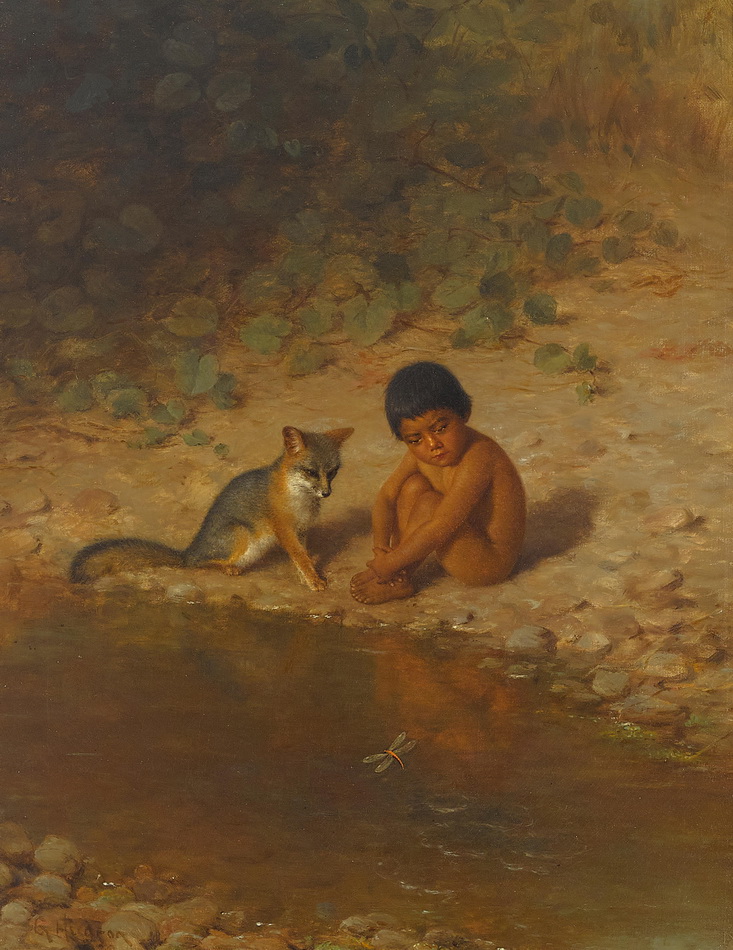
163. 格雷斯·卡彭特·哈德森 Tullo\'s Boy Dubert 20 1/2 x 15 3/4英寸框架26 1/2 x 21 5/8英寸 高清作品[37%]

Tullo\'s Boy Dubert  20 1/2 x 15 3/4in framed 26 1/2 x 21 5/8in

图片文件尺寸 : 5375 x 5979px

Grace Carpenter Hudson: Tullo\'s Boy Dubert (Our Little Brothers)
signed \'G. Hudson\' (lower left), signed again and inscribed \'622 G. Hudson / Ukiah- Cal\' (on the reverse)
oil on canvas
20 1/2 x 15 3/4in
framed 26 1/2 x 21 5/8in
Painted in 1928.

格雷斯·卡彭特·哈德森 Tullo\'s Boy Dubert 20 1/2 x 15 3/4英寸框架26 1/2 x 21 5/8英寸

164. 房子,巴托洛姆·德。 《根据西班牙法定人数进行的印度地区叙事》Devastatarum Verissima……法兰克福:Theodor de Bry和Johann Saur,1598年。 高清作品[31%]

Narratio Regionum Indicarum Per Hispanos Quosdam Devastatarum Verissima....  Frankfurt: Theodor de Bry and Johann Saur, 1598.

图片文件尺寸 : 5074 x 4552px

LAS CASAS, BARTOLOME DE. :Narratio Regionum Indicarum Per Hispanos Quosdam Devastatarum Verissima.... Frankfurt: Theodor de Bry and Johann Saur, 1598.
4to (202 x 160 mm). Title printed within wide pictorial engraved border, 17 engraved half-page illustrations in text by the brothers de Bry after Josse van Winghe. [8], 141, [1] pp., lacking the final blank. Modern half brown morocco; front joint rubbed, some light staining and foxing, title border and one other engraving trimmed close at fore-edge.
Provenance: Royal Institution of Great Britain (library and discard stamps on front paste-down, gilt stamp on spine).

FIRST LATIN EDITION of Las Casas\'s classic work, which includes the celebrated series of plates depicting the atrocities committed by the Spanish settlers on the Indians. Alden 598.20; Church 320; Palau 46960; Sabin 11283.

房子,巴托洛姆·德。 《根据西班牙法定人数进行的印度地区叙事》Devastatarum Verissima……法兰克福:Theodor de Bry和Johann Saur,1598年。

165. Maria Lassnig,当代艺术I 高清作品[25%]

DO-Maria Lassnig  - 现代艺术 I
图片文件像素:5485 x 5808 px

Maria Lassnig,当代艺术I-

Maria Lassnig * - Zeitgenössische Kunst I-

(Kappel, Carinthia, 1919–2014 Vienna)
“Untitled”, 1980, gouache, colour instruction for the print version of the painting “Die Last des Fleisches”, 1973, of the catalogue “Austria. Biennale di Venezia 1980. Maria Lassnig”, on paper (envelope from the gallery Peithner-Lichtenfels - addressed to Maria Lassnig), to the upper edge in the artist’s handwriting “Text ausbessern”, image size 17 x 21.5 cm, envelope 20.5 x 21.5 cm, framed

Provenance:
excerpt from an email from 20 May 2022

Registered:
Maria Lassnig Stiftung (14.10.2022)

This work is included in the Maria Lassnig catalogue raisonné (certificate available).

Auszug aus einem E-Mail, 20. Mai 2022:
“Mein Vater ... bekam die kleinformatige Arbeit von Maria Lassnig während der Herstellung des Kataloges “Austria. Biennale di Venezia 1980. Maria Lassnig” ... in der Druckerei Brüder Rosenbaum 1980 geschenkt.
Leider befand Maria Lassnig das Ektachrom ... ihres Gemäldes “Die Last des Fleisches” ... in der Farbwiedergabe nicht zufriedenstellend.
... mein Vater bat sie entsprechend um eine Orientierungshilfe ...
Maria Lassnig fertigte zuhause die vorliegende Gouache ... an.
Nach dem zweiten Probedruck und diversen Farbkorrekturen bekam mein Vater ... die Zustimmung Maria Lassnigs für den Druck sowie die Gouache von “Die Last des Fleisches” als Dankeschön zum Geschenk.
Die Arbeit blieb seither in Familienbesitz.”

Excerpt from an email from 20 May 2022:
“My father [...] received the small-format work by Maria Lassnig during the production of the catalogue Austria. Biennale di Venezia 1980.
Maria Lassnig [...] in the Rosenbaum Brothers printing house in 1980.

Unfortunately, Maria Lassnig found the ectachrome [...] of her painting „Die Last des Fleisches“ [...] was not satisfactory in its colour reproduction [...]. Accordingly, my father asked her for a guide [...] Maria Lassnig made the present gouache at home [...]. After the second test print and various colour corrections, my father [...] received Maria Lassnig’s approval for the print as well as the gouache of„Die Last des Fleisches“ as a thank-you gift. The work has remained in the family ever since.”

166. 行政卡有限。 奥地利大公查尔斯在西班牙王位继承战争中塑造了自己的西班牙查理三世, 高清作品[20%]

Rare patent of nobility issued by Archduke Charles of Austria , fashioning himself Charles III of Spain during the War of the Spanish Succession ,

图片文件尺寸 : 4726 x 4820px

ILLUMINATED CARTA EXECUTORIA.:Rare patent of nobility issued by Archduke Charles of Austria (later Charles VI, Holy Roman Emperor), fashioning himself Charles III of Spain during the War of the Spanish Succession (1701–1714), conveying the title of Marquess of Callus (in Catalonia) upon Don Jaime Vicente Alamany Descallar, manuscript on vellum, text in Latin, 1711, 290 x 200 mm, 8 leaves bound as a single quire of 4 bifolia.
Collation: i8, the first leaf treated as a blank flyleaf. 22-26 long lines written in brown ink in italic script with one-line roman capitals; headings in larger capitals on ff. 2r-2v; written area: 215 x 125 mm. All text pages decorated with full borders containing delicate brown ink drawings. F. 2r with a cartouche depicting the king on a rearing horse firing a pistol, surmounted by a crown, below him a globe held by two putti and inscribed \"America\", below that the words NOS CAROLUS in a cartouche, all flanked by personifications of the church and the state and other motifs. On f. 2v the continuation of the text continues under a round seal stamped in in black ink, containing a coat of arms, and inscribed: CAROLUS III DEI GRATIA HISPANIARUM ET INDIARUM REX. Borders of ff. 2v-6v filled with vedute, vignettes, putti, cartouches, and various flourishes similar to those found in engraved writing-master books of the period. F. 7r with the last lines of the text and several notarial attestations. F. 7v blank. F. 8r with a large colored coat of arms surrounded by colored arabesque flourishes. F. 8v blank. Binding of later red velvet over pasteboards (worn) with remains of two monkeys-fist closures of woven silk, red silk doublures and single red silk flyleaves front and back, remains of a braided silk cord intended to attach the seal and a circular depression inside the back cover intended to hold the seal (seal missing).

RARE PATENT OF NOBILITY OF \"CHARLES III\" DURING HIS EMBATTLED CLAIM TO THE SPANISH THRONE. On the death of his Hapsburg relative King Charles II of Spain (1661-1700) without a direct heir, Archduke Charles of Austria declared himself the King of Spain, thus occasioning the War of the Spanish Succession, which pitted him against a rival candidate, Philip, Duke of Anjou, grandson of Louis XIV, and a distant cousin of the Archduke. In 1711, when his brother, the Holy Roman Emperor Joseph I, died the Archduke returned to Vienna to assume the imperial crown, while Philip was eventually recognized as King Philip V of Spain. During his brief time as claimant to the Spanish throne, Charles never extended his sphere of influence beyond Catalonia and lived there only from 1705 to 1711.

行政卡有限。 奥地利大公查尔斯在西班牙王位继承战争中塑造了自己的西班牙查理三世,

167. 多斯托耶夫斯基的名片上写着亚历山大·赫尔岑。 照片署名并题写(俄语)给亚历山大·赫尔岑, 高清作品[11%]

Photograph signed and inscribed [in Russian] to Alexander Herzen,

图片文件尺寸 : 3981 x 5780px

DOSTOEVSKY CARTE-DE-VISITE INSCRIBED TO ALEXANDER HERZEN.:DOSTOEVSKY, FYODOR. 1821-1881. Photograph signed and inscribed [in Russian] to Alexander Herzen, albumen print carte-de-visite full length portrait by M.B. Tulinov, Petersburg, 1861, 105 x 65 mm, inscribed by Dostoevsky in Russian to the verso, \"Alexander Ivanovich Herzen in memory of our meeting in London. Fyodor Dostoyevsky 8 July/20 July 1862,\" minor stain to verso.
Provenance: Alexander Ivanovich Herzen; to daughter Olga Aleksandrovna [Herzen] Monod; by descent.
Publication: For a discussion of the photograph, see Volgin, Igor. \"Introduction\" to The Dostoevsky Archive (1997), p 21.

Pull quote: \"Herzen awaits his readers in the future. Far above the heads of the present crowd, he transmits his thoughts to those who will be able to comprehend them.\" – Leo Tolstoy, 1905.

VERY RARE CARTE DE VISITE PHOTOGRAPH OF FYODOR DOSTOEVSKY PRESENTED TO ALEXANDER HERZEN IN REMEMBRANCE OF THEIR 1862 MEETING IN LONDON: A TREMENDOUSLY IMPORTANT ASSOCIATION BETWEEN TWO OF THE LEADING INTELLECTUALS OF THE 19TH-CENTURY.

Alexander Herzen was one of the most important and influential Russian writers and thinkers of the 19th-century. called the \"father of Russian socialism,\" he had a profound influence on late-19th century Russian writers, including Fyodor Dostoevsky. Born illegitimately to a wealthy Russian landowner, Herzen became a dissident and critic of the Russian feudal system. Of Herzen, Tolstoy said he had never met a man \"with so rare a combination of scintillating brilliance and depth.\" His writings, including From the Other Shore (1848) and those appearing in his influential publications of the 1850s-60s The Bell and the Polestar, would help mold a generation of Russian writing and thought.

Herzen and Dostoevsky met for the first time in Russia in 1846, following Dostoevsky\'s comment in a letter to his brother that Herzen and Goncharov stand as \"the most remarkable\" of his rivals; Herzen\'s recollection of the meeting was less than effusive, however: \"I can\'t say he made a particularly present impression.\" Their second meeting occurred when Dostoevsky visited Herzen in London in July of 1862, of which this photograph is a memento. During the 1850s and early 1860s, visits to the emigree Herzen by Russian writers and intellectuals were something of a right of passage, and Dostoevsky\'s visit followed right on the heels of Turgenev. This series of meetings profoundly affected Dostoevsky and his work, and is clearly acknowledged in his Winter Notes which he wrote later that year, exhibiting a clear debt to Herzen\'s own writings. Dostoevsky, along with Solzhenitsyn, acknowledged the formative influence of Herzen on his work, and Herzen would also appear in composite in a number of Dostoevsky\'s characters throughout his career. Herzen, however, noted, rather condescendingly, \"Dostoevsky was here yesterday—he is a naïve, not entirely lucid, but a very dear person. He believes enthusiastically in the Russian people.\"

The two towering figures would meet again on a steamship from Naples to Livorno the following year, where Dostoevsky was travelling with his mistress Polina Suslova. According to Suslova\'s diaries (as published in The Dostoevsky Archives), Dostoevsky took pains to hide their relationship from Herzen, introducing her vaguely as a family member, and even encouraged her to arrange a visit with Herzen\'s son in Paris that Winter. After they parted, Dostoevsky became angry with her over a photograph of her he had seen at Herzen\'s, which she had given at an earlier date. In 1865, Dostoevsky wrote to Herzen imploring him for a loan, and became peevish when Herzen did not immediately respond. By the late 1860s Dostoevsky would disparage Herzen, somewhat unfairly, as a \"Westernizer,\" leading to his more severe criticism of Herzen in his Writer\'s Diary.

Herzen was one of the most complex and brilliant figures of the 19th-century, and was largely responsible for assimilating western ideas into Russian thought, while still maintaining his advocacy for the freedom of the Russian serf.

In reality, the two writers/thinkers shared a great deal in their outlook: both asserted the importance of the individual, and the folly of the search for a unified teleological system, cutting against the grain of their mid-19th century contemporaries. While Herzen was embraced by Lenin, identified as the \"father of Russian socialism,\" Herzen\'s socialism was a different breed, \"Centralization may do a great deal for order and for various public undertakings, but it is incompatible with freedom. It easily brings a nation to the position of a well-tended flock or a pack of hounds cleverly kept in order by a huntsman.\" Lenin regarded Herzen\'s focus on freedom as a shortcoming of his bourgeois roots. During the 20th-century Russian-British philosopher Isaiah Berlin came across Herzen\'s writings and recognized the prescience of Herzen\'s thought. It was Berlin, who reestablished Herzen\'s influence, agreeing with and amplifying his idea that the pursuit of \"a perfect society\" invariably leads to blood.

The present photograph was taken by Mikhail Borisovich Tulinov (1823–1889) in Petersburg in 1861. Any period photograph of Dostoevsky is rare, and moreso inscribed. We trace two inscribed photographs at auction in the last 40 years. However, we find no record of an inscribed photograph of similar substance and importance in the historical record. An incredible, and incredibly rare, Dostoevsky item tying together two of the greatest thinkers and writers of the 19th-century.

REFERENCES:
Kelly, Aileen. The Discovery of Chance: The Life and Thought of Alexander Herzen. 2016.
Kelly, Aileen. \"Irony and Utopia in Herzen and Dostoevsky: From the Other Shore and Diary of a Writer.\" The Russian Review, 50:4 (1991), pp 397-416.
Lantz, Kenneth. The Dostoevsky Encycolpedia. 2004.
Serakin, Peter. The Dostoevsky Archive: Firsthand Accounts of the Novelist from Contemporaries\' Memoirs and Rare Periodicals. 1997.


\"If only people wanted to save themselves instead of saving the world, how much they would do for the salvation of the world and the liberation of humanity!\" – Alexander Herzen, From the Other Shore, 1848.

多斯托耶夫斯基的名片上写着亚历山大·赫尔岑。 照片署名并题写(俄语)给亚历山大·赫尔岑,

brothers油画图片- 高清brothers绘画作品- 代表作全集 中艺名画下载


161. 康纳兄弟诺埃尔·加拉格尔 这是疯狂的日子 高清作品[43%]

These Are Crazy Days

图片文件尺寸 : 5146 x 4892px

THE CONNOR BROTHERS NOEL GALLAGHER:These Are Crazy Days
Pigment print with hand-applied acrylic, oil stick and varnish, 2021, on wove, signed by the artists and Noel Gallagher, dated and inscribed \'AP\' in pencil, an artist\'s proof aside from the numbered edition of 100, published by Maddox Gallery, London, the full sheet, 1300 x 900mm (51 1/8 x 35 3/8in)(SH)


康纳兄弟诺埃尔·加拉格尔 这是疯狂的日子
162. 万利保险箱 卡普萨利斯档案馆 高清作品[42%]

The Kapsalis Archive

图片文件尺寸 : 4852 x 5913px

Seif Wanly:The Kapsalis Archive
a large and comprehensive collection of artworks, letters, sketches and ephemera from Seif and Adham Wanly
consisting of 5 paintings and pastels by Seif Wanly, 2 paintings and pastels by Adham Wanly, 1 sketch by Ahmed Fahmi, approx. 140 anatomical sketches, drawings and studies by Seif and Adham Wanly, a set of approx. 23 post cards, hand painted cards and love letters from Fanny Ezersky to the brothers, a further approximately 50 greeting cards, exhibition catalogues and other ephemera
the archive approximately covers the period 1956-1960

万利保险箱 卡普萨利斯档案馆

163. 格雷斯·卡彭特·哈德森 Tullo\'s Boy Dubert 20 1/2 x 15 3/4英寸框架26 1/2 x 21 5/8英寸 高清作品[37%]

Tullo\'s Boy Dubert  20 1/2 x 15 3/4in framed 26 1/2 x 21 5/8in

图片文件尺寸 : 5375 x 5979px

Grace Carpenter Hudson: Tullo\'s Boy Dubert (Our Little Brothers)
signed \'G. Hudson\' (lower left), signed again and inscribed \'622 G. Hudson / Ukiah- Cal\' (on the reverse)
oil on canvas
20 1/2 x 15 3/4in
framed 26 1/2 x 21 5/8in
Painted in 1928.

格雷斯·卡彭特·哈德森 Tullo\'s Boy Dubert 20 1/2 x 15 3/4英寸框架26 1/2 x 21 5/8英寸

164. 房子,巴托洛姆·德。 《根据西班牙法定人数进行的印度地区叙事》Devastatarum Verissima……法兰克福:Theodor de Bry和Johann Saur,1598年。 高清作品[31%]

Narratio Regionum Indicarum Per Hispanos Quosdam Devastatarum Verissima....  Frankfurt: Theodor de Bry and Johann Saur, 1598.

图片文件尺寸 : 5074 x 4552px

LAS CASAS, BARTOLOME DE. :Narratio Regionum Indicarum Per Hispanos Quosdam Devastatarum Verissima.... Frankfurt: Theodor de Bry and Johann Saur, 1598.
4to (202 x 160 mm). Title printed within wide pictorial engraved border, 17 engraved half-page illustrations in text by the brothers de Bry after Josse van Winghe. [8], 141, [1] pp., lacking the final blank. Modern half brown morocco; front joint rubbed, some light staining and foxing, title border and one other engraving trimmed close at fore-edge.
Provenance: Royal Institution of Great Britain (library and discard stamps on front paste-down, gilt stamp on spine).

FIRST LATIN EDITION of Las Casas\'s classic work, which includes the celebrated series of plates depicting the atrocities committed by the Spanish settlers on the Indians. Alden 598.20; Church 320; Palau 46960; Sabin 11283.

房子,巴托洛姆·德。 《根据西班牙法定人数进行的印度地区叙事》Devastatarum Verissima……法兰克福:Theodor de Bry和Johann Saur,1598年。

165. Maria Lassnig,当代艺术I 高清作品[25%]

DO-Maria Lassnig  - 现代艺术 I
图片文件像素:5485 x 5808 px

Maria Lassnig,当代艺术I-

Maria Lassnig * - Zeitgenössische Kunst I-

(Kappel, Carinthia, 1919–2014 Vienna)
“Untitled”, 1980, gouache, colour instruction for the print version of the painting “Die Last des Fleisches”, 1973, of the catalogue “Austria. Biennale di Venezia 1980. Maria Lassnig”, on paper (envelope from the gallery Peithner-Lichtenfels - addressed to Maria Lassnig), to the upper edge in the artist’s handwriting “Text ausbessern”, image size 17 x 21.5 cm, envelope 20.5 x 21.5 cm, framed

Provenance:
excerpt from an email from 20 May 2022

Registered:
Maria Lassnig Stiftung (14.10.2022)

This work is included in the Maria Lassnig catalogue raisonné (certificate available).

Auszug aus einem E-Mail, 20. Mai 2022:
“Mein Vater ... bekam die kleinformatige Arbeit von Maria Lassnig während der Herstellung des Kataloges “Austria. Biennale di Venezia 1980. Maria Lassnig” ... in der Druckerei Brüder Rosenbaum 1980 geschenkt.
Leider befand Maria Lassnig das Ektachrom ... ihres Gemäldes “Die Last des Fleisches” ... in der Farbwiedergabe nicht zufriedenstellend.
... mein Vater bat sie entsprechend um eine Orientierungshilfe ...
Maria Lassnig fertigte zuhause die vorliegende Gouache ... an.
Nach dem zweiten Probedruck und diversen Farbkorrekturen bekam mein Vater ... die Zustimmung Maria Lassnigs für den Druck sowie die Gouache von “Die Last des Fleisches” als Dankeschön zum Geschenk.
Die Arbeit blieb seither in Familienbesitz.”

Excerpt from an email from 20 May 2022:
“My father [...] received the small-format work by Maria Lassnig during the production of the catalogue Austria. Biennale di Venezia 1980.
Maria Lassnig [...] in the Rosenbaum Brothers printing house in 1980.

Unfortunately, Maria Lassnig found the ectachrome [...] of her painting „Die Last des Fleisches“ [...] was not satisfactory in its colour reproduction [...]. Accordingly, my father asked her for a guide [...] Maria Lassnig made the present gouache at home [...]. After the second test print and various colour corrections, my father [...] received Maria Lassnig’s approval for the print as well as the gouache of„Die Last des Fleisches“ as a thank-you gift. The work has remained in the family ever since.”

166. 行政卡有限。 奥地利大公查尔斯在西班牙王位继承战争中塑造了自己的西班牙查理三世, 高清作品[20%]

Rare patent of nobility issued by Archduke Charles of Austria , fashioning himself Charles III of Spain during the War of the Spanish Succession ,

图片文件尺寸 : 4726 x 4820px

ILLUMINATED CARTA EXECUTORIA.:Rare patent of nobility issued by Archduke Charles of Austria (later Charles VI, Holy Roman Emperor), fashioning himself Charles III of Spain during the War of the Spanish Succession (1701–1714), conveying the title of Marquess of Callus (in Catalonia) upon Don Jaime Vicente Alamany Descallar, manuscript on vellum, text in Latin, 1711, 290 x 200 mm, 8 leaves bound as a single quire of 4 bifolia.
Collation: i8, the first leaf treated as a blank flyleaf. 22-26 long lines written in brown ink in italic script with one-line roman capitals; headings in larger capitals on ff. 2r-2v; written area: 215 x 125 mm. All text pages decorated with full borders containing delicate brown ink drawings. F. 2r with a cartouche depicting the king on a rearing horse firing a pistol, surmounted by a crown, below him a globe held by two putti and inscribed \"America\", below that the words NOS CAROLUS in a cartouche, all flanked by personifications of the church and the state and other motifs. On f. 2v the continuation of the text continues under a round seal stamped in in black ink, containing a coat of arms, and inscribed: CAROLUS III DEI GRATIA HISPANIARUM ET INDIARUM REX. Borders of ff. 2v-6v filled with vedute, vignettes, putti, cartouches, and various flourishes similar to those found in engraved writing-master books of the period. F. 7r with the last lines of the text and several notarial attestations. F. 7v blank. F. 8r with a large colored coat of arms surrounded by colored arabesque flourishes. F. 8v blank. Binding of later red velvet over pasteboards (worn) with remains of two monkeys-fist closures of woven silk, red silk doublures and single red silk flyleaves front and back, remains of a braided silk cord intended to attach the seal and a circular depression inside the back cover intended to hold the seal (seal missing).

RARE PATENT OF NOBILITY OF \"CHARLES III\" DURING HIS EMBATTLED CLAIM TO THE SPANISH THRONE. On the death of his Hapsburg relative King Charles II of Spain (1661-1700) without a direct heir, Archduke Charles of Austria declared himself the King of Spain, thus occasioning the War of the Spanish Succession, which pitted him against a rival candidate, Philip, Duke of Anjou, grandson of Louis XIV, and a distant cousin of the Archduke. In 1711, when his brother, the Holy Roman Emperor Joseph I, died the Archduke returned to Vienna to assume the imperial crown, while Philip was eventually recognized as King Philip V of Spain. During his brief time as claimant to the Spanish throne, Charles never extended his sphere of influence beyond Catalonia and lived there only from 1705 to 1711.

行政卡有限。 奥地利大公查尔斯在西班牙王位继承战争中塑造了自己的西班牙查理三世,

167. 多斯托耶夫斯基的名片上写着亚历山大·赫尔岑。 照片署名并题写(俄语)给亚历山大·赫尔岑, 高清作品[11%]

Photograph signed and inscribed [in Russian] to Alexander Herzen,

图片文件尺寸 : 3981 x 5780px

DOSTOEVSKY CARTE-DE-VISITE INSCRIBED TO ALEXANDER HERZEN.:DOSTOEVSKY, FYODOR. 1821-1881. Photograph signed and inscribed [in Russian] to Alexander Herzen, albumen print carte-de-visite full length portrait by M.B. Tulinov, Petersburg, 1861, 105 x 65 mm, inscribed by Dostoevsky in Russian to the verso, \"Alexander Ivanovich Herzen in memory of our meeting in London. Fyodor Dostoyevsky 8 July/20 July 1862,\" minor stain to verso.
Provenance: Alexander Ivanovich Herzen; to daughter Olga Aleksandrovna [Herzen] Monod; by descent.
Publication: For a discussion of the photograph, see Volgin, Igor. \"Introduction\" to The Dostoevsky Archive (1997), p 21.

Pull quote: \"Herzen awaits his readers in the future. Far above the heads of the present crowd, he transmits his thoughts to those who will be able to comprehend them.\" – Leo Tolstoy, 1905.

VERY RARE CARTE DE VISITE PHOTOGRAPH OF FYODOR DOSTOEVSKY PRESENTED TO ALEXANDER HERZEN IN REMEMBRANCE OF THEIR 1862 MEETING IN LONDON: A TREMENDOUSLY IMPORTANT ASSOCIATION BETWEEN TWO OF THE LEADING INTELLECTUALS OF THE 19TH-CENTURY.

Alexander Herzen was one of the most important and influential Russian writers and thinkers of the 19th-century. called the \"father of Russian socialism,\" he had a profound influence on late-19th century Russian writers, including Fyodor Dostoevsky. Born illegitimately to a wealthy Russian landowner, Herzen became a dissident and critic of the Russian feudal system. Of Herzen, Tolstoy said he had never met a man \"with so rare a combination of scintillating brilliance and depth.\" His writings, including From the Other Shore (1848) and those appearing in his influential publications of the 1850s-60s The Bell and the Polestar, would help mold a generation of Russian writing and thought.

Herzen and Dostoevsky met for the first time in Russia in 1846, following Dostoevsky\'s comment in a letter to his brother that Herzen and Goncharov stand as \"the most remarkable\" of his rivals; Herzen\'s recollection of the meeting was less than effusive, however: \"I can\'t say he made a particularly present impression.\" Their second meeting occurred when Dostoevsky visited Herzen in London in July of 1862, of which this photograph is a memento. During the 1850s and early 1860s, visits to the emigree Herzen by Russian writers and intellectuals were something of a right of passage, and Dostoevsky\'s visit followed right on the heels of Turgenev. This series of meetings profoundly affected Dostoevsky and his work, and is clearly acknowledged in his Winter Notes which he wrote later that year, exhibiting a clear debt to Herzen\'s own writings. Dostoevsky, along with Solzhenitsyn, acknowledged the formative influence of Herzen on his work, and Herzen would also appear in composite in a number of Dostoevsky\'s characters throughout his career. Herzen, however, noted, rather condescendingly, \"Dostoevsky was here yesterday—he is a naïve, not entirely lucid, but a very dear person. He believes enthusiastically in the Russian people.\"

The two towering figures would meet again on a steamship from Naples to Livorno the following year, where Dostoevsky was travelling with his mistress Polina Suslova. According to Suslova\'s diaries (as published in The Dostoevsky Archives), Dostoevsky took pains to hide their relationship from Herzen, introducing her vaguely as a family member, and even encouraged her to arrange a visit with Herzen\'s son in Paris that Winter. After they parted, Dostoevsky became angry with her over a photograph of her he had seen at Herzen\'s, which she had given at an earlier date. In 1865, Dostoevsky wrote to Herzen imploring him for a loan, and became peevish when Herzen did not immediately respond. By the late 1860s Dostoevsky would disparage Herzen, somewhat unfairly, as a \"Westernizer,\" leading to his more severe criticism of Herzen in his Writer\'s Diary.

Herzen was one of the most complex and brilliant figures of the 19th-century, and was largely responsible for assimilating western ideas into Russian thought, while still maintaining his advocacy for the freedom of the Russian serf.

In reality, the two writers/thinkers shared a great deal in their outlook: both asserted the importance of the individual, and the folly of the search for a unified teleological system, cutting against the grain of their mid-19th century contemporaries. While Herzen was embraced by Lenin, identified as the \"father of Russian socialism,\" Herzen\'s socialism was a different breed, \"Centralization may do a great deal for order and for various public undertakings, but it is incompatible with freedom. It easily brings a nation to the position of a well-tended flock or a pack of hounds cleverly kept in order by a huntsman.\" Lenin regarded Herzen\'s focus on freedom as a shortcoming of his bourgeois roots. During the 20th-century Russian-British philosopher Isaiah Berlin came across Herzen\'s writings and recognized the prescience of Herzen\'s thought. It was Berlin, who reestablished Herzen\'s influence, agreeing with and amplifying his idea that the pursuit of \"a perfect society\" invariably leads to blood.

The present photograph was taken by Mikhail Borisovich Tulinov (1823–1889) in Petersburg in 1861. Any period photograph of Dostoevsky is rare, and moreso inscribed. We trace two inscribed photographs at auction in the last 40 years. However, we find no record of an inscribed photograph of similar substance and importance in the historical record. An incredible, and incredibly rare, Dostoevsky item tying together two of the greatest thinkers and writers of the 19th-century.

REFERENCES:
Kelly, Aileen. The Discovery of Chance: The Life and Thought of Alexander Herzen. 2016.
Kelly, Aileen. \"Irony and Utopia in Herzen and Dostoevsky: From the Other Shore and Diary of a Writer.\" The Russian Review, 50:4 (1991), pp 397-416.
Lantz, Kenneth. The Dostoevsky Encycolpedia. 2004.
Serakin, Peter. The Dostoevsky Archive: Firsthand Accounts of the Novelist from Contemporaries\' Memoirs and Rare Periodicals. 1997.


\"If only people wanted to save themselves instead of saving the world, how much they would do for the salvation of the world and the liberation of humanity!\" – Alexander Herzen, From the Other Shore, 1848.

多斯托耶夫斯基的名片上写着亚历山大·赫尔岑。 照片署名并题写(俄语)给亚历山大·赫尔岑,