161. 文森特·劳伦兹(Vincent Laurensz)的《瓦尼塔斯静物》(A Vanitas Still Life),长笛、骷髅、乐谱、金冠、匕首、贝壳和其他物品,全部摆放在一张有部分窗帘的桌子上 高清作品[49%]

A Vanitas Still Life With A Flute, A Skull, Music Sheets, A Gold Crown, A Dagger, Shells And Other Objects, All Arranged On A Partly Draped Table-

图片文件尺寸 : 3290 x 4000px

文森特·劳伦兹(Vincent Laurensz)的《瓦尼塔斯静物》(A Vanitas Still Life),长笛、骷髅、乐谱、金冠、匕首、贝壳和其他物品,全部摆放在一张有部分窗帘的桌子上-Vincent Laurensz. van der Vinne I

瓦尼塔斯的静物画,有长笛、骷髅、乐谱、金冠、匕首、贝壳和其他物品,全部摆放在一张有部分窗帘的桌子上--Vincent Laurensz. van der Vinne I (荷兰, 1628-1702)

162. 帕甘,威利。1882-1955. 《雷鸟》(The Thunderbird)的14件服装设计,由米歇尔·福金(Michel Fokine)编舞,由其妻子维拉·福金娜(Vera Fokina)演唱剧本,是一幕阿兹特克芭蕾舞剧,于1921年9月3日在纽约竞技场开幕, 高清作品[49%]

14 costume designs for The Thunderbird, one-act Aztec ballet choreographed by Michel Fokine with libretto by his wife Vera Fokina, performed in the revue Get Together, opened at the New York Hippodrome, September 3, 1921,

图片文件尺寸 : 5004 x 3920px

POGANY, WILLY. 1882-1955.:14 costume designs for The Thunderbird, one-act Aztec ballet choreographed by Michel Fokine with libretto by his wife Vera Fokina, performed in the revue Get Together, opened at the New York Hippodrome, September 3, 1921, watercolor, gouache and silver paint over pencil, 13 measure 480 x 348 mm (19 x 13 5/8 inches); and one for Vera Fokina measuring 535 x 370 mm (20 1/2 x 14 1/2 inches), all but one signed \"Willy Pogany\" and four with Fokine\'s autograph pencil notation \"O. K./ M. Fokine,\" with additional manuscript notes in Russian and English, many in his hand, on versos, various date labels affixed to the versos, fabric samples to the verso of one, some chipping to corners, minor soiling. Housed in custom cloth box, morocco title label Willy Pogany 1882-1955 on spine.

FINE COLLECTION OF POGANY COSTUME DESIGNS FOR FOKINE\'S THE THUNDERBIRD. Hungarian-born artist Willy Pogány was one of the most versatile artists of the early 20th Century. He first gained fame as an exceptional children\'s and other gift book illustrator after he moved to London in 1908. Ten years later he came to the United States where he became a prolific contributor to books and magazines and a busy set and costume designer for Broadway, the Metropolitan Opera and the movies. His murals graced theaters and apartment buildings. In Hollywood, he was art director for many motion pictures including Dames, Dante\'s Inferno, Kid Millions and Wonder Bar. Walter Lantz\'s Technicolor animated short Scrambled Eggs (1939) featured Pogány\'s Peterkin, a mischievous satyr.

Michel Fokine (1880-1942) was one of the most influential dancers and choreographers of the Modern Era. Sergei Diaghilev made him resident choreographer of the Ballets Russes in 1909. Among his greatest ballets for this company were The Firebird (1910); Petrushka (1912); and Le Spectre de la Rose (1911) in which Nijinsky danced the lead role. He and his wife, ballerina Vera Fokina, left Russia in 1918. After the triumphal 1918 New York debut of Rimsky-Korsakov\'s opera Le Coq d\'or at The Met as a ballet by Fokine with sets and costumes by Pogány (\"as mad as Trotzky [sic] and twice as exhilarating\"), the choreographer and his designer teamed again for a new ballet based on an Aztec legend. The Thunderbird was the highlight of Dillingham\'s oddly assorted Broadway revue Get Together. Fokina was responsible for the libretto; and she and her husband danced as Princess Nahua and Atzlan. The music was a selection from Russian composers Borodin, Glinka and Tchaikovsky, and Fokine also choreographed a ballet on ice for the show based on \"The Red Shoes.\" \"Fokine has done a gorgeous piece of choreography, and Mr. Pogany has given it setting and costumes that surpass anything he has heretofore done, not even his \'Coq d\'Or.\' The story of the princess released by love from the power of a wizard and her union with her warrior lover is beautifully told\" (New York Tribune, Sept. 5, 1921). The Thunderbird was like a Native American Firebird. Perhaps the loveliest of Pogány\'s designs was for Fokina\'s princess, a silver costume with white ostrich plumes.

帕甘,威利。1882-1955. 《雷鸟》(The Thunderbird)的14件服装设计,由米歇尔·福金(Michel Fokine)编舞,由其妻子维拉·福金娜(Vera Fokina)演唱剧本,是一幕阿兹特克芭蕾舞剧,于1921年9月3日在纽约竞技场开幕,

163. 萨尔瓦多·达利 72号板块,有了所有这些麻烦,你不会逃避戈雅的任性弗朗西斯科·戈雅,72号板块,你不会逃避突发奇想 高清作品[49%]

Plate 72, Con todos estos lios, no te escaparas  from Les Caprices de Goya; Francisco Goya , Plate 72, No te escaparas , from Los Caprichos

图片文件尺寸 : 4882 x 4623px

Salvador Dalí:Plate 72, Con todos estos lios, no te escaparas (with all these troubles no one can escape) from Les Caprices de Goya; Francisco Goya (1746-1828), Plate 72, No te escaparas (you can\'t escape), from Los Caprichos (2 works) (Field 77-3-9; Harris 107), 1977; 1799
Heliogravure of Goya\'s plate 72, reworked and altered with drypoint and stencil on Rives BFK, signed in pencil and numbered 10/200 (plus 20 epreuves d\'artiste), published by Berggruen, Paris, with full margins,

WITH

Francisco Goya (1746-1828)
Plate 61, from Los Caprichos, Fifth Edition, c. 1881-1886
Etching on wove paper, pubished/printed by Real Academia/Calcografía, Madrid, with margins. (2 works)
9 x 9 1/4in (22.7 x 17cm); 8 1/2 x 6in (21.5 x 15.cm)
sheet 17 1/2 x 12 1/4in (44.4 x 31cm); 11 3/4 x 8 3/8in (29 x 20.5cm)

萨尔瓦多·达利 72号板块,有了所有这些麻烦,你不会逃避戈雅的任性弗朗西斯科·戈雅,72号板块,你不会逃避突发奇想

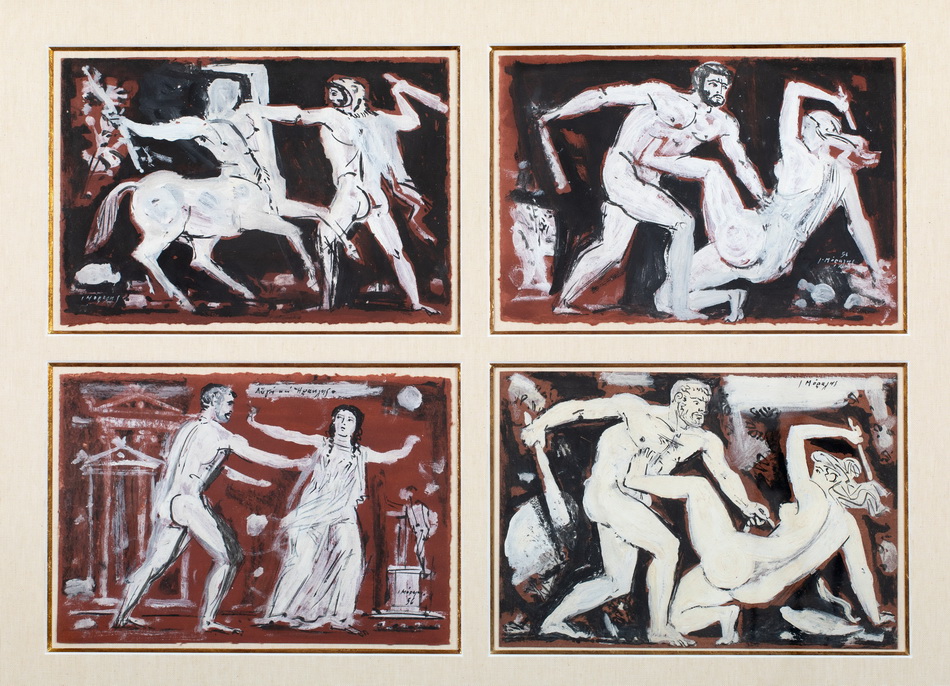
164. 伊阿尼斯·莫拉里斯 四个SC带大力神的神话NES 23 x 33cm chacun67 x 87cm带卡片 高清作品[49%]

Quatre scènes de mythologie avec Hercule 23 x 33cm  chacun67 x 87cm  avec la carde

图片文件尺寸 : 4772 x 5937px

Yiannis Moralis: Quatre scènes de mythologie avec Hercule
chacune signée en grec, deux sont datées \'56\'
acrylique sur papier
23 x 33cm (9 1/16 x 13in) chacun
67 x 87cm (26 3/8 x 34 1/4in) avec la carde

Peint en 1956

all signed in Greek, two of them dated
acrylic on paper

伊阿尼斯·莫拉里斯 四个SC带大力神的神话NES 23 x 33cm chacun67 x 87cm带卡片

165. 皮耶罗·多拉齐奥 高清作品[49%]

DO-Piero Dorazio  - 现代艺术 I
图片文件像素:5842 x 5474 px

皮耶罗·多拉齐奥-

Piero Dorazio * - Zeitgenössische Kunst I-

(Rome 1927–2005 Perugia)
Untitled [Contro il rassegnarsi], 1967, Signed, dated, dedicated and inscribed on the reverse, oil on canvas, 100 x 100, framed

This work is registered in the Archivio Piero Dorazio, Milan and is accompanied by a photo certificate of authenticity

Provenance:
V. Pirozzi Collection, Rome
Sale Farsetti, Prato, 27 May 2000, lot 303
Anfiteatro Arte, Milan
European Private Collection

Exhibited:
Milan, Galleria Anfiteatro Arte, 1999, exh. cat. p. 47 no. 15 with ill.
Genoa, Dorazio, Marco Canepa Arte Contemporanea, 2006, exh. cat. with ill.
Padua, Piero Dorazio, Anfiteatro Arte, 1 February – 18 March 2007, exh. cat. p. 74 and 75 with ill. (label on the reverse)


Literature:
M. Volpi Orandini, J. Lassaigne, G. Crisafi, Dorazio Catalogo ragionato delle opere, Alfieri Editore, 1977, no. 8 (in the addenda at the end of the catalogue)

The subject of the painting always drives from the previous painting, hence there is no reason for inspiration. One tries again, keeps on trying to do what he has already done…
Piero Dorazio

Of all the great first and second generation 美国 painters I have known since 1953 (the third generation is not yet discernable), Kenneth Noland is a truly singular case.

He is from North Carolina and Washington, i.e. the provinces, rather than the artistic milieu of New York.

[...]In the 1950s and 1960s I never understood whether some artistic circles in the Metropolis or certain isolated artists like Kenneth Noland and Morris Louis, Georgia O\'Keeffe in New Mexico or Andrew Wyeth in Pennsylvania were more provincial. Although isolated, Louis and Noland were already the most modern of modern 美国 painters in the early 1960s. They were a surprising revelation when discovered and presented by the critic Clement Greenberg at the 法国 and Co. Gallery in New York. Their exhibitions in that gallery between \'59 and \'60 remain by far the most exciting of the decade.

Kenneth Noland\'s painting has nothing to do, therefore, with all the clichés of 美国 painting disseminated here by European critics who have framed all expressions into schools or categories or groups (Action Painting, New Dada, Abstract expressionism, Pop Art, Minimal Art etc.) letting what were actually the most creative values and personalities slip through their fingers. [...]

Ken Noland established himself, from the late 1960s and 1970s, among those few artists defined as \'Colour field painters\' or \'Post Painterly Abstraction\' not as a group but rather as a trend: Helen Frankenhaler, Morris Louis, Jules Olitsky, Friedel Dzubas, Larry Poons. There was a convergence of interests among these painters for colour as an element that defines large spaces and long periods of time for the observer, who is induced to meditate because he is immersed in the rhythm of the lines and chromatic masses of a truly abstract painting, devoid of any allusion or reference to the real, the metaphysical or the subjective temperament. Painting that refers on the one hand to the decorative character of early Matisse, and on the other to the secular spirit of Constructivism. Among those painters, Noland was always the one who, with tenacity and clarity of purpose, was best able to sublimate \'pure visibility\' into a highly lyrical personal poetics. His nature as a colourist and his technique inspired his constant formal research into surface-colour and material-colour relationships. [...]

In these works chromatic fantasy and refined sensitivity, arranged in a precise structural order, bring the brushstrokes and pictorial matter to life in decisive and delicate spaces and lights and rhythms, expressing a constant reflection on the inevitable characteristics of reality. Constancy and appearance, the negative and the positive, fullness and emptiness; our gaze is entertained and delighted by this repertoire of perception, emotion and mind.

(Piero Dorazio, Il singolare caso di Kenenth Noland, in “Rigando dritto. Piero Dorazio Scritti 1945-2004, pp. 425-427)

166. 亚伯拉罕,奥尔特利乌斯。1527-1598. 奥特利亚剧院的简短简编。安特卫普:Jan B.Vrients,1502年[但1602]。 高清作品[49%]

Breve Compendio dal Theatro Orteliano. Antwerp: Jan B. Vrients, 1502 [but 1602].

图片文件尺寸 : 4325 x 3927px

ORTELIUS, ABRAHAM. 1527-1598.:Breve Compendio dal Theatro Orteliano. Antwerp: Jan B. Vrients, 1502 [but 1602].
Oblong 8vo (110 x 142 mm). Engraved printer\'s device on title, engraved armorial dedication on verso of title, 122 engraved full-page maps plans. Rebacked contemporary brown morocco gilt, retaining original spine with three raised bands, all edges gilt. Wear and light soiling to covers, margins a bit trimmed, just touching first line of text on title page, light dampstaining, erased ink ownership inscription on title, paper repairs to title and last 2 leaves.

Italian edition of the \"pocket\" version of Ortelius\'s Theatrum, with plates made in the studio of Philip Galle, translated from the Latin by Giovanni Paulet d\'Anversa. Published 4 years after Ortelius\'s death, it bears the obviously erroneous publication date of 1502 on the title. Vrients added three plates of Celestial and Terrestrial maps from previous editions, and in this form it was published in Latin, Italian, Dutch, French, and English. Koeman IIIA 332:22.

亚伯拉罕,奥尔特利乌斯。1527-1598. 奥特利亚剧院的简短简编。安特卫普:Jan B.Vrients,1502年[但1602]。

167. 海伦·布拉德利 汤姆叔叔的葬礼流程60.3 x 151.5 cm。 高清作品[48%]

Uncle Tom\'s Funeral Procession 60.3 x 151.5 cm.

图片文件尺寸 : 4640 x 4271px

Helen Bradley: Uncle Tom\'s Funeral Procession
signed \'HELEN BRADLEY\' and with fly insignia (lower right); further signed, inscribed and dated \'\"Theyre off\" called John Sam\'els wife Florrie, who was/standing on a chair peeping through the Blind, but Martha/Higgingbottom who was also peeping was away counting/the neighbours who were following the Hearse. \"We cant/feed all that lot\" said aunt Mary, who was away/stealing the ham. Mother wasnt thinking about the food/but great uncle Toms sideboard. \"I wonder who he\'s left it/too\" she said, but aunt Annie (who was only an aunt by/marriage) said, \"Jane, youve enough furniture, I could do/ with that sideboard\". Just then Sarah\'s voice came from/upstairs, \"Everybody\'s making for the front gardens and/I can hear a bull bellowing\", So mother, aunt Mary,/and aunt Frances rushed upstairs to see what was happening/sure enough, Joe Wroe the Butcher was so busy watching/great uncle Toms funeral that he forgot to fasten his bulls in,/so out they came and away they ran. Two were soon caught but/one ran down into Lees, and the thought of it deterred several people/ who were coming to the house for the funeral tea which made it/easier for mother and the aunts. Alas we didnt get the sideboard/and the year was 1909./Helen Layfield Bradley 1973.\' (on a label attached to backboard)
oil on canvas laid on board
60.3 x 151.5 cm. (23 3/4 x 59 5/8 in.)

海伦·布拉德利 汤姆叔叔的葬礼流程60.3 x 151.5 cm。

168. 海伦·布拉德利 汤姆叔叔的葬礼流程60.3 x 151.5 cm。 高清作品[48%]

Uncle Tom\'s Funeral Procession 60.3 x 151.5 cm.

图片文件尺寸 : 4614 x 4383px

Helen Bradley: Uncle Tom\'s Funeral Procession
signed \'HELEN BRADLEY\' and with fly insignia (lower right); further signed, inscribed and dated \'\"Theyre off\" called John Sam\'els wife Florrie, who was/standing on a chair peeping through the Blind, but Martha/Higgingbottom who was also peeping was away counting/the neighbours who were following the Hearse. \"We cant/feed all that lot\" said aunt Mary, who was away/stealing the ham. Mother wasnt thinking about the food/but great uncle Toms sideboard. \"I wonder who he\'s left it/too\" she said, but aunt Annie (who was only an aunt by/marriage) said, \"Jane, youve enough furniture, I could do/ with that sideboard\". Just then Sarah\'s voice came from/upstairs, \"Everybody\'s making for the front gardens and/I can hear a bull bellowing\", So mother, aunt Mary,/and aunt Frances rushed upstairs to see what was happening/sure enough, Joe Wroe the Butcher was so busy watching/great uncle Toms funeral that he forgot to fasten his bulls in,/so out they came and away they ran. Two were soon caught but/one ran down into Lees, and the thought of it deterred several people/ who were coming to the house for the funeral tea which made it/easier for mother and the aunts. Alas we didnt get the sideboard/and the year was 1909./Helen Layfield Bradley 1973.\' (on a label attached to the backboard)
oil on canvas laid on board
60.3 x 151.5 cm. (23 3/4 x 59 5/8 in.)

海伦·布拉德利 汤姆叔叔的葬礼流程60.3 x 151.5 cm。

169. 伊万·拉布津-现代 高清作品[48%]

DO-Ivan Rabuzin  - Moderne
图片文件像素:4692 x 5698 px

伊万·拉布津-现代-

Ivan Rabuzin * - Moderne-

(Ključ, Croatia 1921–2008 Varaždin)
Abbraccio alle colline, 1964, signiert und datiert, Öl auf Leinwand, 61 x 82 cm, gerahmt

Provenienz:
Studio d’arte Dino Tega, Mailand (rückseitig Stempel)
Europäische Privatsammlung

Ausgestellt:
Mailand, Ivan Rabuzin, Galleria Il Milione, 20. Januar – 13. Februar 1971 (rückseitig bezeichnet)

Literatur:
R. Carrieri, Rabuzin, Edizioni Tega, Mailand 1972, S. 151 Nr. 28 mit Abb.
Gualdo Tadino, I pittori del sacro cuore, Chiesa Monumentale di San Francesco, 3. August - 31. Dezember 2015, Ausst.-Kat. S. 12 mit Abb.

170. Giuseppe Capogrossi,当代艺术I` by Giuseppe Capogrossi 高清作品[47%]

DO-Giuseppe Capogrossi  - Zeitgenössische Kunst I
图片文件像素:4600 x 3500 px

Giuseppe Capogrossi,当代艺术I-

-

(Rom 1900–1972)
Domenica d’estate-Superficie 10, 1953, signiert und datiert; auf der Rückseite signiert, betitelt und datiert, Öl auf Leinwand, 73 x 60 cm, gerahmt

Die vorliegende Arbeit ist im Archivio Capogrossi, Rom, registriert. Ein Fotozertifikat von Guglielmo Capogrossi liegt bei.

„Mein Ziel ist es, den Menschen zu helfen, das zu sehen, was ihre Augen nicht wahrnehmen: einen Blickwinkel auf den Raum, in dem ihre Meinungen und Handlungen entstehen“.

Der unverwechselbare Stil von Giuseppe Capogrossi (1900-1972) wird hier in einem Werk aus der Serie „Superfici“ vorgestellt. Capogrossi wählte einen informalistischen Malstil, der sich durch ein einziges elementares und äußerst kommunikatives Zeichen auszeichnet, das von der Nachkriegszeit an zum Leitmotiv seiner Werke wurde und welches seine Art, Kunst zu machen, revolutionieren sollte.

Eine Gabel, ein Dreizack oder ein Kamm – oder wie auch immer der Betrachter seine Werke definieren möchte – ist die Matrix, die Capogrossis Striche zu etwas ganz Persönlichem macht. Es ist ein monogrammatisches Divertissement (Pier Giorgio Pasini), eine Zeichensprache, die sich auf immer neuen Farbfeldern frei wiederholt und das Konzept der ausdrucksstarken Vereinfachung respektiert, das der 1950 von ihm mit Alberto Burri, Mario Ballocco und Ettore Colla gegründeten „Gruppo Origine“ zugrunde liegt. Es ist erwähnenswert, dass Capogrossis Werke nie ganz fertig sind, sondern dass der Künstler oft nach einer gewissen Zeit zu seinen Werken zurückkehrte, um sie zu verändern, zu ergänzen und zu retuschieren.

„Surperficie 10“ basiert, wie alle anderen Werke dieser Serie, auf einer geometrischen und doch zufälligen Masse schwarzer Zeichen, deren Konturen vollständig eliminiert sind und die zweidimensionale Farbfelder umfassen.

Die Ablehnung der dreidimensionalen Form, die Reduktion der Farbe auf das Wesentliche und die Überhöhung der reinen und elementaren grafischen Elemente sind die Eckpfeiler der Kunst von Giuseppe Capogrossi, die sich mit den Kernkonzepten der Gruppo Origine mehr als überdecken: Strenge, Anti-Intellektualismus, Anti-Dekoratismus und die Abwesenheit von expressivem Charakter.

all i油画图片- 高清all i绘画作品- 代表作全集 中艺名画下载


161. 文森特·劳伦兹(Vincent Laurensz)的《瓦尼塔斯静物》(A Vanitas Still Life),长笛、骷髅、乐谱、金冠、匕首、贝壳和其他物品,全部摆放在一张有部分窗帘的桌子上 高清作品[49%]

A Vanitas Still Life With A Flute, A Skull, Music Sheets, A Gold Crown, A Dagger, Shells And Other Objects, All Arranged On A Partly Draped Table-

图片文件尺寸 : 3290 x 4000px

文森特·劳伦兹(Vincent Laurensz)的《瓦尼塔斯静物》(A Vanitas Still Life),长笛、骷髅、乐谱、金冠、匕首、贝壳和其他物品,全部摆放在一张有部分窗帘的桌子上-Vincent Laurensz. van der Vinne I

瓦尼塔斯的静物画,有长笛、骷髅、乐谱、金冠、匕首、贝壳和其他物品,全部摆放在一张有部分窗帘的桌子上--Vincent Laurensz. van der Vinne I (荷兰, 1628-1702)
162. 帕甘,威利。1882-1955. 《雷鸟》(The Thunderbird)的14件服装设计,由米歇尔·福金(Michel Fokine)编舞,由其妻子维拉·福金娜(Vera Fokina)演唱剧本,是一幕阿兹特克芭蕾舞剧,于1921年9月3日在纽约竞技场开幕, 高清作品[49%]

14 costume designs for The Thunderbird, one-act Aztec ballet choreographed by Michel Fokine with libretto by his wife Vera Fokina, performed in the revue Get Together, opened at the New York Hippodrome, September 3, 1921,

图片文件尺寸 : 5004 x 3920px

POGANY, WILLY. 1882-1955.:14 costume designs for The Thunderbird, one-act Aztec ballet choreographed by Michel Fokine with libretto by his wife Vera Fokina, performed in the revue Get Together, opened at the New York Hippodrome, September 3, 1921, watercolor, gouache and silver paint over pencil, 13 measure 480 x 348 mm (19 x 13 5/8 inches); and one for Vera Fokina measuring 535 x 370 mm (20 1/2 x 14 1/2 inches), all but one signed \"Willy Pogany\" and four with Fokine\'s autograph pencil notation \"O. K./ M. Fokine,\" with additional manuscript notes in Russian and English, many in his hand, on versos, various date labels affixed to the versos, fabric samples to the verso of one, some chipping to corners, minor soiling. Housed in custom cloth box, morocco title label Willy Pogany 1882-1955 on spine.

FINE COLLECTION OF POGANY COSTUME DESIGNS FOR FOKINE\'S THE THUNDERBIRD. Hungarian-born artist Willy Pogány was one of the most versatile artists of the early 20th Century. He first gained fame as an exceptional children\'s and other gift book illustrator after he moved to London in 1908. Ten years later he came to the United States where he became a prolific contributor to books and magazines and a busy set and costume designer for Broadway, the Metropolitan Opera and the movies. His murals graced theaters and apartment buildings. In Hollywood, he was art director for many motion pictures including Dames, Dante\'s Inferno, Kid Millions and Wonder Bar. Walter Lantz\'s Technicolor animated short Scrambled Eggs (1939) featured Pogány\'s Peterkin, a mischievous satyr.

Michel Fokine (1880-1942) was one of the most influential dancers and choreographers of the Modern Era. Sergei Diaghilev made him resident choreographer of the Ballets Russes in 1909. Among his greatest ballets for this company were The Firebird (1910); Petrushka (1912); and Le Spectre de la Rose (1911) in which Nijinsky danced the lead role. He and his wife, ballerina Vera Fokina, left Russia in 1918. After the triumphal 1918 New York debut of Rimsky-Korsakov\'s opera Le Coq d\'or at The Met as a ballet by Fokine with sets and costumes by Pogány (\"as mad as Trotzky [sic] and twice as exhilarating\"), the choreographer and his designer teamed again for a new ballet based on an Aztec legend. The Thunderbird was the highlight of Dillingham\'s oddly assorted Broadway revue Get Together. Fokina was responsible for the libretto; and she and her husband danced as Princess Nahua and Atzlan. The music was a selection from Russian composers Borodin, Glinka and Tchaikovsky, and Fokine also choreographed a ballet on ice for the show based on \"The Red Shoes.\" \"Fokine has done a gorgeous piece of choreography, and Mr. Pogany has given it setting and costumes that surpass anything he has heretofore done, not even his \'Coq d\'Or.\' The story of the princess released by love from the power of a wizard and her union with her warrior lover is beautifully told\" (New York Tribune, Sept. 5, 1921). The Thunderbird was like a Native American Firebird. Perhaps the loveliest of Pogány\'s designs was for Fokina\'s princess, a silver costume with white ostrich plumes.

帕甘,威利。1882-1955. 《雷鸟》(The Thunderbird)的14件服装设计,由米歇尔·福金(Michel Fokine)编舞,由其妻子维拉·福金娜(Vera Fokina)演唱剧本,是一幕阿兹特克芭蕾舞剧,于1921年9月3日在纽约竞技场开幕,

163. 萨尔瓦多·达利 72号板块,有了所有这些麻烦,你不会逃避戈雅的任性弗朗西斯科·戈雅,72号板块,你不会逃避突发奇想 高清作品[49%]

Plate 72, Con todos estos lios, no te escaparas  from Les Caprices de Goya; Francisco Goya , Plate 72, No te escaparas , from Los Caprichos

图片文件尺寸 : 4882 x 4623px

Salvador Dalí:Plate 72, Con todos estos lios, no te escaparas (with all these troubles no one can escape) from Les Caprices de Goya; Francisco Goya (1746-1828), Plate 72, No te escaparas (you can\'t escape), from Los Caprichos (2 works) (Field 77-3-9; Harris 107), 1977; 1799
Heliogravure of Goya\'s plate 72, reworked and altered with drypoint and stencil on Rives BFK, signed in pencil and numbered 10/200 (plus 20 epreuves d\'artiste), published by Berggruen, Paris, with full margins,

WITH

Francisco Goya (1746-1828)
Plate 61, from Los Caprichos, Fifth Edition, c. 1881-1886
Etching on wove paper, pubished/printed by Real Academia/Calcografía, Madrid, with margins. (2 works)
9 x 9 1/4in (22.7 x 17cm); 8 1/2 x 6in (21.5 x 15.cm)
sheet 17 1/2 x 12 1/4in (44.4 x 31cm); 11 3/4 x 8 3/8in (29 x 20.5cm)

萨尔瓦多·达利 72号板块,有了所有这些麻烦,你不会逃避戈雅的任性弗朗西斯科·戈雅,72号板块,你不会逃避突发奇想

164. 伊阿尼斯·莫拉里斯 四个SC带大力神的神话NES 23 x 33cm chacun67 x 87cm带卡片 高清作品[49%]

Quatre scènes de mythologie avec Hercule 23 x 33cm  chacun67 x 87cm  avec la carde

图片文件尺寸 : 4772 x 5937px

Yiannis Moralis: Quatre scènes de mythologie avec Hercule
chacune signée en grec, deux sont datées \'56\'
acrylique sur papier
23 x 33cm (9 1/16 x 13in) chacun
67 x 87cm (26 3/8 x 34 1/4in) avec la carde

Peint en 1956

all signed in Greek, two of them dated
acrylic on paper

伊阿尼斯·莫拉里斯 四个SC带大力神的神话NES 23 x 33cm chacun67 x 87cm带卡片

165. 皮耶罗·多拉齐奥 高清作品[49%]

DO-Piero Dorazio  - 现代艺术 I
图片文件像素:5842 x 5474 px

皮耶罗·多拉齐奥-

Piero Dorazio * - Zeitgenössische Kunst I-

(Rome 1927–2005 Perugia)
Untitled [Contro il rassegnarsi], 1967, Signed, dated, dedicated and inscribed on the reverse, oil on canvas, 100 x 100, framed

This work is registered in the Archivio Piero Dorazio, Milan and is accompanied by a photo certificate of authenticity

Provenance:
V. Pirozzi Collection, Rome
Sale Farsetti, Prato, 27 May 2000, lot 303
Anfiteatro Arte, Milan
European Private Collection

Exhibited:
Milan, Galleria Anfiteatro Arte, 1999, exh. cat. p. 47 no. 15 with ill.
Genoa, Dorazio, Marco Canepa Arte Contemporanea, 2006, exh. cat. with ill.
Padua, Piero Dorazio, Anfiteatro Arte, 1 February – 18 March 2007, exh. cat. p. 74 and 75 with ill. (label on the reverse)


Literature:
M. Volpi Orandini, J. Lassaigne, G. Crisafi, Dorazio Catalogo ragionato delle opere, Alfieri Editore, 1977, no. 8 (in the addenda at the end of the catalogue)

The subject of the painting always drives from the previous painting, hence there is no reason for inspiration. One tries again, keeps on trying to do what he has already done…
Piero Dorazio

Of all the great first and second generation 美国 painters I have known since 1953 (the third generation is not yet discernable), Kenneth Noland is a truly singular case.

He is from North Carolina and Washington, i.e. the provinces, rather than the artistic milieu of New York.

[...]In the 1950s and 1960s I never understood whether some artistic circles in the Metropolis or certain isolated artists like Kenneth Noland and Morris Louis, Georgia O\'Keeffe in New Mexico or Andrew Wyeth in Pennsylvania were more provincial. Although isolated, Louis and Noland were already the most modern of modern 美国 painters in the early 1960s. They were a surprising revelation when discovered and presented by the critic Clement Greenberg at the 法国 and Co. Gallery in New York. Their exhibitions in that gallery between \'59 and \'60 remain by far the most exciting of the decade.

Kenneth Noland\'s painting has nothing to do, therefore, with all the clichés of 美国 painting disseminated here by European critics who have framed all expressions into schools or categories or groups (Action Painting, New Dada, Abstract expressionism, Pop Art, Minimal Art etc.) letting what were actually the most creative values and personalities slip through their fingers. [...]

Ken Noland established himself, from the late 1960s and 1970s, among those few artists defined as \'Colour field painters\' or \'Post Painterly Abstraction\' not as a group but rather as a trend: Helen Frankenhaler, Morris Louis, Jules Olitsky, Friedel Dzubas, Larry Poons. There was a convergence of interests among these painters for colour as an element that defines large spaces and long periods of time for the observer, who is induced to meditate because he is immersed in the rhythm of the lines and chromatic masses of a truly abstract painting, devoid of any allusion or reference to the real, the metaphysical or the subjective temperament. Painting that refers on the one hand to the decorative character of early Matisse, and on the other to the secular spirit of Constructivism. Among those painters, Noland was always the one who, with tenacity and clarity of purpose, was best able to sublimate \'pure visibility\' into a highly lyrical personal poetics. His nature as a colourist and his technique inspired his constant formal research into surface-colour and material-colour relationships. [...]

In these works chromatic fantasy and refined sensitivity, arranged in a precise structural order, bring the brushstrokes and pictorial matter to life in decisive and delicate spaces and lights and rhythms, expressing a constant reflection on the inevitable characteristics of reality. Constancy and appearance, the negative and the positive, fullness and emptiness; our gaze is entertained and delighted by this repertoire of perception, emotion and mind.

(Piero Dorazio, Il singolare caso di Kenenth Noland, in “Rigando dritto. Piero Dorazio Scritti 1945-2004, pp. 425-427)

166. 亚伯拉罕,奥尔特利乌斯。1527-1598. 奥特利亚剧院的简短简编。安特卫普:Jan B.Vrients,1502年[但1602]。 高清作品[49%]

Breve Compendio dal Theatro Orteliano. Antwerp: Jan B. Vrients, 1502 [but 1602].

图片文件尺寸 : 4325 x 3927px

ORTELIUS, ABRAHAM. 1527-1598.:Breve Compendio dal Theatro Orteliano. Antwerp: Jan B. Vrients, 1502 [but 1602].
Oblong 8vo (110 x 142 mm). Engraved printer\'s device on title, engraved armorial dedication on verso of title, 122 engraved full-page maps plans. Rebacked contemporary brown morocco gilt, retaining original spine with three raised bands, all edges gilt. Wear and light soiling to covers, margins a bit trimmed, just touching first line of text on title page, light dampstaining, erased ink ownership inscription on title, paper repairs to title and last 2 leaves.

Italian edition of the \"pocket\" version of Ortelius\'s Theatrum, with plates made in the studio of Philip Galle, translated from the Latin by Giovanni Paulet d\'Anversa. Published 4 years after Ortelius\'s death, it bears the obviously erroneous publication date of 1502 on the title. Vrients added three plates of Celestial and Terrestrial maps from previous editions, and in this form it was published in Latin, Italian, Dutch, French, and English. Koeman IIIA 332:22.

亚伯拉罕,奥尔特利乌斯。1527-1598. 奥特利亚剧院的简短简编。安特卫普:Jan B.Vrients,1502年[但1602]。

167. 海伦·布拉德利 汤姆叔叔的葬礼流程60.3 x 151.5 cm。 高清作品[48%]

Uncle Tom\'s Funeral Procession 60.3 x 151.5 cm.

图片文件尺寸 : 4640 x 4271px

Helen Bradley: Uncle Tom\'s Funeral Procession
signed \'HELEN BRADLEY\' and with fly insignia (lower right); further signed, inscribed and dated \'\"Theyre off\" called John Sam\'els wife Florrie, who was/standing on a chair peeping through the Blind, but Martha/Higgingbottom who was also peeping was away counting/the neighbours who were following the Hearse. \"We cant/feed all that lot\" said aunt Mary, who was away/stealing the ham. Mother wasnt thinking about the food/but great uncle Toms sideboard. \"I wonder who he\'s left it/too\" she said, but aunt Annie (who was only an aunt by/marriage) said, \"Jane, youve enough furniture, I could do/ with that sideboard\". Just then Sarah\'s voice came from/upstairs, \"Everybody\'s making for the front gardens and/I can hear a bull bellowing\", So mother, aunt Mary,/and aunt Frances rushed upstairs to see what was happening/sure enough, Joe Wroe the Butcher was so busy watching/great uncle Toms funeral that he forgot to fasten his bulls in,/so out they came and away they ran. Two were soon caught but/one ran down into Lees, and the thought of it deterred several people/ who were coming to the house for the funeral tea which made it/easier for mother and the aunts. Alas we didnt get the sideboard/and the year was 1909./Helen Layfield Bradley 1973.\' (on a label attached to backboard)
oil on canvas laid on board
60.3 x 151.5 cm. (23 3/4 x 59 5/8 in.)

海伦·布拉德利 汤姆叔叔的葬礼流程60.3 x 151.5 cm。

168. 海伦·布拉德利 汤姆叔叔的葬礼流程60.3 x 151.5 cm。 高清作品[48%]

Uncle Tom\'s Funeral Procession 60.3 x 151.5 cm.

图片文件尺寸 : 4614 x 4383px

Helen Bradley: Uncle Tom\'s Funeral Procession
signed \'HELEN BRADLEY\' and with fly insignia (lower right); further signed, inscribed and dated \'\"Theyre off\" called John Sam\'els wife Florrie, who was/standing on a chair peeping through the Blind, but Martha/Higgingbottom who was also peeping was away counting/the neighbours who were following the Hearse. \"We cant/feed all that lot\" said aunt Mary, who was away/stealing the ham. Mother wasnt thinking about the food/but great uncle Toms sideboard. \"I wonder who he\'s left it/too\" she said, but aunt Annie (who was only an aunt by/marriage) said, \"Jane, youve enough furniture, I could do/ with that sideboard\". Just then Sarah\'s voice came from/upstairs, \"Everybody\'s making for the front gardens and/I can hear a bull bellowing\", So mother, aunt Mary,/and aunt Frances rushed upstairs to see what was happening/sure enough, Joe Wroe the Butcher was so busy watching/great uncle Toms funeral that he forgot to fasten his bulls in,/so out they came and away they ran. Two were soon caught but/one ran down into Lees, and the thought of it deterred several people/ who were coming to the house for the funeral tea which made it/easier for mother and the aunts. Alas we didnt get the sideboard/and the year was 1909./Helen Layfield Bradley 1973.\' (on a label attached to the backboard)
oil on canvas laid on board
60.3 x 151.5 cm. (23 3/4 x 59 5/8 in.)

海伦·布拉德利 汤姆叔叔的葬礼流程60.3 x 151.5 cm。

169. 伊万·拉布津-现代 高清作品[48%]

DO-Ivan Rabuzin  - Moderne
图片文件像素:4692 x 5698 px

伊万·拉布津-现代-

Ivan Rabuzin * - Moderne-

(Ključ, Croatia 1921–2008 Varaždin)
Abbraccio alle colline, 1964, signiert und datiert, Öl auf Leinwand, 61 x 82 cm, gerahmt

Provenienz:
Studio d’arte Dino Tega, Mailand (rückseitig Stempel)
Europäische Privatsammlung

Ausgestellt:
Mailand, Ivan Rabuzin, Galleria Il Milione, 20. Januar – 13. Februar 1971 (rückseitig bezeichnet)

Literatur:
R. Carrieri, Rabuzin, Edizioni Tega, Mailand 1972, S. 151 Nr. 28 mit Abb.
Gualdo Tadino, I pittori del sacro cuore, Chiesa Monumentale di San Francesco, 3. August - 31. Dezember 2015, Ausst.-Kat. S. 12 mit Abb.

170. Giuseppe Capogrossi,当代艺术I` by Giuseppe Capogrossi 高清作品[47%]

DO-Giuseppe Capogrossi  - Zeitgenössische Kunst I
图片文件像素:4600 x 3500 px

Giuseppe Capogrossi,当代艺术I-

-

(Rom 1900–1972)
Domenica d’estate-Superficie 10, 1953, signiert und datiert; auf der Rückseite signiert, betitelt und datiert, Öl auf Leinwand, 73 x 60 cm, gerahmt

Die vorliegende Arbeit ist im Archivio Capogrossi, Rom, registriert. Ein Fotozertifikat von Guglielmo Capogrossi liegt bei.

„Mein Ziel ist es, den Menschen zu helfen, das zu sehen, was ihre Augen nicht wahrnehmen: einen Blickwinkel auf den Raum, in dem ihre Meinungen und Handlungen entstehen“.

Der unverwechselbare Stil von Giuseppe Capogrossi (1900-1972) wird hier in einem Werk aus der Serie „Superfici“ vorgestellt. Capogrossi wählte einen informalistischen Malstil, der sich durch ein einziges elementares und äußerst kommunikatives Zeichen auszeichnet, das von der Nachkriegszeit an zum Leitmotiv seiner Werke wurde und welches seine Art, Kunst zu machen, revolutionieren sollte.

Eine Gabel, ein Dreizack oder ein Kamm – oder wie auch immer der Betrachter seine Werke definieren möchte – ist die Matrix, die Capogrossis Striche zu etwas ganz Persönlichem macht. Es ist ein monogrammatisches Divertissement (Pier Giorgio Pasini), eine Zeichensprache, die sich auf immer neuen Farbfeldern frei wiederholt und das Konzept der ausdrucksstarken Vereinfachung respektiert, das der 1950 von ihm mit Alberto Burri, Mario Ballocco und Ettore Colla gegründeten „Gruppo Origine“ zugrunde liegt. Es ist erwähnenswert, dass Capogrossis Werke nie ganz fertig sind, sondern dass der Künstler oft nach einer gewissen Zeit zu seinen Werken zurückkehrte, um sie zu verändern, zu ergänzen und zu retuschieren.

„Surperficie 10“ basiert, wie alle anderen Werke dieser Serie, auf einer geometrischen und doch zufälligen Masse schwarzer Zeichen, deren Konturen vollständig eliminiert sind und die zweidimensionale Farbfelder umfassen.

Die Ablehnung der dreidimensionalen Form, die Reduktion der Farbe auf das Wesentliche und die Überhöhung der reinen und elementaren grafischen Elemente sind die Eckpfeiler der Kunst von Giuseppe Capogrossi, die sich mit den Kernkonzepten der Gruppo Origine mehr als überdecken: Strenge, Anti-Intellektualismus, Anti-Dekoratismus und die Abwesenheit von expressivem Charakter.