141. 威瑟利(塞西尔·普莱特上尉) 警备队队长塞西尔·普列特·韦瑟利(Cecil Poulett Weatherley)的手稿笔记本,描述了他在1896-1899年环湖航行的情况 高清作品[25%]

Manuscript notebook of Captain Cecil Poulett Weatherley , of the Vigilant, describing his circumnavigation of Lake Bangweolo, 1896-1899, [c.1899]

图片文件尺寸 : 4503 x 4542px

WEATHERLEY (CAPTAIN CECIL POULETT):Manuscript notebook of Captain Cecil Poulett Weatherley (1860-1932), of the Vigilant, describing his circumnavigation of Lake Bangweolo, 1896-1899, comprising detailed notes of compass bearings, longitude and latitude and notes on the geographical features, interspersed with later additional commentary on the land and its people, and illustrated with some thirty-five fine pencil and watercolour maps and drawings, including two portraits (\"...from a sketch made in the Vigilant 23-9-98...\"), describing his route from the Isthmus of Fungé (\"...a stretch of extremely white sand...\"), via Kawendé Country (\"...beautifully wooded with tall Mipundu trees...\"), Kirui Island (\"...out and away, the best wooded of the islands...\"), N\'Kanga and Kasanga Marshes (\"...High papyrus with water ways for canoes...\"), Bemba Chifunawuli (\"...discovered by me in 1896...\"), Luapula (\"...a delightful little river...\"), Mumbotuta Falls (\"...the sight of the Luapula), Mwyangashé River (\"...most disappointing in every way...\"), Wengé Hills (\"...High walls of red sandstone...\"), and Mweru, ending by apologising for gaps in the account as he had mislaid the piece of paper on which he wrote his calculations, with extensive notes on the names of African families and the correct pronunciation of the same, c.315 pages, in ink, dust-staining and marks with some water staining, original ruled vellum boards, faded notes in ink and pencil on front board, worn, binding loose, small 4to (200 x 135mm.), [c.1899]

威瑟利(塞西尔·普莱特上尉) 警备队队长塞西尔·普列特·韦瑟利(Cecil Poulett Weatherley)的手稿笔记本,描述了他在1896-1899年环湖航行的情况

142. 安迪·沃霍尔,当代艺术I 高清作品[24%]

DO-Andy Warhol - 现代艺术 I
图片文件像素:5491 x 4804 px

安迪·沃霍尔,当代艺术I-

Andy Warhol - Zeitgenössische Kunst I-

(Pittsburgh 1928–1987 New York)
Jack Nicklaus, 1977, acrylic, silkscreen, ink on canvas, on the reverse with the stamps of The Estate of Andy Warhol and The Andy Warhol Foundation for the Visual Arts, New York, numbered with archive number PO 41.049, numbered again on the stretcher, 25.4 x 25.4 cm, on stretcher

Provenance:
Estate of the artist
Private collection, Florence
Galerie Hafenrichter, Nurnberg
Private collection, 德国y - acquired from the above

Literature:
Catalogue Raisonné, Andy Warhol, Paintings, 1976–1978, no. 3846

This small-format work by Andy Warhol from 1977 is a portrait of one of the best golfers of the 20th century - US golfer Jack Nicklaus, also known as The Golden Bear.

From the early 1960s until the late 1980s, Nicklaus was regarded as one of the best golfers in the world. With 18 major victories under his belt, he is still the most successful player in his sport.

This portrait was created as part of Warhol’s so-called Athletes series, commissioned by his friend and art collector Richard Weisman. It includes a total of ten portraits of famous athletes of the time, such as Muhammad Ali, Chris Evert and Pelé.
It is an interesting departure from Warhol’s usual society portraits and occupies a rather idiosyncratic position in his extensive oeuvre.

Warhol had little interest in sports and its heros, and did not choose the protagonists of the series himself, leaving this task to Weisman. The latter knew many athletes personally, which made it easy to persuade them to pose for Warhol. Warhol eventually met each of the top athletes in person, and took photographs of them with his Polaroid Big Shot camera. The silkscreen portraits were subsequently created on the basis of these images. Each portrait is executed in various colors, and captures both the glamour and personality of the individual athlete.

Of the around 60 Polaroids Warhol made of Jack Nicklaus with his Big Shot camera, he selected four and processed them further into canvases.
On the basis on the photographs of Nicklaus with his golf club, Warhol ultimately created 15 original portraits of the athlete.

143. 米谢·弗龙 高清作品[24%]

DO-Jean-Michel Folon  - 现代艺术 I
图片文件像素:5663 x 4147 px

米谢·弗龙-

Jean-Michel Folon * - Zeitgenössische Kunst I-

(Brussels 1934–2005 Monaco)
La pêche miraculeuse (Buste aux poissons) / The Miraculous Catch (Bust with Fish), 2005, bronze, signed and numbered HC 2/2 (from an edition of 2 + 2 EA + 2 HC) with the foundry mark: Romain Fils, h 81 cm w 43 cm.

This work will be included in the artist’s forthcoming catalogue raisonné currently being prepared by the Fondation Folon.

This work is registered at the Fondation Folon with the number F400 and is accompanied by a certificate of authenticity.

Provenance:
European Private Collection

The 比利时 artist Jean-Michel Folon (1934-2005) has left a universal mark on the collective imagination of the last third of the 20th century through his posters, illustrations, television animations, and his numerous exhibitions. A humanist, he left behind a figurative and poetic body of work rooted in traditional techniques, which was atypical for an environment dominated by conceptual art. Folon turned to sculpture in the early 1990s, having initially focused on paper-based techniques (inks, silk-screen printing, watercolour), thus providing him with a new challenge.
His sculptures are inspired by ethnographic art and characterised by their frontality and corporality, from the Cyclades to the Etruscans, from African masks to Amerindian totems. They are largely centred on the human being and embody themes that were once treated graphically and thus project the artist\'s universe into atypical and natural environments: landscapes, gardens, parks, interiors.

La pêche miraculeuse (Buste aux poissons) [The Miraculous Catch (Bust with Fish)] from 2005 presents the artist’s favoured Everyman, the character with the hat, onto whom everyone can project themselves. He is holding an armful of fish. This bust sculpture is a variation on a theme that Folon had explored with a few years earlier in his Fontaine aux poissons [Fountain with Fish], which has been shown to the public on numerous occasions at major exhibitions, notably in Florence in 2005. The quality of the patina of this remarkable Catch is typical of Folon\'s quasi-pictorial quest for sculpture. It drew this comment from the sculptor.

“You make impressionist sculptures, these are the patinas of a painter and each of your sculptures will be unique because you will never be able to do the same thing twice.”
César

144. 俄罗斯艺术杂志。 Zhar Ptitsa/Jar Ptitsa[火鸟]。巴黎和柏林:Russkoe Iskustvo,1921年8月至1926年1月。 高清作品[23%]

Zhar-Ptitsa/Jar-Ptitza [The Firebird]. Paris and Berlin: Russkoe Iskusstvo, August 1921-January 1926.

图片文件尺寸 : 5489 x 4959px

RUSSIAN ART JOURNAL.:Zhar-Ptitsa/Jar-Ptitza [The Firebird]. Paris and Berlin: Russkoe Iskusstvo, August 1921-January 1926. 14 issues in 13 volumes (No. 4/5 double issue). 4to (315 x 240 mm). Illustrated in color and black and white, with many plates tipped in. Original color lithographed wrappers. Some issues missing spines with pages detached; internal tears and some loss.

A COMPLETE SET OF THE RARE RUSSIAN EMIGRE LITERARY ART MAGAZINE IN ORIGINAL ISSUES, reportedly no more than 300 copies were printed. Supplemental summaries of the numbers were provided in the back in a variety of languages including English. Zhar-ptitsa was the most influential art journal of the flourishing community of exiles who were feverishly trying to keep the culture of Old Russia alive. Due to paper shortages and extensive censorship by the Bolsheviks back in the USSR, the Russian book business was booming in Germany and France. This lavish periodical was the natural successor to S. Diaghilev\'s Mir iskusstva since many of those involved had been members of the World of Art Group and designers for the Ballets Russes. The rich selection subjects and contributors under A. E. Kogan\'s art department embraced L. Bakst, A. Benois, I. Bilibin, M. Chagall, S. Chekhonin, N. Goncharova, B. Grigoriev, B. Kustodiev, M. Larionov, V. Shukaev, K. Somov, S. Sudeikin and many other important artists. Poet Sasha Cherny was literary editor; and such important writers as L. Andreev, K. Balmont, I. Bunin, V. Khodasevich, B. Pilnyak, A. Remizov, N. Teffi, A.N. Tolstoi, B. Zaitsev, and the young Vladimir Nabokov (as \"V. Sirin\") appeared in its pages. Fekula called Zhar-ptitsa \"perhaps the most famous of post-revolutionary art journals, whose contributors threw new light on the development of Russian art at the beginning of the twentieth century.\" According to Vengerov, \"Even separate issues of the magazine, let alone complete sets of its issues, are a great bibliographic rarity.\" Fekula 5742; Vengerov Staraya russkaya kniga 105.

俄罗斯艺术杂志。 Zhar Ptitsa/Jar Ptitsa[火鸟]。巴黎和柏林:Russkoe Iskustvo,1921年8月至1926年1月。

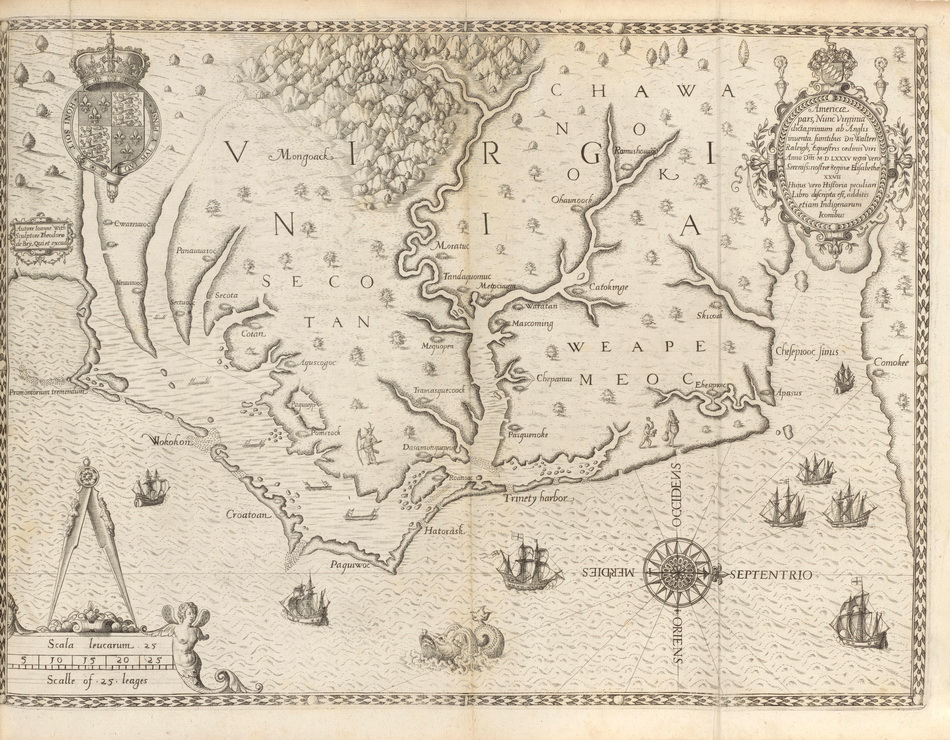
145. 布莱,西奥多·德。1528-1598年托马斯·哈里奥特。 弗吉尼亚州商业和国际贸易部。法兰克福:约翰·韦切尔,1590年。 高清作品[21%]

Admiranda Narratio Fida Tamen, de Commodis et Incolarum Ritibus Virginiae.  Frankfurt: Johann Wechel, 1590.

图片文件尺寸 : 4455 x 4726px

BRY, THEODOR DE. 1528-1598; AND THOMAS HARIOT.:Admiranda Narratio Fida Tamen, de Commodis et Incolarum Ritibus Virginiae. Frankfurt: Johann Wechel, 1590.
Folio (332 x 240 mm). Engraved title (first issue, see below), engraved arms on dedication leaf, double-page engraved map of Virginia in first state, engraved plate of Adam and Eve in first state with inscription \"Iodocus a winghe in Theodore de Bry fe.\" and 27 engraved plates after John White. Late 19th-century red morocco gilt by \"Bradstreet\'s for J. Comly MacCoy,\" gilt edges. Some light mostly marginal staining. Provenance: J.C. MacCoy (booklabel and binding).


FIRST EDITION, MOSTLY FIRST ISSUE (see below) OF THE FIRST VOLUME OF DE BRY\'S GREAT VOYAGES, BEING THOMAS HARIOT\'S DESCRIPTION OF VIRGINIA, and published during De Bry\'s lifetime. Thomas Hariot accompanied the 1585 expedition to Roanoke funded by Sir Walter Raleigh and acted as a translator. He had learned Carolina Algonquian from two Roanoke chiefs brought to England by Raleigh the year before. His account is a very encouraging one as the mysterious disappearance of Roanoke colony was not reported in Europe until John White, the expedition artist and mapmaker, returned in 1590.The 23 illustrations to the text, which are after John White\'s drawings, are by far the most important visual record of New World natives as first encountered by the English colonists. Also included is the highly important double-page map, the first map to identify Chesapeake Bay and \"the first printed map of this degree of detail and accuracy for any part of the present area of the United States\" (Cumming). It was dubbed by Burden \"one of the most significant cartographical milestones in colonial North American history ... the most accurate map drawn in the sixteenth century of any part of that continent. It became the prototype of the area until long after James Moxon\'s map in 1671... This is the first map to focus on Virginia (now largely North Carolina), and records the first English attempts at colonization in the New World. First issue engraved title as Church 140a, the plate not worn but without the printed \"cum gratia et privilege...\" at the bottom of the title panel. Map and most plates in first issue (plates 4, 7, 11, 12 second issue). D6 is a blank and genuine. Burden 76 (first state); Church 140; Cumming Southeast 12-13; European Americana 590/31; Sabin 8784.

布莱,西奥多·德。1528-1598年托马斯·哈里奥特。 弗吉尼亚州商业和国际贸易部。法兰克福:约翰·韦切尔,1590年。

146. 蒙迪尼斯(DI LUZZI,MONDINO)。1275–1326. 阿纳托米娅·蒙迪尼由梅勒斯塔特医生修正。[莱比锡:马丁·兰茨贝格,1493年。] 高清作品[20%]

Anathomia Mundini emendata per doctorem melerstat. [Leipzig: Martin Landsberg, 1493.]

图片文件尺寸 : 5043 x 4532px

MUNDINUS (DI LUZZI, MONDINO). 1275–1326.:MELLERSTADT, MARTINUS, editor. c.1455-1513. Anathomia Mundini emendata per doctorem melerstat. [Leipzig: Martin Landsberg, 1493.]
4to (200 x 140 mm). 40 leaves, 34 lines, title with full-page woodcut of an anatomical scene. Modern calf antique. Inner margin of title neatly reinforced, tiny repair to blank outer margin of last leaf, illegible old library stamp to lower margin of title page, scattered light browning, mostly marginal.

FIRST ILLUSTRATED EDITION OF THE FIRST DEDICATED ANATOMY BOOK. \"The first modern book devoted solely to anatomy ... Mundinus re-introduced human dissection, which had been neglected for 1500 years before him; he was the most noted dissector of his period, and he set forth the medieval anatomical vocabulary, deriving it mainly from Arabic\" (Garrison). Mondino de\' Luzzi, professor at Bologna, is considered to be the founder of anatomy in the Middle Ages. His treatise remained popular until the beginning of the 16th-century and appeared in multiple editions.

\"The subject of anatomy was not taught either by lectures or by dissection in the universities at the middle of the fifteenth century. An occasional \'anatomy\' was held, but the neglect of the subject is well illustrated by the absence of anatomical books. There is only one in the list, that of Mundinus . . . Mundinus was a professor at Bologna from 1306 to 1326, and was the first to teach anatomy from the subject, usually the corpse of a condemned criminal; but there is the record of a procedure in 1319 against four medical students for body-snatching. His Anatomia, written in 1316, was for two hundred years the popular text book\" (Osler).

In the introduction of the book, Mundinus says, \"proposui meis scholaribus in medicina quoddam opus componere, \'I have proposed to compose a work in medicine for my scholars.\" The work \"met a need universally felt just at that time and commended itself for its brevity, conciseness, and completeness, as well as for the fact that it taught for each separate organ the necessary anatomic technique, as. for example, in the first chapter: \'Situato itaque corpore vel homine mortuo per decollationem vel suspensionem supino\', etc., \'accordingly, laying out the body of a man dead by decapitation or hanging, etc....\" (Choulant). VERY RARE: According to American Book Prices Current no copy sold in the past 42 years. Choulant-Frank History and Bibliography of Anatomic Illustration (Chicago 1920, pp 88-93); Garrison-Morton-Norman 361 (for the 1478 edition); Goff M-874; GW M-25671 (recording only 2 copies/fragments); Hain 11633; see Osler Incunabula Medica 156; Wellcome I, 4484.

蒙迪尼斯(DI LUZZI,MONDINO)。1275–1326. 阿纳托米娅·蒙迪尼由梅勒斯塔特医生修正。[莱比锡:马丁·兰茨贝格,1493年。]

147. 草间弥生,当代艺术I 高清作品[18%]

DO-Yayoi Kusama - 现代艺术 I
图片文件像素:5457 x 4998 px

草间弥生,当代艺术I-

Yayoi Kusama - Zeitgenössische Kunst I-

(born in Matsumoto, Japan 1929)
Pumpkin KKK, 2002, signed, dated and titled on the reverse, acrylic on canvas, 22.7 x 15.8 cm, in plexiglass box

This work is accompanied by a registration card issued by Yayoi Kusama Studio

We are grateful to Yayoi Kusama Inc. for confirming the registration of the work in its database

Provenance:
European Private Collection

Iconic Pumpkin

Yayoi Kusama is possibly the best known Japanese artist in the world. Her famous polka dots have become her trademark and Kusama\'s stylized pumpkins are among the most iconic masterpieces of contemporary art.

Born in the late 1920s, Yayoi Kusama grew up in the conservative confines of the small town of Matsumoto in Nagano Prefecture in Japan. She attended the Kyoto School of Arts and Crafts, and after staging her first exhibitions, through which she was ‘discovered’ by the international art world, Kusama was able to emigrate to America, where she lived and worked, primarily in New York, from 1957 to 1973. Kusama celebrated her first major success in New York in 1959 with a solo exhibition at the Brata Gallery, entitled Obsessional Monochrome. The Infinity Net Paintings exhibited there were compositions of dense networks executed with white brushstrokes on a black ground and characterised by the theme of repetition.

Grids, flashes of light and, above all, dots that repeat endlessly are the most striking characteristic of Kusama\'s works and established her fame as the ‘Polka Dot Princess’. For the artist, the dots that overgrow everything are not merely a harmless pattern. They have their origins in the hallucinations and panic attacks she has experienced since her youth, which determined her perception of the world. Growing up, she saw dot and net patterns and feared she would dissolve into them. The polka dots and their constant repetition now became an expression of the search for infinity and the desire for self-dissolution. The dots erase the image into which the artist channels her fears. With her polka dots, Kusama covers not only canvases, but also everyday objects such as tea kettles or bookshelves, clothes, giant tentacles, oversized flowers, entire rooms or herself. And pumpkins as well.

\"Pumpkin KKK\" (2002) represents another important theme in Yayoi Kusama\'s work. For Kusama, the pumpkin is associated with memories of childhood and has been a favourite motif with almost mythical status since the 1970s-1980s. The artist first saw pumpkins during walks with her grandfather, and they had a calming effect on the hallucination-stricken artist. \"I love pumpkins for their humorous shape, their warmth and their human quality,\" Kusama says. She devoted herself to pumpkins in paintings and sculptures and incorporated them into her Infinity Rooms. Bold colours characterise the pumpkins, as do the precisely placed polka dots. The colour scheme follows an inner symbolism, according to which the artist categorises unprocessed experiences. The pumpkins stand for triumph over inner struggles, their endless repetition allows the artist to find her mental balance.

Since her return to Japan, Kusama, who has never made a secret of her illness, has voluntarily lived in a psychiatric institution. In 2017, a museum dedicated solely to her opened in Tokyo and numerous international exhibitions testify to considerable on-going interest in her work. With her unconventional works, her extraordinary performances, self-dramatisations and happenings, Kusama has anticipated many trends in contemporary art.

had油画图片- 高清had绘画作品- 代表作全集 中艺名画下载


141. 威瑟利(塞西尔·普莱特上尉) 警备队队长塞西尔·普列特·韦瑟利(Cecil Poulett Weatherley)的手稿笔记本,描述了他在1896-1899年环湖航行的情况 高清作品[25%]

Manuscript notebook of Captain Cecil Poulett Weatherley , of the Vigilant, describing his circumnavigation of Lake Bangweolo, 1896-1899, [c.1899]

图片文件尺寸 : 4503 x 4542px

WEATHERLEY (CAPTAIN CECIL POULETT):Manuscript notebook of Captain Cecil Poulett Weatherley (1860-1932), of the Vigilant, describing his circumnavigation of Lake Bangweolo, 1896-1899, comprising detailed notes of compass bearings, longitude and latitude and notes on the geographical features, interspersed with later additional commentary on the land and its people, and illustrated with some thirty-five fine pencil and watercolour maps and drawings, including two portraits (\"...from a sketch made in the Vigilant 23-9-98...\"), describing his route from the Isthmus of Fungé (\"...a stretch of extremely white sand...\"), via Kawendé Country (\"...beautifully wooded with tall Mipundu trees...\"), Kirui Island (\"...out and away, the best wooded of the islands...\"), N\'Kanga and Kasanga Marshes (\"...High papyrus with water ways for canoes...\"), Bemba Chifunawuli (\"...discovered by me in 1896...\"), Luapula (\"...a delightful little river...\"), Mumbotuta Falls (\"...the sight of the Luapula), Mwyangashé River (\"...most disappointing in every way...\"), Wengé Hills (\"...High walls of red sandstone...\"), and Mweru, ending by apologising for gaps in the account as he had mislaid the piece of paper on which he wrote his calculations, with extensive notes on the names of African families and the correct pronunciation of the same, c.315 pages, in ink, dust-staining and marks with some water staining, original ruled vellum boards, faded notes in ink and pencil on front board, worn, binding loose, small 4to (200 x 135mm.), [c.1899]

威瑟利(塞西尔·普莱特上尉) 警备队队长塞西尔·普列特·韦瑟利(Cecil Poulett Weatherley)的手稿笔记本,描述了他在1896-1899年环湖航行的情况

142. 安迪·沃霍尔,当代艺术I 高清作品[24%]

DO-Andy Warhol - 现代艺术 I
图片文件像素:5491 x 4804 px

安迪·沃霍尔,当代艺术I-

Andy Warhol - Zeitgenössische Kunst I-

(Pittsburgh 1928–1987 New York)
Jack Nicklaus, 1977, acrylic, silkscreen, ink on canvas, on the reverse with the stamps of The Estate of Andy Warhol and The Andy Warhol Foundation for the Visual Arts, New York, numbered with archive number PO 41.049, numbered again on the stretcher, 25.4 x 25.4 cm, on stretcher

Provenance:
Estate of the artist
Private collection, Florence
Galerie Hafenrichter, Nurnberg
Private collection, 德国y - acquired from the above

Literature:
Catalogue Raisonné, Andy Warhol, Paintings, 1976–1978, no. 3846

This small-format work by Andy Warhol from 1977 is a portrait of one of the best golfers of the 20th century - US golfer Jack Nicklaus, also known as The Golden Bear.

From the early 1960s until the late 1980s, Nicklaus was regarded as one of the best golfers in the world. With 18 major victories under his belt, he is still the most successful player in his sport.

This portrait was created as part of Warhol’s so-called Athletes series, commissioned by his friend and art collector Richard Weisman. It includes a total of ten portraits of famous athletes of the time, such as Muhammad Ali, Chris Evert and Pelé.
It is an interesting departure from Warhol’s usual society portraits and occupies a rather idiosyncratic position in his extensive oeuvre.

Warhol had little interest in sports and its heros, and did not choose the protagonists of the series himself, leaving this task to Weisman. The latter knew many athletes personally, which made it easy to persuade them to pose for Warhol. Warhol eventually met each of the top athletes in person, and took photographs of them with his Polaroid Big Shot camera. The silkscreen portraits were subsequently created on the basis of these images. Each portrait is executed in various colors, and captures both the glamour and personality of the individual athlete.

Of the around 60 Polaroids Warhol made of Jack Nicklaus with his Big Shot camera, he selected four and processed them further into canvases.
On the basis on the photographs of Nicklaus with his golf club, Warhol ultimately created 15 original portraits of the athlete.

143. 米谢·弗龙 高清作品[24%]

DO-Jean-Michel Folon  - 现代艺术 I
图片文件像素:5663 x 4147 px

米谢·弗龙-

Jean-Michel Folon * - Zeitgenössische Kunst I-

(Brussels 1934–2005 Monaco)
La pêche miraculeuse (Buste aux poissons) / The Miraculous Catch (Bust with Fish), 2005, bronze, signed and numbered HC 2/2 (from an edition of 2 + 2 EA + 2 HC) with the foundry mark: Romain Fils, h 81 cm w 43 cm.

This work will be included in the artist’s forthcoming catalogue raisonné currently being prepared by the Fondation Folon.

This work is registered at the Fondation Folon with the number F400 and is accompanied by a certificate of authenticity.

Provenance:
European Private Collection

The 比利时 artist Jean-Michel Folon (1934-2005) has left a universal mark on the collective imagination of the last third of the 20th century through his posters, illustrations, television animations, and his numerous exhibitions. A humanist, he left behind a figurative and poetic body of work rooted in traditional techniques, which was atypical for an environment dominated by conceptual art. Folon turned to sculpture in the early 1990s, having initially focused on paper-based techniques (inks, silk-screen printing, watercolour), thus providing him with a new challenge.
His sculptures are inspired by ethnographic art and characterised by their frontality and corporality, from the Cyclades to the Etruscans, from African masks to Amerindian totems. They are largely centred on the human being and embody themes that were once treated graphically and thus project the artist\'s universe into atypical and natural environments: landscapes, gardens, parks, interiors.

La pêche miraculeuse (Buste aux poissons) [The Miraculous Catch (Bust with Fish)] from 2005 presents the artist’s favoured Everyman, the character with the hat, onto whom everyone can project themselves. He is holding an armful of fish. This bust sculpture is a variation on a theme that Folon had explored with a few years earlier in his Fontaine aux poissons [Fountain with Fish], which has been shown to the public on numerous occasions at major exhibitions, notably in Florence in 2005. The quality of the patina of this remarkable Catch is typical of Folon\'s quasi-pictorial quest for sculpture. It drew this comment from the sculptor.

“You make impressionist sculptures, these are the patinas of a painter and each of your sculptures will be unique because you will never be able to do the same thing twice.”
César

144. 俄罗斯艺术杂志。 Zhar Ptitsa/Jar Ptitsa[火鸟]。巴黎和柏林:Russkoe Iskustvo,1921年8月至1926年1月。 高清作品[23%]

Zhar-Ptitsa/Jar-Ptitza [The Firebird]. Paris and Berlin: Russkoe Iskusstvo, August 1921-January 1926.

图片文件尺寸 : 5489 x 4959px

RUSSIAN ART JOURNAL.:Zhar-Ptitsa/Jar-Ptitza [The Firebird]. Paris and Berlin: Russkoe Iskusstvo, August 1921-January 1926. 14 issues in 13 volumes (No. 4/5 double issue). 4to (315 x 240 mm). Illustrated in color and black and white, with many plates tipped in. Original color lithographed wrappers. Some issues missing spines with pages detached; internal tears and some loss.

A COMPLETE SET OF THE RARE RUSSIAN EMIGRE LITERARY ART MAGAZINE IN ORIGINAL ISSUES, reportedly no more than 300 copies were printed. Supplemental summaries of the numbers were provided in the back in a variety of languages including English. Zhar-ptitsa was the most influential art journal of the flourishing community of exiles who were feverishly trying to keep the culture of Old Russia alive. Due to paper shortages and extensive censorship by the Bolsheviks back in the USSR, the Russian book business was booming in Germany and France. This lavish periodical was the natural successor to S. Diaghilev\'s Mir iskusstva since many of those involved had been members of the World of Art Group and designers for the Ballets Russes. The rich selection subjects and contributors under A. E. Kogan\'s art department embraced L. Bakst, A. Benois, I. Bilibin, M. Chagall, S. Chekhonin, N. Goncharova, B. Grigoriev, B. Kustodiev, M. Larionov, V. Shukaev, K. Somov, S. Sudeikin and many other important artists. Poet Sasha Cherny was literary editor; and such important writers as L. Andreev, K. Balmont, I. Bunin, V. Khodasevich, B. Pilnyak, A. Remizov, N. Teffi, A.N. Tolstoi, B. Zaitsev, and the young Vladimir Nabokov (as \"V. Sirin\") appeared in its pages. Fekula called Zhar-ptitsa \"perhaps the most famous of post-revolutionary art journals, whose contributors threw new light on the development of Russian art at the beginning of the twentieth century.\" According to Vengerov, \"Even separate issues of the magazine, let alone complete sets of its issues, are a great bibliographic rarity.\" Fekula 5742; Vengerov Staraya russkaya kniga 105.

俄罗斯艺术杂志。 Zhar Ptitsa/Jar Ptitsa[火鸟]。巴黎和柏林:Russkoe Iskustvo,1921年8月至1926年1月。

145. 布莱,西奥多·德。1528-1598年托马斯·哈里奥特。 弗吉尼亚州商业和国际贸易部。法兰克福:约翰·韦切尔,1590年。 高清作品[21%]

Admiranda Narratio Fida Tamen, de Commodis et Incolarum Ritibus Virginiae.  Frankfurt: Johann Wechel, 1590.

图片文件尺寸 : 4455 x 4726px

BRY, THEODOR DE. 1528-1598; AND THOMAS HARIOT.:Admiranda Narratio Fida Tamen, de Commodis et Incolarum Ritibus Virginiae. Frankfurt: Johann Wechel, 1590.
Folio (332 x 240 mm). Engraved title (first issue, see below), engraved arms on dedication leaf, double-page engraved map of Virginia in first state, engraved plate of Adam and Eve in first state with inscription \"Iodocus a winghe in Theodore de Bry fe.\" and 27 engraved plates after John White. Late 19th-century red morocco gilt by \"Bradstreet\'s for J. Comly MacCoy,\" gilt edges. Some light mostly marginal staining. Provenance: J.C. MacCoy (booklabel and binding).


FIRST EDITION, MOSTLY FIRST ISSUE (see below) OF THE FIRST VOLUME OF DE BRY\'S GREAT VOYAGES, BEING THOMAS HARIOT\'S DESCRIPTION OF VIRGINIA, and published during De Bry\'s lifetime. Thomas Hariot accompanied the 1585 expedition to Roanoke funded by Sir Walter Raleigh and acted as a translator. He had learned Carolina Algonquian from two Roanoke chiefs brought to England by Raleigh the year before. His account is a very encouraging one as the mysterious disappearance of Roanoke colony was not reported in Europe until John White, the expedition artist and mapmaker, returned in 1590.The 23 illustrations to the text, which are after John White\'s drawings, are by far the most important visual record of New World natives as first encountered by the English colonists. Also included is the highly important double-page map, the first map to identify Chesapeake Bay and \"the first printed map of this degree of detail and accuracy for any part of the present area of the United States\" (Cumming). It was dubbed by Burden \"one of the most significant cartographical milestones in colonial North American history ... the most accurate map drawn in the sixteenth century of any part of that continent. It became the prototype of the area until long after James Moxon\'s map in 1671... This is the first map to focus on Virginia (now largely North Carolina), and records the first English attempts at colonization in the New World. First issue engraved title as Church 140a, the plate not worn but without the printed \"cum gratia et privilege...\" at the bottom of the title panel. Map and most plates in first issue (plates 4, 7, 11, 12 second issue). D6 is a blank and genuine. Burden 76 (first state); Church 140; Cumming Southeast 12-13; European Americana 590/31; Sabin 8784.

布莱,西奥多·德。1528-1598年托马斯·哈里奥特。 弗吉尼亚州商业和国际贸易部。法兰克福:约翰·韦切尔,1590年。

146. 蒙迪尼斯(DI LUZZI,MONDINO)。1275–1326. 阿纳托米娅·蒙迪尼由梅勒斯塔特医生修正。[莱比锡:马丁·兰茨贝格,1493年。] 高清作品[20%]

Anathomia Mundini emendata per doctorem melerstat. [Leipzig: Martin Landsberg, 1493.]

图片文件尺寸 : 5043 x 4532px

MUNDINUS (DI LUZZI, MONDINO). 1275–1326.:MELLERSTADT, MARTINUS, editor. c.1455-1513. Anathomia Mundini emendata per doctorem melerstat. [Leipzig: Martin Landsberg, 1493.]
4to (200 x 140 mm). 40 leaves, 34 lines, title with full-page woodcut of an anatomical scene. Modern calf antique. Inner margin of title neatly reinforced, tiny repair to blank outer margin of last leaf, illegible old library stamp to lower margin of title page, scattered light browning, mostly marginal.

FIRST ILLUSTRATED EDITION OF THE FIRST DEDICATED ANATOMY BOOK. \"The first modern book devoted solely to anatomy ... Mundinus re-introduced human dissection, which had been neglected for 1500 years before him; he was the most noted dissector of his period, and he set forth the medieval anatomical vocabulary, deriving it mainly from Arabic\" (Garrison). Mondino de\' Luzzi, professor at Bologna, is considered to be the founder of anatomy in the Middle Ages. His treatise remained popular until the beginning of the 16th-century and appeared in multiple editions.

\"The subject of anatomy was not taught either by lectures or by dissection in the universities at the middle of the fifteenth century. An occasional \'anatomy\' was held, but the neglect of the subject is well illustrated by the absence of anatomical books. There is only one in the list, that of Mundinus . . . Mundinus was a professor at Bologna from 1306 to 1326, and was the first to teach anatomy from the subject, usually the corpse of a condemned criminal; but there is the record of a procedure in 1319 against four medical students for body-snatching. His Anatomia, written in 1316, was for two hundred years the popular text book\" (Osler).

In the introduction of the book, Mundinus says, \"proposui meis scholaribus in medicina quoddam opus componere, \'I have proposed to compose a work in medicine for my scholars.\" The work \"met a need universally felt just at that time and commended itself for its brevity, conciseness, and completeness, as well as for the fact that it taught for each separate organ the necessary anatomic technique, as. for example, in the first chapter: \'Situato itaque corpore vel homine mortuo per decollationem vel suspensionem supino\', etc., \'accordingly, laying out the body of a man dead by decapitation or hanging, etc....\" (Choulant). VERY RARE: According to American Book Prices Current no copy sold in the past 42 years. Choulant-Frank History and Bibliography of Anatomic Illustration (Chicago 1920, pp 88-93); Garrison-Morton-Norman 361 (for the 1478 edition); Goff M-874; GW M-25671 (recording only 2 copies/fragments); Hain 11633; see Osler Incunabula Medica 156; Wellcome I, 4484.

蒙迪尼斯(DI LUZZI,MONDINO)。1275–1326. 阿纳托米娅·蒙迪尼由梅勒斯塔特医生修正。[莱比锡:马丁·兰茨贝格,1493年。]

147. 草间弥生,当代艺术I 高清作品[18%]

DO-Yayoi Kusama - 现代艺术 I
图片文件像素:5457 x 4998 px

草间弥生,当代艺术I-

Yayoi Kusama - Zeitgenössische Kunst I-

(born in Matsumoto, Japan 1929)
Pumpkin KKK, 2002, signed, dated and titled on the reverse, acrylic on canvas, 22.7 x 15.8 cm, in plexiglass box

This work is accompanied by a registration card issued by Yayoi Kusama Studio

We are grateful to Yayoi Kusama Inc. for confirming the registration of the work in its database

Provenance:
European Private Collection

Iconic Pumpkin

Yayoi Kusama is possibly the best known Japanese artist in the world. Her famous polka dots have become her trademark and Kusama\'s stylized pumpkins are among the most iconic masterpieces of contemporary art.

Born in the late 1920s, Yayoi Kusama grew up in the conservative confines of the small town of Matsumoto in Nagano Prefecture in Japan. She attended the Kyoto School of Arts and Crafts, and after staging her first exhibitions, through which she was ‘discovered’ by the international art world, Kusama was able to emigrate to America, where she lived and worked, primarily in New York, from 1957 to 1973. Kusama celebrated her first major success in New York in 1959 with a solo exhibition at the Brata Gallery, entitled Obsessional Monochrome. The Infinity Net Paintings exhibited there were compositions of dense networks executed with white brushstrokes on a black ground and characterised by the theme of repetition.

Grids, flashes of light and, above all, dots that repeat endlessly are the most striking characteristic of Kusama\'s works and established her fame as the ‘Polka Dot Princess’. For the artist, the dots that overgrow everything are not merely a harmless pattern. They have their origins in the hallucinations and panic attacks she has experienced since her youth, which determined her perception of the world. Growing up, she saw dot and net patterns and feared she would dissolve into them. The polka dots and their constant repetition now became an expression of the search for infinity and the desire for self-dissolution. The dots erase the image into which the artist channels her fears. With her polka dots, Kusama covers not only canvases, but also everyday objects such as tea kettles or bookshelves, clothes, giant tentacles, oversized flowers, entire rooms or herself. And pumpkins as well.

\"Pumpkin KKK\" (2002) represents another important theme in Yayoi Kusama\'s work. For Kusama, the pumpkin is associated with memories of childhood and has been a favourite motif with almost mythical status since the 1970s-1980s. The artist first saw pumpkins during walks with her grandfather, and they had a calming effect on the hallucination-stricken artist. \"I love pumpkins for their humorous shape, their warmth and their human quality,\" Kusama says. She devoted herself to pumpkins in paintings and sculptures and incorporated them into her Infinity Rooms. Bold colours characterise the pumpkins, as do the precisely placed polka dots. The colour scheme follows an inner symbolism, according to which the artist categorises unprocessed experiences. The pumpkins stand for triumph over inner struggles, their endless repetition allows the artist to find her mental balance.

Since her return to Japan, Kusama, who has never made a secret of her illness, has voluntarily lived in a psychiatric institution. In 2017, a museum dedicated solely to her opened in Tokyo and numerous international exhibitions testify to considerable on-going interest in her work. With her unconventional works, her extraordinary performances, self-dramatisations and happenings, Kusama has anticipated many trends in contemporary art.