4611. 福图纳托·德佩罗-现代` by Fortunato Depero 高清作品[29%]

DO-Fortunato Depero  - Moderne
图片文件像素:4600 x 3500 px

福图纳托·德佩罗-现代-

-

(Fondo/Trient 1892–1960 Rovereto)
Mongolfiera sopra New Milford, 1948, Öl auf Leinwand, 80 x 105 cm, gerahmt

Im Herbst 1947 unternahm Depero einen weiteren Versuch, sich in Amerika zu etablieren. Er hoffte, mit „Buxus“ den Durchbruch zu schaffen, verbrachte jedoch den Winter 1947-1948, einen der kältesten in New York seit Menschengedenken, einsam und fast verhungert in einem Hinterzimmer eines Büros.
Für den Futurismus und sein eigenes Werk fand er nur Feindseligkeit und verschlossene Türen vor:
Glücklicherweise kam im Frühjahr 1948 auch seine Frau aus Italien nach und sie fanden Gastfreundschaft in einer schönen Villa in New Milford, Connecticut, etwa 150 Meilen von New York entfernt. Dort, inmitten der ländlichen Ruhe, fand er ein Gefühl der Gelassenheit und konnte hart arbeiten. „Die Natur“, schrieb er an einen Freund, „ist hier einfach ozeanisch. Wir sind von Hügeln mit üppiger Vegetation umgeben ... Wir sind eingetaucht in eine Palette von Grüntönen und Pflanzen aller Art ... Alles, was ich höre, ist das Rascheln der Blätter von sechs riesigen, typisch amerikanischen Pappeln. Nur wenige Autos fahren vorbei, denn wir befinden uns hier richtig auf dem Land mit riesigen Rinderherden ... Wenn ich daran denke, dass ich gestern sogar Rosetta und mich selbst nackt im Gras gemalt habe, während am Himmel über New Milford ein Heißluftballon vorbeiflog ...“

M. Scudiero, D. Magnetti, Depero Futurista, Turin 2004

4612. 罗哈斯·萨米恩托,胡安·德。FL.1540-1550。 《Astrolabium,Planisphaerium Vocant》中的评论员,《Lucem Editi》中的《图书馆性爱第一》。巴黎:迈克尔·瓦斯科桑,1550年。 高清作品[29%]

Commentariorum in Astrolabium quod Planisphaerium Vocant, Libri Sex nunc Primum in Lucem Editi.  Paris: Michael Vascosan, 1550.

图片文件尺寸 : 5267 x 5418px

ROJAS SARMIENTO, JUAN DE. Fl.1540-1550.:Commentariorum in Astrolabium quod Planisphaerium Vocant, Libri Sex nunc Primum in Lucem Editi. Paris: Michael Vascosan, 1550.
8vo (230 x 165 mm). Woodcut illustrations and diagrams, including 15 full-page illustrations of the astrolabe, woodcut initials. [xxiv], 282, [12] pp, lacking 2M6 (blank), italic type. Modern full paneled cat\'s paw calf, spine gilt; title extended and repaired, slight foxing, a few pages with extensive early ink marginalia, E1 lower corner repair.

FIRST EDITION of this important treatise on the astrolabe, presenting Rojas\' model for a universal astrolabe with orthographic projection. \"The chief novelty in [the astrolabe] consisted in a special treatment of the face of the instrument as an orthographic projection of the sphere on the plane of the meridian\" (Gunther, Astrolabes of the World). Houzeau Lancaster 3275; Mortimer, Harvard French 462.

罗哈斯·萨米恩托,胡安·德。FL.1540-1550。 《Astrolabium,Planisphaerium Vocant》中的评论员,《Lucem Editi》中的《图书馆性爱第一》。巴黎:迈克尔·瓦斯科桑,1550年。

4613. 多斯托耶夫斯基的名片上写着亚历山大·赫尔岑。 照片署名并题写(俄语)给亚历山大·赫尔岑, 高清作品[28%]

Photograph signed and inscribed [in Russian] to Alexander Herzen,

图片文件尺寸 : 3981 x 5780px

DOSTOEVSKY CARTE-DE-VISITE INSCRIBED TO ALEXANDER HERZEN.:DOSTOEVSKY, FYODOR. 1821-1881. Photograph signed and inscribed [in Russian] to Alexander Herzen, albumen print carte-de-visite full length portrait by M.B. Tulinov, Petersburg, 1861, 105 x 65 mm, inscribed by Dostoevsky in Russian to the verso, \"Alexander Ivanovich Herzen in memory of our meeting in London. Fyodor Dostoyevsky 8 July/20 July 1862,\" minor stain to verso.
Provenance: Alexander Ivanovich Herzen; to daughter Olga Aleksandrovna [Herzen] Monod; by descent.
Publication: For a discussion of the photograph, see Volgin, Igor. \"Introduction\" to The Dostoevsky Archive (1997), p 21.

Pull quote: \"Herzen awaits his readers in the future. Far above the heads of the present crowd, he transmits his thoughts to those who will be able to comprehend them.\" – Leo Tolstoy, 1905.

VERY RARE CARTE DE VISITE PHOTOGRAPH OF FYODOR DOSTOEVSKY PRESENTED TO ALEXANDER HERZEN IN REMEMBRANCE OF THEIR 1862 MEETING IN LONDON: A TREMENDOUSLY IMPORTANT ASSOCIATION BETWEEN TWO OF THE LEADING INTELLECTUALS OF THE 19TH-CENTURY.

Alexander Herzen was one of the most important and influential Russian writers and thinkers of the 19th-century. called the \"father of Russian socialism,\" he had a profound influence on late-19th century Russian writers, including Fyodor Dostoevsky. Born illegitimately to a wealthy Russian landowner, Herzen became a dissident and critic of the Russian feudal system. Of Herzen, Tolstoy said he had never met a man \"with so rare a combination of scintillating brilliance and depth.\" His writings, including From the Other Shore (1848) and those appearing in his influential publications of the 1850s-60s The Bell and the Polestar, would help mold a generation of Russian writing and thought.

Herzen and Dostoevsky met for the first time in Russia in 1846, following Dostoevsky\'s comment in a letter to his brother that Herzen and Goncharov stand as \"the most remarkable\" of his rivals; Herzen\'s recollection of the meeting was less than effusive, however: \"I can\'t say he made a particularly present impression.\" Their second meeting occurred when Dostoevsky visited Herzen in London in July of 1862, of which this photograph is a memento. During the 1850s and early 1860s, visits to the emigree Herzen by Russian writers and intellectuals were something of a right of passage, and Dostoevsky\'s visit followed right on the heels of Turgenev. This series of meetings profoundly affected Dostoevsky and his work, and is clearly acknowledged in his Winter Notes which he wrote later that year, exhibiting a clear debt to Herzen\'s own writings. Dostoevsky, along with Solzhenitsyn, acknowledged the formative influence of Herzen on his work, and Herzen would also appear in composite in a number of Dostoevsky\'s characters throughout his career. Herzen, however, noted, rather condescendingly, \"Dostoevsky was here yesterday—he is a naïve, not entirely lucid, but a very dear person. He believes enthusiastically in the Russian people.\"

The two towering figures would meet again on a steamship from Naples to Livorno the following year, where Dostoevsky was travelling with his mistress Polina Suslova. According to Suslova\'s diaries (as published in The Dostoevsky Archives), Dostoevsky took pains to hide their relationship from Herzen, introducing her vaguely as a family member, and even encouraged her to arrange a visit with Herzen\'s son in Paris that Winter. After they parted, Dostoevsky became angry with her over a photograph of her he had seen at Herzen\'s, which she had given at an earlier date. In 1865, Dostoevsky wrote to Herzen imploring him for a loan, and became peevish when Herzen did not immediately respond. By the late 1860s Dostoevsky would disparage Herzen, somewhat unfairly, as a \"Westernizer,\" leading to his more severe criticism of Herzen in his Writer\'s Diary.

Herzen was one of the most complex and brilliant figures of the 19th-century, and was largely responsible for assimilating western ideas into Russian thought, while still maintaining his advocacy for the freedom of the Russian serf.

In reality, the two writers/thinkers shared a great deal in their outlook: both asserted the importance of the individual, and the folly of the search for a unified teleological system, cutting against the grain of their mid-19th century contemporaries. While Herzen was embraced by Lenin, identified as the \"father of Russian socialism,\" Herzen\'s socialism was a different breed, \"Centralization may do a great deal for order and for various public undertakings, but it is incompatible with freedom. It easily brings a nation to the position of a well-tended flock or a pack of hounds cleverly kept in order by a huntsman.\" Lenin regarded Herzen\'s focus on freedom as a shortcoming of his bourgeois roots. During the 20th-century Russian-British philosopher Isaiah Berlin came across Herzen\'s writings and recognized the prescience of Herzen\'s thought. It was Berlin, who reestablished Herzen\'s influence, agreeing with and amplifying his idea that the pursuit of \"a perfect society\" invariably leads to blood.

The present photograph was taken by Mikhail Borisovich Tulinov (1823–1889) in Petersburg in 1861. Any period photograph of Dostoevsky is rare, and moreso inscribed. We trace two inscribed photographs at auction in the last 40 years. However, we find no record of an inscribed photograph of similar substance and importance in the historical record. An incredible, and incredibly rare, Dostoevsky item tying together two of the greatest thinkers and writers of the 19th-century.

REFERENCES:
Kelly, Aileen. The Discovery of Chance: The Life and Thought of Alexander Herzen. 2016.
Kelly, Aileen. \"Irony and Utopia in Herzen and Dostoevsky: From the Other Shore and Diary of a Writer.\" The Russian Review, 50:4 (1991), pp 397-416.
Lantz, Kenneth. The Dostoevsky Encycolpedia. 2004.
Serakin, Peter. The Dostoevsky Archive: Firsthand Accounts of the Novelist from Contemporaries\' Memoirs and Rare Periodicals. 1997.


\"If only people wanted to save themselves instead of saving the world, how much they would do for the salvation of the world and the liberation of humanity!\" – Alexander Herzen, From the Other Shore, 1848.

多斯托耶夫斯基的名片上写着亚历山大·赫尔岑。 照片署名并题写(俄语)给亚历山大·赫尔岑,

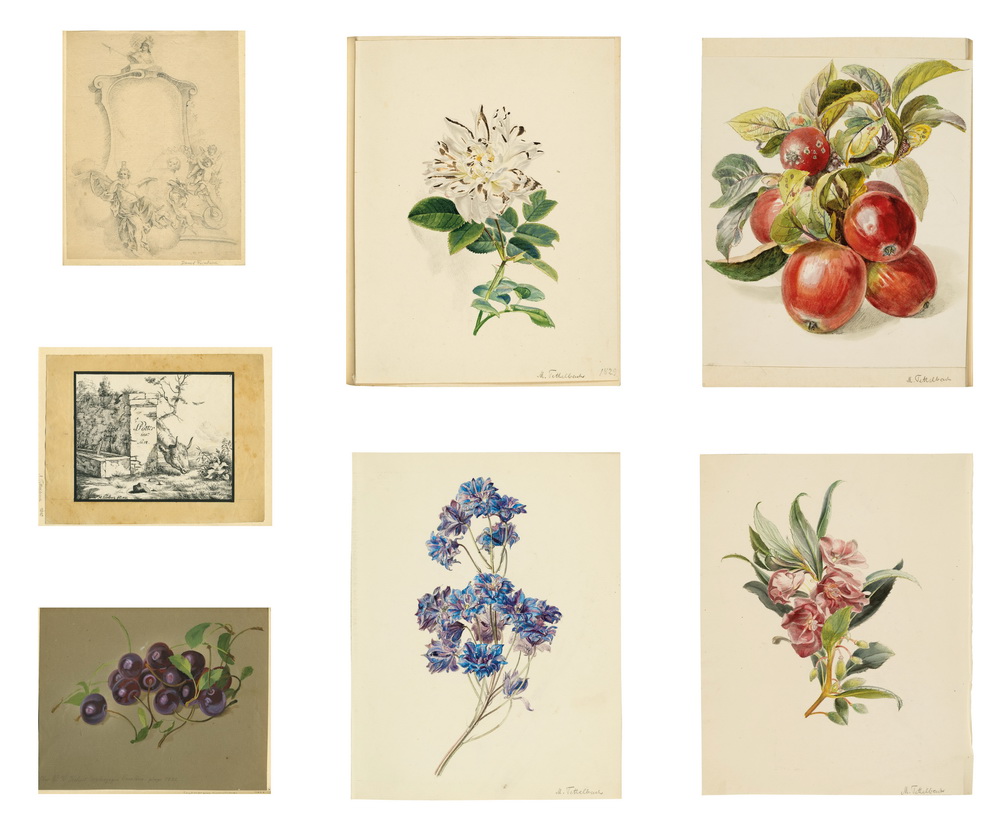
4614. 阿尔布姆,德累斯顿,约18世纪半叶至19世纪半叶` by Album, Dresden ca. 2. Hälfte 18. Jahrhundert bis ca. 1. Hälfte 19. Jahrhundert 高清作品[28%]

DO-Album, Dresden ca. 2. Hälfte 18. Jahrhundert bis ca. 1. Hälfte 19. Jahrhundert - Meisterzeichnungen und Druckgraphik bis 1900, Aquarelle, Miniaturen
图片文件像素:4600 x 3500 px

阿尔布姆,德累斯顿,约18世纪半叶至19世纪半叶-

-

u. a. Moritz Tettelbach (1794-1870), David Friedrich (1719-1766), Karoline Ferdinande von Österreich (1801-1832) Kopfstudien, Tierdarstellungen, Figurale Szenen, Landschaften, Obstund Blumenstudien, 7 Blätter, signiert und datiert Augusta Tettelbach am 11. August 1793, Moritz Tettelbach, allererster Versuch im Malen 1805, M. Tettelbach 1807, M. Tettelbach 1808, M. Tettelbach fec. 1810, E. Engelbrecht 1856, Ihre k. k. Hoheit Erzherzogin Carolina pinx. 1821, versch. Techniken, Bleistift, Tusche, Aquarell auf Papier, ca. 69 Stück auf 40 Albumseiten kaschiert bzw. montiert, versch. Formate, teilweise fleckig, Album: 25 x 23,5 x 2,5 cm, dazu: Kuvert mit 13 kleinen Kopfstudien, Bleistift auf Papier, Traubenstillleben, Aquarell auf Naturpapier, beschädigt, (BH)

Eine Händescheidung der Skizzen und Studien des Albums ist schwierig. Die wenigsten sind eigenhändig signiert, die meisten jedoch mit Sammlervermerken versehen. Vertreten sind Mitglieder der Familie Tettelbach - Gottfried Benjamin Tettelbach (Vater), Moritz Tettelbach (Sohn), Augusta Tettelbach (Tochter), Mitglieder der Familie Friedrich – David Friedrich Friedrich (Vater), Johann Alexander David Friedrich (Sohn), Caroline Friederike Friedrich (Tochter) und Schülerinnen Moritz Tettelbachs – u.a. Erzherzogin Caroline Ferdinande von Österreich.

Ernst Moritz Gustav Tettelbach(1794-1870), war Sohn des Gottfried Benjamin Tettelbach „Königlich Sächsischer Hof- und Kabinetts-Steinschneider und Graveur zu Friedrichstadt bey Dresden“. Auch seine Geschwister waren Künstler – die Blumenmalerin Augusta Tettelbach und die Steinschneider Felix und Paul Clemens Alexander Tettelbach. Moritz Tettelbach erhielt ab 1806 Zeichenunterricht bei Johann Eleazar Zeissig, genannt Schenau und erlernte ab 1807 bei seiner Tante Caroline Friedrike Friedrich die Frucht- und Blumenmalerei. Der junge Künstler war auf mehreren Kunstausstellungen in Dresden vertreten, 1914 im Salon. Seit den 1820er Jahren war Tettelbach neben seinem Onkel Jacob Friedrich und seinem Vetter Carl Friedrich u.a. im Schloss Pillnitz damit beschäftigt für König Friedrich August II das dortige Herbarium künstlerisch aufzunehmen. So entstand eine einzigartige Folge von Pflanzenaquarellen. Mitte der 1830er Jahre hielt sich Tettelbach in Wien auf, wo er auch Aufträge für den kaiserlichen Hof ausführte. 1865 weilte er vorübergehend in Paris.

Caroline Friederike Friedrich (1749-1815) gehörte einer über 4 Generationen wirkenden Künstlerfamilie an. Sie war die Tochter des Radierers und Tapetenmalers David Friedrich Friedrich (1719-1766) und wurde von ihrem Vater im Zeichnen unterrichtet, ihr Bruder Johann David Alexander Friedrich (1744-1793) lehrte ihr die Öl- und Aquarellmalerei. Caroline Friedrich bildete sich aber auch durch Beobachtung der Natur autodidaktisch weiter. Ab 1770 erhielt sie ein Stipendium der Kurfürstlich Sächsischen Kunstakademie, 1774 wurde sie zum Ehrenmitglied ernannt und ab 1783 gab sie dort als einzige Frau Unterricht. Ab 1776 nahm sie regelmäßig mit Stillleben an den Akademieausstellungen teil. Sie kombinierte Blumen, Früchte, Insekten und Nahrungsmittel mit schimmernden oder durchscheinenden Gefäßen und wurde von den Kunstkritikern oft mit dem holländischen Stilllebenmaler Jan von Huysum verglichen. Das Kupferstichkabinett Dresden bewahrt eine beachtliche Zahl Zeichnungen, Aquarelle und Gouachen auf.

Karoline Ferdinande von Österreich (1801-1832) war die Tochter von Kaiser Franz II. und dessen zweiter Gemahlin Maria Theresa von Neapel-Sizilien. Sie wurde als 18-Jährige mit dem Neffen des sächsischen Königs, dem späteren König Friedrich August II. von Sachsen, vermählt. Die Ehe dauerte 13 Jahre lang und blieb kinderlos. Am 22. Mai 1832 verstarb Prinzessin Karoline Ferdinande im Alter von 31 Jahren.

4615. 多梅尼科·玛丽亚·弗雷塔` by Domenico Maria Fratta 高清作品[28%]

DO-Domenico Maria Fratta - Meisterzeichnungen und Druckgraphik bis 1900, Aquarelle, Miniaturen
图片文件像素:4600 x 3500 px

多梅尼科·玛丽亚·弗雷塔-

-

(Bologna 1696-1763) Das Urteil des Salomon (recto), Studie für den linken Teil derselben Komposition (verso), Feder in Braun, grau laviert, auf Bütten, 16,8 x 21,5 cm, Passep., ohne Rahmen, (Sch)

Die Zuschreibung an Domenico Fratta wurde von Dr. Marco Riccòmini anhand einer hochauflösenden digitalen Fotografie bestätigt.

Domenico Maria Fratta war einer der talentiertesten Schüler des bologneser Malers Donato Creti (1671-1749), dessen Zeichnungen lange seinem Meister zugeschrieben waren, bis man sie seinem individuellen Stil zuordnen konnte. Die Vorderseite der zeichnung ist vor allem in den Figuren der Krieger mit zwei Studien des Künstlers im Musée du Rouen vergleichbar (Inv. 1975.4.5301; Inv. 1975.4.5302), die in den Körperhaltungen und den antiken Rüstungen große Ähnlichkeiten mit dem vorliegenden Blatt aufweisen. Die Kombination der grauen Lavierung mit der braunen Feder findet sich auch in einer Zeichnung in der Glasgover Art Gallery (Inv. PR2000.4. t) Die Rückseite der Zeichnung zeigt die große Leichtigkeit des Künstlers im Umgang mit der Feder und die stilistische Nähe zu seinem Lehrer Creti. Vgl. M. Riccomini, "Guerriers en scene: Fratta et le Maitre de Philippe", in: Revue du Louvre, 2016, Nr. 5, S. 67-73;
V. Abbate / A. Mazza , Il Libro dei Panduri. Disegni di Domenico Maria Fratta nelle collezioni di Palazzo Abatellis, Ausst. Kat. Palermo, 10. November 1994 - 5. Februar 1995.

4616. 一套油漆燃烧游戏 江户时代,19世纪 高清作品[28%]

Edo period , 19th century

图片文件尺寸 : 4998 x 5058px

A LACQUER INCENSE-GAME SET:Edo period (1615-1868), 19th century
Comprising a base supported on four bracket feet, a tiered box with lid and an outer cover with cut-out sides reaching down to the base; the tiered box containing: a base with salt-makers\' kilns and rakes on a pine-clad shore; a tray with seven sets of five small boxes inscribed with the names of different incense-game formats including Kokinko (Ancient and Modern), Genpeiko (Minamoto and Taira), and Jusshuko (Ten Varieties); another tray with implements for cutting and arranging incense; a suzuribako (writing box) for recording guesses and scores, fitted with a suzuri (inkstone) and suiteki (water dropper), the lid with ho-o birds and autumn plants; a checkered board for game tokens; and a lid with blossoming cherry trees and birds in flight, the sides of the box with a variety of scenes including birds on a flowering prunus tree with frogs in the water below, and a willow tree and bridge, the top of the outer cover with flowering wisteria arranged on a bamboo framework; the decoration in gold, aokin, and silver hiramaki-e and takamaki-e, with shell details on the outer cover, against a ground of polished black lacquer or gold hirame flakes over black lacquer, the implements with silver and steel components
8 1/8 x 10 3/4 x 8 3/4in (20.6 x 27.3 x 22.2cm)

一套油漆燃烧游戏 江户时代,19世纪

4617. 阿塔纳修斯·基尔彻。1602-1680. Romani Collegii Societatus Jesu Museum Celeberrrimum。阿姆斯特丹:Janssonius van Waesberge,1678年。 高清作品[28%]

Romani Collegii Societatus Jesu Musaeum Celeberrimum. Amsterdam: Janssonius van Waesberge, 1678.

图片文件尺寸 : 5163 x 5291px

KIRCHER, ATHANASIUS. 1602-1680. :Romani Collegii Societatus Jesu Musaeum Celeberrimum. Amsterdam: Janssonius van Waesberge, 1678.
Folio (375 x 260 mm). Engraved additional title, engraved portrait of Kircher, 17 engraved plates (9 folding), 4 engravings and numerous woodcuts to text, initials, tailpieces. Later half vellum and boards; few stray pen marks to rear cover, margins of text toned and spotted, final few leaves foxed.

FIRST EDITION of the first catalogue of the Museo Kircheriano at the Roman College, a detailed inventory of Kircher\'s cabinet of curiosities of Chinese and Egyptian antiquities, scientific instruments, optical devices and ancient musical instruments. Kircher \"was in an excellent situation, at the hub of the Jesuit order, to gather relics, specimens, manuscripts, and any other oddities or rarities his fellow Jesuits brought back to Rome from all parts of the world ... In 1678 , the Museo Kircheriano was at its peak, with a new exhibit hall and a printed catalogue\" (Merrill, p xxvii). A second catalogue was published in 1709 followed by a long period of decline in the maintenance of the collection. Much of Kircher\'s collection was eventually incorporated into the Museo Nazionale. Caillet 5784.

阿塔纳修斯·基尔彻。1602-1680. Romani Collegii Societatus Jesu Museum Celeberrrimum。阿姆斯特丹:Janssonius van Waesberge,1678年。

4618. 雅岛加库泰(1786?-1868),被归为新赛龙游(1764?-1820) 19世纪江户时代的两幅苏里莫诺-希基希班版画和一幅苏里莫-艾班-横野版画 高清作品[28%]

Two surimono shikishiban prints and a surimono aiban yoko-e printEdo period , 19th century

图片文件尺寸 : 4642 x 4598px

YASHIMA GAKUTEI (1786?-1868) AND ATTRIBUTED TO RYURYUKYO SHINSAI (1764?-1820):Two surimono shikishiban prints and a surimono aiban yoko-e print
Edo period (1615-1868), 19th century
The first, Nintoku Tenno, Nihongi (Emperor Nintoku, Chronicle of Japan), from the series Honchoren honcho nijushiko (24 Japanese Paragons of Filial Piety for the Honcho Circle), with a poem by Isonoya Naonari, signed Gakutei; the second, a patterned case and a mirror, with text Horinouchi ren (Horinouchi Club) and a poem by Hitsukatsutei Kusanari, signed Gakutei and sealed Yashima; the third, two beauties in kimono, one standing and one sitting on an engawa veranda with budding willow and prunus trees, with poems by multiple poets, attributed to Ryuryukyo Shinsai (3)
The first, 8 x 7 1/8in (20.3 x 18.1cm); the second, 8 3/8 x 7 3/8in (21.2 x 18.7cm); the third, 8 1/8 x 11in (20.6 x 27.9cm)

雅岛加库泰(1786?-1868),被归为新赛龙游(1764?-1820) 19世纪江户时代的两幅苏里莫诺-希基希班版画和一幅苏里莫-艾班-横野版画

4619. 炼金术手稿。 十七世纪托马斯·诺顿的《炼金法则》的英文手稿, 高清作品[28%]

Seventeenth-century English manuscript transcription of Thomas Norton\'s The Ordinal of Alchemy,

图片文件尺寸 : 4261 x 4579px

ALCHEMICAL MANUSCRIPT.:Seventeenth-century English manuscript transcription of Thomas Norton\'s The Ordinal of Alchemy, 182 x 150 mm, 104 numbered pp, ink on paper, written rectos and versos, initial blank lettered \"A.a.a.a.b.b.b.c.c.d.d.,\" and two additional blanks at rear, [England, 17th-century]. Bound in modern paper wrappers.
Provenance: From the collection of Robert Raymo.

One of the most famous works of English Alchemy, the Ordinal is a 15th-century poem of 3000+ lines composed by Thomas Norton (c.1433–1513) the chief disciple of England\'s grandmaster of Alchemy, George Ripley (from whom Norton here says he \"learned all the secrets of Alkimy\"). The Ordinal is a broad-based work of alchemy discussing the philosopher\'s stone and the transmutation of the elements into gold, together with the medicinal aspects of alchemy; it additionally conveys specific information about the relevance of color, music, and the positioning of the planets to the alchemical process. The Ordinal was first published in English in Ashmole\'s Theatrum Chemicum Britannicum (1652). There are minor differences between this text and that printed by Ashmole, suggesting either a pre-1652 date of transcription or an alternative manuscript tradition. Only some 32 manuscript exemplars of this text are known to be extant.

炼金术手稿。 十七世纪托马斯·诺顿的《炼金法则》的英文手稿,

4620. 费尔南多·莱格尔-现代 高清作品[28%]

DO-Fernand Léger  - Moderne
图片文件像素:5002 x 4295 px

费尔南多·莱格尔-现代-

Fernand Léger * - Moderne-

(Argentan 1881–1955 Gif-sur-Yvette)
Composition mécanique, 1923, monogrammiert, datiert F. L. 23, Graphit auf Papier, 36,9 x 27,2 cm, gerahmt

Fotozertifikat:
Irus Hansma, 30. September 2015 mit der Nr. 111/09/2015.

Das Werk wird von Irus Hansma in das derzeit in Vorbereitung befindliche Werkverzeichnis der Arbeiten auf Papier aufgenommen.

Provenienz:
Privatsammlung, USA
Ketterer Kunst, München, 10. Dezember 2016, Los 325 - dort vom jetzigen Besitzer erworben

Léger verbrachte die unmittelbaren Nachkriegsjahre damit den mechanischen Stil zu entwickeln, den er an der Front zu erforschen begonnen hatte. Bei Légers „période mécanique“ handelt es sich um eine Werkphase, in der er vorwiegend der Maschinenwelt entlehnte Elemente zu abstrakten geometrischen Kompositionen zusammenfügte. In engster Folge ‚schraubt‘ Fernand Léger bei seinem Werk „Composition mecanique“ aus dem Jahr 1923 Teil für Teil zusammen. In der Komposition finden sich unter anderem Lochbleche, Kreise und Rechtecke. Sie greifen ineinander, ergänzen sowie durchdringen sich und kommen in scheinbar variierter Form wieder zum Vorschein. Man verliert sich in dem Geflecht der unterschiedlich nuancierten grauen Linien und Flächen, die Augen begeben sich fasziniert und geleitet auf Erkundungstour durch die vermeintlichen Höhen und Tiefen des Werkes.
Die hier angebotene Zeichnung kann als unmittelbare Vorlage für das 1924 entstandene Gemälde „Élément mécanique“ angesehen werden, dass sich heute im Musée National d\'Art Moderne, Centre Georges Pompidou, in Paris befindet.

anning油画图片- 高清anning绘画作品- 代表作全集 中艺名画下载


4611. 福图纳托·德佩罗-现代` by Fortunato Depero 高清作品[29%]

DO-Fortunato Depero  - Moderne
图片文件像素:4600 x 3500 px

福图纳托·德佩罗-现代-

-

(Fondo/Trient 1892–1960 Rovereto)
Mongolfiera sopra New Milford, 1948, Öl auf Leinwand, 80 x 105 cm, gerahmt

Im Herbst 1947 unternahm Depero einen weiteren Versuch, sich in Amerika zu etablieren. Er hoffte, mit „Buxus“ den Durchbruch zu schaffen, verbrachte jedoch den Winter 1947-1948, einen der kältesten in New York seit Menschengedenken, einsam und fast verhungert in einem Hinterzimmer eines Büros.
Für den Futurismus und sein eigenes Werk fand er nur Feindseligkeit und verschlossene Türen vor:
Glücklicherweise kam im Frühjahr 1948 auch seine Frau aus Italien nach und sie fanden Gastfreundschaft in einer schönen Villa in New Milford, Connecticut, etwa 150 Meilen von New York entfernt. Dort, inmitten der ländlichen Ruhe, fand er ein Gefühl der Gelassenheit und konnte hart arbeiten. „Die Natur“, schrieb er an einen Freund, „ist hier einfach ozeanisch. Wir sind von Hügeln mit üppiger Vegetation umgeben ... Wir sind eingetaucht in eine Palette von Grüntönen und Pflanzen aller Art ... Alles, was ich höre, ist das Rascheln der Blätter von sechs riesigen, typisch amerikanischen Pappeln. Nur wenige Autos fahren vorbei, denn wir befinden uns hier richtig auf dem Land mit riesigen Rinderherden ... Wenn ich daran denke, dass ich gestern sogar Rosetta und mich selbst nackt im Gras gemalt habe, während am Himmel über New Milford ein Heißluftballon vorbeiflog ...“

M. Scudiero, D. Magnetti, Depero Futurista, Turin 2004

4612. 罗哈斯·萨米恩托,胡安·德。FL.1540-1550。 《Astrolabium,Planisphaerium Vocant》中的评论员,《Lucem Editi》中的《图书馆性爱第一》。巴黎:迈克尔·瓦斯科桑,1550年。 高清作品[29%]

Commentariorum in Astrolabium quod Planisphaerium Vocant, Libri Sex nunc Primum in Lucem Editi.  Paris: Michael Vascosan, 1550.

图片文件尺寸 : 5267 x 5418px

ROJAS SARMIENTO, JUAN DE. Fl.1540-1550.:Commentariorum in Astrolabium quod Planisphaerium Vocant, Libri Sex nunc Primum in Lucem Editi. Paris: Michael Vascosan, 1550.
8vo (230 x 165 mm). Woodcut illustrations and diagrams, including 15 full-page illustrations of the astrolabe, woodcut initials. [xxiv], 282, [12] pp, lacking 2M6 (blank), italic type. Modern full paneled cat\'s paw calf, spine gilt; title extended and repaired, slight foxing, a few pages with extensive early ink marginalia, E1 lower corner repair.

FIRST EDITION of this important treatise on the astrolabe, presenting Rojas\' model for a universal astrolabe with orthographic projection. \"The chief novelty in [the astrolabe] consisted in a special treatment of the face of the instrument as an orthographic projection of the sphere on the plane of the meridian\" (Gunther, Astrolabes of the World). Houzeau Lancaster 3275; Mortimer, Harvard French 462.

罗哈斯·萨米恩托,胡安·德。FL.1540-1550。 《Astrolabium,Planisphaerium Vocant》中的评论员,《Lucem Editi》中的《图书馆性爱第一》。巴黎:迈克尔·瓦斯科桑,1550年。

4613. 多斯托耶夫斯基的名片上写着亚历山大·赫尔岑。 照片署名并题写(俄语)给亚历山大·赫尔岑, 高清作品[28%]

Photograph signed and inscribed [in Russian] to Alexander Herzen,

图片文件尺寸 : 3981 x 5780px

DOSTOEVSKY CARTE-DE-VISITE INSCRIBED TO ALEXANDER HERZEN.:DOSTOEVSKY, FYODOR. 1821-1881. Photograph signed and inscribed [in Russian] to Alexander Herzen, albumen print carte-de-visite full length portrait by M.B. Tulinov, Petersburg, 1861, 105 x 65 mm, inscribed by Dostoevsky in Russian to the verso, \"Alexander Ivanovich Herzen in memory of our meeting in London. Fyodor Dostoyevsky 8 July/20 July 1862,\" minor stain to verso.
Provenance: Alexander Ivanovich Herzen; to daughter Olga Aleksandrovna [Herzen] Monod; by descent.
Publication: For a discussion of the photograph, see Volgin, Igor. \"Introduction\" to The Dostoevsky Archive (1997), p 21.

Pull quote: \"Herzen awaits his readers in the future. Far above the heads of the present crowd, he transmits his thoughts to those who will be able to comprehend them.\" – Leo Tolstoy, 1905.

VERY RARE CARTE DE VISITE PHOTOGRAPH OF FYODOR DOSTOEVSKY PRESENTED TO ALEXANDER HERZEN IN REMEMBRANCE OF THEIR 1862 MEETING IN LONDON: A TREMENDOUSLY IMPORTANT ASSOCIATION BETWEEN TWO OF THE LEADING INTELLECTUALS OF THE 19TH-CENTURY.

Alexander Herzen was one of the most important and influential Russian writers and thinkers of the 19th-century. called the \"father of Russian socialism,\" he had a profound influence on late-19th century Russian writers, including Fyodor Dostoevsky. Born illegitimately to a wealthy Russian landowner, Herzen became a dissident and critic of the Russian feudal system. Of Herzen, Tolstoy said he had never met a man \"with so rare a combination of scintillating brilliance and depth.\" His writings, including From the Other Shore (1848) and those appearing in his influential publications of the 1850s-60s The Bell and the Polestar, would help mold a generation of Russian writing and thought.

Herzen and Dostoevsky met for the first time in Russia in 1846, following Dostoevsky\'s comment in a letter to his brother that Herzen and Goncharov stand as \"the most remarkable\" of his rivals; Herzen\'s recollection of the meeting was less than effusive, however: \"I can\'t say he made a particularly present impression.\" Their second meeting occurred when Dostoevsky visited Herzen in London in July of 1862, of which this photograph is a memento. During the 1850s and early 1860s, visits to the emigree Herzen by Russian writers and intellectuals were something of a right of passage, and Dostoevsky\'s visit followed right on the heels of Turgenev. This series of meetings profoundly affected Dostoevsky and his work, and is clearly acknowledged in his Winter Notes which he wrote later that year, exhibiting a clear debt to Herzen\'s own writings. Dostoevsky, along with Solzhenitsyn, acknowledged the formative influence of Herzen on his work, and Herzen would also appear in composite in a number of Dostoevsky\'s characters throughout his career. Herzen, however, noted, rather condescendingly, \"Dostoevsky was here yesterday—he is a naïve, not entirely lucid, but a very dear person. He believes enthusiastically in the Russian people.\"

The two towering figures would meet again on a steamship from Naples to Livorno the following year, where Dostoevsky was travelling with his mistress Polina Suslova. According to Suslova\'s diaries (as published in The Dostoevsky Archives), Dostoevsky took pains to hide their relationship from Herzen, introducing her vaguely as a family member, and even encouraged her to arrange a visit with Herzen\'s son in Paris that Winter. After they parted, Dostoevsky became angry with her over a photograph of her he had seen at Herzen\'s, which she had given at an earlier date. In 1865, Dostoevsky wrote to Herzen imploring him for a loan, and became peevish when Herzen did not immediately respond. By the late 1860s Dostoevsky would disparage Herzen, somewhat unfairly, as a \"Westernizer,\" leading to his more severe criticism of Herzen in his Writer\'s Diary.

Herzen was one of the most complex and brilliant figures of the 19th-century, and was largely responsible for assimilating western ideas into Russian thought, while still maintaining his advocacy for the freedom of the Russian serf.

In reality, the two writers/thinkers shared a great deal in their outlook: both asserted the importance of the individual, and the folly of the search for a unified teleological system, cutting against the grain of their mid-19th century contemporaries. While Herzen was embraced by Lenin, identified as the \"father of Russian socialism,\" Herzen\'s socialism was a different breed, \"Centralization may do a great deal for order and for various public undertakings, but it is incompatible with freedom. It easily brings a nation to the position of a well-tended flock or a pack of hounds cleverly kept in order by a huntsman.\" Lenin regarded Herzen\'s focus on freedom as a shortcoming of his bourgeois roots. During the 20th-century Russian-British philosopher Isaiah Berlin came across Herzen\'s writings and recognized the prescience of Herzen\'s thought. It was Berlin, who reestablished Herzen\'s influence, agreeing with and amplifying his idea that the pursuit of \"a perfect society\" invariably leads to blood.

The present photograph was taken by Mikhail Borisovich Tulinov (1823–1889) in Petersburg in 1861. Any period photograph of Dostoevsky is rare, and moreso inscribed. We trace two inscribed photographs at auction in the last 40 years. However, we find no record of an inscribed photograph of similar substance and importance in the historical record. An incredible, and incredibly rare, Dostoevsky item tying together two of the greatest thinkers and writers of the 19th-century.

REFERENCES:
Kelly, Aileen. The Discovery of Chance: The Life and Thought of Alexander Herzen. 2016.
Kelly, Aileen. \"Irony and Utopia in Herzen and Dostoevsky: From the Other Shore and Diary of a Writer.\" The Russian Review, 50:4 (1991), pp 397-416.
Lantz, Kenneth. The Dostoevsky Encycolpedia. 2004.
Serakin, Peter. The Dostoevsky Archive: Firsthand Accounts of the Novelist from Contemporaries\' Memoirs and Rare Periodicals. 1997.


\"If only people wanted to save themselves instead of saving the world, how much they would do for the salvation of the world and the liberation of humanity!\" – Alexander Herzen, From the Other Shore, 1848.

多斯托耶夫斯基的名片上写着亚历山大·赫尔岑。 照片署名并题写(俄语)给亚历山大·赫尔岑,

4614. 阿尔布姆,德累斯顿,约18世纪半叶至19世纪半叶` by Album, Dresden ca. 2. Hälfte 18. Jahrhundert bis ca. 1. Hälfte 19. Jahrhundert 高清作品[28%]

DO-Album, Dresden ca. 2. Hälfte 18. Jahrhundert bis ca. 1. Hälfte 19. Jahrhundert - Meisterzeichnungen und Druckgraphik bis 1900, Aquarelle, Miniaturen
图片文件像素:4600 x 3500 px

阿尔布姆,德累斯顿,约18世纪半叶至19世纪半叶-

-

u. a. Moritz Tettelbach (1794-1870), David Friedrich (1719-1766), Karoline Ferdinande von Österreich (1801-1832) Kopfstudien, Tierdarstellungen, Figurale Szenen, Landschaften, Obstund Blumenstudien, 7 Blätter, signiert und datiert Augusta Tettelbach am 11. August 1793, Moritz Tettelbach, allererster Versuch im Malen 1805, M. Tettelbach 1807, M. Tettelbach 1808, M. Tettelbach fec. 1810, E. Engelbrecht 1856, Ihre k. k. Hoheit Erzherzogin Carolina pinx. 1821, versch. Techniken, Bleistift, Tusche, Aquarell auf Papier, ca. 69 Stück auf 40 Albumseiten kaschiert bzw. montiert, versch. Formate, teilweise fleckig, Album: 25 x 23,5 x 2,5 cm, dazu: Kuvert mit 13 kleinen Kopfstudien, Bleistift auf Papier, Traubenstillleben, Aquarell auf Naturpapier, beschädigt, (BH)

Eine Händescheidung der Skizzen und Studien des Albums ist schwierig. Die wenigsten sind eigenhändig signiert, die meisten jedoch mit Sammlervermerken versehen. Vertreten sind Mitglieder der Familie Tettelbach - Gottfried Benjamin Tettelbach (Vater), Moritz Tettelbach (Sohn), Augusta Tettelbach (Tochter), Mitglieder der Familie Friedrich – David Friedrich Friedrich (Vater), Johann Alexander David Friedrich (Sohn), Caroline Friederike Friedrich (Tochter) und Schülerinnen Moritz Tettelbachs – u.a. Erzherzogin Caroline Ferdinande von Österreich.

Ernst Moritz Gustav Tettelbach(1794-1870), war Sohn des Gottfried Benjamin Tettelbach „Königlich Sächsischer Hof- und Kabinetts-Steinschneider und Graveur zu Friedrichstadt bey Dresden“. Auch seine Geschwister waren Künstler – die Blumenmalerin Augusta Tettelbach und die Steinschneider Felix und Paul Clemens Alexander Tettelbach. Moritz Tettelbach erhielt ab 1806 Zeichenunterricht bei Johann Eleazar Zeissig, genannt Schenau und erlernte ab 1807 bei seiner Tante Caroline Friedrike Friedrich die Frucht- und Blumenmalerei. Der junge Künstler war auf mehreren Kunstausstellungen in Dresden vertreten, 1914 im Salon. Seit den 1820er Jahren war Tettelbach neben seinem Onkel Jacob Friedrich und seinem Vetter Carl Friedrich u.a. im Schloss Pillnitz damit beschäftigt für König Friedrich August II das dortige Herbarium künstlerisch aufzunehmen. So entstand eine einzigartige Folge von Pflanzenaquarellen. Mitte der 1830er Jahre hielt sich Tettelbach in Wien auf, wo er auch Aufträge für den kaiserlichen Hof ausführte. 1865 weilte er vorübergehend in Paris.

Caroline Friederike Friedrich (1749-1815) gehörte einer über 4 Generationen wirkenden Künstlerfamilie an. Sie war die Tochter des Radierers und Tapetenmalers David Friedrich Friedrich (1719-1766) und wurde von ihrem Vater im Zeichnen unterrichtet, ihr Bruder Johann David Alexander Friedrich (1744-1793) lehrte ihr die Öl- und Aquarellmalerei. Caroline Friedrich bildete sich aber auch durch Beobachtung der Natur autodidaktisch weiter. Ab 1770 erhielt sie ein Stipendium der Kurfürstlich Sächsischen Kunstakademie, 1774 wurde sie zum Ehrenmitglied ernannt und ab 1783 gab sie dort als einzige Frau Unterricht. Ab 1776 nahm sie regelmäßig mit Stillleben an den Akademieausstellungen teil. Sie kombinierte Blumen, Früchte, Insekten und Nahrungsmittel mit schimmernden oder durchscheinenden Gefäßen und wurde von den Kunstkritikern oft mit dem holländischen Stilllebenmaler Jan von Huysum verglichen. Das Kupferstichkabinett Dresden bewahrt eine beachtliche Zahl Zeichnungen, Aquarelle und Gouachen auf.

Karoline Ferdinande von Österreich (1801-1832) war die Tochter von Kaiser Franz II. und dessen zweiter Gemahlin Maria Theresa von Neapel-Sizilien. Sie wurde als 18-Jährige mit dem Neffen des sächsischen Königs, dem späteren König Friedrich August II. von Sachsen, vermählt. Die Ehe dauerte 13 Jahre lang und blieb kinderlos. Am 22. Mai 1832 verstarb Prinzessin Karoline Ferdinande im Alter von 31 Jahren.

4615. 多梅尼科·玛丽亚·弗雷塔` by Domenico Maria Fratta 高清作品[28%]

DO-Domenico Maria Fratta - Meisterzeichnungen und Druckgraphik bis 1900, Aquarelle, Miniaturen
图片文件像素:4600 x 3500 px

多梅尼科·玛丽亚·弗雷塔-

-

(Bologna 1696-1763) Das Urteil des Salomon (recto), Studie für den linken Teil derselben Komposition (verso), Feder in Braun, grau laviert, auf Bütten, 16,8 x 21,5 cm, Passep., ohne Rahmen, (Sch)

Die Zuschreibung an Domenico Fratta wurde von Dr. Marco Riccòmini anhand einer hochauflösenden digitalen Fotografie bestätigt.

Domenico Maria Fratta war einer der talentiertesten Schüler des bologneser Malers Donato Creti (1671-1749), dessen Zeichnungen lange seinem Meister zugeschrieben waren, bis man sie seinem individuellen Stil zuordnen konnte. Die Vorderseite der zeichnung ist vor allem in den Figuren der Krieger mit zwei Studien des Künstlers im Musée du Rouen vergleichbar (Inv. 1975.4.5301; Inv. 1975.4.5302), die in den Körperhaltungen und den antiken Rüstungen große Ähnlichkeiten mit dem vorliegenden Blatt aufweisen. Die Kombination der grauen Lavierung mit der braunen Feder findet sich auch in einer Zeichnung in der Glasgover Art Gallery (Inv. PR2000.4. t) Die Rückseite der Zeichnung zeigt die große Leichtigkeit des Künstlers im Umgang mit der Feder und die stilistische Nähe zu seinem Lehrer Creti. Vgl. M. Riccomini, "Guerriers en scene: Fratta et le Maitre de Philippe", in: Revue du Louvre, 2016, Nr. 5, S. 67-73;
V. Abbate / A. Mazza , Il Libro dei Panduri. Disegni di Domenico Maria Fratta nelle collezioni di Palazzo Abatellis, Ausst. Kat. Palermo, 10. November 1994 - 5. Februar 1995.

4616. 一套油漆燃烧游戏 江户时代,19世纪 高清作品[28%]

Edo period , 19th century

图片文件尺寸 : 4998 x 5058px

A LACQUER INCENSE-GAME SET:Edo period (1615-1868), 19th century
Comprising a base supported on four bracket feet, a tiered box with lid and an outer cover with cut-out sides reaching down to the base; the tiered box containing: a base with salt-makers\' kilns and rakes on a pine-clad shore; a tray with seven sets of five small boxes inscribed with the names of different incense-game formats including Kokinko (Ancient and Modern), Genpeiko (Minamoto and Taira), and Jusshuko (Ten Varieties); another tray with implements for cutting and arranging incense; a suzuribako (writing box) for recording guesses and scores, fitted with a suzuri (inkstone) and suiteki (water dropper), the lid with ho-o birds and autumn plants; a checkered board for game tokens; and a lid with blossoming cherry trees and birds in flight, the sides of the box with a variety of scenes including birds on a flowering prunus tree with frogs in the water below, and a willow tree and bridge, the top of the outer cover with flowering wisteria arranged on a bamboo framework; the decoration in gold, aokin, and silver hiramaki-e and takamaki-e, with shell details on the outer cover, against a ground of polished black lacquer or gold hirame flakes over black lacquer, the implements with silver and steel components
8 1/8 x 10 3/4 x 8 3/4in (20.6 x 27.3 x 22.2cm)

一套油漆燃烧游戏 江户时代,19世纪

4617. 阿塔纳修斯·基尔彻。1602-1680. Romani Collegii Societatus Jesu Museum Celeberrrimum。阿姆斯特丹:Janssonius van Waesberge,1678年。 高清作品[28%]

Romani Collegii Societatus Jesu Musaeum Celeberrimum. Amsterdam: Janssonius van Waesberge, 1678.

图片文件尺寸 : 5163 x 5291px

KIRCHER, ATHANASIUS. 1602-1680. :Romani Collegii Societatus Jesu Musaeum Celeberrimum. Amsterdam: Janssonius van Waesberge, 1678.
Folio (375 x 260 mm). Engraved additional title, engraved portrait of Kircher, 17 engraved plates (9 folding), 4 engravings and numerous woodcuts to text, initials, tailpieces. Later half vellum and boards; few stray pen marks to rear cover, margins of text toned and spotted, final few leaves foxed.

FIRST EDITION of the first catalogue of the Museo Kircheriano at the Roman College, a detailed inventory of Kircher\'s cabinet of curiosities of Chinese and Egyptian antiquities, scientific instruments, optical devices and ancient musical instruments. Kircher \"was in an excellent situation, at the hub of the Jesuit order, to gather relics, specimens, manuscripts, and any other oddities or rarities his fellow Jesuits brought back to Rome from all parts of the world ... In 1678 , the Museo Kircheriano was at its peak, with a new exhibit hall and a printed catalogue\" (Merrill, p xxvii). A second catalogue was published in 1709 followed by a long period of decline in the maintenance of the collection. Much of Kircher\'s collection was eventually incorporated into the Museo Nazionale. Caillet 5784.

阿塔纳修斯·基尔彻。1602-1680. Romani Collegii Societatus Jesu Museum Celeberrrimum。阿姆斯特丹:Janssonius van Waesberge,1678年。

4618. 雅岛加库泰(1786?-1868),被归为新赛龙游(1764?-1820) 19世纪江户时代的两幅苏里莫诺-希基希班版画和一幅苏里莫-艾班-横野版画 高清作品[28%]

Two surimono shikishiban prints and a surimono aiban yoko-e printEdo period , 19th century

图片文件尺寸 : 4642 x 4598px

YASHIMA GAKUTEI (1786?-1868) AND ATTRIBUTED TO RYURYUKYO SHINSAI (1764?-1820):Two surimono shikishiban prints and a surimono aiban yoko-e print
Edo period (1615-1868), 19th century
The first, Nintoku Tenno, Nihongi (Emperor Nintoku, Chronicle of Japan), from the series Honchoren honcho nijushiko (24 Japanese Paragons of Filial Piety for the Honcho Circle), with a poem by Isonoya Naonari, signed Gakutei; the second, a patterned case and a mirror, with text Horinouchi ren (Horinouchi Club) and a poem by Hitsukatsutei Kusanari, signed Gakutei and sealed Yashima; the third, two beauties in kimono, one standing and one sitting on an engawa veranda with budding willow and prunus trees, with poems by multiple poets, attributed to Ryuryukyo Shinsai (3)
The first, 8 x 7 1/8in (20.3 x 18.1cm); the second, 8 3/8 x 7 3/8in (21.2 x 18.7cm); the third, 8 1/8 x 11in (20.6 x 27.9cm)

雅岛加库泰(1786?-1868),被归为新赛龙游(1764?-1820) 19世纪江户时代的两幅苏里莫诺-希基希班版画和一幅苏里莫-艾班-横野版画

4619. 炼金术手稿。 十七世纪托马斯·诺顿的《炼金法则》的英文手稿, 高清作品[28%]

Seventeenth-century English manuscript transcription of Thomas Norton\'s The Ordinal of Alchemy,

图片文件尺寸 : 4261 x 4579px

ALCHEMICAL MANUSCRIPT.:Seventeenth-century English manuscript transcription of Thomas Norton\'s The Ordinal of Alchemy, 182 x 150 mm, 104 numbered pp, ink on paper, written rectos and versos, initial blank lettered \"A.a.a.a.b.b.b.c.c.d.d.,\" and two additional blanks at rear, [England, 17th-century]. Bound in modern paper wrappers.
Provenance: From the collection of Robert Raymo.

One of the most famous works of English Alchemy, the Ordinal is a 15th-century poem of 3000+ lines composed by Thomas Norton (c.1433–1513) the chief disciple of England\'s grandmaster of Alchemy, George Ripley (from whom Norton here says he \"learned all the secrets of Alkimy\"). The Ordinal is a broad-based work of alchemy discussing the philosopher\'s stone and the transmutation of the elements into gold, together with the medicinal aspects of alchemy; it additionally conveys specific information about the relevance of color, music, and the positioning of the planets to the alchemical process. The Ordinal was first published in English in Ashmole\'s Theatrum Chemicum Britannicum (1652). There are minor differences between this text and that printed by Ashmole, suggesting either a pre-1652 date of transcription or an alternative manuscript tradition. Only some 32 manuscript exemplars of this text are known to be extant.

炼金术手稿。 十七世纪托马斯·诺顿的《炼金法则》的英文手稿,

4620. 费尔南多·莱格尔-现代 高清作品[28%]

DO-Fernand Léger  - Moderne
图片文件像素:5002 x 4295 px

费尔南多·莱格尔-现代-

Fernand Léger * - Moderne-

(Argentan 1881–1955 Gif-sur-Yvette)
Composition mécanique, 1923, monogrammiert, datiert F. L. 23, Graphit auf Papier, 36,9 x 27,2 cm, gerahmt

Fotozertifikat:
Irus Hansma, 30. September 2015 mit der Nr. 111/09/2015.

Das Werk wird von Irus Hansma in das derzeit in Vorbereitung befindliche Werkverzeichnis der Arbeiten auf Papier aufgenommen.

Provenienz:
Privatsammlung, USA
Ketterer Kunst, München, 10. Dezember 2016, Los 325 - dort vom jetzigen Besitzer erworben

Léger verbrachte die unmittelbaren Nachkriegsjahre damit den mechanischen Stil zu entwickeln, den er an der Front zu erforschen begonnen hatte. Bei Légers „période mécanique“ handelt es sich um eine Werkphase, in der er vorwiegend der Maschinenwelt entlehnte Elemente zu abstrakten geometrischen Kompositionen zusammenfügte. In engster Folge ‚schraubt‘ Fernand Léger bei seinem Werk „Composition mecanique“ aus dem Jahr 1923 Teil für Teil zusammen. In der Komposition finden sich unter anderem Lochbleche, Kreise und Rechtecke. Sie greifen ineinander, ergänzen sowie durchdringen sich und kommen in scheinbar variierter Form wieder zum Vorschein. Man verliert sich in dem Geflecht der unterschiedlich nuancierten grauen Linien und Flächen, die Augen begeben sich fasziniert und geleitet auf Erkundungstour durch die vermeintlichen Höhen und Tiefen des Werkes.
Die hier angebotene Zeichnung kann als unmittelbare Vorlage für das 1924 entstandene Gemälde „Élément mécanique“ angesehen werden, dass sich heute im Musée National d\'Art Moderne, Centre Georges Pompidou, in Paris befindet.