4581. 草间弥生,当代艺术I 高清作品[31%]

DO-Yayoi Kusama - 现代艺术 I
图片文件像素:5457 x 4998 px

草间弥生,当代艺术I-

Yayoi Kusama - Zeitgenössische Kunst I-

(born in Matsumoto, Japan 1929)
Pumpkin KKK, 2002, signed, dated and titled on the reverse, acrylic on canvas, 22.7 x 15.8 cm, in plexiglass box

This work is accompanied by a registration card issued by Yayoi Kusama Studio

We are grateful to Yayoi Kusama Inc. for confirming the registration of the work in its database

Provenance:
European Private Collection

Iconic Pumpkin

Yayoi Kusama is possibly the best known Japanese artist in the world. Her famous polka dots have become her trademark and Kusama\'s stylized pumpkins are among the most iconic masterpieces of contemporary art.

Born in the late 1920s, Yayoi Kusama grew up in the conservative confines of the small town of Matsumoto in Nagano Prefecture in Japan. She attended the Kyoto School of Arts and Crafts, and after staging her first exhibitions, through which she was ‘discovered’ by the international art world, Kusama was able to emigrate to America, where she lived and worked, primarily in New York, from 1957 to 1973. Kusama celebrated her first major success in New York in 1959 with a solo exhibition at the Brata Gallery, entitled Obsessional Monochrome. The Infinity Net Paintings exhibited there were compositions of dense networks executed with white brushstrokes on a black ground and characterised by the theme of repetition.

Grids, flashes of light and, above all, dots that repeat endlessly are the most striking characteristic of Kusama\'s works and established her fame as the ‘Polka Dot Princess’. For the artist, the dots that overgrow everything are not merely a harmless pattern. They have their origins in the hallucinations and panic attacks she has experienced since her youth, which determined her perception of the world. Growing up, she saw dot and net patterns and feared she would dissolve into them. The polka dots and their constant repetition now became an expression of the search for infinity and the desire for self-dissolution. The dots erase the image into which the artist channels her fears. With her polka dots, Kusama covers not only canvases, but also everyday objects such as tea kettles or bookshelves, clothes, giant tentacles, oversized flowers, entire rooms or herself. And pumpkins as well.

\"Pumpkin KKK\" (2002) represents another important theme in Yayoi Kusama\'s work. For Kusama, the pumpkin is associated with memories of childhood and has been a favourite motif with almost mythical status since the 1970s-1980s. The artist first saw pumpkins during walks with her grandfather, and they had a calming effect on the hallucination-stricken artist. \"I love pumpkins for their humorous shape, their warmth and their human quality,\" Kusama says. She devoted herself to pumpkins in paintings and sculptures and incorporated them into her Infinity Rooms. Bold colours characterise the pumpkins, as do the precisely placed polka dots. The colour scheme follows an inner symbolism, according to which the artist categorises unprocessed experiences. The pumpkins stand for triumph over inner struggles, their endless repetition allows the artist to find her mental balance.

Since her return to Japan, Kusama, who has never made a secret of her illness, has voluntarily lived in a psychiatric institution. In 2017, a museum dedicated solely to her opened in Tokyo and numerous international exhibitions testify to considerable on-going interest in her work. With her unconventional works, her extraordinary performances, self-dramatisations and happenings, Kusama has anticipated many trends in contemporary art.

4582. 皮埃尔·奥古斯特·雷诺阿-现代` by Pierre Auguste Renoir 高清作品[31%]

DO-Pierre Auguste Renoir - Moderne
图片文件像素:4600 x 3500 px

皮埃尔·奥古斯特·雷诺阿-现代-

-

(Limoges 1841–1919 Cagnes bei Nizza)
Enfants jouant à la balle, um 1900, Farblithographie auf Velin, Probedruck neben einer Edition von 200 Exemplaren, Bildgröße 59 x 51,8 cm, Blattgröße 74 x 55,5 cm, Verlag Ambroise Vollard, Paris, gerahmt

Das von Pierre-Auguste Renoir rechts unten im Stein schwarz signierte Werk „Enfants jouant à balle“ stammt aus einer Auflage von 200 Exemplaren, die von Auguste Clot gedruckt und von Ambroise Vollard verlegt wurde. Dieses in 10 Farben gezogene Werk ist einer von nur vier Farbdrucken, die Renoir Zeit seines Lebens geschaffen hat. Unter anderem ist es auch unter dem Titel „La Récolte des Pommes de Terre“ (Die Kartoffelernte) bekannt. Die Farblithographie zeigt vier Mädchen, die an einem schönen Sommertag sorglos auf einem Feld spielen. Exemplare dieses Werkes sind in öffentlichen Sammlungen auf der ganzen Welt ausgestellt, darunter das Cabinet des Estampes in Paris, das Kupferstich-Kabinett in Dresden, das Metropolitan Museum of Art in New York, das Museum of Fine Arts in Boston, die New York Public Library oder die National Gallery of Art in Washington, D.C.

4583. 安东·艾恩斯尔` by Anton Einsle 高清作品[31%]

DO-Anton Einsle - Gemälde des 19. Jahrhunderts
图片文件像素:4600 x 3500 px

安东·艾恩斯尔-

-

(Wien 1801–1871)
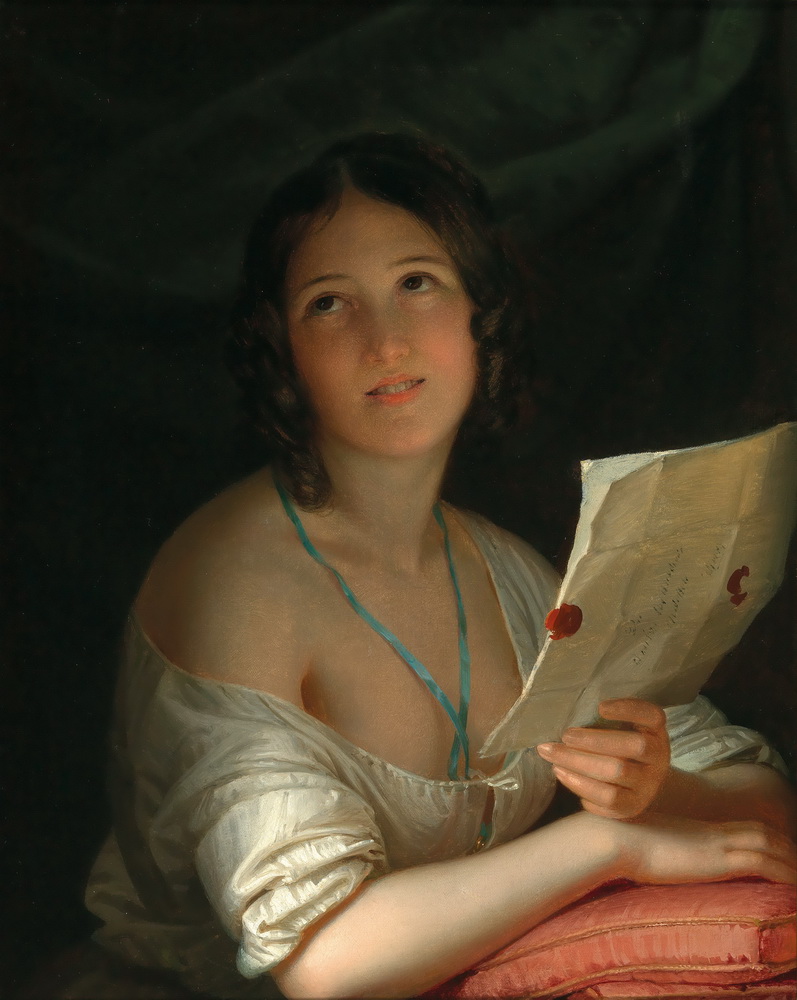
Der Brief, um 1842, rückseitig nicht eigenhändig bezeichnet Hofmaler Anton Einsle 1848, Der Liebesbrief, Öl auf Leinwand, 66 x 52 cm, gerahmt


Diese reizende Szene einer schönen Lesenden gehört zu den eher seltenen Genrebildern des erfolgreichen Biedermeiermalers Anton Einsle, der sich seinen Ruhm vorwiegend mit Porträts der kaiserlichen Familie und des Adels verdient hatte. Genrebilder hingegen dienten der Unterhaltung und bieten auch dem heutigen Betrachter genug Anregung, aus jeder Szene eine eigene Erzählung zu formen, die Phantasie spielen zu lassen. Das fällt bei diesem Bild, das Porträt und Genre gekonnt verbindet, nicht schwer. Wer mag diesem schönen Mädchen, das mit sehnsuchtsvollem Blick vom Lesen eines Briefes aufblickt, geschrieben haben, was war die Botschaft?

Die feine Zeichnung des Gesichtes entspricht einem gewissen Schönheitstypus, wie ihn Anton Einsle in Anlehnung an die italienischen Barockmaler gerne anwandte, ihn aber dann individuell ausformulierte. Charakteristisch für den Maler ist auch der wie zu einem Seufzen leicht geöffnete Mund, mit dem er genauso wie mit der Drehung des Kopfes Bewegung und Lebendigkeit vermittelt. Die gekonnte Regie des Lichtes unterstreicht weiters den Moment der Sehnsucht und der erwartungsvollen Freude.

4584. 佩特鲁斯,阿尔乔尼乌斯。C、 1487–1527年。 流亡的手段。威尼斯:阿尔迪,1522年。 高清作品[31%]

Medices legatus de exilio. Venice: Aldi, 1522.

图片文件尺寸 : 5426 x 6025px

ALCYONIUS, PETRUS (PIETRO ALCIONIO). C.1487-1527.:Medices legatus de exilio. Venice: Aldi, 1522.
4to (210 x 134 mm). Woodcut printer\'s device on title and colophon. 20th century red morocco, ruled in gilt, with gilt printer\'s devices reproduced on both covers, marbled endpapers. Some wear to joints, old ink notations, scattered browning and spotting.
Provenance: Giorgio di Veroli (1890-1952, bookplate).

Alcyonius, a Venetian classicist scholar under the patronage of Pope Clement VII, was appointed Professor of Classical Greek at the University of Florence in 1522. That same year, he published this work, written in the form of a dialogue whose thesis is that exile is not an evil. It was written in elegant Latin, reminiscent of Cicero, which lead to a personal enemy accusing him of secretly plagiarizing passages from Cicero\'s lost work De Gloria, and then destroying the only existing copy of the original to hide his plagiarism. Though the accusation was groundless, it did irreparable harm to his reputation. Adams A633; Brunet I, 153; Renouard 95/6.

佩特鲁斯,阿尔乔尼乌斯。C、 1487–1527年。 流亡的手段。威尼斯:阿尔迪,1522年。

4585. 金黑漆文件盒 江户时代或明治时代19世纪中后期 高清作品[31%]

Edo period  or Meiji era  mid/late 19th century

图片文件尺寸 : 4627 x 4320px

A GOLD AND BLACK LACQUER DOCUMENT BOX:Edo period (1615-1868) or Meiji era (1868-1912) mid/late 19th century
Of standard form with rounded corners and slightly domed lid of inrobuta (flush-fitting) type, the black lacquer ground covered on the exterior in gold hirame flakes and on the interior in gold nashiji flakes, decorated in gold, aokin, silver, black, and colored hiramaki-e and takamaki-e, with gold Gyobu nashiji, kirigane and other embellishments, the exterior showing part of a set of Hyakunin isshu (100 Poems, Each by a Different Poet) cards, including portraits of Ki no Tomonori, Mibu no Tadami, Fujiwara no Yoshitaka, Ise, and Sanjo Udaijin with their poems, the interior with an empty courtier\'s gissha (ox-drawn carriage), its handles resting on a stand, next to a stream and between two rustic fences with stands of autumn foliage, the rims silver
With lacquered wood tomobako storage box
17 x 13 1/2 x 5 1/4in (43.2 x 34.3 x 13.3cm)

金黑漆文件盒 江户时代或明治时代19世纪中后期

4586. Alfons Walde-现代 高清作品[30%]

DO-Alfons Walde  - Moderne
图片文件像素:5280 x 5638 px

Alfons Walde-现代-

Alfons Walde * - Moderne-

(Oberndorf 1891–1958 Kitzbühel)
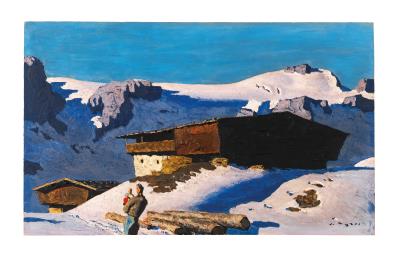
„Einsamer Berghof“, ca. 1935, signiert A. Walde, Öl auf Karton, 43 x 71 cm, Orig.-Rahmen

Verzeichnet:
Archiv Alfons Walde

Provenienz:
direkt vom Künstler erworben
Privatsammlung, Kitzbühel
im Erbgang an den jetzigen Besitzer

Ausstellung:
Das Gemälde war in den letzten zehn Jahren als Leihgabe in der ständigen Sammlung des Alfons-Walde-Museums in Kitzbühel ausgestellt.

Der „Einsame Berghof“ mit seinem im gleißenden Schnee ruhenden Bauernhaus und der Staffage einer Mutter mit Kind zählt zu den einfühlsamsten Bildmotiven Alfons Waldes in den frühen 1930er Jahren. Charakteristisch ist die weiche, zum Teil pastos trockene Malweise, die differenzierte Farbnuancen und unterschiedliche plastische Ausformungen erzielt. Das warme, ungebrochene Licht des späten Winters unterstreicht die Haptik der Dinge, sanft gleitende Schatten modellieren und beleben die klangvolle Ruhe dieser Naturbetrachtung. Räumliche Tiefe vermittelt der Blick in eine Landschaftsmulde und hinüber auf einen hoch aufsteigenden Berghang, zugedeckt von Schneefeldern, dessen Farbe sich mit dem Tageslicht vom hellen Weiß zum zarten Rosa der Dämmerung reizvoll verändert.

„Die Werke anderer Maler interessieren mich immer weniger. Ich habe nichts zu gewinnen. Mir bleibt nur die Natur als Vorbild.“

Alfons Walde 1925

4587. 拉瓦锡,安托内拉伦特。1743-1794. 在现代发现的基础上,以新的顺序呈现的化学元素。巴黎:库切特的蓟,1789年。 高清作品[30%]

Traite elementaire de chimie, presente dans un ordre nouveau et d\'apres le decouvertes modernes. Paris: Chardon for Cuchet, 1789.

图片文件尺寸 : 5049 x 5939px

LAVOISIER, ANTOINE-LAURENT. 1743-1794.:Traite elementaire de chimie, presente dans un ordre nouveau et d\'apres le decouvertes modernes. Paris: Chardon for Cuchet, 1789.
2 volumes. 8vo (210 x 135 mm). Half-titles, 13 folding engraved plates by and after Marie Anne Pierrette Paulze Lavoisier, 2 folding tables. Original boards, manuscript paper title labels, top edge trimmed, others uncut; volume two leaves unopened; custom folding box. Rubbed, corners a little rounded, scattered light spotting.

A FINE FRESH COPY IN ORIGINAL BOARDS OF THE FIRST EDITION, SECOND ISSUE of the book that \"accomplished a chemical revolution\" (PMM 238); the first issue (or trial issue) is known in only two copies. Lavoisier\'s landmark work \"put an end to the phlogiston theory and the surviving remnants of alchemy\" (PMM), and laid the groundwork for the modern scientific study of chemistry. Dibner 43; Duveen, p 340; Norman 1295; PMM 238.

拉瓦锡,安托内拉伦特。1743-1794. 在现代发现的基础上,以新的顺序呈现的化学元素。巴黎:库切特的蓟,1789年。

4588. HUGI,FRANZ JOSEPH。1791-1855. 自然历史阿尔卑斯之旅。Solothurn和莱比锡:J.Amiet Lutiger,1830年。 高清作品[30%]

Naturhistorische Alpenreise. Solothurn and Leipzig: J. Amiet-Lutiger, 1830.

图片文件尺寸 : 4025 x 5608px

HUGI, FRANZ JOSEPH. 1791-1855.:Naturhistorische Alpenreise. Solothurn and Leipzig: J. Amiet-Lutiger, 1830.
8vo (197 x 125 mm). Engraved frontispiece, additional engraved vignette title page, 9 folding tables, 16 lithographic plates (5 folding), 2 hand-colored folding engraved maps. Contemporary marbled boards, hand-inked paper lettering piece on spine. Spine ends bumped and chipped, a bit worn, scattered spotting, some curling and browning to edges of folding plates.

Swiss geologist and professor Hugi made the first scientific study of Alpine glaciers and was a member of the first party to attempt climbing the Finsteraarhorn in the Bernese Alps in 1829, although he did not reach the summit himself. The title page vignette depicts the construction of a hut on the Unteraar glacier in 1830, which is marked on one of the maps. This proved to have an unintended scientific benefit, as the movement of the hut down the glacier over the next several years would yield valuable information about glacial movement. Dreyer 364; Lonchamp 1561; Poggendorff I, 1155.

HUGI,FRANZ JOSEPH。1791-1855. 自然历史阿尔卑斯之旅。Solothurn和莱比锡:J.Amiet Lutiger,1830年。

4589. 再见,菲利普。1638–1725. 关于Viventia的观察,这在Viventibus的案例中没有发现。用奇怪的显微照片。罗马:多米尼克斯·安东尼乌斯·赫拉克勒斯,1691年。 高清作品[30%]

Observationes circa Viventia, quae in rebus non Viventibus reperiuntur. Cum Micrographia curiosa. Rome: Dominicus Antonius Hercules, 1691.

图片文件尺寸 : 5392 x 5561px

BUONANNI, FILIPPO. 1638-1725.:Observationes circa Viventia, quae in rebus non Viventibus reperiuntur. Cum Micrographia curiosa. Rome: Dominicus Antonius Hercules, 1691.
8vo (215 x 157 mm). 69 plates (4 folding). Modern quarter morocco and marbled boards. Margins slightly trimmed, repaired tear to upper outside corner of title page, repair to margin of of n2, a few marginal annotations in ink, scattered browning and spotting.

FIRST EDITION. Bounanni, a Jesuit scholar and pupil of Athanasius Kircher, published this work based on his observations through a three-lens microscope of his own construction. His conclusions supported spontaneous generation of living matter, in contrast to those of his contemporary, Francesco Redi. An identical 2nd edition was published in 1699. Garrison-Morton-Norman 264; Krivatsy 1935; Nissen ZBI 752; Norman 374; Wellcome II, 198.

再见,菲利普。1638–1725. 关于Viventia的观察,这在Viventibus的案例中没有发现。用奇怪的显微照片。罗马:多米尼克斯·安东尼乌斯·赫拉克勒斯,1691年。

4590. 贝尔纳多·卡斯特罗:1900年以前的绘画大师和版画、水彩画、微型画` by Bernardo Castello 高清作品[30%]

DO-Bernardo Castello - Meisterzeichnungen und Druckgraphik bis 1900, Aquarelle, Miniaturen
图片文件像素:4600 x 3500 px

贝尔纳多·卡斯特罗:1900年以前的绘画大师和版画、水彩画、微型画-

-

(Genua 1557-1629) Szene aus der Geschichte von Alexander dem Großen, Entwurf für eine Lünette, Feder in Braun über Bleistift, braun laviert, weiß gehöht, auf Bütten, alt montiert, rückseitig Figurenskizzen in Bleistift von anderer Hand, 19 x 34,8 cm, Passep., ohne Rahmen, (Sch)

Die vorliegende Zeichnung könnte in Vorbereitung für ein Fresko als Teil eines Zyklus mit Darstellungen aus dem Leben Alexanders des Großen entstanden sein. Das Format der Lünette würde zumindest nahe legen, dass es sich dabei um ein Projekt für eine Wanddekoration gehandelt haben könnte. Stilistisch dürfte das Blatt aus dem Spätwerk von Bernardo Castello stammen und könnte eventuell für die Malereien der Loggia der Villa Saluzzo in Albaro, Genua entstanden sein, die u. a. dem Kampf Alexanders des großem gegen König Porus gewidmet waren.

Die Zuschreibung an Bernardo Castello wurde von Prof. Jonathan Bober anhand einer hochauflösenden digitalen Fotografie bestätigt.

anning油画图片- 高清anning绘画作品- 代表作全集 中艺名画下载


4581. 草间弥生,当代艺术I 高清作品[31%]

DO-Yayoi Kusama - 现代艺术 I
图片文件像素:5457 x 4998 px

草间弥生,当代艺术I-

Yayoi Kusama - Zeitgenössische Kunst I-

(born in Matsumoto, Japan 1929)
Pumpkin KKK, 2002, signed, dated and titled on the reverse, acrylic on canvas, 22.7 x 15.8 cm, in plexiglass box

This work is accompanied by a registration card issued by Yayoi Kusama Studio

We are grateful to Yayoi Kusama Inc. for confirming the registration of the work in its database

Provenance:
European Private Collection

Iconic Pumpkin

Yayoi Kusama is possibly the best known Japanese artist in the world. Her famous polka dots have become her trademark and Kusama\'s stylized pumpkins are among the most iconic masterpieces of contemporary art.

Born in the late 1920s, Yayoi Kusama grew up in the conservative confines of the small town of Matsumoto in Nagano Prefecture in Japan. She attended the Kyoto School of Arts and Crafts, and after staging her first exhibitions, through which she was ‘discovered’ by the international art world, Kusama was able to emigrate to America, where she lived and worked, primarily in New York, from 1957 to 1973. Kusama celebrated her first major success in New York in 1959 with a solo exhibition at the Brata Gallery, entitled Obsessional Monochrome. The Infinity Net Paintings exhibited there were compositions of dense networks executed with white brushstrokes on a black ground and characterised by the theme of repetition.

Grids, flashes of light and, above all, dots that repeat endlessly are the most striking characteristic of Kusama\'s works and established her fame as the ‘Polka Dot Princess’. For the artist, the dots that overgrow everything are not merely a harmless pattern. They have their origins in the hallucinations and panic attacks she has experienced since her youth, which determined her perception of the world. Growing up, she saw dot and net patterns and feared she would dissolve into them. The polka dots and their constant repetition now became an expression of the search for infinity and the desire for self-dissolution. The dots erase the image into which the artist channels her fears. With her polka dots, Kusama covers not only canvases, but also everyday objects such as tea kettles or bookshelves, clothes, giant tentacles, oversized flowers, entire rooms or herself. And pumpkins as well.

\"Pumpkin KKK\" (2002) represents another important theme in Yayoi Kusama\'s work. For Kusama, the pumpkin is associated with memories of childhood and has been a favourite motif with almost mythical status since the 1970s-1980s. The artist first saw pumpkins during walks with her grandfather, and they had a calming effect on the hallucination-stricken artist. \"I love pumpkins for their humorous shape, their warmth and their human quality,\" Kusama says. She devoted herself to pumpkins in paintings and sculptures and incorporated them into her Infinity Rooms. Bold colours characterise the pumpkins, as do the precisely placed polka dots. The colour scheme follows an inner symbolism, according to which the artist categorises unprocessed experiences. The pumpkins stand for triumph over inner struggles, their endless repetition allows the artist to find her mental balance.

Since her return to Japan, Kusama, who has never made a secret of her illness, has voluntarily lived in a psychiatric institution. In 2017, a museum dedicated solely to her opened in Tokyo and numerous international exhibitions testify to considerable on-going interest in her work. With her unconventional works, her extraordinary performances, self-dramatisations and happenings, Kusama has anticipated many trends in contemporary art.

4582. 皮埃尔·奥古斯特·雷诺阿-现代` by Pierre Auguste Renoir 高清作品[31%]

DO-Pierre Auguste Renoir - Moderne
图片文件像素:4600 x 3500 px

皮埃尔·奥古斯特·雷诺阿-现代-

-

(Limoges 1841–1919 Cagnes bei Nizza)
Enfants jouant à la balle, um 1900, Farblithographie auf Velin, Probedruck neben einer Edition von 200 Exemplaren, Bildgröße 59 x 51,8 cm, Blattgröße 74 x 55,5 cm, Verlag Ambroise Vollard, Paris, gerahmt

Das von Pierre-Auguste Renoir rechts unten im Stein schwarz signierte Werk „Enfants jouant à balle“ stammt aus einer Auflage von 200 Exemplaren, die von Auguste Clot gedruckt und von Ambroise Vollard verlegt wurde. Dieses in 10 Farben gezogene Werk ist einer von nur vier Farbdrucken, die Renoir Zeit seines Lebens geschaffen hat. Unter anderem ist es auch unter dem Titel „La Récolte des Pommes de Terre“ (Die Kartoffelernte) bekannt. Die Farblithographie zeigt vier Mädchen, die an einem schönen Sommertag sorglos auf einem Feld spielen. Exemplare dieses Werkes sind in öffentlichen Sammlungen auf der ganzen Welt ausgestellt, darunter das Cabinet des Estampes in Paris, das Kupferstich-Kabinett in Dresden, das Metropolitan Museum of Art in New York, das Museum of Fine Arts in Boston, die New York Public Library oder die National Gallery of Art in Washington, D.C.

4583. 安东·艾恩斯尔` by Anton Einsle 高清作品[31%]

DO-Anton Einsle - Gemälde des 19. Jahrhunderts
图片文件像素:4600 x 3500 px

安东·艾恩斯尔-

-

(Wien 1801–1871)
Der Brief, um 1842, rückseitig nicht eigenhändig bezeichnet Hofmaler Anton Einsle 1848, Der Liebesbrief, Öl auf Leinwand, 66 x 52 cm, gerahmt


Diese reizende Szene einer schönen Lesenden gehört zu den eher seltenen Genrebildern des erfolgreichen Biedermeiermalers Anton Einsle, der sich seinen Ruhm vorwiegend mit Porträts der kaiserlichen Familie und des Adels verdient hatte. Genrebilder hingegen dienten der Unterhaltung und bieten auch dem heutigen Betrachter genug Anregung, aus jeder Szene eine eigene Erzählung zu formen, die Phantasie spielen zu lassen. Das fällt bei diesem Bild, das Porträt und Genre gekonnt verbindet, nicht schwer. Wer mag diesem schönen Mädchen, das mit sehnsuchtsvollem Blick vom Lesen eines Briefes aufblickt, geschrieben haben, was war die Botschaft?

Die feine Zeichnung des Gesichtes entspricht einem gewissen Schönheitstypus, wie ihn Anton Einsle in Anlehnung an die italienischen Barockmaler gerne anwandte, ihn aber dann individuell ausformulierte. Charakteristisch für den Maler ist auch der wie zu einem Seufzen leicht geöffnete Mund, mit dem er genauso wie mit der Drehung des Kopfes Bewegung und Lebendigkeit vermittelt. Die gekonnte Regie des Lichtes unterstreicht weiters den Moment der Sehnsucht und der erwartungsvollen Freude.

4584. 佩特鲁斯,阿尔乔尼乌斯。C、 1487–1527年。 流亡的手段。威尼斯:阿尔迪,1522年。 高清作品[31%]

Medices legatus de exilio. Venice: Aldi, 1522.

图片文件尺寸 : 5426 x 6025px

ALCYONIUS, PETRUS (PIETRO ALCIONIO). C.1487-1527.:Medices legatus de exilio. Venice: Aldi, 1522.
4to (210 x 134 mm). Woodcut printer\'s device on title and colophon. 20th century red morocco, ruled in gilt, with gilt printer\'s devices reproduced on both covers, marbled endpapers. Some wear to joints, old ink notations, scattered browning and spotting.
Provenance: Giorgio di Veroli (1890-1952, bookplate).

Alcyonius, a Venetian classicist scholar under the patronage of Pope Clement VII, was appointed Professor of Classical Greek at the University of Florence in 1522. That same year, he published this work, written in the form of a dialogue whose thesis is that exile is not an evil. It was written in elegant Latin, reminiscent of Cicero, which lead to a personal enemy accusing him of secretly plagiarizing passages from Cicero\'s lost work De Gloria, and then destroying the only existing copy of the original to hide his plagiarism. Though the accusation was groundless, it did irreparable harm to his reputation. Adams A633; Brunet I, 153; Renouard 95/6.

佩特鲁斯,阿尔乔尼乌斯。C、 1487–1527年。 流亡的手段。威尼斯:阿尔迪,1522年。

4585. 金黑漆文件盒 江户时代或明治时代19世纪中后期 高清作品[31%]

Edo period  or Meiji era  mid/late 19th century

图片文件尺寸 : 4627 x 4320px

A GOLD AND BLACK LACQUER DOCUMENT BOX:Edo period (1615-1868) or Meiji era (1868-1912) mid/late 19th century
Of standard form with rounded corners and slightly domed lid of inrobuta (flush-fitting) type, the black lacquer ground covered on the exterior in gold hirame flakes and on the interior in gold nashiji flakes, decorated in gold, aokin, silver, black, and colored hiramaki-e and takamaki-e, with gold Gyobu nashiji, kirigane and other embellishments, the exterior showing part of a set of Hyakunin isshu (100 Poems, Each by a Different Poet) cards, including portraits of Ki no Tomonori, Mibu no Tadami, Fujiwara no Yoshitaka, Ise, and Sanjo Udaijin with their poems, the interior with an empty courtier\'s gissha (ox-drawn carriage), its handles resting on a stand, next to a stream and between two rustic fences with stands of autumn foliage, the rims silver
With lacquered wood tomobako storage box
17 x 13 1/2 x 5 1/4in (43.2 x 34.3 x 13.3cm)

金黑漆文件盒 江户时代或明治时代19世纪中后期

4586. Alfons Walde-现代 高清作品[30%]

DO-Alfons Walde  - Moderne
图片文件像素:5280 x 5638 px

Alfons Walde-现代-

Alfons Walde * - Moderne-

(Oberndorf 1891–1958 Kitzbühel)
„Einsamer Berghof“, ca. 1935, signiert A. Walde, Öl auf Karton, 43 x 71 cm, Orig.-Rahmen

Verzeichnet:
Archiv Alfons Walde

Provenienz:
direkt vom Künstler erworben
Privatsammlung, Kitzbühel
im Erbgang an den jetzigen Besitzer

Ausstellung:
Das Gemälde war in den letzten zehn Jahren als Leihgabe in der ständigen Sammlung des Alfons-Walde-Museums in Kitzbühel ausgestellt.

Der „Einsame Berghof“ mit seinem im gleißenden Schnee ruhenden Bauernhaus und der Staffage einer Mutter mit Kind zählt zu den einfühlsamsten Bildmotiven Alfons Waldes in den frühen 1930er Jahren. Charakteristisch ist die weiche, zum Teil pastos trockene Malweise, die differenzierte Farbnuancen und unterschiedliche plastische Ausformungen erzielt. Das warme, ungebrochene Licht des späten Winters unterstreicht die Haptik der Dinge, sanft gleitende Schatten modellieren und beleben die klangvolle Ruhe dieser Naturbetrachtung. Räumliche Tiefe vermittelt der Blick in eine Landschaftsmulde und hinüber auf einen hoch aufsteigenden Berghang, zugedeckt von Schneefeldern, dessen Farbe sich mit dem Tageslicht vom hellen Weiß zum zarten Rosa der Dämmerung reizvoll verändert.

„Die Werke anderer Maler interessieren mich immer weniger. Ich habe nichts zu gewinnen. Mir bleibt nur die Natur als Vorbild.“

Alfons Walde 1925

4587. 拉瓦锡,安托内拉伦特。1743-1794. 在现代发现的基础上,以新的顺序呈现的化学元素。巴黎:库切特的蓟,1789年。 高清作品[30%]

Traite elementaire de chimie, presente dans un ordre nouveau et d\'apres le decouvertes modernes. Paris: Chardon for Cuchet, 1789.

图片文件尺寸 : 5049 x 5939px

LAVOISIER, ANTOINE-LAURENT. 1743-1794.:Traite elementaire de chimie, presente dans un ordre nouveau et d\'apres le decouvertes modernes. Paris: Chardon for Cuchet, 1789.
2 volumes. 8vo (210 x 135 mm). Half-titles, 13 folding engraved plates by and after Marie Anne Pierrette Paulze Lavoisier, 2 folding tables. Original boards, manuscript paper title labels, top edge trimmed, others uncut; volume two leaves unopened; custom folding box. Rubbed, corners a little rounded, scattered light spotting.

A FINE FRESH COPY IN ORIGINAL BOARDS OF THE FIRST EDITION, SECOND ISSUE of the book that \"accomplished a chemical revolution\" (PMM 238); the first issue (or trial issue) is known in only two copies. Lavoisier\'s landmark work \"put an end to the phlogiston theory and the surviving remnants of alchemy\" (PMM), and laid the groundwork for the modern scientific study of chemistry. Dibner 43; Duveen, p 340; Norman 1295; PMM 238.

拉瓦锡,安托内拉伦特。1743-1794. 在现代发现的基础上,以新的顺序呈现的化学元素。巴黎:库切特的蓟,1789年。

4588. HUGI,FRANZ JOSEPH。1791-1855. 自然历史阿尔卑斯之旅。Solothurn和莱比锡:J.Amiet Lutiger,1830年。 高清作品[30%]

Naturhistorische Alpenreise. Solothurn and Leipzig: J. Amiet-Lutiger, 1830.

图片文件尺寸 : 4025 x 5608px

HUGI, FRANZ JOSEPH. 1791-1855.:Naturhistorische Alpenreise. Solothurn and Leipzig: J. Amiet-Lutiger, 1830.
8vo (197 x 125 mm). Engraved frontispiece, additional engraved vignette title page, 9 folding tables, 16 lithographic plates (5 folding), 2 hand-colored folding engraved maps. Contemporary marbled boards, hand-inked paper lettering piece on spine. Spine ends bumped and chipped, a bit worn, scattered spotting, some curling and browning to edges of folding plates.

Swiss geologist and professor Hugi made the first scientific study of Alpine glaciers and was a member of the first party to attempt climbing the Finsteraarhorn in the Bernese Alps in 1829, although he did not reach the summit himself. The title page vignette depicts the construction of a hut on the Unteraar glacier in 1830, which is marked on one of the maps. This proved to have an unintended scientific benefit, as the movement of the hut down the glacier over the next several years would yield valuable information about glacial movement. Dreyer 364; Lonchamp 1561; Poggendorff I, 1155.

HUGI,FRANZ JOSEPH。1791-1855. 自然历史阿尔卑斯之旅。Solothurn和莱比锡:J.Amiet Lutiger,1830年。

4589. 再见,菲利普。1638–1725. 关于Viventia的观察,这在Viventibus的案例中没有发现。用奇怪的显微照片。罗马:多米尼克斯·安东尼乌斯·赫拉克勒斯,1691年。 高清作品[30%]

Observationes circa Viventia, quae in rebus non Viventibus reperiuntur. Cum Micrographia curiosa. Rome: Dominicus Antonius Hercules, 1691.

图片文件尺寸 : 5392 x 5561px

BUONANNI, FILIPPO. 1638-1725.:Observationes circa Viventia, quae in rebus non Viventibus reperiuntur. Cum Micrographia curiosa. Rome: Dominicus Antonius Hercules, 1691.
8vo (215 x 157 mm). 69 plates (4 folding). Modern quarter morocco and marbled boards. Margins slightly trimmed, repaired tear to upper outside corner of title page, repair to margin of of n2, a few marginal annotations in ink, scattered browning and spotting.

FIRST EDITION. Bounanni, a Jesuit scholar and pupil of Athanasius Kircher, published this work based on his observations through a three-lens microscope of his own construction. His conclusions supported spontaneous generation of living matter, in contrast to those of his contemporary, Francesco Redi. An identical 2nd edition was published in 1699. Garrison-Morton-Norman 264; Krivatsy 1935; Nissen ZBI 752; Norman 374; Wellcome II, 198.

再见,菲利普。1638–1725. 关于Viventia的观察,这在Viventibus的案例中没有发现。用奇怪的显微照片。罗马:多米尼克斯·安东尼乌斯·赫拉克勒斯,1691年。

4590. 贝尔纳多·卡斯特罗:1900年以前的绘画大师和版画、水彩画、微型画` by Bernardo Castello 高清作品[30%]

DO-Bernardo Castello - Meisterzeichnungen und Druckgraphik bis 1900, Aquarelle, Miniaturen
图片文件像素:4600 x 3500 px

贝尔纳多·卡斯特罗:1900年以前的绘画大师和版画、水彩画、微型画-

-

(Genua 1557-1629) Szene aus der Geschichte von Alexander dem Großen, Entwurf für eine Lünette, Feder in Braun über Bleistift, braun laviert, weiß gehöht, auf Bütten, alt montiert, rückseitig Figurenskizzen in Bleistift von anderer Hand, 19 x 34,8 cm, Passep., ohne Rahmen, (Sch)

Die vorliegende Zeichnung könnte in Vorbereitung für ein Fresko als Teil eines Zyklus mit Darstellungen aus dem Leben Alexanders des Großen entstanden sein. Das Format der Lünette würde zumindest nahe legen, dass es sich dabei um ein Projekt für eine Wanddekoration gehandelt haben könnte. Stilistisch dürfte das Blatt aus dem Spätwerk von Bernardo Castello stammen und könnte eventuell für die Malereien der Loggia der Villa Saluzzo in Albaro, Genua entstanden sein, die u. a. dem Kampf Alexanders des großem gegen König Porus gewidmet waren.

Die Zuschreibung an Bernardo Castello wurde von Prof. Jonathan Bober anhand einer hochauflösenden digitalen Fotografie bestätigt.