2851. 克里斯托(Javacheff Christo,当代艺术I 高清作品[20%]

DO-Christo  (Javacheff Christo) - 现代艺术 I
图片文件像素:6353 x 5789 px

克里斯托(Javacheff Christo,当代艺术I-

Christo * (Javacheff Christo) - Zeitgenössische Kunst I-

(Gabrovo, Bulgaria 1935–2020 New York)
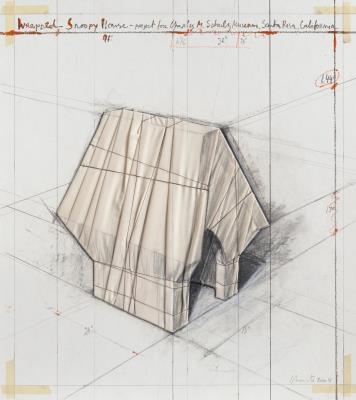
Wrapped Snoopy House (Collage), 2004, signed, dated Christo 2004, cloth, threads, charcoal, pencil, color crayon, paint and adhesive tape on cardboard, 61.2 x 55 cm,
framed under plexiglass

The wrapped Snoopy House is registered in the Christo and Jeanne-Claude Archives, New York.

We are grateful to Jonathan Henery, Christo and Jeanne-Claude Archives, New York, for his scientific support in cataloguing the work.

Provenance:
Studio of the artist
Collection of the printer and fabricator Jack Lemon, Chicago
Private collection, 德国y

Literature:
This work is the prototype for the multiple, published by Schulz Museum, Santa Rosa, California see: Matthias Koddenberg, Jörg Schellmann: Christo and Jeanne-Claude: Prints and Objects. Catalogue Raisonné, p. 213, no 188

Charles M. Schulz (1922-2000) was the cartoonist of the globally successful comic series \"Peanuts\". The 美国 author and illustrator portrayed 美国 suburban life from the perspective of a group of children in the daily comic strips, which ran for decades. Peanuts was special in that it combined pointed wit with philosophical reflection.

Most of the comic strips focus on the main characters Charlie Brown and his dog Snoopy. Snoopy, the white dog with the black floppy ears, is now considered an integral part of our popular culture.
Snoopy lives in a kennel in Charlie Brown\'s garden. There, the beagle spends most of his time lying lazily on the roof of his hut, the so-called Snoopy Dog House, pondering his philosophical thoughts while waiting for his next meal.

In 1975, Charles M. Schulz met the packaging artists Jeanne-Claude and Christo at a discussion group in Colorado. The cartoonist then paid tribute to the artist couple by creating a Peanuts comic strip in 1978 in which Christo wraps Snoopy‘s House in fabric. In the comic strip, Snoopy wonders what Christo will cover next and finds his house wrapped at the end of the sequence. Christo returned the cartoonist\'s compliment by turning the comic image into reality decades later, designing a life-size, three-dimensional doghouse for the Charles M. Schulz Museum and wrapping it in tarpaulin, polyethylene and rope.
The work offered here is an original collage with real fabric wrapping, created by Christo in 1994 as a prototype for the later multiple. The multiple is number 188 in the catalogue raisonné.
This original work came from the estate of printer Jack Lemon, who founded his life\'s work, the Landfall Press, in Chicago in 1970. Lemon and his team printed lithographs by Christo, Philip Pearlstein and Sol LeWitt, among others.

2852. 多斯托耶夫斯基的名片上写着亚历山大·赫尔岑。 照片署名并题写(俄语)给亚历山大·赫尔岑, 高清作品[19%]

Photograph signed and inscribed [in Russian] to Alexander Herzen,

图片文件尺寸 : 3981 x 5780px

DOSTOEVSKY CARTE-DE-VISITE INSCRIBED TO ALEXANDER HERZEN.:DOSTOEVSKY, FYODOR. 1821-1881. Photograph signed and inscribed [in Russian] to Alexander Herzen, albumen print carte-de-visite full length portrait by M.B. Tulinov, Petersburg, 1861, 105 x 65 mm, inscribed by Dostoevsky in Russian to the verso, \"Alexander Ivanovich Herzen in memory of our meeting in London. Fyodor Dostoyevsky 8 July/20 July 1862,\" minor stain to verso.
Provenance: Alexander Ivanovich Herzen; to daughter Olga Aleksandrovna [Herzen] Monod; by descent.
Publication: For a discussion of the photograph, see Volgin, Igor. \"Introduction\" to The Dostoevsky Archive (1997), p 21.

Pull quote: \"Herzen awaits his readers in the future. Far above the heads of the present crowd, he transmits his thoughts to those who will be able to comprehend them.\" – Leo Tolstoy, 1905.

VERY RARE CARTE DE VISITE PHOTOGRAPH OF FYODOR DOSTOEVSKY PRESENTED TO ALEXANDER HERZEN IN REMEMBRANCE OF THEIR 1862 MEETING IN LONDON: A TREMENDOUSLY IMPORTANT ASSOCIATION BETWEEN TWO OF THE LEADING INTELLECTUALS OF THE 19TH-CENTURY.

Alexander Herzen was one of the most important and influential Russian writers and thinkers of the 19th-century. called the \"father of Russian socialism,\" he had a profound influence on late-19th century Russian writers, including Fyodor Dostoevsky. Born illegitimately to a wealthy Russian landowner, Herzen became a dissident and critic of the Russian feudal system. Of Herzen, Tolstoy said he had never met a man \"with so rare a combination of scintillating brilliance and depth.\" His writings, including From the Other Shore (1848) and those appearing in his influential publications of the 1850s-60s The Bell and the Polestar, would help mold a generation of Russian writing and thought.

Herzen and Dostoevsky met for the first time in Russia in 1846, following Dostoevsky\'s comment in a letter to his brother that Herzen and Goncharov stand as \"the most remarkable\" of his rivals; Herzen\'s recollection of the meeting was less than effusive, however: \"I can\'t say he made a particularly present impression.\" Their second meeting occurred when Dostoevsky visited Herzen in London in July of 1862, of which this photograph is a memento. During the 1850s and early 1860s, visits to the emigree Herzen by Russian writers and intellectuals were something of a right of passage, and Dostoevsky\'s visit followed right on the heels of Turgenev. This series of meetings profoundly affected Dostoevsky and his work, and is clearly acknowledged in his Winter Notes which he wrote later that year, exhibiting a clear debt to Herzen\'s own writings. Dostoevsky, along with Solzhenitsyn, acknowledged the formative influence of Herzen on his work, and Herzen would also appear in composite in a number of Dostoevsky\'s characters throughout his career. Herzen, however, noted, rather condescendingly, \"Dostoevsky was here yesterday—he is a naïve, not entirely lucid, but a very dear person. He believes enthusiastically in the Russian people.\"

The two towering figures would meet again on a steamship from Naples to Livorno the following year, where Dostoevsky was travelling with his mistress Polina Suslova. According to Suslova\'s diaries (as published in The Dostoevsky Archives), Dostoevsky took pains to hide their relationship from Herzen, introducing her vaguely as a family member, and even encouraged her to arrange a visit with Herzen\'s son in Paris that Winter. After they parted, Dostoevsky became angry with her over a photograph of her he had seen at Herzen\'s, which she had given at an earlier date. In 1865, Dostoevsky wrote to Herzen imploring him for a loan, and became peevish when Herzen did not immediately respond. By the late 1860s Dostoevsky would disparage Herzen, somewhat unfairly, as a \"Westernizer,\" leading to his more severe criticism of Herzen in his Writer\'s Diary.

Herzen was one of the most complex and brilliant figures of the 19th-century, and was largely responsible for assimilating western ideas into Russian thought, while still maintaining his advocacy for the freedom of the Russian serf.

In reality, the two writers/thinkers shared a great deal in their outlook: both asserted the importance of the individual, and the folly of the search for a unified teleological system, cutting against the grain of their mid-19th century contemporaries. While Herzen was embraced by Lenin, identified as the \"father of Russian socialism,\" Herzen\'s socialism was a different breed, \"Centralization may do a great deal for order and for various public undertakings, but it is incompatible with freedom. It easily brings a nation to the position of a well-tended flock or a pack of hounds cleverly kept in order by a huntsman.\" Lenin regarded Herzen\'s focus on freedom as a shortcoming of his bourgeois roots. During the 20th-century Russian-British philosopher Isaiah Berlin came across Herzen\'s writings and recognized the prescience of Herzen\'s thought. It was Berlin, who reestablished Herzen\'s influence, agreeing with and amplifying his idea that the pursuit of \"a perfect society\" invariably leads to blood.

The present photograph was taken by Mikhail Borisovich Tulinov (1823–1889) in Petersburg in 1861. Any period photograph of Dostoevsky is rare, and moreso inscribed. We trace two inscribed photographs at auction in the last 40 years. However, we find no record of an inscribed photograph of similar substance and importance in the historical record. An incredible, and incredibly rare, Dostoevsky item tying together two of the greatest thinkers and writers of the 19th-century.

REFERENCES:
Kelly, Aileen. The Discovery of Chance: The Life and Thought of Alexander Herzen. 2016.
Kelly, Aileen. \"Irony and Utopia in Herzen and Dostoevsky: From the Other Shore and Diary of a Writer.\" The Russian Review, 50:4 (1991), pp 397-416.
Lantz, Kenneth. The Dostoevsky Encycolpedia. 2004.
Serakin, Peter. The Dostoevsky Archive: Firsthand Accounts of the Novelist from Contemporaries\' Memoirs and Rare Periodicals. 1997.


\"If only people wanted to save themselves instead of saving the world, how much they would do for the salvation of the world and the liberation of humanity!\" – Alexander Herzen, From the Other Shore, 1848.

多斯托耶夫斯基的名片上写着亚历山大·赫尔岑。 照片署名并题写(俄语)给亚历山大·赫尔岑,

2853. 维克托·布劳纳` by Victor Brauner 高清作品[19%]

DO-Victor Brauner  - Moderne
图片文件像素:4600 x 3500 px

维克托·布劳纳-

-

(Piatra Neamt, Rumänien 1903–1966 Paris)
La leçon de Twist, 1962, signiert und datiert; auf der Rückseite betitelt, Öl auf Leinwand, 116 x 89 cm, gerahmt

Victor Brauner ist ein figurativer Maler mit symbolischen Zügen, der den Surrealisten, insbesondere Dali und Magritte, sehr nahe stand.
Die Verwandtschaft mit dem Surrealismus zeigt sich in seiner Fähigkeit, das Unbewusste zu erforschen, insbesondere durch den Blickwinkel des Traums, aber in einer primitiven Darstellung, einer quasi-infantilen Art von Zeichnung, die mit dem Wunsch konzipiert wurde, die ursprünglichen Stadien der menschlichen Rasse darzustellen.
Was Brauner von den Surrealisten unterscheidet, sind die charakteristischen Merkmale seiner Kunst, nämlich die Flächigkeit der Zeichnung, die schematische Naivität, die Frontalität: eine Rückkehr zu den zweidimensionalen, abgeflachten Figuren und zur primitiven Kunst, in der Paul Klee im 20. Jahrhundert den Maßstab setzte.
Der Vergleich zwischen Victor Brauners Stil und Klees Maske der Angst liegt auf der Hand, sowohl was die Anlehnung an ethnologische Masken betrifft als auch die beiden Beinpaare, die typologisch die Anwesenheit zweier Figuren suggerieren, die in einem einzigen Körper vereint sind, wie in „La leçon de Twist“.
Brauner stand auch der Art brut („rohe Kunst“) von Jean Dubuffet nahe, die sich wirklich in primitive Zustände zurückzog und sich von der zeitgenössischen Kultur des 20. Jahrhunderts entflieht.
Gemeinsam sind ihnen scharfe Konturen und homogene Hintergründe, elementare Formen, die Mythen verbergen oder erzählen: eine expressive Strenge, die zu einer klaren Lesart der Bilder führt.
In „La leçon de Twist“, einem Gemälde aus den 1960er Jahren, das zwischen den Strömungen des Surrealismus, der Metaphysik und des magischen Realismus angesiedelt ist, bietet uns Brauner eine „art autre“: weder ein Übermaß an musealem Neoklassizismus noch ein wilder Brutalismus, „sondern eine lange Reise zurück zu den stilisierten Eleganzen anderer Epochen, Hieroglyphen, apotropäischen Symbolen, Initiationsriten“ (Renato Barilli), und vermittelt uns so das Gefühl, die Primitiven einer neuen Epoche zu sein.

„Das Thema des Gemäldes ist totemistisch; das Gemälde ist daher magisch und stellt eine direkte, bezaubernde Beziehung zu den großen primitiven Träumereien her“.
(Comunicazione senza pregiudizio, Victor Brauner Januar 1961)
„Die triumphierende Vorstellungskraft wird die Grundlage für eine befreiende Ethik sein. Verbote und Beschränkungen aller Art werden abgeschafft, und es wird sich eine Wirklichkeit eröffnen, in der alles möglich ist“.

Manoscritto dimenticato dietro consapevolezza, Victor Brauner Januar 1964

„Wenn ich vor dem Bild von Victor Brauner stehe, wird meine Freude heilig“.

(André Breton, „Entre chien et loup“, Cahiers d'art, 1945-46)."

2854. Jií(Georg)Dokoupil,当代艺术I 高清作品[19%]

DO-Jiří (Georg) Dokoupil  - 现代艺术 I
图片文件像素:5925 x 4626 px

Jií(Georg)Dokoupil,当代艺术I-

Jiří (Georg) Dokoupil * - Zeitgenössische Kunst I-

(born in Krnov 1954)
Mis Mus Sian, 2014, titled, several times signed Dokoupil on the overlap, soap-lye and pigments on canvas, 250 x 300 cm or 300 x 250 cm (the work can be hung vertical or horizontal), on stretcher

Provenance:
Studio of the artist
Kasmin Gallery, New York
Private collection, 德国y

Literature:
Kasmin Gallery, Jiří (Georg) Dokoupil, New paintings,
exhibition catalogue, New York 2015
Jiří Georg Dokoupil, Soap Bubble Paintings, Berlin 2015

Exhibited:
Kasmin Gallery, New York, Jiří (Georg) Dokoupil, New paintings,
8 January - 7 February 2015

Jiří (Georg) Dokoupil has been putting his art on canvases since the 1970s - and for much of that time without a brush. He constantly reinvents the production of artworks, expresses his creativity with the most diverse materials, such as breast milk or fruit juices, and thinks \"outside the box\". His oeuvre now comprises about 140 series, which are not at all alike. He is a quick-change artist in the contemporary art world. Like a pop culture star, he completely reinvents his art with each series.

The early flight from his homeland and the associated deprivation of a national, social and personal identity meant the artist never developed a fixed style of his own. (Compare Wilfried Dickhoff, Soap Bubble Thinking, p.5, in: Jiří (Georg) Dokoupil..

Soap Bubble Paintings, Berlin 2015)
The Soap Bubble Paintings series is one of his longest-running series. The work offered here, \"Mis Mus Sian\", is part of it.

Standing on a ladder with a metal hoop, Jiří (Georg) Dokoupil. lowers his soap bubbles onto the canvas. He uses soap suds mixed with shimmering pigments, the exact composition of which he keeps strictly secret. The individual layers of soap bubbles, their shimmering pigments and superimpositions create a sphere of their own. The result is a depth undreamed of in a two-dimensional work, which can only be properly experienced through viewing the work in person. The soap bubbles glitter dynamically on the deep blue background of the painting and evoke movement through their different shapes and orientations. Due to the enormous format of over 250 x 300 cm, the experience of the work is like visiting a giant aquarium. At first, one is overwhelmed by the work’s abundance and appearance and, as time goes by, one dives deeper and deeper into its cosmos. The artist leaves it up to the owner to hang the work in portrait or landscape format. For this reason, he has signed the reverse on two sides.
„It’s all about making something that is not doable“
Jiří (Gerog) Dokupil

2855. Alexej von Jawlensky-现代` by Alexej von Jawlensky 高清作品[18%]

DO-Alexej von Jawlensky - Moderne
图片文件像素:4600 x 3500 px

Alexej von Jawlensky-现代-

-

(Torschok 1864–1941 Wiesbaden)
Variation, Winter, 1915, Nr. 54, monogrammiert A. J., Öl auf strukturiertem Leinenpapier, 36,2 x 27,2 cm, auf Karton, 44,7 x 33,7 cm, auf der Rückseite signiert, datiert, bezeichnet A. Jawlensky, 1915, Nr. 54 (verblasst), Winter L (durchgestrichen) mit orangefarbenem Farbstift, rechts unten 316. Stempel Dr. Joseph Drexel Nürnberg Marienplatz 5, nummeriert 6 in orange von Lisa Kümmel und Nr. 316 in blauem Farbstift von anderer Hand, gerahmt

Mit Ausbruch des Ersten Weltkriegs war Jawlensky als russischer Staatsangehöriger gezwungen gemeinsam mit seiner Familie aus Deutschland zu fliehen. Binnen kürzester Zeit mussten Leben und Besitztümer zurückgelassen werden. Die Familie fand Zuflucht in Saint Prex am Genfersee. Vom turbulenten Luxusleben, das ihm durch seine Mäzenin Marianne von Werefkin zuvor ermöglicht wurde, ging es recht plötzlich in eine politisch erzwungene Isolation.
Der Blick aus dem Fenster, auf eine Welt, die sich ohne ihn weiterdrehte, wurde sein Motiv für die Werkserie aus der auch Variation: Winter, 1915 N.54 stammt. Die Veränderungen der Natur über die Jahreszeiten hinweg, aber auch die Veränderung der Gemütslage Jawlenskys aufgrund des anhaltenden Exils werden in der Werkserie sichtbar. Mit fortschreitender Zeit entwickelt sich sein expressionistischer Ausdruck immer weiter heraus. Mit den ›Variationen über ein landschaftliches Thema‹ bildet Jawlensky sein künstlerisches Schaffen enorm fort und setzt Maßstäbe für seine späteren Porträts, die ›Abstrakten Köpfe‹.
Variation: Winter, 1915 N.54 ist Teil einer bedeutenden Reihe im Oeuvre des Malers. Jawlensky nutzte das Exil und die soziale Isolation, für seine künstlerische Weiterentwicklung und schaffte mit den wenigen vorhandenen Möglichkeiten eine neue Ära in seinem Werk. Die auferlegte Isolation, der Blick aus dem Fenster als einziges Erlebnis im Alltag erinnern sehr an die Auswirkungen der derzeitig anhaltenden Pandemie. Jawlensky überdauerte diese schwierige Zeit und fand Zuflucht in der Kunst.
Die ›Variationen über ein landschaftliches Thema‹ sind ein Beweis für die Beharrlichkeit des Menschen, der in der Lage ist, auch länger anhaltende schwierige Zeiten zu überdauern und daraus zu lernen. Variation: Winter, 1915 N.54 ist ein Zeichen einer solchen Zeit und ein Beispiel für einen erfolgreichen persönlichen Umgang mit Krisensituationen – und darüber hinaus eine farbenfrohe leuchtende Ansicht im Kleinformat als Hoffnungsschimmer.

„Anfangs wollte ich in St. Prex weiterarbeiten, wie ich in München gearbeitet hatte. Aber etwas in meinem Inneren erlaubte mir nicht, die farbigen, sinnlichen, Bilder zu malen. Meine Seele war durch vieles Leiden anders geworden, und das verlangte andere Formen und Farben zu finden, um das auszudrücken, was meine Seele bewegte. Ich fing an, meine sogenannten ›Variationen über ein landschaftliches Thema‹, die ich vom Fenster aus sah, zu malen. Und das waren ein paar Bäume, ein Weg und der Himmel.“

(Jawlensky, Lebenserinnerungen, 1937)

2856. 西格马尔·波尔克,当代艺术I 高清作品[17%]

DO-Sigmar Polke  - 现代艺术 I
图片文件像素:4483 x 5098 px

西格马尔·波尔克,当代艺术I-

Sigmar Polke * - Zeitgenössische Kunst I-

(Oels/Niederschlesien 1942-2010 Cologne)
Untitled, 1994, on the reverse signed, dated twice S. Polke 94, natural resin and pigments (malachite, lapis lazuli and realgar) on canvas, 95 x 75 cm, framed

We are grateful to Michael Trier, Cologne, for his scientific advice in cataloguing this work.

Provenance:
Private Collection, North Rhine-Westphalia - directly from the artist
Van Ham Kunstauktionen, Cologne, 01 December 2021, lot 301 - acquired there by the present owner

Sigmar Polke has left us an extensive oeuvre, centred first and foremost on his irrepressible interest in colour. The production of colours was of great importance to the artist, who was often described as an alchemist, and he wanted to explore it from the bottom up. With the aid of the most modern techniques and motifs he was constantly searching for the origin of painting, sometimes also with a great deal of irony. Art ought to be an experiment with an open outcome, and he, the artist, ought to elicit the hidden beauty from the material world with his works.

Polke worked with the so-called \"Schüttbilder\" from the early 1970s on, colour samples and \"Probierbilder\", in which calculated chaos is elevated to a creative principle. Ten years later, Polke\'s painting showed a change \"that was much discussed in connection with the works for the exhibition Zeitgeist in 1982, for Documenta 7 in the same year and reached a climax in his contribution to the 德国 pavilion at the 42nd Venice Biennale (1986). Figuration recedes in favour of the more gestural and process-like use of colour, its lush or veil-like overlays and fusions.\"
(Katharina Schmidt, quoted from: Sigmar Polke – Zeichnungen, Aquarelle, Skizzenbücher 1962 – 1988, exh. cat., Kunstmuseum Bonn 1988, p. 194).

The 1994 work offered here is in the tradition of the colour samples of the 1970s and refers pictorially to the colour plates from 1992, which are in the Stedelijk Museum in Amsterdam. Its presentation is very painterly and overall reminiscent of the wall painting at the Venice Biennale (1986), for which Sigmar Polke was awarded the Golden Lion.

In the present work, the artist mixed a total of three dyes with natural resin and applied them to the canvas. In the lower area, the ultramarine blue of the dark blue semi-precious stone lapis lazuli dominates. Lapis lazuli is one of the oldest pigment stones of all and was already used as pigment in prehistoric Europe. For the upper part of the picture, Polke used the powdered pigment of the semi-precious stone malachite. The coarser the grain, the more intense the shade of colour. Malachite pigment was prized in antiquity as a cold green for wall paintings. It was used in panel paintings in the Renaissance. Next to green earths, malachite was the most important green pigment until the 18th century. On the left-hand side in the central area of the canvas, Polke painted an oval with the chemical pigment realgar. Realgar, also called ruby sulphur or ruby of arsenic, has a changing hue, which depends on the grind of the pigment. The darker shades are an orange-red, the lighter ones a yellow-orange, as seen in this painting. Although there are modern alternatives, Polke seems to have found processing the colours and pigments of the old masters with an awareness of modern times highly interesting.

2857. 罗马尼亚艺术家大全 – 罗马尼亚都有哪些画家? 高清作品[16%]


尼古拉·格里戈雷斯库 1838-1907 画家
扬·安德莱斯库 1850-1882 画家
斯特凡·卢钦 1868-1916 画家
格奥尔基·彼得拉斯库 1872-1949 画家
阿瑟西格尔 1875-1944 画家
康斯坦丁·布朗库西 1876-1957 雕塑家
汉斯·马蒂斯-图伊奇 1884-1960 画家
哈里戈特利布 1895-1992
维克多布劳纳 1903-1966 画家
彼得·塔卡尔 1905-1995 画家/版画家
赫达斯特恩 1910-2011 版画家
索尔斯坦伯格 1914-1999 插画家
阿维格多阿里卡 1929-2010 画家
丹尼尔斯波里 生于 1930 年 画家
索雷尔 Etrog 1933年出生 雕塑家
丹·佩乔夫斯基 1961年出生

DO-Stefan Luchian - Moderne罗马尼亚艺术作品集

2858. 马格努斯·普莱森,当代艺术I 高清作品[16%]

DO-Magnus Plessen  - 现代艺术 I
图片文件像素:5844 x 5142 px

马格努斯·普莱森,当代艺术I-

Magnus Plessen * - Zeitgenössische Kunst I-

(born in Hamburg 1967)
Untitled, 2009, signed, dated, titled on the overlap Plessen 2009, oil on canvas, 117 x 89 cm, on stretcher

Provenance:
Mai 36 Galerie, Zurich (gallery label)
Private collection, 德国y - acquired from the above

Literature:
Uta Grosenick and Daniel Marzona (Eds.): Magnus Plessen. Die Augen in der Hand. Malerei 1999-2009. 100 Bilder, Cologne 2009, cat.-no. 93, with full page color illustration on p. 47

From a background as a photographer and filmmaker, Magnus Plessen has turned himself into one of the most well-known painters of our time. His unique composition technique and reduced visual language as well as the broad stroke of his palette knife lets his artworks play along the boundary of the abstract and the figurative. The characteristics of Plessen’s paintings lie in their systematic development of an image, constructed by adding and removing sections of paint to reveal passages of compact form and negative space. The artist uses the idea of rotation as a means of reordering structure and dimensionality within the painting.

“It’s literally moving away from you. The relationship of the viewer to the painting and the attempt to achieve some kind of loosening is something that physically takes place in my mind but is also an action in the process of making.” (ibid.)

The artwork being auctioned here resembles this situation. Uncoordinated objects and colour fields seem to float through the canvas. As a viewer you recognize some familiar objects such as the hand or the cable and are able use them as fixed points to create your own first-hand impression of the artwork.

“I don’t want to link painting back to the reality that we know. I would like to link it to an unknown place. So, what could that place look like? It’s light, it’s colour, it’s different forces that hold the objects which are readily recognisable in my paintings together. Hold them in place, in position, give them a place. I normally tend to bring the same objects or body parts to the canvas, e.g. hands, feet or fruit. I think it’s important to bring these familiar things that I deploy onto the empty canvas. I think you need something familiar in an unfamiliar place. It just makes it so much easier to move and find your way through that space.”
(Magnus Plessen on the exhibition: Riding the Image, White Cube, Mason’s Yard, 14.9.-10.11.2012)

From a background as a photographer and filmmaker, Magnus Plessen has turned himself into one of the most well-known painters of our time. His unique composition technique and reduced visual language as well as the broad stroke of his palette knife lets his artworks play along the boundary of the abstract and the figurative. The characteristics of Plessen’s paintings lie in their systematic development of an image, constructed by adding and removing sections of paint to reveal passages of compact form and negative space. The artist uses the idea of rotation as a means of reordering structure and dimensionality within the painting.

“It’s literally moving away from you. The relationship of the viewer to the painting and the attempt to achieve some kind of loosening is something that physically takes place in my mind but is also an action in the process of making.” (ibid.)
The artwork being auctioned here resembles this situation. Uncoordinated objects and colour fields seem to float through the canvas. As a viewer you recognize some familiar objects such as the hand or the cable and are able use them as fixed points to create your own first-hand impression of the artwork.

2859. Lempicka Tamara-现代 高清作品[16%]

DO-Tamara de Lempicka  - Moderne
图片文件像素:5378 x 3944 px

Lempicka Tamara-现代-

Tamara de Lempicka * - Moderne-

(Warschau 1898–1980 Cuernavaca /Mexiko)
Chambre d’hôtel, ca. 1951, signiert, Öl auf Leinwand, 56 x 48 cm, gerahmt

Provenienz:
Galleria Bonaparte, Mailand
Europäische Privatsammlung

Ausgestellt:
Montecatini Terme, Da De Chirico a Fontana. Gli anni d\'oro di Montecatini Terme, 27. September - 3. November 2002, Ausst.-Kat. S. 127 und 223
Mailand, Tamara de Lempicka, Palazzo Reale, 5. Oktober 2006 – 14. Januar 2007, Ausst.-Kat. Nr. 58, S. 166–167 mit Abb.
Paris, Tamara De Lempicka, La Reine de l’Art Déco, Pinacothèque de Paris, 18. April – 8. September 2013, Ausstellungs Kat. S. 212–213 mit Abb. (mit falschen Maßangaben)
Turin, Tamara de Lempicka, Palazzo Chiabalese, 19. März - 6. September 2015
Verona, Palazzo Forti, 20. September 2015 - 31. Januar 2016, Ausst.-Kat.
Madrid, Tamara de Lempicka, Reina del Art Déco, Palacio de Gaviria, 5. Oktober 2018 - 5. Mai 2019

Literatur:
A. Blondel, Tamara de Lempicka, catalogue raisonné 1921–1979, Acatos, Lausanne 1999, Nr. B 301, S. 359 mit Abb. (mit falschen Maßangaben)

Tamara de Lempicka, die herausragende Vertreterin der Art-Déco-Malerei in den 1920er Jahren, kombinierte in ihrem späteren Werk disparate Elemente aus ihrem Frühwerk, wie in ihrem „Chambre d\'Hôtel“.

Tamara de Lempicka gilt als eine der erfolgreichsten Frauen der Kunstgeschichte. Nach der Oktoberrevolution flüchtete die in Polen geborene Künstlerin von St. Petersburg nach Paris, wo sie ihren Ruhm begründete. De Lempicka verkehrte in den Cafés der französischen Hauptstadt, wo sie zahlreiche Persönlichkeiten wie Georges Braque und Filippo Tommaso Marinetti kennenlernte. Ihre Gemälde haben eine starke visuelle Wirkung und zeichnen sich durch dekonstruierte, volumetrische Formen aus, in denen die Einflüsse des naturalistischen Kubismus und die Harmonie des italienischen Manierismus durchscheinen. Ein Großteil ihrer Werke sind Porträts von Persönlichkeiten, die in den von ihr besuchten Salons verkehrten. Die Porträtierten tragen reale Züge und sind gleichzeitig Symbolfiguren, elegant und geschmückt mit dem Reichtum der schönen Gesellschaft, in der sie lebten. Auch die zahlreichen Selbstporträts der Künstlerin zeugen von ihrer Lebens- und Genussfreude. Der kühle, glatte Malstil evoziert Theatralik, die Porträtierten wirken skulptural und monumental, der versteinerte Blick verbirgt jeden Anflug von Menschlichkeit.
Nach einer Amerikareise und Jahren des Erfolges erlebt de Lempicka das, was sie selbst als „Künstlerdepression” bezeichnete. Der ständige Druck, etwas zu produzieren und die Erwartungen ihrer Umgebung zu erfüllen, führte zu einer Erschöpfung und Auszehrung ihrer Kreativität. Ab etwa 1930 schlug de Lempicka einen anderen Weg ein, und ihr Werk nahm einen eher meditativen, fast religiösen Charakter an. Auch ihre Technik näherte sich einem hyperrealistischen und surrealistischen Modell an, wie das Gemälde „Chambre d\'Hôtel“ von 1951 zeigt, das in Amerika entstand, wo de Lempicka nach der Flucht vor den Nazis eine neue Heimat fand: Die Studie eines Zimmers präsentiert sich als gleichzeitig still und ohrenbetäubend laut. Es gibt keine Gesichter, wie in ihren früheren Werken, aber es gibt Raum für eine weniger konstruierte Struktur, die in ihrer Form weniger gebrochen, aber viel strenger in ihrer visuellen Wirkung ist. Man sieht einen Ausschnitt aus einem Hotelzimmer, in dem ein Spiegel den Raum weiter vergrößert und eine Art Durchgang darin schafft. Die Komposition ist durchdachter, fast narrativ, sie wird nicht mehr vom Rahmen erdrückt, sondern setzt sich fort und deutet den größeren Zusammenhang an.

Bildcredit:
Tamara de Lempicka in einem Kleid von Marcel Rochas, Paris, um 1931, Foto. Dora Kallmus (Madame d’Ora), © AGF / Bridgeman Images

2860. 胡里奥·勒帕克,当代艺术I` by Julio Le Parc 高清作品[16%]

DO-Julio Le Parc  - Zeitgenössische Kunst I
图片文件像素:4600 x 3500 px

胡里奥·勒帕克,当代艺术I-

-

(Mendoza, Argentinien 1928 geb., lebt und arbeitet in Paris)
Continuel Mobile Rouge Vert, 1969, rückseitig auf einem Aufkleber signiert, Aluminium, Nylon und Kunststoff, 100 x 100 x 8,5 cm

Wir danken dem Atelier Le Parc für die Bestätigung der Authentizität dieses Werkes.

Der Künstler Julio Le Parc (geb. 1928) experimentierte mit der kinetischen und konzeptuellen Kunst der 1960er Jahre und gehört so zu den Künstlern der Op-Art, oder Optischen Kunst.

Seine Werke aus den 1960er Jahren zielen darauf ab, den Blick des Betrachters durch den Einsatz beweglicher plastischer Elemente, künstlicher Beleuchtung, beweglicher Materialien und Nylonfäden zu beeinflussen und mit ihm zu interagieren.

Seine kontinuierliche Erforschung der visuellen Wirkung von Kunst führte 1960 zur Gründung der GRAV (Groupe de Recherche d’Art Visuel) in Paris.

Er wurde von der Biennale von Venedig anerkannt und erhielt 1966 den ersten Preis. Die Serie der Continuel Mobile, wie das hier vorgestellte Werk in grün und rot, beschreibt der Künstler 1968 wie folgt: „Diese Kästen halfen mir, mich mit den Problemen auseinanderzusetzen, die mich damals beschäftigten: die Vielfalt der Situationen in ein und derselben Erfahrung, die Begriffe der Bewegung, der Instabilität und der Wahrscheinlichkeit, die Berücksichtigung äußerer Zufälligkeiten im Werk, der Wunsch, mich von der Vorstellung eines stabilen, einmaligen und definitiven Werks zu lösen.

Eine solche Erfahrung lässt sich wie folgt beschreiben. Auf einen weißen Hintergrund (60 x 60 cm) wird in einem Abstand von 5 cm eine weitere weiße Fläche gleicher Größe gelegt. Diese zweite Fläche wird gleichmäßig in 5 x 5 cm große Quadrate geschnitten. Diese Quadrate werden, während sie ihre Position beibehalten, an einem sehr dünnen Nylonfaden vor dem Hintergrund aufgehängt, so dass sie alle möglichen Positionen einnehmen und sich jeweils unabhängig voneinander drehen können. So sind ihre Positionen unbestimmt, ihre Bewegung wird je nach Beschaffenheit der Umgebungsluft langsamer oder schneller und die Beleuchtung verändert sich mit dem Winkel des Lichts [...]“.

Diese Erfahrungen werden visuell in eine immer andere und doch immer gleiche Situation übersetzt und von Le Parc mit der Absicht entwickelt, den traditionellen, figurativen Kunstbegriff zu entmystifizieren, der in den Mittelpunkt der Debatte und der Problematik gestellt wird, die versucht, gesellschaftliche Haltungen zu hinterfragen.

„Wir möchten, ohne Anspruch auf konzeptionelle oder theoretische Genauigkeit, einige Aspekte unserer Position und unserer Tätigkeit einfach und klar darlegen. Es sei darauf hingewiesen, dass unsere Arbeit keinen Anspruch auf Absolutheit und Endgültigkeit erhebt. Unser Hauptanliegen ist es, uns in der zeitgenössischen Kunst zu verorten, wobei wir uns bewusst sind, dass plastische Kunst eine soziale Konnotation behalten muss [...].

Das Konzept des Kunstwerkes beginnt bei uns zu verschwinden. Wir versuchen einfach, mit klaren und objektiven Mitteln die tatsächliche menschliche Erfahrung zu visualisieren [...].

Was die praktische Umsetzung betrifft, so wird eine immaterielle Ebene betont, die zwischen dem Werk (oder der Erfahrung) und dem menschlichen Auge existiert. Jedes Kunstwerk ist vor allem eine visuelle Präsenz. Wir erkennen den visuellen Dialog zwischen Wesen und Objekt. Der Platz, den wir der Existenz der plastischen Tatsache einräumen, liegt weder in der vorgefassten emotionalen Vermutung des Seins, noch in der technischen Realisierung des Werks selbst, sondern in der Konjugation von Sein und Objekt auf einer äquidistanten visuellen Ebene“.

Julio Le Parc, Elimina la parola „Arte”, 1960

doing油画图片- 高清doing绘画作品- 代表作全集 中艺名画下载


2851. 克里斯托(Javacheff Christo,当代艺术I 高清作品[20%]

DO-Christo  (Javacheff Christo) - 现代艺术 I
图片文件像素:6353 x 5789 px

克里斯托(Javacheff Christo,当代艺术I-

Christo * (Javacheff Christo) - Zeitgenössische Kunst I-

(Gabrovo, Bulgaria 1935–2020 New York)
Wrapped Snoopy House (Collage), 2004, signed, dated Christo 2004, cloth, threads, charcoal, pencil, color crayon, paint and adhesive tape on cardboard, 61.2 x 55 cm,
framed under plexiglass

The wrapped Snoopy House is registered in the Christo and Jeanne-Claude Archives, New York.

We are grateful to Jonathan Henery, Christo and Jeanne-Claude Archives, New York, for his scientific support in cataloguing the work.

Provenance:
Studio of the artist
Collection of the printer and fabricator Jack Lemon, Chicago
Private collection, 德国y

Literature:
This work is the prototype for the multiple, published by Schulz Museum, Santa Rosa, California see: Matthias Koddenberg, Jörg Schellmann: Christo and Jeanne-Claude: Prints and Objects. Catalogue Raisonné, p. 213, no 188

Charles M. Schulz (1922-2000) was the cartoonist of the globally successful comic series \"Peanuts\". The 美国 author and illustrator portrayed 美国 suburban life from the perspective of a group of children in the daily comic strips, which ran for decades. Peanuts was special in that it combined pointed wit with philosophical reflection.

Most of the comic strips focus on the main characters Charlie Brown and his dog Snoopy. Snoopy, the white dog with the black floppy ears, is now considered an integral part of our popular culture.
Snoopy lives in a kennel in Charlie Brown\'s garden. There, the beagle spends most of his time lying lazily on the roof of his hut, the so-called Snoopy Dog House, pondering his philosophical thoughts while waiting for his next meal.

In 1975, Charles M. Schulz met the packaging artists Jeanne-Claude and Christo at a discussion group in Colorado. The cartoonist then paid tribute to the artist couple by creating a Peanuts comic strip in 1978 in which Christo wraps Snoopy‘s House in fabric. In the comic strip, Snoopy wonders what Christo will cover next and finds his house wrapped at the end of the sequence. Christo returned the cartoonist\'s compliment by turning the comic image into reality decades later, designing a life-size, three-dimensional doghouse for the Charles M. Schulz Museum and wrapping it in tarpaulin, polyethylene and rope.
The work offered here is an original collage with real fabric wrapping, created by Christo in 1994 as a prototype for the later multiple. The multiple is number 188 in the catalogue raisonné.
This original work came from the estate of printer Jack Lemon, who founded his life\'s work, the Landfall Press, in Chicago in 1970. Lemon and his team printed lithographs by Christo, Philip Pearlstein and Sol LeWitt, among others.

2852. 多斯托耶夫斯基的名片上写着亚历山大·赫尔岑。 照片署名并题写(俄语)给亚历山大·赫尔岑, 高清作品[19%]

Photograph signed and inscribed [in Russian] to Alexander Herzen,

图片文件尺寸 : 3981 x 5780px

DOSTOEVSKY CARTE-DE-VISITE INSCRIBED TO ALEXANDER HERZEN.:DOSTOEVSKY, FYODOR. 1821-1881. Photograph signed and inscribed [in Russian] to Alexander Herzen, albumen print carte-de-visite full length portrait by M.B. Tulinov, Petersburg, 1861, 105 x 65 mm, inscribed by Dostoevsky in Russian to the verso, \"Alexander Ivanovich Herzen in memory of our meeting in London. Fyodor Dostoyevsky 8 July/20 July 1862,\" minor stain to verso.
Provenance: Alexander Ivanovich Herzen; to daughter Olga Aleksandrovna [Herzen] Monod; by descent.
Publication: For a discussion of the photograph, see Volgin, Igor. \"Introduction\" to The Dostoevsky Archive (1997), p 21.

Pull quote: \"Herzen awaits his readers in the future. Far above the heads of the present crowd, he transmits his thoughts to those who will be able to comprehend them.\" – Leo Tolstoy, 1905.

VERY RARE CARTE DE VISITE PHOTOGRAPH OF FYODOR DOSTOEVSKY PRESENTED TO ALEXANDER HERZEN IN REMEMBRANCE OF THEIR 1862 MEETING IN LONDON: A TREMENDOUSLY IMPORTANT ASSOCIATION BETWEEN TWO OF THE LEADING INTELLECTUALS OF THE 19TH-CENTURY.

Alexander Herzen was one of the most important and influential Russian writers and thinkers of the 19th-century. called the \"father of Russian socialism,\" he had a profound influence on late-19th century Russian writers, including Fyodor Dostoevsky. Born illegitimately to a wealthy Russian landowner, Herzen became a dissident and critic of the Russian feudal system. Of Herzen, Tolstoy said he had never met a man \"with so rare a combination of scintillating brilliance and depth.\" His writings, including From the Other Shore (1848) and those appearing in his influential publications of the 1850s-60s The Bell and the Polestar, would help mold a generation of Russian writing and thought.

Herzen and Dostoevsky met for the first time in Russia in 1846, following Dostoevsky\'s comment in a letter to his brother that Herzen and Goncharov stand as \"the most remarkable\" of his rivals; Herzen\'s recollection of the meeting was less than effusive, however: \"I can\'t say he made a particularly present impression.\" Their second meeting occurred when Dostoevsky visited Herzen in London in July of 1862, of which this photograph is a memento. During the 1850s and early 1860s, visits to the emigree Herzen by Russian writers and intellectuals were something of a right of passage, and Dostoevsky\'s visit followed right on the heels of Turgenev. This series of meetings profoundly affected Dostoevsky and his work, and is clearly acknowledged in his Winter Notes which he wrote later that year, exhibiting a clear debt to Herzen\'s own writings. Dostoevsky, along with Solzhenitsyn, acknowledged the formative influence of Herzen on his work, and Herzen would also appear in composite in a number of Dostoevsky\'s characters throughout his career. Herzen, however, noted, rather condescendingly, \"Dostoevsky was here yesterday—he is a naïve, not entirely lucid, but a very dear person. He believes enthusiastically in the Russian people.\"

The two towering figures would meet again on a steamship from Naples to Livorno the following year, where Dostoevsky was travelling with his mistress Polina Suslova. According to Suslova\'s diaries (as published in The Dostoevsky Archives), Dostoevsky took pains to hide their relationship from Herzen, introducing her vaguely as a family member, and even encouraged her to arrange a visit with Herzen\'s son in Paris that Winter. After they parted, Dostoevsky became angry with her over a photograph of her he had seen at Herzen\'s, which she had given at an earlier date. In 1865, Dostoevsky wrote to Herzen imploring him for a loan, and became peevish when Herzen did not immediately respond. By the late 1860s Dostoevsky would disparage Herzen, somewhat unfairly, as a \"Westernizer,\" leading to his more severe criticism of Herzen in his Writer\'s Diary.

Herzen was one of the most complex and brilliant figures of the 19th-century, and was largely responsible for assimilating western ideas into Russian thought, while still maintaining his advocacy for the freedom of the Russian serf.

In reality, the two writers/thinkers shared a great deal in their outlook: both asserted the importance of the individual, and the folly of the search for a unified teleological system, cutting against the grain of their mid-19th century contemporaries. While Herzen was embraced by Lenin, identified as the \"father of Russian socialism,\" Herzen\'s socialism was a different breed, \"Centralization may do a great deal for order and for various public undertakings, but it is incompatible with freedom. It easily brings a nation to the position of a well-tended flock or a pack of hounds cleverly kept in order by a huntsman.\" Lenin regarded Herzen\'s focus on freedom as a shortcoming of his bourgeois roots. During the 20th-century Russian-British philosopher Isaiah Berlin came across Herzen\'s writings and recognized the prescience of Herzen\'s thought. It was Berlin, who reestablished Herzen\'s influence, agreeing with and amplifying his idea that the pursuit of \"a perfect society\" invariably leads to blood.

The present photograph was taken by Mikhail Borisovich Tulinov (1823–1889) in Petersburg in 1861. Any period photograph of Dostoevsky is rare, and moreso inscribed. We trace two inscribed photographs at auction in the last 40 years. However, we find no record of an inscribed photograph of similar substance and importance in the historical record. An incredible, and incredibly rare, Dostoevsky item tying together two of the greatest thinkers and writers of the 19th-century.

REFERENCES:
Kelly, Aileen. The Discovery of Chance: The Life and Thought of Alexander Herzen. 2016.
Kelly, Aileen. \"Irony and Utopia in Herzen and Dostoevsky: From the Other Shore and Diary of a Writer.\" The Russian Review, 50:4 (1991), pp 397-416.
Lantz, Kenneth. The Dostoevsky Encycolpedia. 2004.
Serakin, Peter. The Dostoevsky Archive: Firsthand Accounts of the Novelist from Contemporaries\' Memoirs and Rare Periodicals. 1997.


\"If only people wanted to save themselves instead of saving the world, how much they would do for the salvation of the world and the liberation of humanity!\" – Alexander Herzen, From the Other Shore, 1848.

多斯托耶夫斯基的名片上写着亚历山大·赫尔岑。 照片署名并题写(俄语)给亚历山大·赫尔岑,

2853. 维克托·布劳纳` by Victor Brauner 高清作品[19%]

DO-Victor Brauner  - Moderne
图片文件像素:4600 x 3500 px

维克托·布劳纳-

-

(Piatra Neamt, Rumänien 1903–1966 Paris)
La leçon de Twist, 1962, signiert und datiert; auf der Rückseite betitelt, Öl auf Leinwand, 116 x 89 cm, gerahmt

Victor Brauner ist ein figurativer Maler mit symbolischen Zügen, der den Surrealisten, insbesondere Dali und Magritte, sehr nahe stand.
Die Verwandtschaft mit dem Surrealismus zeigt sich in seiner Fähigkeit, das Unbewusste zu erforschen, insbesondere durch den Blickwinkel des Traums, aber in einer primitiven Darstellung, einer quasi-infantilen Art von Zeichnung, die mit dem Wunsch konzipiert wurde, die ursprünglichen Stadien der menschlichen Rasse darzustellen.
Was Brauner von den Surrealisten unterscheidet, sind die charakteristischen Merkmale seiner Kunst, nämlich die Flächigkeit der Zeichnung, die schematische Naivität, die Frontalität: eine Rückkehr zu den zweidimensionalen, abgeflachten Figuren und zur primitiven Kunst, in der Paul Klee im 20. Jahrhundert den Maßstab setzte.
Der Vergleich zwischen Victor Brauners Stil und Klees Maske der Angst liegt auf der Hand, sowohl was die Anlehnung an ethnologische Masken betrifft als auch die beiden Beinpaare, die typologisch die Anwesenheit zweier Figuren suggerieren, die in einem einzigen Körper vereint sind, wie in „La leçon de Twist“.
Brauner stand auch der Art brut („rohe Kunst“) von Jean Dubuffet nahe, die sich wirklich in primitive Zustände zurückzog und sich von der zeitgenössischen Kultur des 20. Jahrhunderts entflieht.
Gemeinsam sind ihnen scharfe Konturen und homogene Hintergründe, elementare Formen, die Mythen verbergen oder erzählen: eine expressive Strenge, die zu einer klaren Lesart der Bilder führt.
In „La leçon de Twist“, einem Gemälde aus den 1960er Jahren, das zwischen den Strömungen des Surrealismus, der Metaphysik und des magischen Realismus angesiedelt ist, bietet uns Brauner eine „art autre“: weder ein Übermaß an musealem Neoklassizismus noch ein wilder Brutalismus, „sondern eine lange Reise zurück zu den stilisierten Eleganzen anderer Epochen, Hieroglyphen, apotropäischen Symbolen, Initiationsriten“ (Renato Barilli), und vermittelt uns so das Gefühl, die Primitiven einer neuen Epoche zu sein.

„Das Thema des Gemäldes ist totemistisch; das Gemälde ist daher magisch und stellt eine direkte, bezaubernde Beziehung zu den großen primitiven Träumereien her“.
(Comunicazione senza pregiudizio, Victor Brauner Januar 1961)
„Die triumphierende Vorstellungskraft wird die Grundlage für eine befreiende Ethik sein. Verbote und Beschränkungen aller Art werden abgeschafft, und es wird sich eine Wirklichkeit eröffnen, in der alles möglich ist“.

Manoscritto dimenticato dietro consapevolezza, Victor Brauner Januar 1964

„Wenn ich vor dem Bild von Victor Brauner stehe, wird meine Freude heilig“.

(André Breton, „Entre chien et loup“, Cahiers d'art, 1945-46)."

2854. Jií(Georg)Dokoupil,当代艺术I 高清作品[19%]

DO-Jiří (Georg) Dokoupil  - 现代艺术 I
图片文件像素:5925 x 4626 px

Jií(Georg)Dokoupil,当代艺术I-

Jiří (Georg) Dokoupil * - Zeitgenössische Kunst I-

(born in Krnov 1954)
Mis Mus Sian, 2014, titled, several times signed Dokoupil on the overlap, soap-lye and pigments on canvas, 250 x 300 cm or 300 x 250 cm (the work can be hung vertical or horizontal), on stretcher

Provenance:
Studio of the artist
Kasmin Gallery, New York
Private collection, 德国y

Literature:
Kasmin Gallery, Jiří (Georg) Dokoupil, New paintings,
exhibition catalogue, New York 2015
Jiří Georg Dokoupil, Soap Bubble Paintings, Berlin 2015

Exhibited:
Kasmin Gallery, New York, Jiří (Georg) Dokoupil, New paintings,
8 January - 7 February 2015

Jiří (Georg) Dokoupil has been putting his art on canvases since the 1970s - and for much of that time without a brush. He constantly reinvents the production of artworks, expresses his creativity with the most diverse materials, such as breast milk or fruit juices, and thinks \"outside the box\". His oeuvre now comprises about 140 series, which are not at all alike. He is a quick-change artist in the contemporary art world. Like a pop culture star, he completely reinvents his art with each series.

The early flight from his homeland and the associated deprivation of a national, social and personal identity meant the artist never developed a fixed style of his own. (Compare Wilfried Dickhoff, Soap Bubble Thinking, p.5, in: Jiří (Georg) Dokoupil..

Soap Bubble Paintings, Berlin 2015)
The Soap Bubble Paintings series is one of his longest-running series. The work offered here, \"Mis Mus Sian\", is part of it.

Standing on a ladder with a metal hoop, Jiří (Georg) Dokoupil. lowers his soap bubbles onto the canvas. He uses soap suds mixed with shimmering pigments, the exact composition of which he keeps strictly secret. The individual layers of soap bubbles, their shimmering pigments and superimpositions create a sphere of their own. The result is a depth undreamed of in a two-dimensional work, which can only be properly experienced through viewing the work in person. The soap bubbles glitter dynamically on the deep blue background of the painting and evoke movement through their different shapes and orientations. Due to the enormous format of over 250 x 300 cm, the experience of the work is like visiting a giant aquarium. At first, one is overwhelmed by the work’s abundance and appearance and, as time goes by, one dives deeper and deeper into its cosmos. The artist leaves it up to the owner to hang the work in portrait or landscape format. For this reason, he has signed the reverse on two sides.
„It’s all about making something that is not doable“
Jiří (Gerog) Dokupil

2855. Alexej von Jawlensky-现代` by Alexej von Jawlensky 高清作品[18%]

DO-Alexej von Jawlensky - Moderne
图片文件像素:4600 x 3500 px

Alexej von Jawlensky-现代-

-

(Torschok 1864–1941 Wiesbaden)
Variation, Winter, 1915, Nr. 54, monogrammiert A. J., Öl auf strukturiertem Leinenpapier, 36,2 x 27,2 cm, auf Karton, 44,7 x 33,7 cm, auf der Rückseite signiert, datiert, bezeichnet A. Jawlensky, 1915, Nr. 54 (verblasst), Winter L (durchgestrichen) mit orangefarbenem Farbstift, rechts unten 316. Stempel Dr. Joseph Drexel Nürnberg Marienplatz 5, nummeriert 6 in orange von Lisa Kümmel und Nr. 316 in blauem Farbstift von anderer Hand, gerahmt

Mit Ausbruch des Ersten Weltkriegs war Jawlensky als russischer Staatsangehöriger gezwungen gemeinsam mit seiner Familie aus Deutschland zu fliehen. Binnen kürzester Zeit mussten Leben und Besitztümer zurückgelassen werden. Die Familie fand Zuflucht in Saint Prex am Genfersee. Vom turbulenten Luxusleben, das ihm durch seine Mäzenin Marianne von Werefkin zuvor ermöglicht wurde, ging es recht plötzlich in eine politisch erzwungene Isolation.
Der Blick aus dem Fenster, auf eine Welt, die sich ohne ihn weiterdrehte, wurde sein Motiv für die Werkserie aus der auch Variation: Winter, 1915 N.54 stammt. Die Veränderungen der Natur über die Jahreszeiten hinweg, aber auch die Veränderung der Gemütslage Jawlenskys aufgrund des anhaltenden Exils werden in der Werkserie sichtbar. Mit fortschreitender Zeit entwickelt sich sein expressionistischer Ausdruck immer weiter heraus. Mit den ›Variationen über ein landschaftliches Thema‹ bildet Jawlensky sein künstlerisches Schaffen enorm fort und setzt Maßstäbe für seine späteren Porträts, die ›Abstrakten Köpfe‹.
Variation: Winter, 1915 N.54 ist Teil einer bedeutenden Reihe im Oeuvre des Malers. Jawlensky nutzte das Exil und die soziale Isolation, für seine künstlerische Weiterentwicklung und schaffte mit den wenigen vorhandenen Möglichkeiten eine neue Ära in seinem Werk. Die auferlegte Isolation, der Blick aus dem Fenster als einziges Erlebnis im Alltag erinnern sehr an die Auswirkungen der derzeitig anhaltenden Pandemie. Jawlensky überdauerte diese schwierige Zeit und fand Zuflucht in der Kunst.
Die ›Variationen über ein landschaftliches Thema‹ sind ein Beweis für die Beharrlichkeit des Menschen, der in der Lage ist, auch länger anhaltende schwierige Zeiten zu überdauern und daraus zu lernen. Variation: Winter, 1915 N.54 ist ein Zeichen einer solchen Zeit und ein Beispiel für einen erfolgreichen persönlichen Umgang mit Krisensituationen – und darüber hinaus eine farbenfrohe leuchtende Ansicht im Kleinformat als Hoffnungsschimmer.

„Anfangs wollte ich in St. Prex weiterarbeiten, wie ich in München gearbeitet hatte. Aber etwas in meinem Inneren erlaubte mir nicht, die farbigen, sinnlichen, Bilder zu malen. Meine Seele war durch vieles Leiden anders geworden, und das verlangte andere Formen und Farben zu finden, um das auszudrücken, was meine Seele bewegte. Ich fing an, meine sogenannten ›Variationen über ein landschaftliches Thema‹, die ich vom Fenster aus sah, zu malen. Und das waren ein paar Bäume, ein Weg und der Himmel.“

(Jawlensky, Lebenserinnerungen, 1937)

2856. 西格马尔·波尔克,当代艺术I 高清作品[17%]

DO-Sigmar Polke  - 现代艺术 I
图片文件像素:4483 x 5098 px

西格马尔·波尔克,当代艺术I-

Sigmar Polke * - Zeitgenössische Kunst I-

(Oels/Niederschlesien 1942-2010 Cologne)
Untitled, 1994, on the reverse signed, dated twice S. Polke 94, natural resin and pigments (malachite, lapis lazuli and realgar) on canvas, 95 x 75 cm, framed

We are grateful to Michael Trier, Cologne, for his scientific advice in cataloguing this work.

Provenance:
Private Collection, North Rhine-Westphalia - directly from the artist
Van Ham Kunstauktionen, Cologne, 01 December 2021, lot 301 - acquired there by the present owner

Sigmar Polke has left us an extensive oeuvre, centred first and foremost on his irrepressible interest in colour. The production of colours was of great importance to the artist, who was often described as an alchemist, and he wanted to explore it from the bottom up. With the aid of the most modern techniques and motifs he was constantly searching for the origin of painting, sometimes also with a great deal of irony. Art ought to be an experiment with an open outcome, and he, the artist, ought to elicit the hidden beauty from the material world with his works.

Polke worked with the so-called \"Schüttbilder\" from the early 1970s on, colour samples and \"Probierbilder\", in which calculated chaos is elevated to a creative principle. Ten years later, Polke\'s painting showed a change \"that was much discussed in connection with the works for the exhibition Zeitgeist in 1982, for Documenta 7 in the same year and reached a climax in his contribution to the 德国 pavilion at the 42nd Venice Biennale (1986). Figuration recedes in favour of the more gestural and process-like use of colour, its lush or veil-like overlays and fusions.\"
(Katharina Schmidt, quoted from: Sigmar Polke – Zeichnungen, Aquarelle, Skizzenbücher 1962 – 1988, exh. cat., Kunstmuseum Bonn 1988, p. 194).

The 1994 work offered here is in the tradition of the colour samples of the 1970s and refers pictorially to the colour plates from 1992, which are in the Stedelijk Museum in Amsterdam. Its presentation is very painterly and overall reminiscent of the wall painting at the Venice Biennale (1986), for which Sigmar Polke was awarded the Golden Lion.

In the present work, the artist mixed a total of three dyes with natural resin and applied them to the canvas. In the lower area, the ultramarine blue of the dark blue semi-precious stone lapis lazuli dominates. Lapis lazuli is one of the oldest pigment stones of all and was already used as pigment in prehistoric Europe. For the upper part of the picture, Polke used the powdered pigment of the semi-precious stone malachite. The coarser the grain, the more intense the shade of colour. Malachite pigment was prized in antiquity as a cold green for wall paintings. It was used in panel paintings in the Renaissance. Next to green earths, malachite was the most important green pigment until the 18th century. On the left-hand side in the central area of the canvas, Polke painted an oval with the chemical pigment realgar. Realgar, also called ruby sulphur or ruby of arsenic, has a changing hue, which depends on the grind of the pigment. The darker shades are an orange-red, the lighter ones a yellow-orange, as seen in this painting. Although there are modern alternatives, Polke seems to have found processing the colours and pigments of the old masters with an awareness of modern times highly interesting.

2857. 罗马尼亚艺术家大全 – 罗马尼亚都有哪些画家? 高清作品[16%]


尼古拉·格里戈雷斯库 1838-1907 画家
扬·安德莱斯库 1850-1882 画家
斯特凡·卢钦 1868-1916 画家
格奥尔基·彼得拉斯库 1872-1949 画家
阿瑟西格尔 1875-1944 画家
康斯坦丁·布朗库西 1876-1957 雕塑家
汉斯·马蒂斯-图伊奇 1884-1960 画家
哈里戈特利布 1895-1992
维克多布劳纳 1903-1966 画家
彼得·塔卡尔 1905-1995 画家/版画家
赫达斯特恩 1910-2011 版画家
索尔斯坦伯格 1914-1999 插画家
阿维格多阿里卡 1929-2010 画家
丹尼尔斯波里 生于 1930 年 画家
索雷尔 Etrog 1933年出生 雕塑家
丹·佩乔夫斯基 1961年出生

DO-Stefan Luchian - Moderne罗马尼亚艺术作品集

2858. 马格努斯·普莱森,当代艺术I 高清作品[16%]

DO-Magnus Plessen  - 现代艺术 I
图片文件像素:5844 x 5142 px

马格努斯·普莱森,当代艺术I-

Magnus Plessen * - Zeitgenössische Kunst I-

(born in Hamburg 1967)
Untitled, 2009, signed, dated, titled on the overlap Plessen 2009, oil on canvas, 117 x 89 cm, on stretcher

Provenance:
Mai 36 Galerie, Zurich (gallery label)
Private collection, 德国y - acquired from the above

Literature:
Uta Grosenick and Daniel Marzona (Eds.): Magnus Plessen. Die Augen in der Hand. Malerei 1999-2009. 100 Bilder, Cologne 2009, cat.-no. 93, with full page color illustration on p. 47

From a background as a photographer and filmmaker, Magnus Plessen has turned himself into one of the most well-known painters of our time. His unique composition technique and reduced visual language as well as the broad stroke of his palette knife lets his artworks play along the boundary of the abstract and the figurative. The characteristics of Plessen’s paintings lie in their systematic development of an image, constructed by adding and removing sections of paint to reveal passages of compact form and negative space. The artist uses the idea of rotation as a means of reordering structure and dimensionality within the painting.

“It’s literally moving away from you. The relationship of the viewer to the painting and the attempt to achieve some kind of loosening is something that physically takes place in my mind but is also an action in the process of making.” (ibid.)

The artwork being auctioned here resembles this situation. Uncoordinated objects and colour fields seem to float through the canvas. As a viewer you recognize some familiar objects such as the hand or the cable and are able use them as fixed points to create your own first-hand impression of the artwork.

“I don’t want to link painting back to the reality that we know. I would like to link it to an unknown place. So, what could that place look like? It’s light, it’s colour, it’s different forces that hold the objects which are readily recognisable in my paintings together. Hold them in place, in position, give them a place. I normally tend to bring the same objects or body parts to the canvas, e.g. hands, feet or fruit. I think it’s important to bring these familiar things that I deploy onto the empty canvas. I think you need something familiar in an unfamiliar place. It just makes it so much easier to move and find your way through that space.”
(Magnus Plessen on the exhibition: Riding the Image, White Cube, Mason’s Yard, 14.9.-10.11.2012)

From a background as a photographer and filmmaker, Magnus Plessen has turned himself into one of the most well-known painters of our time. His unique composition technique and reduced visual language as well as the broad stroke of his palette knife lets his artworks play along the boundary of the abstract and the figurative. The characteristics of Plessen’s paintings lie in their systematic development of an image, constructed by adding and removing sections of paint to reveal passages of compact form and negative space. The artist uses the idea of rotation as a means of reordering structure and dimensionality within the painting.

“It’s literally moving away from you. The relationship of the viewer to the painting and the attempt to achieve some kind of loosening is something that physically takes place in my mind but is also an action in the process of making.” (ibid.)
The artwork being auctioned here resembles this situation. Uncoordinated objects and colour fields seem to float through the canvas. As a viewer you recognize some familiar objects such as the hand or the cable and are able use them as fixed points to create your own first-hand impression of the artwork.

2859. Lempicka Tamara-现代 高清作品[16%]

DO-Tamara de Lempicka  - Moderne
图片文件像素:5378 x 3944 px

Lempicka Tamara-现代-

Tamara de Lempicka * - Moderne-

(Warschau 1898–1980 Cuernavaca /Mexiko)
Chambre d’hôtel, ca. 1951, signiert, Öl auf Leinwand, 56 x 48 cm, gerahmt

Provenienz:
Galleria Bonaparte, Mailand
Europäische Privatsammlung

Ausgestellt:
Montecatini Terme, Da De Chirico a Fontana. Gli anni d\'oro di Montecatini Terme, 27. September - 3. November 2002, Ausst.-Kat. S. 127 und 223
Mailand, Tamara de Lempicka, Palazzo Reale, 5. Oktober 2006 – 14. Januar 2007, Ausst.-Kat. Nr. 58, S. 166–167 mit Abb.
Paris, Tamara De Lempicka, La Reine de l’Art Déco, Pinacothèque de Paris, 18. April – 8. September 2013, Ausstellungs Kat. S. 212–213 mit Abb. (mit falschen Maßangaben)
Turin, Tamara de Lempicka, Palazzo Chiabalese, 19. März - 6. September 2015
Verona, Palazzo Forti, 20. September 2015 - 31. Januar 2016, Ausst.-Kat.
Madrid, Tamara de Lempicka, Reina del Art Déco, Palacio de Gaviria, 5. Oktober 2018 - 5. Mai 2019

Literatur:
A. Blondel, Tamara de Lempicka, catalogue raisonné 1921–1979, Acatos, Lausanne 1999, Nr. B 301, S. 359 mit Abb. (mit falschen Maßangaben)

Tamara de Lempicka, die herausragende Vertreterin der Art-Déco-Malerei in den 1920er Jahren, kombinierte in ihrem späteren Werk disparate Elemente aus ihrem Frühwerk, wie in ihrem „Chambre d\'Hôtel“.

Tamara de Lempicka gilt als eine der erfolgreichsten Frauen der Kunstgeschichte. Nach der Oktoberrevolution flüchtete die in Polen geborene Künstlerin von St. Petersburg nach Paris, wo sie ihren Ruhm begründete. De Lempicka verkehrte in den Cafés der französischen Hauptstadt, wo sie zahlreiche Persönlichkeiten wie Georges Braque und Filippo Tommaso Marinetti kennenlernte. Ihre Gemälde haben eine starke visuelle Wirkung und zeichnen sich durch dekonstruierte, volumetrische Formen aus, in denen die Einflüsse des naturalistischen Kubismus und die Harmonie des italienischen Manierismus durchscheinen. Ein Großteil ihrer Werke sind Porträts von Persönlichkeiten, die in den von ihr besuchten Salons verkehrten. Die Porträtierten tragen reale Züge und sind gleichzeitig Symbolfiguren, elegant und geschmückt mit dem Reichtum der schönen Gesellschaft, in der sie lebten. Auch die zahlreichen Selbstporträts der Künstlerin zeugen von ihrer Lebens- und Genussfreude. Der kühle, glatte Malstil evoziert Theatralik, die Porträtierten wirken skulptural und monumental, der versteinerte Blick verbirgt jeden Anflug von Menschlichkeit.
Nach einer Amerikareise und Jahren des Erfolges erlebt de Lempicka das, was sie selbst als „Künstlerdepression” bezeichnete. Der ständige Druck, etwas zu produzieren und die Erwartungen ihrer Umgebung zu erfüllen, führte zu einer Erschöpfung und Auszehrung ihrer Kreativität. Ab etwa 1930 schlug de Lempicka einen anderen Weg ein, und ihr Werk nahm einen eher meditativen, fast religiösen Charakter an. Auch ihre Technik näherte sich einem hyperrealistischen und surrealistischen Modell an, wie das Gemälde „Chambre d\'Hôtel“ von 1951 zeigt, das in Amerika entstand, wo de Lempicka nach der Flucht vor den Nazis eine neue Heimat fand: Die Studie eines Zimmers präsentiert sich als gleichzeitig still und ohrenbetäubend laut. Es gibt keine Gesichter, wie in ihren früheren Werken, aber es gibt Raum für eine weniger konstruierte Struktur, die in ihrer Form weniger gebrochen, aber viel strenger in ihrer visuellen Wirkung ist. Man sieht einen Ausschnitt aus einem Hotelzimmer, in dem ein Spiegel den Raum weiter vergrößert und eine Art Durchgang darin schafft. Die Komposition ist durchdachter, fast narrativ, sie wird nicht mehr vom Rahmen erdrückt, sondern setzt sich fort und deutet den größeren Zusammenhang an.

Bildcredit:
Tamara de Lempicka in einem Kleid von Marcel Rochas, Paris, um 1931, Foto. Dora Kallmus (Madame d’Ora), © AGF / Bridgeman Images

2860. 胡里奥·勒帕克,当代艺术I` by Julio Le Parc 高清作品[16%]

DO-Julio Le Parc  - Zeitgenössische Kunst I
图片文件像素:4600 x 3500 px

胡里奥·勒帕克,当代艺术I-

-

(Mendoza, Argentinien 1928 geb., lebt und arbeitet in Paris)
Continuel Mobile Rouge Vert, 1969, rückseitig auf einem Aufkleber signiert, Aluminium, Nylon und Kunststoff, 100 x 100 x 8,5 cm

Wir danken dem Atelier Le Parc für die Bestätigung der Authentizität dieses Werkes.

Der Künstler Julio Le Parc (geb. 1928) experimentierte mit der kinetischen und konzeptuellen Kunst der 1960er Jahre und gehört so zu den Künstlern der Op-Art, oder Optischen Kunst.

Seine Werke aus den 1960er Jahren zielen darauf ab, den Blick des Betrachters durch den Einsatz beweglicher plastischer Elemente, künstlicher Beleuchtung, beweglicher Materialien und Nylonfäden zu beeinflussen und mit ihm zu interagieren.

Seine kontinuierliche Erforschung der visuellen Wirkung von Kunst führte 1960 zur Gründung der GRAV (Groupe de Recherche d’Art Visuel) in Paris.

Er wurde von der Biennale von Venedig anerkannt und erhielt 1966 den ersten Preis. Die Serie der Continuel Mobile, wie das hier vorgestellte Werk in grün und rot, beschreibt der Künstler 1968 wie folgt: „Diese Kästen halfen mir, mich mit den Problemen auseinanderzusetzen, die mich damals beschäftigten: die Vielfalt der Situationen in ein und derselben Erfahrung, die Begriffe der Bewegung, der Instabilität und der Wahrscheinlichkeit, die Berücksichtigung äußerer Zufälligkeiten im Werk, der Wunsch, mich von der Vorstellung eines stabilen, einmaligen und definitiven Werks zu lösen.

Eine solche Erfahrung lässt sich wie folgt beschreiben. Auf einen weißen Hintergrund (60 x 60 cm) wird in einem Abstand von 5 cm eine weitere weiße Fläche gleicher Größe gelegt. Diese zweite Fläche wird gleichmäßig in 5 x 5 cm große Quadrate geschnitten. Diese Quadrate werden, während sie ihre Position beibehalten, an einem sehr dünnen Nylonfaden vor dem Hintergrund aufgehängt, so dass sie alle möglichen Positionen einnehmen und sich jeweils unabhängig voneinander drehen können. So sind ihre Positionen unbestimmt, ihre Bewegung wird je nach Beschaffenheit der Umgebungsluft langsamer oder schneller und die Beleuchtung verändert sich mit dem Winkel des Lichts [...]“.

Diese Erfahrungen werden visuell in eine immer andere und doch immer gleiche Situation übersetzt und von Le Parc mit der Absicht entwickelt, den traditionellen, figurativen Kunstbegriff zu entmystifizieren, der in den Mittelpunkt der Debatte und der Problematik gestellt wird, die versucht, gesellschaftliche Haltungen zu hinterfragen.

„Wir möchten, ohne Anspruch auf konzeptionelle oder theoretische Genauigkeit, einige Aspekte unserer Position und unserer Tätigkeit einfach und klar darlegen. Es sei darauf hingewiesen, dass unsere Arbeit keinen Anspruch auf Absolutheit und Endgültigkeit erhebt. Unser Hauptanliegen ist es, uns in der zeitgenössischen Kunst zu verorten, wobei wir uns bewusst sind, dass plastische Kunst eine soziale Konnotation behalten muss [...].

Das Konzept des Kunstwerkes beginnt bei uns zu verschwinden. Wir versuchen einfach, mit klaren und objektiven Mitteln die tatsächliche menschliche Erfahrung zu visualisieren [...].

Was die praktische Umsetzung betrifft, so wird eine immaterielle Ebene betont, die zwischen dem Werk (oder der Erfahrung) und dem menschlichen Auge existiert. Jedes Kunstwerk ist vor allem eine visuelle Präsenz. Wir erkennen den visuellen Dialog zwischen Wesen und Objekt. Der Platz, den wir der Existenz der plastischen Tatsache einräumen, liegt weder in der vorgefassten emotionalen Vermutung des Seins, noch in der technischen Realisierung des Werks selbst, sondern in der Konjugation von Sein und Objekt auf einer äquidistanten visuellen Ebene“.

Julio Le Parc, Elimina la parola „Arte”, 1960