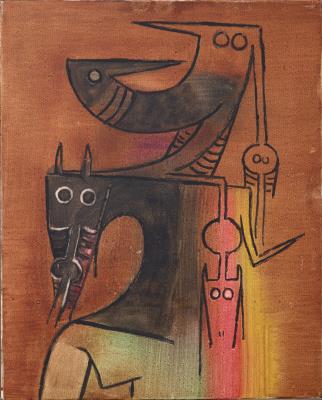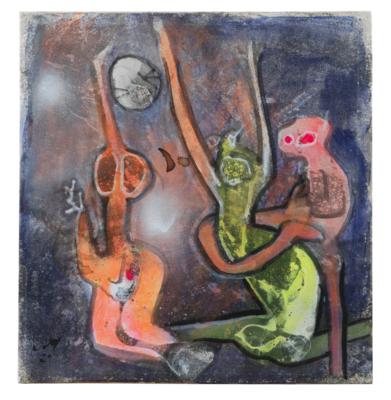
2811. 罗伯托·塞巴斯蒂安·马塔-现代 高清作品[27%]

DO-Roberto Sebastian Matta  - Moderne
图片文件像素:4899 x 4623 px

罗伯托·塞巴斯蒂安·马塔-现代-

Roberto Sebastian Matta * - Moderne-

(Santiago, Chile 1911–2002 Civitavecchia, Italien)
Le palle della palla, Öl auf Leinwand, 52,3 x 50 cm, gerahmt

Das Werk ist bei Archives de l’oeuvre de Matta, Tarquinia, registriert. Ein Fotozertifikat liegt bei.

Provenienz:
Riva Yares Gallery, Scottsdale
Galleria d’Arte Maggiore, Bologna
Europäische Privatsammlung

Ausgestellt:
Riva Yares Gallery, Scottsdale, 7. Februar - 5. März 1991, S. 8 mit Abb.

Zitat:
„Seit vierzig Jahren hat Matta ununterbrochen gemalt, gedacht, geliebt, gekämpft, angeeckt, diskutiert, bewegt, empört, erleuchtet. Er ist Jongleur, Ingenieur, Illusionist, verwirrt, inspiriert, stammelnd, redselig, Magier, Zauberer, Clown, Hellseher, Dichter, rebellisch, großzügig. Die Sonne begleitet ihn immer. Da überrascht uns nichts; eines seiner Mottos lautet: die Sonne für diejenigen, die zu sammeln verstehen. Aber es gibt noch eine andere Sonne, eine geheime, vor der er es versteht, allein zu bleiben und Nein zu sagen. Matta wird abwechselnd von zwei Sonnen beleuchtet, der Sonne des großen Ortes und der Sonne der Zelle. Der Surrealismus war eine große, warmherzige Rebellion in diesem grausamen und eisigen Jahrhundert. Matta bleibt diesem subversiven und großzügigen Impuls treu. Matta ist einer unserer großen zeitgenössischen Künstler. Das war er von Anfang an und das bleibt er auch.”

Octavio Paz, „Vestibule,“ in: Matta, Centre National d\'Art et
de Culture Georges Pompidou, Paris 1985

2812. 丹尼尔·里希特,当代艺术I 高清作品[27%]

DO-Daniel Richter  - 现代艺术 I
图片文件像素:5412 x 4936 px

丹尼尔·里希特,当代艺术I-

Daniel Richter * - Zeitgenössische Kunst I-

(born in Lütjenburg in 1962)
Jump from the towers, 2009, signed, dated Daniel Richter 09 on the reverse, oil on canvas, 60 x 50 cm, framed

Provenance:
Private Collection, North Rhine-Westphalia

Daniel Richter is one of 德国y\'s best-known contemporary artists. In a constant balancing act between his left-wing political origins as a squatter in Hamburg and his new lifestyle as a 德国 star painter, Richter uses iconographic representations from art history, mass media and pop culture in his works. He places these as if on a stage onto a reduced, mystical pictorial background often characterised by darkness, depicting the figures themselves in a painterly excess of light and colour.

This pictorial composition is typical of Richter and can also be found in his stage designs for the 2010 Salzburg Festival.

In Jump from the towers, it seems as if the figures are jumping out of the screen with wide-open eyes, as if in panic, in reference to the images of the 9/11 terrorist attack circulating in the media. Their bodies dissolve into streaks and splashes of colour as they move, and their colourfulness is reminiscent of the view through a thermal imaging camera. This connotation fits Richter\'s recurring theme of the total surveillance of society. The figures\' leap into the unknown triggers fascination and at the same time nervousness in the viewer.

2813. Valerio Adami,当代艺术I 高清作品[27%]

DO-Valerio Adami  - 现代艺术 I
图片文件像素:5850 x 5365 px

Valerio Adami,当代艺术I-

Valerio Adami * - Zeitgenössische Kunst I-

(born in Bologna in 1935)
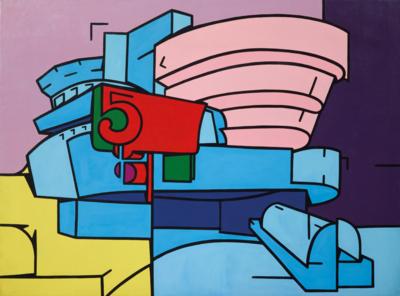
The Guggenheim, 1968, dated, signed and titled on the reverse, oil on canvas, 97 x 130 cm, framed

This work is registered in the Archivio Valerio Adami

This work is accompanied by a certificate signed by the artist

Provenance:
Sale Farsetti, Prato, 26 November 1994
European Private Collection

As Valerio Adami wrote in 1968, “The hand is a kind of seismograph giving body to the traces left by the circuit of imagination”: the drawing hand is an instrument that records what the eye looks at and the mind sees. It is the starting point of the artist’s method: the hand-seismograph that in the “journey of drawing” goes through the kaleidoscope of his inspiration, and that in the essentiality of the line reworks, summarizes, juxtaposes, disassembles and reassembles it. […]

The lines of the drawing, eternally moving as the mind distilling them, - since for Adami “nulla dies sine linea” (no day without a line) – are the “off the beaten track” trails that the artist constantly crosses and connects. He does so by bringing distant worlds together, from the Ganges to the Matterhorn and from Paris to Finland by making the Greek mythological narrative coexist with New York street life, by recalling the light spells of Lake Maggiore or the clouds at sunrise.
(G. Ranzi, Valerio Adami and the lightly swaying desire, in “Valerio Adami. Immagine e pensiero”, Dep Art, Milan 2002)

2814. Gerardo Dottori-现代 高清作品[27%]

DO-Gerardo Dottori  - Moderne
图片文件像素:5317 x 4272 px

Gerardo Dottori-现代-

Gerardo Dottori * - Moderne-

(Perugia 1884–1977)
Temporale in città, 1919, signiert und datiert; rückseitig auf einem Aufkleber betitelt, datiert und signiert, Öl auf Tafel, 43 x 50 cm, gerahmt

Ein Fotozertifikat von Massimo Duranti liegt als Fotokopie vor.

Provenienz:
Galleria Giorgi, Florenz (Rückseite Klebezettel)
Galleria Arte Centro, Mailand (rücks. Klebezettel und Stempel)
Sammlung Man, Mailand
Artenetwork, Marcon, Venedig (Provenienz-Zertifikat vorhanden)
Europäische Privatsammlung (dort erworben)

Ausgestellt:
Rom, Casa d\'Arte Bragaglia, 1920, Ausst.-Kat. Nr. 31
Florenz, XIX Biennale Internazionale d’Arte Premio del Fiorino, Palazzo Strozzi, 3. Mai – 15. Juni 1969 (Rückseite Klebezettel)
Rom, Centro Arte Editalia, 1970
Florenz, Salone Arte Contemporanea, Galleria Giorgi, 1972, Ausst.-Kat. Nr. 6 mit Abb.
Mailand, Futurismo e Aeropittura. Velocità e dinamismo dal Trentino alla Sicilia, Galleria Arte Centro, 2009, Ausst.-Kat. S. 48 Nr. 141 mit Abb.
Alessandria, A+B+C/F=Futurismo, Palazzo del Monferrato, 2009, Ausstellungs Kat. S. 73
Mamiamo di Traversetolo, Parma, Futurismo! Da Boccioni all’Aeropittura, Fondazione Magnani Rocca, 2009, Ausstellungs Kat. S. 116 mit Abb.

Literatur:
B. Crispoldi, 1920 mit Abb.
V. Scheiwiller, 1966, Nr. 3
A. Sartoris, 1968, Nr. 14
Le Arti, Nr. 7/8 bis, 1970, S. 14
M. Duranti, Catalogo Ragionato delle opere di Gerardo Dottori, Effe Fabrizio Fabbri Editore, 2006, S. 445, Nr. 72-219 mit Abb.
F. Lattuada (Hrsg.), Collezione Man, I Futuristi, 2007, S. 61
F. Lattuada (Hrsg.), Il secondo futurismo, Arte Centro, Mailand 2021, S. 59 Nr. 73

2815. 安托万·科佩尔(Antoine Coypel)归因于/归因于,1900年以前的绘画大师和版画、水彩、微缩画` by Antoine Coypel zugeschrieben/attributed, 高清作品[27%]

DO-Antoine Coypel zugeschrieben/attributed, - Meisterzeichnungen und Druckgraphik bis 1900, Aquarelle, Miniaturen
图片文件像素:4600 x 3500 px

安托万·科佩尔(Antoine Coypel)归因于/归因于,1900年以前的绘画大师和版画、水彩、微缩画-

-

(1661-1722)
Der Triumph der Galatea, schwarze und rote Kreide auf Bütten, 19,5 x 26,8 cm, Passep., ohne Rahmen, (Sch)

Die Komposition der vorliegenden Zeichnung steht in Verbindung zu Coypels Gemälde "Der Triumph der Galatea", das auch in einem Kupferstich von Charles Louis Simmoneau (1695) reproduziert wurde (vgl. N. Garnier, Antoine Coypel 1661-1722, Paris 1989, Kat. 52, Fig. 86). Die Vorzeichnung zu dem Gemälde befindet sich im Musée du Louvre, Paris (Inv. Nr. R. F. 12.340). Das Gemälde Coypels, bei dem es sich um eine der frühesten mythologischen Darstellungen des Künstlers handelt wird oft als Pendant zu "Bacchus und Ariadne" (Garnier 1989, Kat. 49) gesehen. Die Komposition erinnert in ihrer triagonalen Anordnung der Figuren an Vorbilder von Raphael und Poussin, wärend die Figuren der Tritonen an jene von Rubens in der Galerie du Luxembourg erinnern, die von Coypel kopiert wurden (Garnier 1989, Kat. 411-412). Eventuell ist die vorliegende Zeichnung in Vorbereitung für das Gemälde oder eine Version danach entstanden.

2816. 朱塞佩·桑托马索 高清作品[27%]

DO-Giuseppe Santomaso  - 现代艺术 I
图片文件像素:5880 x 4350 px

朱塞佩·桑托马索-

Giuseppe Santomaso * - Zeitgenössische Kunst I-

(Venice 1907–1990)
Nero e giallo, 1959, signed and dated, oil on paper laid down on wood, 66.5 x 47 cm, framed

This work is registered in the Archivio Santomaso, Galleria Blu, Milan

Provenance:
Alitalia Collection
Sale Finarte, Asta della Collezione Alitalia, Rome, 8 December 2009, lot 132
Sale Farsetti, Prato, 28 November 2014, lot 405 (certificate of provenance available)
European Private Collection

Exhibited:
Rome, Santomaso, Galleria Pogliani, 28 November - 20 December 1959, mentioned in the exh. cat. (with wrong medium)

Literature:
L. Alfieri, Santomaso. Catalogue raisonné 1931–1974, Alfieri,
Venice 1975, no. 318 (with wrong medium)

The great achievements of the Alitalia airline between 1960 and 1961 also comprise the exact period in which the nucleus of the entire collection was formed. The idea of bringing works of art on board aircraft was Corrado Cagli’s, who had to garner the support of engineer Bruno Velani. He had two clear objectives: to make the flight more pleasant by stimulating the traveller\'s aesthetic sensibilities and to disseminate 意大利 artistic culture abroad. Cagli, helped by his friend and gallery owner Bruno Herlitzka, directly commissioned some of the paintings exhibited in the aircraft from the most talented young artists.

[...] Taken as a whole, the collection constitutes a rare compendium of what was happening mainly between 1954 and 1962, thus documenting a good part of the major trends in the 意大利 art world (Burri, Fontana, Gruppo degli Otto, Forma 1, etc.).
(Cfr. Finarte, Asta della Collezione Alitalia, Rome, 8 December 2009)

2817. Wifredo Lam。 高清作品[27%]

DO-Wifredo Lam  - Moderne
图片文件像素:4941 x 5118 px

Wifredo Lam。-

Wifredo Lam * - Moderne-

(Kuba 1902–1982 Paris)
Ohne Titel, 1974, signiert und datiert (verblaßt), rückseitig signiert, datiert, Öl auf Leinwand, 50 x 40 cm, gerahmt

Provenienz:
Galleria Il Prisma, Cuneo
Galleria d’Arte Borgogna, Mailand
Galleria d’Arte Rizziero, Teramo (rückseitig Etikett)
Galleria Cafiso, Mailand (Fotozertifikat vorhanden)
Europäische Privatsammlung

Literatur:
L. L. Lam, E. Lam, Wifredo Lam. Catalogue Raisonné of the Painted Work, Bd. II 1961–1982, S. 460, Nr. 75 102 mit Abb.

Damals, in den 1950er Jahren, reisten wir sehr wenig. Die Strecke Mailand-Paris mit dem Nachtzug galt als eine große Reise.

Für Lam, den großen Nomaden der modernen Malerei, galt das nicht. Seine unbändige Neugier zu sehen und zu lernen trieb ihn dazu, ständig von einem Kontinent zum anderen zu reisen. Es heißt, er sei immer auf der Suche nach sich selbst, seinen Ursprüngen, den Voodoo-Mythen und dem Gott Changò. Wie Matta und Camacho wurde er im Dschungel geboren, in einer Welt der Magie und der Gewalt, der Stacheln, der Klauen, der Zähne und der Hörner. Der Urwald wimmelt von Wesen, die seine Formen reproduzieren: Schilf, Bambus, Palmen, Ebenholz, Mahagoni und Kakteen, alles in einem Universum aus Stacheln und speerartigen Sträuchern, die der Mensch fällen muss, um den Dschungel zu durchqueren.

(Enrico Baj, Il nomade della giungla, in „Wifredo Lam. Cuba Italia. Un percorso“, Silvana Editoriale 2002)

2818. 托马斯,莫费特。1553-1604. 昆虫或最小玩家。伦敦:托马斯·科茨为威廉·霍普创作,1634年。 高清作品[27%]

Insectorum sive Minimorum animalium theatrum. London: Thomas Cotes for William Hope, 1634.

图片文件尺寸 : 4255 x 5369px

MOFFETT, THOMAS. 1553-1604.:Insectorum sive Minimorum animalium theatrum. London: Thomas Cotes for William Hope, 1634.
Folio (297 x 194 mm). Large woodcut vignette on title, numerous woodcut illustrations (including 4 unnumbered full-pages at end). Contemporary calf, rebacked. Covers scuffed, light soiling around edges of title, scattered browning and spotting.
Provenance: Arthur Hugh Smith-Barry [Anglo-Irish Baron, 1843-1925] (Marbury Hall bookplates); Oliver Howard [English bookseller and Managing Director of Bernard Quaritch, 1905-1961] (bookplate).

FIRST EDITION of \"the first book about insects published in Britain\" (Salmon, Aurelian Legacy, p 95). Compiled in the late 16th century by Moffett, who is often mistakenly said to have used a microscope in his observations, but in fact made the highly accurate woodcuts with the naked eye. Sir Theodore Turquet de Mayerne published the work posthumously from the manuscript, which is preserved today in the British Library. The illustration of the American Swallowtail on p 98 is the first printed representation of an American butterfly. There are three variant imprints, this example with p 48 incorrectly numbered 52, but these variants do not indicate a chronology — simply that the edition was shared among booksellers. Garrison-Morton-Norman 288; Lisney 3; Nissen ZBI 2852; STC 17993a.

托马斯,莫费特。1553-1604. 昆虫或最小玩家。伦敦:托马斯·科茨为威廉·霍普创作,1634年。

2819. 福图纳托·德佩罗-现代` by Fortunato Depero 高清作品[27%]

DO-Fortunato Depero  - Moderne
图片文件像素:4600 x 3500 px

福图纳托·德佩罗-现代-

-

(Fondo/Trient 1892–1960 Rovereto)
Mongolfiera sopra New Milford, 1948, Öl auf Leinwand, 80 x 105 cm, gerahmt

Im Herbst 1947 unternahm Depero einen weiteren Versuch, sich in Amerika zu etablieren. Er hoffte, mit „Buxus“ den Durchbruch zu schaffen, verbrachte jedoch den Winter 1947-1948, einen der kältesten in New York seit Menschengedenken, einsam und fast verhungert in einem Hinterzimmer eines Büros.
Für den Futurismus und sein eigenes Werk fand er nur Feindseligkeit und verschlossene Türen vor:
Glücklicherweise kam im Frühjahr 1948 auch seine Frau aus Italien nach und sie fanden Gastfreundschaft in einer schönen Villa in New Milford, Connecticut, etwa 150 Meilen von New York entfernt. Dort, inmitten der ländlichen Ruhe, fand er ein Gefühl der Gelassenheit und konnte hart arbeiten. „Die Natur“, schrieb er an einen Freund, „ist hier einfach ozeanisch. Wir sind von Hügeln mit üppiger Vegetation umgeben ... Wir sind eingetaucht in eine Palette von Grüntönen und Pflanzen aller Art ... Alles, was ich höre, ist das Rascheln der Blätter von sechs riesigen, typisch amerikanischen Pappeln. Nur wenige Autos fahren vorbei, denn wir befinden uns hier richtig auf dem Land mit riesigen Rinderherden ... Wenn ich daran denke, dass ich gestern sogar Rosetta und mich selbst nackt im Gras gemalt habe, während am Himmel über New Milford ein Heißluftballon vorbeiflog ...“

M. Scudiero, D. Magnetti, Depero Futurista, Turin 2004

2820. 多梅尼科·玛丽亚·弗雷塔` by Domenico Maria Fratta 高清作品[27%]

DO-Domenico Maria Fratta - Meisterzeichnungen und Druckgraphik bis 1900, Aquarelle, Miniaturen
图片文件像素:4600 x 3500 px

多梅尼科·玛丽亚·弗雷塔-

-

(Bologna 1696-1763) Das Urteil des Salomon (recto), Studie für den linken Teil derselben Komposition (verso), Feder in Braun, grau laviert, auf Bütten, 16,8 x 21,5 cm, Passep., ohne Rahmen, (Sch)

Die Zuschreibung an Domenico Fratta wurde von Dr. Marco Riccòmini anhand einer hochauflösenden digitalen Fotografie bestätigt.

Domenico Maria Fratta war einer der talentiertesten Schüler des bologneser Malers Donato Creti (1671-1749), dessen Zeichnungen lange seinem Meister zugeschrieben waren, bis man sie seinem individuellen Stil zuordnen konnte. Die Vorderseite der zeichnung ist vor allem in den Figuren der Krieger mit zwei Studien des Künstlers im Musée du Rouen vergleichbar (Inv. 1975.4.5301; Inv. 1975.4.5302), die in den Körperhaltungen und den antiken Rüstungen große Ähnlichkeiten mit dem vorliegenden Blatt aufweisen. Die Kombination der grauen Lavierung mit der braunen Feder findet sich auch in einer Zeichnung in der Glasgover Art Gallery (Inv. PR2000.4. t) Die Rückseite der Zeichnung zeigt die große Leichtigkeit des Künstlers im Umgang mit der Feder und die stilistische Nähe zu seinem Lehrer Creti. Vgl. M. Riccomini, "Guerriers en scene: Fratta et le Maitre de Philippe", in: Revue du Louvre, 2016, Nr. 5, S. 67-73;
V. Abbate / A. Mazza , Il Libro dei Panduri. Disegni di Domenico Maria Fratta nelle collezioni di Palazzo Abatellis, Ausst. Kat. Palermo, 10. November 1994 - 5. Februar 1995.

doing油画图片- 高清doing绘画作品- 代表作全集 中艺名画下载


2811. 罗伯托·塞巴斯蒂安·马塔-现代 高清作品[27%]

DO-Roberto Sebastian Matta  - Moderne
图片文件像素:4899 x 4623 px

罗伯托·塞巴斯蒂安·马塔-现代-

Roberto Sebastian Matta * - Moderne-

(Santiago, Chile 1911–2002 Civitavecchia, Italien)
Le palle della palla, Öl auf Leinwand, 52,3 x 50 cm, gerahmt

Das Werk ist bei Archives de l’oeuvre de Matta, Tarquinia, registriert. Ein Fotozertifikat liegt bei.

Provenienz:
Riva Yares Gallery, Scottsdale
Galleria d’Arte Maggiore, Bologna
Europäische Privatsammlung

Ausgestellt:
Riva Yares Gallery, Scottsdale, 7. Februar - 5. März 1991, S. 8 mit Abb.

Zitat:
„Seit vierzig Jahren hat Matta ununterbrochen gemalt, gedacht, geliebt, gekämpft, angeeckt, diskutiert, bewegt, empört, erleuchtet. Er ist Jongleur, Ingenieur, Illusionist, verwirrt, inspiriert, stammelnd, redselig, Magier, Zauberer, Clown, Hellseher, Dichter, rebellisch, großzügig. Die Sonne begleitet ihn immer. Da überrascht uns nichts; eines seiner Mottos lautet: die Sonne für diejenigen, die zu sammeln verstehen. Aber es gibt noch eine andere Sonne, eine geheime, vor der er es versteht, allein zu bleiben und Nein zu sagen. Matta wird abwechselnd von zwei Sonnen beleuchtet, der Sonne des großen Ortes und der Sonne der Zelle. Der Surrealismus war eine große, warmherzige Rebellion in diesem grausamen und eisigen Jahrhundert. Matta bleibt diesem subversiven und großzügigen Impuls treu. Matta ist einer unserer großen zeitgenössischen Künstler. Das war er von Anfang an und das bleibt er auch.”

Octavio Paz, „Vestibule,“ in: Matta, Centre National d\'Art et
de Culture Georges Pompidou, Paris 1985

2812. 丹尼尔·里希特,当代艺术I 高清作品[27%]

DO-Daniel Richter  - 现代艺术 I
图片文件像素:5412 x 4936 px

丹尼尔·里希特,当代艺术I-

Daniel Richter * - Zeitgenössische Kunst I-

(born in Lütjenburg in 1962)
Jump from the towers, 2009, signed, dated Daniel Richter 09 on the reverse, oil on canvas, 60 x 50 cm, framed

Provenance:
Private Collection, North Rhine-Westphalia

Daniel Richter is one of 德国y\'s best-known contemporary artists. In a constant balancing act between his left-wing political origins as a squatter in Hamburg and his new lifestyle as a 德国 star painter, Richter uses iconographic representations from art history, mass media and pop culture in his works. He places these as if on a stage onto a reduced, mystical pictorial background often characterised by darkness, depicting the figures themselves in a painterly excess of light and colour.

This pictorial composition is typical of Richter and can also be found in his stage designs for the 2010 Salzburg Festival.

In Jump from the towers, it seems as if the figures are jumping out of the screen with wide-open eyes, as if in panic, in reference to the images of the 9/11 terrorist attack circulating in the media. Their bodies dissolve into streaks and splashes of colour as they move, and their colourfulness is reminiscent of the view through a thermal imaging camera. This connotation fits Richter\'s recurring theme of the total surveillance of society. The figures\' leap into the unknown triggers fascination and at the same time nervousness in the viewer.

2813. Valerio Adami,当代艺术I 高清作品[27%]

DO-Valerio Adami  - 现代艺术 I
图片文件像素:5850 x 5365 px

Valerio Adami,当代艺术I-

Valerio Adami * - Zeitgenössische Kunst I-

(born in Bologna in 1935)
The Guggenheim, 1968, dated, signed and titled on the reverse, oil on canvas, 97 x 130 cm, framed

This work is registered in the Archivio Valerio Adami

This work is accompanied by a certificate signed by the artist

Provenance:
Sale Farsetti, Prato, 26 November 1994
European Private Collection

As Valerio Adami wrote in 1968, “The hand is a kind of seismograph giving body to the traces left by the circuit of imagination”: the drawing hand is an instrument that records what the eye looks at and the mind sees. It is the starting point of the artist’s method: the hand-seismograph that in the “journey of drawing” goes through the kaleidoscope of his inspiration, and that in the essentiality of the line reworks, summarizes, juxtaposes, disassembles and reassembles it. […]

The lines of the drawing, eternally moving as the mind distilling them, - since for Adami “nulla dies sine linea” (no day without a line) – are the “off the beaten track” trails that the artist constantly crosses and connects. He does so by bringing distant worlds together, from the Ganges to the Matterhorn and from Paris to Finland by making the Greek mythological narrative coexist with New York street life, by recalling the light spells of Lake Maggiore or the clouds at sunrise.
(G. Ranzi, Valerio Adami and the lightly swaying desire, in “Valerio Adami. Immagine e pensiero”, Dep Art, Milan 2002)

2814. Gerardo Dottori-现代 高清作品[27%]

DO-Gerardo Dottori  - Moderne
图片文件像素:5317 x 4272 px

Gerardo Dottori-现代-

Gerardo Dottori * - Moderne-

(Perugia 1884–1977)
Temporale in città, 1919, signiert und datiert; rückseitig auf einem Aufkleber betitelt, datiert und signiert, Öl auf Tafel, 43 x 50 cm, gerahmt

Ein Fotozertifikat von Massimo Duranti liegt als Fotokopie vor.

Provenienz:
Galleria Giorgi, Florenz (Rückseite Klebezettel)
Galleria Arte Centro, Mailand (rücks. Klebezettel und Stempel)
Sammlung Man, Mailand
Artenetwork, Marcon, Venedig (Provenienz-Zertifikat vorhanden)
Europäische Privatsammlung (dort erworben)

Ausgestellt:
Rom, Casa d\'Arte Bragaglia, 1920, Ausst.-Kat. Nr. 31
Florenz, XIX Biennale Internazionale d’Arte Premio del Fiorino, Palazzo Strozzi, 3. Mai – 15. Juni 1969 (Rückseite Klebezettel)
Rom, Centro Arte Editalia, 1970
Florenz, Salone Arte Contemporanea, Galleria Giorgi, 1972, Ausst.-Kat. Nr. 6 mit Abb.
Mailand, Futurismo e Aeropittura. Velocità e dinamismo dal Trentino alla Sicilia, Galleria Arte Centro, 2009, Ausst.-Kat. S. 48 Nr. 141 mit Abb.
Alessandria, A+B+C/F=Futurismo, Palazzo del Monferrato, 2009, Ausstellungs Kat. S. 73
Mamiamo di Traversetolo, Parma, Futurismo! Da Boccioni all’Aeropittura, Fondazione Magnani Rocca, 2009, Ausstellungs Kat. S. 116 mit Abb.

Literatur:
B. Crispoldi, 1920 mit Abb.
V. Scheiwiller, 1966, Nr. 3
A. Sartoris, 1968, Nr. 14
Le Arti, Nr. 7/8 bis, 1970, S. 14
M. Duranti, Catalogo Ragionato delle opere di Gerardo Dottori, Effe Fabrizio Fabbri Editore, 2006, S. 445, Nr. 72-219 mit Abb.
F. Lattuada (Hrsg.), Collezione Man, I Futuristi, 2007, S. 61
F. Lattuada (Hrsg.), Il secondo futurismo, Arte Centro, Mailand 2021, S. 59 Nr. 73

2815. 安托万·科佩尔(Antoine Coypel)归因于/归因于,1900年以前的绘画大师和版画、水彩、微缩画` by Antoine Coypel zugeschrieben/attributed, 高清作品[27%]

DO-Antoine Coypel zugeschrieben/attributed, - Meisterzeichnungen und Druckgraphik bis 1900, Aquarelle, Miniaturen
图片文件像素:4600 x 3500 px

安托万·科佩尔(Antoine Coypel)归因于/归因于,1900年以前的绘画大师和版画、水彩、微缩画-

-

(1661-1722)
Der Triumph der Galatea, schwarze und rote Kreide auf Bütten, 19,5 x 26,8 cm, Passep., ohne Rahmen, (Sch)

Die Komposition der vorliegenden Zeichnung steht in Verbindung zu Coypels Gemälde "Der Triumph der Galatea", das auch in einem Kupferstich von Charles Louis Simmoneau (1695) reproduziert wurde (vgl. N. Garnier, Antoine Coypel 1661-1722, Paris 1989, Kat. 52, Fig. 86). Die Vorzeichnung zu dem Gemälde befindet sich im Musée du Louvre, Paris (Inv. Nr. R. F. 12.340). Das Gemälde Coypels, bei dem es sich um eine der frühesten mythologischen Darstellungen des Künstlers handelt wird oft als Pendant zu "Bacchus und Ariadne" (Garnier 1989, Kat. 49) gesehen. Die Komposition erinnert in ihrer triagonalen Anordnung der Figuren an Vorbilder von Raphael und Poussin, wärend die Figuren der Tritonen an jene von Rubens in der Galerie du Luxembourg erinnern, die von Coypel kopiert wurden (Garnier 1989, Kat. 411-412). Eventuell ist die vorliegende Zeichnung in Vorbereitung für das Gemälde oder eine Version danach entstanden.

2816. 朱塞佩·桑托马索 高清作品[27%]

DO-Giuseppe Santomaso  - 现代艺术 I
图片文件像素:5880 x 4350 px

朱塞佩·桑托马索-

Giuseppe Santomaso * - Zeitgenössische Kunst I-

(Venice 1907–1990)
Nero e giallo, 1959, signed and dated, oil on paper laid down on wood, 66.5 x 47 cm, framed

This work is registered in the Archivio Santomaso, Galleria Blu, Milan

Provenance:
Alitalia Collection
Sale Finarte, Asta della Collezione Alitalia, Rome, 8 December 2009, lot 132
Sale Farsetti, Prato, 28 November 2014, lot 405 (certificate of provenance available)
European Private Collection

Exhibited:
Rome, Santomaso, Galleria Pogliani, 28 November - 20 December 1959, mentioned in the exh. cat. (with wrong medium)

Literature:
L. Alfieri, Santomaso. Catalogue raisonné 1931–1974, Alfieri,
Venice 1975, no. 318 (with wrong medium)

The great achievements of the Alitalia airline between 1960 and 1961 also comprise the exact period in which the nucleus of the entire collection was formed. The idea of bringing works of art on board aircraft was Corrado Cagli’s, who had to garner the support of engineer Bruno Velani. He had two clear objectives: to make the flight more pleasant by stimulating the traveller\'s aesthetic sensibilities and to disseminate 意大利 artistic culture abroad. Cagli, helped by his friend and gallery owner Bruno Herlitzka, directly commissioned some of the paintings exhibited in the aircraft from the most talented young artists.

[...] Taken as a whole, the collection constitutes a rare compendium of what was happening mainly between 1954 and 1962, thus documenting a good part of the major trends in the 意大利 art world (Burri, Fontana, Gruppo degli Otto, Forma 1, etc.).
(Cfr. Finarte, Asta della Collezione Alitalia, Rome, 8 December 2009)

2817. Wifredo Lam。 高清作品[27%]

DO-Wifredo Lam  - Moderne
图片文件像素:4941 x 5118 px

Wifredo Lam。-

Wifredo Lam * - Moderne-

(Kuba 1902–1982 Paris)
Ohne Titel, 1974, signiert und datiert (verblaßt), rückseitig signiert, datiert, Öl auf Leinwand, 50 x 40 cm, gerahmt

Provenienz:
Galleria Il Prisma, Cuneo
Galleria d’Arte Borgogna, Mailand
Galleria d’Arte Rizziero, Teramo (rückseitig Etikett)
Galleria Cafiso, Mailand (Fotozertifikat vorhanden)
Europäische Privatsammlung

Literatur:
L. L. Lam, E. Lam, Wifredo Lam. Catalogue Raisonné of the Painted Work, Bd. II 1961–1982, S. 460, Nr. 75 102 mit Abb.

Damals, in den 1950er Jahren, reisten wir sehr wenig. Die Strecke Mailand-Paris mit dem Nachtzug galt als eine große Reise.

Für Lam, den großen Nomaden der modernen Malerei, galt das nicht. Seine unbändige Neugier zu sehen und zu lernen trieb ihn dazu, ständig von einem Kontinent zum anderen zu reisen. Es heißt, er sei immer auf der Suche nach sich selbst, seinen Ursprüngen, den Voodoo-Mythen und dem Gott Changò. Wie Matta und Camacho wurde er im Dschungel geboren, in einer Welt der Magie und der Gewalt, der Stacheln, der Klauen, der Zähne und der Hörner. Der Urwald wimmelt von Wesen, die seine Formen reproduzieren: Schilf, Bambus, Palmen, Ebenholz, Mahagoni und Kakteen, alles in einem Universum aus Stacheln und speerartigen Sträuchern, die der Mensch fällen muss, um den Dschungel zu durchqueren.

(Enrico Baj, Il nomade della giungla, in „Wifredo Lam. Cuba Italia. Un percorso“, Silvana Editoriale 2002)

2818. 托马斯,莫费特。1553-1604. 昆虫或最小玩家。伦敦:托马斯·科茨为威廉·霍普创作,1634年。 高清作品[27%]

Insectorum sive Minimorum animalium theatrum. London: Thomas Cotes for William Hope, 1634.

图片文件尺寸 : 4255 x 5369px

MOFFETT, THOMAS. 1553-1604.:Insectorum sive Minimorum animalium theatrum. London: Thomas Cotes for William Hope, 1634.
Folio (297 x 194 mm). Large woodcut vignette on title, numerous woodcut illustrations (including 4 unnumbered full-pages at end). Contemporary calf, rebacked. Covers scuffed, light soiling around edges of title, scattered browning and spotting.
Provenance: Arthur Hugh Smith-Barry [Anglo-Irish Baron, 1843-1925] (Marbury Hall bookplates); Oliver Howard [English bookseller and Managing Director of Bernard Quaritch, 1905-1961] (bookplate).

FIRST EDITION of \"the first book about insects published in Britain\" (Salmon, Aurelian Legacy, p 95). Compiled in the late 16th century by Moffett, who is often mistakenly said to have used a microscope in his observations, but in fact made the highly accurate woodcuts with the naked eye. Sir Theodore Turquet de Mayerne published the work posthumously from the manuscript, which is preserved today in the British Library. The illustration of the American Swallowtail on p 98 is the first printed representation of an American butterfly. There are three variant imprints, this example with p 48 incorrectly numbered 52, but these variants do not indicate a chronology — simply that the edition was shared among booksellers. Garrison-Morton-Norman 288; Lisney 3; Nissen ZBI 2852; STC 17993a.

托马斯,莫费特。1553-1604. 昆虫或最小玩家。伦敦:托马斯·科茨为威廉·霍普创作,1634年。

2819. 福图纳托·德佩罗-现代` by Fortunato Depero 高清作品[27%]

DO-Fortunato Depero  - Moderne
图片文件像素:4600 x 3500 px

福图纳托·德佩罗-现代-

-

(Fondo/Trient 1892–1960 Rovereto)
Mongolfiera sopra New Milford, 1948, Öl auf Leinwand, 80 x 105 cm, gerahmt

Im Herbst 1947 unternahm Depero einen weiteren Versuch, sich in Amerika zu etablieren. Er hoffte, mit „Buxus“ den Durchbruch zu schaffen, verbrachte jedoch den Winter 1947-1948, einen der kältesten in New York seit Menschengedenken, einsam und fast verhungert in einem Hinterzimmer eines Büros.
Für den Futurismus und sein eigenes Werk fand er nur Feindseligkeit und verschlossene Türen vor:
Glücklicherweise kam im Frühjahr 1948 auch seine Frau aus Italien nach und sie fanden Gastfreundschaft in einer schönen Villa in New Milford, Connecticut, etwa 150 Meilen von New York entfernt. Dort, inmitten der ländlichen Ruhe, fand er ein Gefühl der Gelassenheit und konnte hart arbeiten. „Die Natur“, schrieb er an einen Freund, „ist hier einfach ozeanisch. Wir sind von Hügeln mit üppiger Vegetation umgeben ... Wir sind eingetaucht in eine Palette von Grüntönen und Pflanzen aller Art ... Alles, was ich höre, ist das Rascheln der Blätter von sechs riesigen, typisch amerikanischen Pappeln. Nur wenige Autos fahren vorbei, denn wir befinden uns hier richtig auf dem Land mit riesigen Rinderherden ... Wenn ich daran denke, dass ich gestern sogar Rosetta und mich selbst nackt im Gras gemalt habe, während am Himmel über New Milford ein Heißluftballon vorbeiflog ...“

M. Scudiero, D. Magnetti, Depero Futurista, Turin 2004

2820. 多梅尼科·玛丽亚·弗雷塔` by Domenico Maria Fratta 高清作品[27%]

DO-Domenico Maria Fratta - Meisterzeichnungen und Druckgraphik bis 1900, Aquarelle, Miniaturen
图片文件像素:4600 x 3500 px

多梅尼科·玛丽亚·弗雷塔-

-

(Bologna 1696-1763) Das Urteil des Salomon (recto), Studie für den linken Teil derselben Komposition (verso), Feder in Braun, grau laviert, auf Bütten, 16,8 x 21,5 cm, Passep., ohne Rahmen, (Sch)

Die Zuschreibung an Domenico Fratta wurde von Dr. Marco Riccòmini anhand einer hochauflösenden digitalen Fotografie bestätigt.

Domenico Maria Fratta war einer der talentiertesten Schüler des bologneser Malers Donato Creti (1671-1749), dessen Zeichnungen lange seinem Meister zugeschrieben waren, bis man sie seinem individuellen Stil zuordnen konnte. Die Vorderseite der zeichnung ist vor allem in den Figuren der Krieger mit zwei Studien des Künstlers im Musée du Rouen vergleichbar (Inv. 1975.4.5301; Inv. 1975.4.5302), die in den Körperhaltungen und den antiken Rüstungen große Ähnlichkeiten mit dem vorliegenden Blatt aufweisen. Die Kombination der grauen Lavierung mit der braunen Feder findet sich auch in einer Zeichnung in der Glasgover Art Gallery (Inv. PR2000.4. t) Die Rückseite der Zeichnung zeigt die große Leichtigkeit des Künstlers im Umgang mit der Feder und die stilistische Nähe zu seinem Lehrer Creti. Vgl. M. Riccomini, "Guerriers en scene: Fratta et le Maitre de Philippe", in: Revue du Louvre, 2016, Nr. 5, S. 67-73;
V. Abbate / A. Mazza , Il Libro dei Panduri. Disegni di Domenico Maria Fratta nelle collezioni di Palazzo Abatellis, Ausst. Kat. Palermo, 10. November 1994 - 5. Februar 1995.